
Features
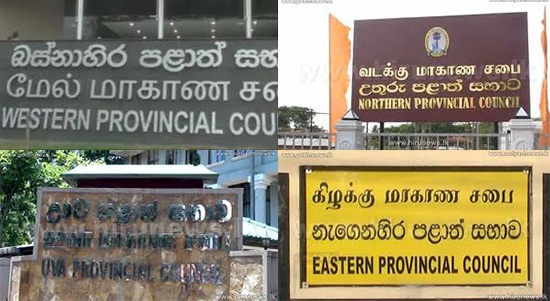
Crisscrossing 13A Abolition

By Austin Fernando
I have recently read a speech by Tamil National Alliance (TNA) Leader R Sampanthan, delivered in 2017. This excellent presentation supported the Thirteenth Amendment (13A) to the Constitution. In appreciation of his intelligent arguments, I share his thinking not to canvass for 13A but to broaden the discussion with forgotten overlapping references that need to be factored in.
Status of 13A
Devolution was thrust upon us, consequent to the Indo-Sri Lanka Accord of 1987. Then, certain groups rejected this pact as well as 13A. Their position remains unchanged.
At the outset, we must remind ourselves that devolution was introduced to facilitate conflict resolution. Someone may argue that 13A was legalized at a time when terrorists held sway, and, therefore, the incumbent government need not stick to the beaten track. TNA politicians may argue that the reasons for, and the outcomes of, the conflict remain although terrorism is no more.
The performance of the Provincial Councils (PCs) is barely satisfactory in many respects. Some critics have dubbed them ‘white elephants.’ I do not subscribe to such extreme criticisms because one reason for the weakness of the PCs is the lack of ‘center-periphery cooperation’. Decades ago, Professor GL Peiris emphasized that the PCs needed empowerment for financing, establishment management, and statute making. To date, these matters remain as issues.
Some others who see intrinsic fault lines in devolution oppose PCs based on concept, content, and politics. They contend that devolving police and land powers, the amalgamation of provinces, etc., trespass the sovereignty and endanger national security.
The vehement call for abolishing the 13A has originated from politicians, supported by media personnel, and a section of the Buddhist monks. Another alternative proposition is to withdraw certain functions (e.g. land and police powers) to impede PCs when drafting a new Constitution.
Indians and 13A
Concurrently, there are some predicting that India will take up cudgels if the 13A is tampered with. Arguments are submitted against Indian interventions on devolution.
One reason adduced is that India failed to adhere to the Accord (e.g. disarming the LTTE) and therefore, its demand that we fully implement the devolution of power is unfair.
Secondly, they argue that foreign interference with our constitutional processes is inappropriate. They point out that the Indian Government repealed Article 370 with Article 35A in 2019, affecting Jammu-Kashmiri laws, including citizenship, property ownership, and fundamental rights, and silenced critics by stating it was an “Indian internal affair.” Hence, they argue that Sri Lanka should follow suit if India objects to abolishing the 13A.
Thirdly, they contend that the Indian government changed Jammu Kashmir rules to allow the Union Government to release lands to Indians to attract development/investment and hence India cannot object if we centralize land administration.
Fourthly, they argue that Indians perform asymmetrical administration in Himachal and Uttarkhand States, as against centralized Jammu-Kashmir, and therefore, by amending 13A, we could do similarly in selected Provinces.
India stands for sovereignty, independence, and the territorial integrity of Sri Lanka, as repeatedly mentioned by Indian leaders. Additionally, there have been commitments made by Indian and Sri Lankan leaders and internationals to promote equal treatment to minorities.
My attempt is to refer to some such, extracted from the quoted speech, add a few more experiences to demonstrate that abolishing 13A will be considered a negative action in resolving conflict-related issues and there could be other solutions.
Probing Indo-Lanka interactions
Let us turn to TNA Leader’s speech. In November 2006, Indian Foreign Secretary Shivashankar Menon has expressed to President Mahinda Rajapaksa: “India looks forward to an early ‘comprehensive political settlement’ of the ethnic issue. It must take into account the aspirations of all sections, including the Tamils.”
This was nearly twenty years after the Accord and while the conflict was ongoing. Responding, President Mahinda Rajapaksa has detailed the work by the All-Party Representatives Committee (APRC) and the Committee of Experts. But it is well-known that these outputs did not matter to his government. It can be likened to the Indian expectations to implement the 13A during the conflict.
At one stage, President Mahinda Rajapaksa was excessively supportive of ‘power-sharing.’ Addressing the inaugural Meeting of the APRC and the Experts Committee, he said: “The unity, territorial integrity, and sovereignty of our country must be preserved” and added, “Our objective must be to develop a just settlement within an undivided Sri Lanka.” Great. This is the common aspiration of people, TNA, and India. While identifying the roadblocks, he expected the people in their localities must “take charge of their destiny and control their politico-economic environment.” This is the Principle of Subsidiarity in action.
He said: “Any solution must be seen as one that stretches to the maximum possible devolution, without sacrificing the sovereignty of the country. Given the ground situation, given the background to the conflict, it, therefore, behooves on particularly the majority community to be proactive in striving for peace ….” This must have been an elixir to Indians and TNA!
Next, Minister Basil Rajapaksa went to India (October 2008) and a statement said: “Both sides discussed the need to move towards a peacefully negotiated political settlement on the island including the North …. The Indian side called for the implementation of the 13A and greater devolution of powers to the Provinces. Minister Basil Rajapaksa emphasized that the President of Sri Lanka and his Government were committed to a political process that should lead to a sustainable solution”. Elixir again!
His message to India was that we had passionately committed to a political process. He is expected to be in the Cabinet soon and knowing the Indian External Affairs Minister Dr. Jaishankar’s ways personally, I may expect a reminder of his message.
PM Manmohan Singh, after this visit of Minister Basil Rajapaksa, (November 2008), informed President Mahinda Rajapaksa that Colombo must create conditions for meeting “legitimate political aspirations” of the Tamils under the devolution package (13A). Irrespective of domestic politics Indians were consistent in demands; Sri Lankans were consistent in declaring unfulfilled hopes!
Prof. Peiris visited India (May 2011) and mentioned “A devolution package building upon the 13th Amendment would contribute towards creating the necessary conditions for such reconciliation.” Further, he referred to the work of the Lessons Learnt and Reconciliation Commission (LLRC), which made extremely attractive, pro-peace, and reconciliation-oriented recommendations. No wonder when Foreign Minister Peiris spoke so favourably on the 13A, Indians continuously and without reservations harped on its implementation.
PM Singh (June 2011) said in Lok Sabha: “The decimation of the LTTE was something good. But the Tamil problem does not disappear, with the defeat of the LTTE. The Tamil population has legitimate grievances. They feel they are reduced to second-class citizens. And our emphasis has been to persuade the Sri Lankan Government that we must move towards a new system of institutional reforms, where the Tamil people will have a feeling that they are equal citizens of Sri Lanka, and they can lead a life of dignity and self-respect. It is not easy.”
Nevertheless, reverting to 2019, one may question whether the Indian politicians’ minds were responsive to the grievances/inequalities their Muslim brethren complained of when the Citizenship Amendment Act, National Register of Citizens, and National Population Register laws were launched.
Two months after PM Singh’s statement, Indian External Affairs Minister S. M. Krishna said in Lok Sabha: “The Government has also articulated its position that the end of the armed conflict in Sri Lanka created a historic opportunity to address all outstanding issues relating to minority communities in Sri Lanka, including Tamils. The Joint Press Release of May 17, 2011 states that all such outstanding issues had to be settled in a spirit of understanding and mutual accommodation imbued with a political vision to work towards genuine national reconciliation.
The External Affairs Minister of Sri Lanka affirmed his Government’s commitment to ensuring expeditious and concrete progress in the ongoing dialogue between the Government of Sri Lanka and representatives of Tamil parties and that a devolution package building upon the 13th Amendment would contribute towards creating the necessary conditions for such reconciliation.” Sensibly we may agree.
The Indian Official Spokesman made a statement after the LRRC Report: “In this context, we have been assured by the Government of Sri Lanka on several occasions in the past, of its commitment towards pursuit of a political process, through a broader dialogue with all parties, including the TNA, leading to the full implementation of the 13th Amendment to the Sri Lankan Constitution, and to go beyond, so as to achieve meaningful devolution of powers and genuine national reconciliation.” Thus, Indian expectation rightly settled on an assurance ‘beyond 13A.’
When even the easily implementable LRRC recommendations were not executed by the government that appointed it, whether India could await further contributions to reconciliation was an issue. Indians may comment that every Sri Lankan government has only kindled hopes, but not delivered. The post-LLRC- UNHRC Resolution (2012) demanded the implementation of constructive LLRC recommendations and strengthening devolution, but we failed to do so.
The Indian Minister of External Affairs made a statement (January 2012) in the presence of our Minister of Foreign Affairs, from which I quote: “The government of Sri Lanka has on many occasions conveyed to us its commitment to move towards a political settlement based upon the full implementation of the 13A to the Sri Lankan Constitution and building on it so as to achieve meaningful devolution of powers.” The Indian Minister has echoed the stark reality.
Then again, the Indian Prime Minister Manmohan Singh said that India was inclined to vote in favour” of a resolution on promoting reconciliation and accountability in Sri Lanka at the 19th session of the UNHRC. His inclination was adopted by voting against us. According to PM Singh, its objective was not wanting to infringe our sovereignty, “…. but concerns should be expressed so that Tamil people can get justice and lead a life of dignity.” In almost all Indian statements a few buzz words- ‘equality, dignity, justice, self-respect, political process, peace’ appear.
There could be many more statements by Indian and Sri Lankan politicians and bureaucrats, unknown to us, confirming the need and commitment to implement the 13A to resolve the Tamils’ difficulties. But since our President was not in active politics per se in 2017 like his brothers and other Ministers, some of these statements may be new to him. However, I may remind two recent relevant statements, most probably known to him, worthy of consideration to understand the Indian attitudes on 13A.
PM Narendra Modi during President Gotabaya Rajapaksa’s State Visit, like other interlocutors, said: “I am confident that the Government of Sri Lanka will carry forward the process of reconciliation, to fulfill the aspirations of the Tamils for equality, justice, peace, and respect. It also includes the implementation of the 13th amendment.” Note the buzz words. President Gotabaya Rajapaksa, without responding directly kept aloof, imaging him “the President of all Sri Lankans, irrespective of ethnicity or religion or voting choices.”
Joint Secretary Amit Narang’s quote on India Sri Lanka Virtual Bilateral Summit – October 26th, 2020- stated that PM Modi has insisted on PM Mahinda Rajapaksa that “Sri Lanka must implement its 13th constitutional amendment to achieve peace and reconciliation…. PM Modi called on the new Government in Sri Lanka to work towards realizing the expectations of Tamils for equality, justice, peace, and dignity.” Buzz words: setting apart political ethics, it is ‘must implement its 13A’ and not ‘may.’ With so many positive quotes stated above I am not surprised of this insistence.
These are ‘oven-fresh’ statements (latter only a fortnight old) and thoughts well embedded in PM Modi’s memory. We should not dupe ourselves into believing that PM Modi forgets easily and will give up demands or forgive when one repeatedly frustrates India! Whether it is Modi or Singh or Krishna or Menon, the buzz words are the same.
Here, PM Modi, like PM Singh (in 2012) expressed his “concerns”. I wish he will refrain from acting like PM Singh as regards the UNCHR 2021. We must remember that irrespective of political divides, for political expediency, Indian politicians capitalize on the Tamil aspirations.
Against this background, President Gotabaya Rajapaksa has withdrawn from promoting “national integration and reconciliation” by repealing Article 33(1)(b) under the mandated presidential duties in 19A. If it seriously conveys his unwillingness to undertake these two duties, abolishing 13A will surely lead to an undesirable reaction.
International commitments
Besides Indians, Sri Lanka has been under the international microscope regarding peacemaking and power-sharing, commencing from Thimpu, extending to Peace Talks, with Ban Ki-Moon, and UNHRC, etc.
A notable event during the Peace Talks was the declaration of the Oslo Communique. Prof. Peiris led the government delegation, and I witnessed his excellent exposition with clarity, resonating factual arguments, and vast knowledge to convince Anton Balasingham, that LTTE should agree to power-sharing, without separation. In a lighter vein, I am reminded how with Professor Peiris’s unmatched academic onslaught (which I adored), Anton Balasingham cut-short the discussion and retreated for external consultations—probably with Prabhakaran.
It was Prof Peiris -the Man of the Day- who pushed for the Oslo Communique. The parties agreed “to explore a solution founded on the principle of internal self-determination in areas of historical habitation of the Tamil-speaking people, based on a federal structure within a united Sri Lanka.”
At the media conference, Prof Peiris praised extensive power-sharing within a one-county framework, sans cessation, and added, “Now if we believe in a political solution if we are renouncing war…. there could not be any other rural tribal except power-sharing – except the basis, the character of a federal solution.”
The 13A is less devolutionary and federalist in content than the Oslo Communique that spoke of historical habitation and federal structure. Therefore, Prof. Peiris could now forget Oslo and take the lead in calming down protesters against 13A. Without any disrespect to Minister Ali Sabry, I may say that Prof. GL Peiris is the best bet to deal with 13A with his experience (especially with Indians). Paradoxically, it is also his disqualification, for his past stance is not in line with calls for abolishing 13A!
After defeating the LTTE, President Mahinda Rajapaksa stated to UN Secretary-General Ban Ki-Moon that his firm resolve was ‘to proceed with the implementation of the 13th Amendment, as well as, to begin a broader dialogue with all parties, including the Tamil parties in the new circumstances, to further enhance this process and to bring about lasting peace and development in Sri Lanka.” After three days, a resolution was submitted at the UNHRC, Geneva confirming his stances with Ban Ki-Moon. It was a commitment to implementing the 13A. For the first time, he made 13A a multilateral commitment.
President Sirisena-PM Wickremesinghe government went a step further by incorporating it in October 2015 UNHRC Cosponsored Resolution. They failed to pass a new Constitution or move-on with 13A. More international attention was drawn to 13A.
Potential political manipulations
In the late 1990s, there were government proposals to create Regional Councils (RCs) – i.e. North-Eastern and South-Eastern RCs and even to create a center-controlled Ampara Electorate, to enable the establishment of the latter RC. Non-contiguous Muslim RC was another concept floated. SLMC Leader Mr. Ashroff was one keen supporter of those proposals.
The abolition of 13A will create a void. Muslim Parliamentarians who supported the 20A may expect Minister Ali Sabry and Romesh de Silva Committee to incorporate the said RCs proposal in the proposed Constitution, sometimes with revisions more favourable to the Muslims. This is a hypothetical situation, but those who call for abolishing 13A should take careful note of. They must be alert to political manipulations because the wrong judgment will cause more trouble than 13A.
Conclusion
In summary, the opponents of 13A, who demand its abolition had better heed the domestic constitutional, political, institutional formations, bilateral agreement with India, many commitments made especially to India and international stakeholders in multilateral agencies. etc. If the decision is not to abolish, the government will be answerable to nationalistic elements who predict political, security, economic, and political organizational risks.
Since the country is faced with a severe economic crisis, the international dimensions thereof are extremely important. As Dr. Jehan Perera writes: “In dealing with international governments, it is equally, if not more, important to keep commitments. The international community of governments is not as gullible as the voting public often is.” This was written during Mahinda Rajapaksa Regime. Now, it is Gotabaya Rajapaksa regime. But irrespective of government changes, the thinking of the international community remains the same as for Sri Lanka’s commitments.
Policies of the political parties that have been in power in India have been consistent as regards 13A and the issues Tamils are faced with. Nevertheless, India’s focus has shifted from devolution to Indo-Pacific, Chinese threats, free trade, investments, etc. and the possibility may exist of settling outstanding issues to mutual benefit (as Minister Krishna has said) “in a spirit of understanding and mutual accommodation imbued with a political vision.”
Abolishing 13A may entail a price payable geopolitically, politically, economically, diplomatically, security-wise, etc. Those who push for abolishing 13A must evaluate the potential balance sheet, weigh alternatives through negotiations and compromises. Forgetting these available options and to be overenthusiastic about their two-thirds majority, which can be used to abolish 13A may not mean happy hunting or a happy ending.


Yes, Sri Lanka has lost one of its most beloved voices. Mariazelle Goonetilleke, of ‘Kandy Lamissi’ fame, is no more.
She passed away last Friday morning (10th July), aged 68, and, undoubtedly, her enormous hit ‘Kandy Lamissi’ will forever keep her memory alive.
Mariazelle Goonetilleke was born on 11 June in Nugegoda, and began singing at age seven. At 10, she won the junior section at an All Island Talent Competition. That win led her to join the popular pre-teen group Junior Rhythmiers.
This talented artiste later played guitar, organ and sang with bands like The Emeralds and Midnight Mist. She also studied classical guitar, under Winston Jayawardene, and vocals under Estelle de Niese.
Her career turned in 1977 with ‘Kandy Lamissi.’
The song was based on verses by Asith Kitto Chandrasena, of the Blue Sapphires, which Mariazelle adapted and added to.
Released on a popular recording label, in Sri Lanka, ‘Kandy Lamissi’ became an instant hit and she came to be known by that name. The bilingual baila is still sung at weddings and social events today.
Mariazelle had a versatile career spanning pop, baila and Sri Lankan music.
Her other popular songs include ‘Sihina Nelum Mal,’ (a tribute to her son Teshan), ‘Gayu Gee,’ ‘Yowun Sihina Loke,’ ‘Wathsala,’ ‘Aluth Iskole’, and ‘Nadunana Adarya’.
In 2025, she released a song, about childhood memories, titled ‘Ape Dadda.’
She worked with legends like Clarence Wijewardene, M.S. Fernando, Stanley Peiris and the Gypsies.
Mariazelle was active from the 1960s right up to 2026. She was known for her versatility, faith, and resilience – even after a serious accident she continued performing.
Mariazelle Goonetilleke truly was a legend. Yes, a true icon of our music scene.
‘Kandy Lamissi’ is part of all our childhoods … and we’ll hear that song and remember her for generations.
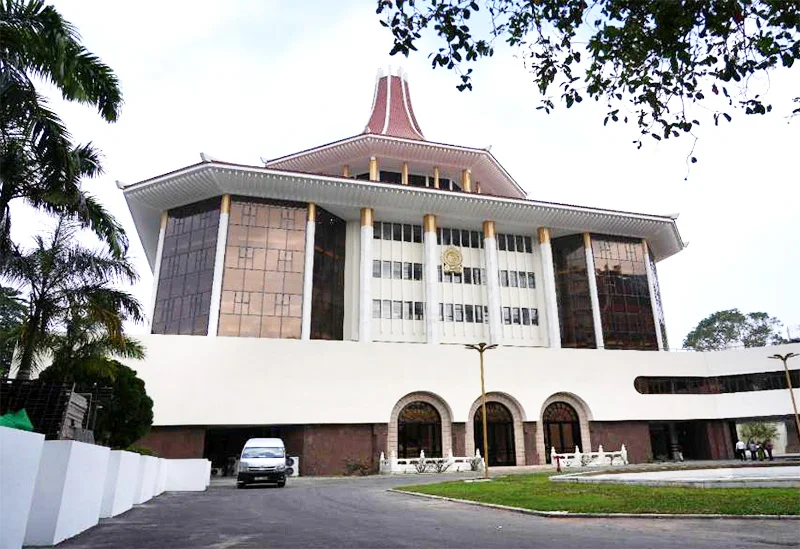
The government, it would seem, plans to amend Article 107(5) of the Constitution to extend the age of retirement of judges of the Supreme Court from 65 to 67 years, and judges of the Court of Appeal from 63 to 65 years.
I. A Flawed Policy Rationale
An attempt is made to justify this measure by resorting to a simple argument: life expectancy has greatly increased as a result of improved medical facilities, with consequent extension of the productive segment of life; and the community will therefore benefit from the accumulated knowledge and experience of judges who still have much to offer, as they approach the age of retirement currently stipulated.
This contention is spurious and entirely unsustainable.
II. Prospective and Retroactive Reform
The age of retirement of judges is, of course, not an immutable norm. There is lively discussion the world over regarding the age to be fixed by law as the point of compulsory retirement.
Significant variation in approach is seen in different jurisdictions. In the United States, judges of the Supreme Court are appointed for life, and the age at which they relinquish office is a matter of personal decision. When a mandatory threshold is laid down, it may vary from 65 and 70 to 75. An inflexible determination is contrary to practice, and is not consistent with sound policy.
This, however, is not the issue. It is a red herring across the trail, intended to distract attention from the central issue. What is important is that the age of retirement, at whatever level it is decided upon, should be determined prior to appointment of the judge, so that when he embarks upon his judicial duties, he knows the span of his judicial career. Its duration should not be changed while he is in office. The constitutional instrument or other definitive text should stipulate, in advance, the point at which the appointment ceases, and the enacted principle should apply across the board to all judges, with no discrimination from case to case.
The effects of departure from this principle are gravely prejudicial to the prestige and stature of the Judiciary. This is well illustrated by the sequence of events in our own country.
During the first half of this year, 2026, three judges of the Supreme Court retired. If the proposed extension of tenure had been effected at the beginning of the year, these judges would have been entitled to its benefit, and would have continued in office for an additional two years.
The precise moment at which the change is brought into operation is the decisive factor in deciding who, among the judges of the court in question, will be beneficiaries of the innovation, and who would be left outside its scope.
The decision as to timing is entirely in the hands of the Executive, with the support of a majority of the Legislature at its disposal. The seriously disquieting result is that the government of the day, by having recourse to ad hoc amendment of the Constitution for this purpose, becomes fully empowered to decide which judges will be recipients of its largesse, and which will not.
This amounts to picking and choosing among the judges of the court, the overriding consideration being the goodwill and discrimination of the government in power.
Whatever the actual intention may be, this inevitably gives rise in the public mind to a doubt whether the decision by the Executive is predicated on acknowledgment of past empathy, or an incentive to future understanding. The arising of this doubt is, by itself, fatal to public perceptions of the objectivity and impartiality of the Judiciary.
The answer lies in prospective, rather than retroactive, prescription of the age of retirement. Nothing is cast in stone, and changing social circumstances certainly call for accommodation in the substance of the law. But the principle to be insisted on is that the changes contemplated should apply to judges to be appointed after the amendment is made, and should not be available as a lever for use to confer on some sitting judges advantages which are tactically withheld from others.
III. Classification and Discrimination
By their very nature, arguments which appeal to longevity, productivity, and waste of talent in human resources, apply universally across the public service. Any limitation to one section, arbitrarily chosen, erodes the very foundation of the suggested rationale.
University professors and other academics in our tertiary education system retire compulsorily at 65 years. The age of retirement of medical consultants is currently fixed, in our country, at 63. Heads of Department throughout our public service relinquish their functions at 60.
In each of these categories, the accumulated experience is considerable. Is it only judges who remain capable of adding value to the public wellbeing at 65? On what rational ground is similar reasoning withheld from other categories of specialised personnel, such as cancer, kidney, and heart specialists, whose contribution in their respective spheres is noteworthy, and should continue to be available to the public?
The Minister of Justice, on the floor of Parliament, tried to justify the government plan by pointing out that judges in developed countries serve beyond the age of 65. He cited as examples several jurisdictions, including the United Kingdom, Germany and Brazil.
What he did not mention is that judges in all these countries are not treated as an isolated exception. On the contrary, the enhanced age of retirement finds its place in an overall culture which lengthens the working lives of all public service personnel in keeping with transformed social conditions and expectations.
The attempt to distinguish judicial officers from all other public officers is capricious, invidious and insincere, and, altogether, lacks the ring of conviction.
IV. Mandate and Legitimacy
An interesting feature of the government plan is the identification of this particular issue as being worthy of high priority and immediate legislative action. No one, to our knowledge, has agitated for urgent legislative intervention in this area, nor has it received even passing mention in the manifesto of the National People’s Power. By contrast, when it went before the people, almost two years ago, it committed itself to decisive action in other fields, including, in particular, the abolition of the Executive Presidency.
Current political experience in the country highlights the importance of many other constitutional issues, in particular, anomalies besetting the electoral system. This has been repeatedly invoked as a reason for delaying the conduct of Provincial Council elections.
There are other issues which call for very early responses in light of current developments — such as the recent ruling by the Vavuniya High Court suspending operation of the Gazette issued by the Governor of the Northern Province, removing from office the Mayor of the Vavuniya Municipal Council. This situation vividly exposes the ambiguities in the constitutional provisions governing the competence of a Governor to exercise the powers of a Provincial Council which is defunct in the absence of elections.
It seems strange, to say the least, that all these crucial issues are going by default, while the obsessive focus of the government is on a matter which is peripheral and divisive. Furthermore, this issue is sought to be taken up on a stand-alone basis, rather than as an integral aspect of a comprehensive constitutional reform initiative.
V. Impact on the Subordinate Judiciary
The question arises in stark form regarding the impact of the proposed change on the ranks of High Court and District Court judges, as well as Magistrates. These are public officers who have devoted their entire working lives to the administration of justice in our country. Given their dedication and commitment, upward mobility in their chosen profession is no less than their due. And yet, their legitimate expectation of promotion to higher levels of the Judiciary is stultified by the unexpected extension of the tenure of judges of superior courts. This will unavoidably result in demotivating these judges, with consequent loss of enthusiasm.
The government, in pursuing its current initiative, has repeatedly stressed the need to retain the services of judicial officers of high calibre. This requires, at the very minimum, the provision of a conducive working environment in which conscientious application is recognised and rewarded. This can hardly be done by depriving judges of access to proper avenues of promotion on which they had relied with every justification.
The problem is certainly not solved by offering to extend the tenure of all judges (not only judges of the Supreme Court and the Court of Appeal) by two years. If implemented, the effect of this is that serving judges of subordinate courts will stagnate in the positions they hold at present, since natural rotation and promotion is interfered with, by the higher judiciary retaining their positions beyond the time span contemplated prior to the proposed innovation.
VI. Equal Protection of the Law
If the government proceeds with its plan to carve out one section of the public service, which is organically an integrated whole, and to confer on it substantial advantages which are deliberately withheld from other strata, the resulting problem has more than a moral or ethical dimension: it produces justiciable legal consequences. This arises from the operation of Article 12(1) of the Constitution, which provides that “all persons are equal before the law and are entitled to the equal protection of the law”.
Trade unions and professional bodies representing services prejudicially affected will thus acquire the right to approach the courts with grievances of constitutionally impermissible discrimination. The glaring anomaly then arises that it is none other than the Supreme Court, in the exercise of its jurisdiction in terms of Chapter XVI of the Constitution, that would have the non-delegable duty to adjudicate upon the matter.
This is a flagrant violation of the essential elements of natural justice, in so far as the direct and exclusive beneficiaries of the impugned measure function as judges in their own cause — a situation which would scarcely invite public confidence in the institution.
VII. Absence of Consultation
A measure so far-reaching in its impact must necessarily be preceded by extensive public consultation. This is amply borne out by international practice. In the United Kingdom, for instance, when extension of judicial tenure was considered in earnest for more than a whole year in 2021, the government proposal was opened up for public debate, eliciting no fewer than 1,200 responses expressing a wide range of points of view.
The striking contrast in our own country is that the proposed amendment is being hatched in secrecy, unbeknown even to members of the government, let alone the community at large. When the Bar Association communicated with the Minister of Justice, the non-committal and evasive reply was that the matter had not been discussed at Cabinet. A furtive and clandestine approach, indicative of singular lack of confidence, is hardly the right approach to constitutional reform in so critical an area.
VIII. Conclusion
The government’s planned proposal is one of the most dangerous constitutional adventures proposed to be embarked upon in recent times. If the amendment is carried into effect, it will spell the doom of democratic institutions, as well as individual and group rights, as we know and cherish them. Most calamitous of all, it will shake the foundations of public confidence in the integrity and objectivity of the Judiciary. What is quite remarkable is that the government initiative is not a response to overtures by the legal community, civil society, or informed and interested groups. It is a self-serving, partisan political initiative by the government in power.
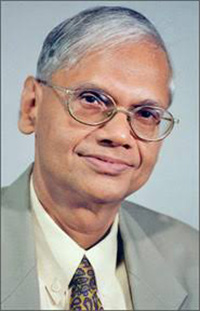 By Professor G. L. Peiris
D. Phil. (Oxford), Ph. D. (Sri Lanka);
Former Minister of Justice, Constitutional Affairs and National Integration;Quondam Visiting Fellow of the Universities of Oxford, Cambridge and London;Former Vice-Chancellor and Emeritus Professor of Law of the University of Colombo.
It is always a joy to arrive in Sri Lanka and I thank President Rajeev Amarasuriya for his kind invitation. There is something in the air of this beautiful island that drains the stress of big city living. I feel lighter and happier whenever I arrive, and last night was no different.
I thank you for the kind words of introduction.
In November 2018, I found myself in the book-lined study of the Indian jurist and friend of Sri Lanka, the redoubtable Fali S. Nariman.
Why was I there? A group of Sri Lankan lawyers working under the banner ‘Lawyers for Democracy’ and led by Upul Jayasuriya, PC had reached out to me to help secure an opinion from Mr. Nariman.
President, Maithripala Sirisena had dismissed Prime Minister Ranil Wickremesinghe. The President proceeded to dissolve Parliament and call for elections. The question was: were these actions constitutional?
Nariman opined that the Presidential proclamation dissolving Parliament was ultra vires the 1978 Sri Lankan Constitution. Reading several provisions of the Constitution harmoniously, Nariman concluded that the proviso under Article 70(1) must be read as a fetter on the power of the President to dissolve Parliament until 4 ½ years after the first meeting / sitting of Parliament. Of course, as you know, the fetter would not apply where Parliament itself had requested early dissolution by a resolution passed by not less than 2/3rds of the whole number of members voting in favour of the resolution.
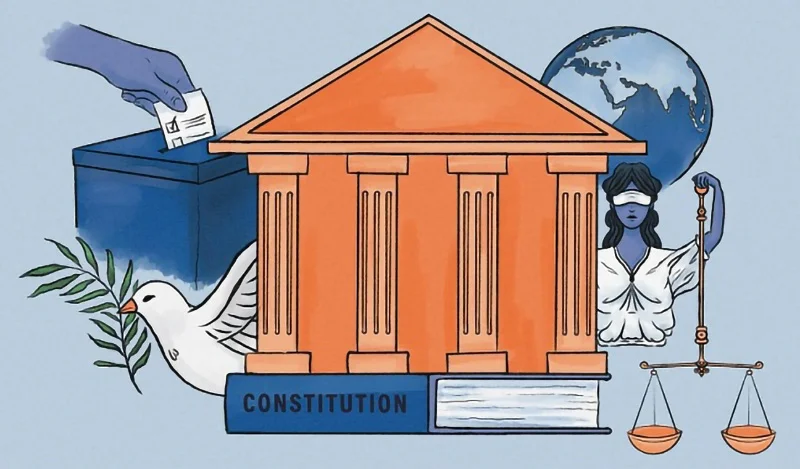
I open with this episode because, here and now, we are again in the midst of a constitutional moment. Yet again, there is a legitimate concern of lawyers and the informed citizenry in Sri Lanka, on whether the Constitution and constitutionalism are being bypassed. It is again time for the legal community in the Asia Pacific and our neighbourhood to step forward and share suggestions based on our own lived experiences and learnings.
Twenty-four years after the Indian Constitution was born in 1950, the leading Indian jurist, Nani Palkhivala, published a slim volume titled “Our Constitution Defaced and Defiled“. The book drew on the 6th John F. Kennedy Memorial Lecture delivered by the author in what was then Bombay. As the title of the book suggests, there is an undercurrent of lament that runs just below the surface of Palkhivala’s lucid prose.
Why the tinge of sadness?
Published in 1974 (four years before your Constitution), Indians had worked their Constitution for 24 years. In less than a quarter century, the Indian Constitution had been amended 25 times. Palkhivala felt that successive amendments had diluted many of the high values, central to the original compact between the citizens of free India and the State they formed. He was particularly distressed at the erosion of property rights and efforts by the State to constrict and confine the role of our Constitutional courts.
Nani Palkhivala is justifiably referred to as the man who saved the Indian Constitution.
Many of you know about Stephen Pleasonton, the US State Department clerk, who in August 1814 hurriedly stuffed the original Declaration of Independence and the US Constitution in coarse linen bags and carried them away from Washington DC hours before British Troops burned the city.
Palkhivala’s role, did not involve linen bags and the timely escape from gutted government buildings. Nevertheless, it was no less heroic.
In a case titled Keshavanand Bharati that spanned several weeks of hearing, Palkhivala persuaded the Indian Supreme Court to adopt the theory of basic structure. This singular contribution to global jurisprudence by the Indian Supreme Court ensures that core traits of the Constitution cannot be abrogated even through constitutional amendments.
While the basic structure doctrine sits well in jurisdictions that allow judicial review of statutes, it has a resonance in other systems as well. The doctrine fosters respect for core constitutional values and a culture of constitutionalism.
The pre-eminent value of constitutionalism is the people’s faith and belief in the supremacy of the Constitution. This is the cardinal value. As we work towards deepening democracy, we have to abide by basic tenets, continuously, without which we will miss our freedoms and the protected spaces that enable us to flourish as open societies.
Historically, the 1978 Sri Lankan Constitution as amended by the 19th Constitutional amendment in 2015 had Article 33(1)(a). This article as it then stood imposed a duty on the President to ensure that the Constitution ‘is respected and upheld by all organs of Government’. These were important words because they unequivocally required the highest constitutional functionary to promote constitutionalism.
In refashioning Article 33(1)(a), the 20th Constitutional Amendment appears to have dropped these weighty words. Indeed, for an overseas observer relying on an assortment of websites to access the definitive constitutional provisions as on date, I noticed a game of constitutional ping-pong, with provisions dropped and restored.
Since the text of the Constitution is extremely important, the fundamental duties, specifically Article 28(a) requires for every person of Sri Lanka to uphold and defend constitution and the law. The choice of words, ‘every person in Sri Lanka’ was interesting for its contrast to a corresponding Article 51A of the Indian Constitution. The Indian Constitution imposes the duty on ‘every citizen’ to ‘respect the Constitution’.
As a visitor to Sri Lanka and a citizen of India, I am currently under a moral and civic obligation to defend two constitutions, a responsibility I happily assume. I do so since constitutionalism is our best bet to navigate the turbulence of a complex world and transit to a fulfilling future.
Constitutionalism has both positive and negative attributes. It has a close cousin in constitutional morality. Indeed, both these expressions are elastic, and at their core are but pathways to securing dignity for individuals and betterment for the community in a just and fair manner.
The political scientist and constitutional commentator Pratap Bhanu Mehta identifies a cluster of characteristics linked to constitutionalism and constitutional morality. He writes:
“I [have] suggested that constitutional morality refers, instead, to the formal virtues of a constitutional sensibility: (1) Self-restraint, (2) respect for plurality, (3) deference to processes, (4) scepticism towards authoritative claims of popular sovereignty, and (5) a commitment to an open culture of criticism that lies at the heart of constitutionalism.”
Dr. B.R. Ambedkar who chaired the drafting committee of the Indian Constitution and was its principal architect, referred to the historian George Grote (pronounced Groht) when addressing the Constituent Assembly. Grote who had studied Athenian democracy emphasised ‘the diffusion of Constitutional morality’ not merely amongst the majority but throughout the whole community. This was an indispensable condition of government at once free and peaceable.
The Indian Supreme Court speaking through Chief Justice Deepak Misra in the celebrated Navtej Singh Johar case (which decriminalised same sex relationships) has an eloquent perspective on constitutionalism.
If I may be permitted a lengthy quote.
“122. The principle of transformative constitutionalism also places upon the judicial arm of the State a duty to ensure and uphold the supremacy of the Constitution, while at the same time ensuring that a sense of transformation is ushered constantly and endlessly in the society by interpreting and enforcing the Constitution as well as other provisions of law in consonance with the avowed object. The idea is to steer the country and its institutions in a democratic egalitarian direction where there is increased protection of fundamental rights and other freedoms. However, it is only when we adhere to constitutionalism as the supreme creed and faith and develop a constitutional culture to protect the fundamental rights of an individual that we can preserve and strengthen the values of our compassionate Constitution.
128. It is the concept of constitutional morality which strives and urges the organs of the State to maintain such a heterogeneous fibre in the society, not just in the limited sense, but also in multifarious ways. It is the responsibility of all the three organs of the State to curb any propensity or proclivity of popular sentiment or majoritarianism. Any attempt to push and shove a homogeneous, uniform, consistent and a standardised philosophy throughout the society would violate the principle of constitutional morality. Devotion and fidelity to constitutional morality must not be equated with the popular sentiment prevalent at a particular point of time.”
The Nobel Laureate Amartya Sen in his study The Idea of Justice (2009) explains what Constitutionalism is not. As many of you might know, Matsya in Sanskrit is a fish and Nyaya is justice. Sen writes:
“Early Indian legal theorists talked disparagingly of what they called Matsyanyaya, ‘justice in the world of fish’, where a big fish can freely devour a small fish. We are warned that avoiding Matsyanyaya must be an essential part of justice, and it is crucial to make sure that the ‘justice of fish’ is not allowed to invade the world of human beings.” – (page 44, The Idea of Justice)
This brings me to the role of Bar Associations. They have a vital societal obligation in educating the community and advancing constitutionalism.
In South Korea, a constitutional crisis erupted in December 2024 when President Yoon Suk Yeol declared martial law and attempted to dissolve the National Assembly, a move that struck at the heart of the country’s democratic framework. In the face of this extraordinary challenge, the Korean Bar Association (KBA) acted swiftly and unequivocally, issuing a public statement condemning the President’s actions as both unconstitutional and a grave assault on the rule of law. The declaration of martial law triggered a massive wave of civil protest. International organisations such as LAWASIA also joined in expressing deep concern, underscoring the broader regional and international consensus on the need to uphold constitutional processes and protect human rights. Facing immense domestic and international pressure, President Yoon rescinded the order within hours. Ultimately, South Korea’s Constitutional Court confirmed the dismissal of President Yoon Suk Yeol, upholding his impeachment and marking a decisive affirmation of constitutional supremacy over authoritarian overreach.
President Yoon Suk Yeol is currently serving a 7-year prison sentence, which was upheld by the Supreme Court of South Korea a few days ago.
Allow me a word of praise for the Bar Association of Sri Lanka. The leadership demonstrated by President Rajeev Amarasuriya builds on the work of so many distinguished past presidents including my dear friend Upul Jayasuriya. BASL has risen above politics, to project a stand founded on principles and values. My great regard for President Amarasuriya has soared as he navigates through the constitutional equivalent of the Straits of Hormuz.
The position taken by BASL as recorded in its communication of 25th May 2026 to His Excellency, President Anura Kumara Dissanayake is unexceptionable. Marshalling facts regarding the increase in the cadre of judges in the Court of Appeal and that of the Supreme Court, BASL noted that there was no workload justification for extending the retirement age of the sitting judges of these courts.
Constitutions are not to be amended merely because the government of the day commands the requisite numbers. The perception that the real reason for extending the retirement age is distant from working norms and efficiency, is apt to erode public trust and confidence.
Public trust is earned and built over decades through the work of individual judges and the collective output of the judiciary. An independent Bar that maintains an open channel of communication with the public is a vital safeguard against assaults on an independent judiciary. An independent Bar has a keen sense of potential dangers that loom. The Sri Lankan public deserves outstanding judges known for their independence and impartiality. Today, BASL is justifiably concerned about tinkering with the retirement age, absent any immediate justification.
I join my distinguished international colleagues, Mr. Steven Thiru, President of the Commonwealth Lawyers’ Association and Mr. T L Yap, President of LAWASIA in both commending the Bar Association of Sri Lanka for its courageous and principled stand and call on the authorities to pay heed to the BASL.
In the Indian experience, invoking the basic structure doctrine, the Supreme Court has consistently struck down amendments to the Constitution that impacted the independence of the judiciary. In the absence of constitutionally mandated judicial review, Sri Lankan society is best served by an open and transparent consultative process before any ad hoc piecemeal amendments are pushed through.
Recall the title of Nani Palkhivala’s book I mentioned: “Our Constitution Defaced and Defiled“. Surely, the people of Sri Lanka deserve better than a piecemeal and ad hoc amendment that defiles the constitutional scheme and possibly impairs the independence of the judiciary.
President Amarasuriya correctly mentioned that the Bar Association of Sri Lanka is guided by principle and conscience, not the political winds of the day. May I suggest a third factor which I will call the “Smell Test”. The Bar Association, comprising so many experienced and venerable practitioners has a keen and well-developed instinct refined over decades. When something “smells wrong” as it does at this constitutional moment, citizens have a reliable guide in BASL. The Bar Association knows something is amiss – something that compromises the independence of the judiciary and the rule of law. The move to amend the Constitution by extending the retirement age of superior court judges fails the Smell Test.
With the help of the Bar Association of Sri Lanka and with the help of its independent judiciary, a culture of constitutionalism is taking hold. Its roots are sinking deep.
The poet, Yasmine Gooneratne has a memorable set of lines:
There was a country where fine poems lay
close to the surface.
Under every hedge
each passing shower would bare a glittering edge.
I am confident that here in Sri Lanka every passing shower of constitutional challenge will reveal the glittering edge of constitutional values and fidelity to the rule of law. (Concluded)
Address to the Bar Association of Sri Lanka on 11 July 2026
by SHYAM DIVAN
Senior Advocate, Supreme Court of India

EFC appoints Yashoravi Bakmiwewa as Director General

The voice behind ‘Kandy Lamissi’ is no more

Dengue nears 70,000 cases, 47 deaths so far

Palaly won’t be vacated: Govt

Sayuri and Chirath clinch Under-14 titles

LB Finance upgrades network with Huawei

‘Dates have the highest sugar content to fight Coronavirus’

Sunday Island 27 December – Headlines

#SundayIsland 17th December – Headlines

Sunday Island – 28th March

Sunday Island Headlines – 21 March

Sunday Island – 21st February – Headlines
-
 News4 days ago
Herath warns prospective migrant workers not to get fleeced by racketeers
-

 Midweek Review6 days ago
Unexpected focus on ‘pieces of tin’ worn by military men
-
 Features2 days ago
Prison riots and politics: NPP’s biggest challenge and Sri Lanka’s biggest opportunity
-

 Editorial3 days ago
What’s the world coming to?
-

 Latest News7 days ago
Nyamhuri and Ngarava stun Bangladesh by defending 141
-
 Foreign News4 days ago
Tensions erupt in Indian state after 11-year-old raped and murdered
-
 Features4 days ago
Devanesan Annan – in Memoriam
-

 News5 days ago
Negombo Prison riot: Ensuring protection of prisoners fundamental responsibility of the state – UN