
Features
Paddy harvest vs electricity; storm over style of singing

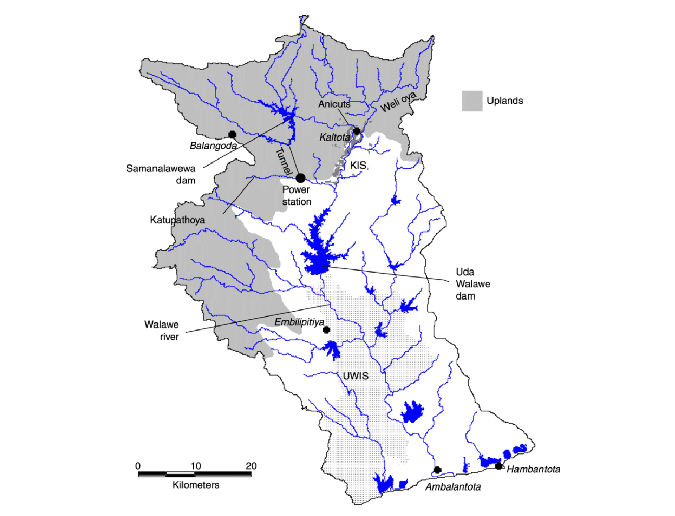
Cassandra in her Friday Cry-s has often noted with deep gratitude  that nature has been benevolent to suffering, down and almost out Sri Lanka. Forest fires due to intemperate temperature in usually cool climes; sudden floods due to torrential rains; erupting volcanoes and earthquakes have all assiduously avoided troubling poor little Sri Lanka struggling against economic woes and continuing corruption. Sadly, not so any longer; meaning climate-changed Nature has struck us, though not cataclysmically nor totally catastrophically, but struck she has. A water shortage from wewas that feed the major rice producing areas of Hambanatota, Uda Walawe, Ampara and elsewhere is prevalent.
Farmers are desperate because needed water for their growing paddy fields has not been trickling in, leave alone spurting forth along irrigation channels. Water was not released from sources such as Uda Walawe and Samanala Wewa. And why? Levels have fallen so low. It was shocking to see pictures of the Uda Walawe Wewa which Cass remembers to have been so full and sea-like when the area was a favourite family holiday spot some years back. The deep water lapped the bund on which vehicles travelled. This week’s TV photographs showed water that was sure shallow far away in the middle of a vast acreage of bare tank bed. Samanala Wewa water is used to generate electricity.
Farmers are on strike – sit down, silent ones. They have loudly proclaimed their prediction that this season their paddy harvest will fail. They shed heart felt tears over their fear of not being able to feed their families and death from starvation staring them in the face. We echo their cries since no harvest means shortage of rice and importing of inferior varieties at great cost – unaffordable as of now.
Two contrary ministers
Two ministers are pitting themselves against each other, trumpeted by various trade unions and political pandits. The Minister of Power powerfully puts forth the threat of four hour power cuts if water is released from the Samanala Wewa to paddy fields. The Minister of Agriculture smilingly, meekly proclaims he will get water released for paddy farmers. The threatened power cuts will be only for southern areas. So where’s the balance between the two fears/threats? The weighing scale, not only to Cassandra but all right thinking people, tips strong in favour of water to paddy farmers. We, or they, the Southrners can suffer power cuts for short periods, but stomachs have to be filled, at least to some extent. TV news yesterday had a spokesman from a mushroomed people’s forum declare that power supply depletion info is merely to buy electricity from money-making private sources. Power mafia at work?
The onsetting SW Monsoon seems not to have brought sufficient rain to fill our wewas, which surprisingly are either overflowing at great danger to those living below spill gates or so low the water can hardly be seen. Where have the always full wewas gone to? Or been sent to? We do hope that at least the receding monsoon will fill these thirsting wewas. Or have the poor farmers to wait for the North East Monsoon – much weaker and not widespread in its dispersal of rain, by which time the now growing paddy plants would have turned to old piduru.
The singer not the song
The song was our national anthem sung at the inauguration of LPL cricket matches, and the singer, I learned, was popular Umara Sinhawansa. Her crime – which to some ultra nationalists (stoopid to Cass) was heinous – was that she rendered Namo Matha in a novel style – operatic it was said. SO WHAT!?
The moment Cass heard that a singer was faulted at the LPL tournament, she remembered how a Sri Lankan opera singer of international fame was booed and derided after the newly formed Yahapalanaya government’s February 4 National Day ceremony in Galle Face Green. This talented, beautiful singer decided to give Danno Bundunge an enhanced lilt with a slightly different rendition from the usual. Didn’t she get into hot water for that! Similarly, as stupidly and insanely as then, Umara is being said by a few ‘legal bigwigs’ to have violated the Constitution of the Democratic, Socialist Republic of SL! Bah to that!
Please read the editorial in The Island of Wednesday August 2, under the title Singer under fire, where the Editor, in his usual sharp and succinct manner verbally shoots around. To show the absolute triviality of the matter in hand – the manner of singing the national anthem – he mentions crimes committed in presidential pardons given to the worst type of criminal with hardly a public protest. Against those ‘mistakes’ of the highest in the land – Mahinda R, Maithripala S, Gotabaya R and Ranil W – Presidents granting pardons of those in death row, this singer’s mistake is as a mustard seed is to an elephant. She is being crucified because some people know no singing style other than the rough and ready baila. This is Sri Lanka for you! Nitty gritties gather so much publicity and social media hype while huge economic crimes, corruption, rape and murder by politicians pass uncensored or ignored.
Referring back to Presidential pardons, the most unpardonable and horrific is Prez Ranil W pardoning them who blew up the Central Bank killing hundreds, blinding and injuring many and causing such economic loss to the country. No protest except a couple of newspaper editorials, a voice or two in the wilderness and a smattering of letters to the Editor like Pardon for terrorists unpardonable by Ranjith Soysa, spokesperson for SPUR in many states of Australia and another Lankan organisation in London.
To Cassandra’s manner of thinking and reaching summations, this privilege given to Presidents of this land amounts to contempt of court since the pardons are for persons judged criminal by the highest court of law. Ranjan Ramanayake was sentenced to four years hard labour just because he gave leeway to his big mouth. Similar for Congress Leader and scion of India’s most respected family – Rahul Gandhi. He said, maybe laughingly, that in any pack of thieves (was it?) there was sure to be a Modi. What weight does that carry for goodness sake! Didn’t Gandhi have to resign his MPship for this statement considered libelous and/or contempt of court. Please correct Cass if she is wrong; don’t quarter and slaughter her. The privilege of pardon MUST be removed from those allowed our presidents; better still remove forever the presidency.
Splashes of humour
Cassandra often rolls around laughing at pronouncements made by politicians. It must however be qualified that her laugh is not a happy one. It is spontaneous, but prompted by derision. Recently, she guffawed at the command issued by the Leader of the Opposition to the Prez himself. In his inimitable style of speaking, whether in King Charles III’s language or our very own national language of Sinhala, he pontificated: “the satyagraha by Embilipitiya farmers has started demanding water for the crops that are blossoming and however, the authorities of this relentless government seem to have no empathy at all …”
It must be the translator’s fault for causing extra derisive laughter by translating his statement ludicrously. Does paddy blossom forth? Sajith would have pronounced the demand in studied Sinhala so more would appreciate his concern. Jeff and Mutt pounced on Sajith’s declared command, asking: “Does he expect the President to cause rains?”
Vegetables being imported
Writing about paddy which gives us our staple food, Cass had its accompaniment vegetables coming to mind immediately followed by Tuesday’s TV announcement that vegetable growers in Welimada, while harvesting their potato crops, complained bitterly the government was considering (or already) importing vegetables. Potatoes are imported cutting into the up county potato production. Importing eggs is bad enough. We should never import vegetables. Make people grow whatever vegetable wherever possible. We can be self-sufficient in this food commodity at least.
a








 The Editor-in-Chief of The Sri Lankan Anchorman, a Toronto-based monthly, celebrating Sri Lankan community life in Canada, is none other than veteran Sri Lankan journalist Dirk Tissera, who moved to Canada in 1997. His wife, Michelle, whom he calls his “tower of strength”, is the Design Editor.
According to reports coming my way, the paper has turned out to be extremely popular in Toronto.
In fact, The Sri Lankan Anchorman won a press award in Toronto for excellence in editorial content and visual presentation.
However, the buzz in the air in Canada, right now, is The Sri Lankan Anchorman’s 22nd Anniversary Gala, to be held on Friday, 12 June, 2026, at the J&J Swagat Banquet Convention Centre, in Toronto.
An action-packed programme has been put together for the night, featuring some of the very best artistes in the Toronto scene.
The Skylines, who are classified as ‘the local musical band in Toronto’, will headline the event.

Dirk Tissera and wife Michelle: Supporting Sri Lanka-Canada community events, in Toronto, since launching The Anchorman
in 2002
They have performed and backed many legendary Sri Lanka singers.
According to Dirk, The Skylines can belt out a rhythm with gusto … be it Western, Sinhala or Tamil hits.
Also adding sparkle to the evening will be the legendary Fahmy Nazick, who, with his smooth and velvety vocals, will have the crowd on the floor.
Fahmy who was a household name, back in Sri Lanka, will be flying down from Virginia, USA.
He has captivated audiences in Sri Lanka, the Middle East and North America, and this will be his fourth visit to Toronto – back by popular demand,
Cherry DeLuna, who is described by Dirk as a powerhouse, also makes her appearance on stage and is all set to stir up the tempo with her cool and easy delivery.
“She’s got a great voice and vocal range that has captivated audiences out here”, says Dirk.
Chamil Welikala, said to be one of the hottest DJs in town, will be spinning his magic … in English, Sinhala, Tamil and Latin.

Both Jive and Baila competitions are on the cards among many other surprises on the night of 12 June.
This is The Anchorman’s fifth annual dance in a row – starting from 2022, 2023, 2024 and 2025 – and both Dirk and Michelle, and The Anchorman, have always produced elegant social events in Toronto.
“We intend to knock this one out of the park,” the duo says, adding that Western music and Sinhala and Tamil songs is something they’ve always delivered and the crowd loves it.
“We have always supported Sri Lanka-Canada community events, in Toronto, since launching The Anchorman, in 2002, and we intend to keep it that way.”
No doubt, there will be a large crowd of Sri Lankans, from all communities, turning up, on 12 June, to support Dirk, Michelle and The Anchorman.
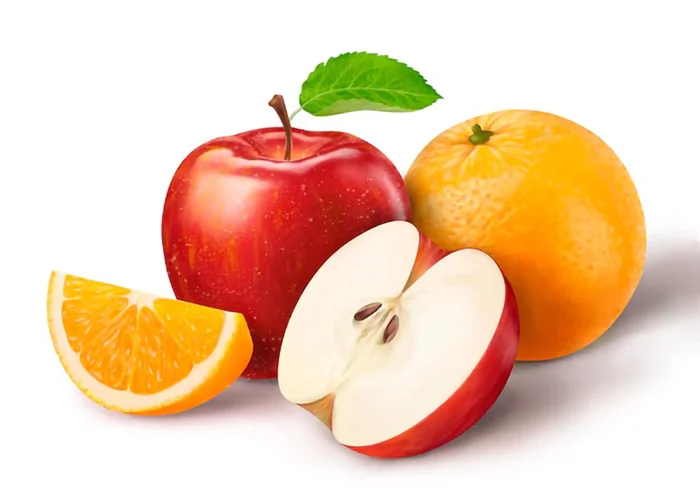
 * Apple and Orange:
Blend a few apple and orange pieces together. Add to it a pinch of turmeric and one tablespoon of honey. Apply it to the face and neck and rinse off after 30 minutes. This face pack is suitable for all skin types.
According to experts, apple is one of the best fruits for your skin health with Vitamin A, B complex and Vitamin C and minerals, while, with the orange peel, excessive oil secretion can be easily balanced.
* Mango and Curd:
Ripe mango pulp, mixed with curd, can be rubbed directly onto the skin to remove dirt and cleanse clogged pores. Rinse off after a few minutes.
Yes, of course, mango is a tasty and delicious fruit and this is the mango season in our part of the world, and it has extra-ordinary benefits to skin health. Vitamins C and E in mangoes protect the skin from the UV rays of the sun and promotes cell regeneration. It also promotes skin elasticity and fights skin dullness and acne, while curd, in combination, further adds to it.
* Grapes and Kiwi:
Take a handful of grapes and make a pulp of it. Simultaneously, take one kiwi fruit and mash it after peeling its skin. Now mix them and add some yoghurt to it. Apply it on your face for few minutes and wash it off.
Here again experts say that kiwi is the best nutrient-rich fruit with high vitamin C, minerals, Omega-3 fatty acids and vitamin E, while grapes contain flavonoids, which is an antioxidant that protects the skin from free radical damage. This homemade face pack acts as a natural cleanser and slows down the ageing process.

 The International Labour Organisation (ILO) now defines a living wage as the wage level necessary for workers and their families to afford a decent standard of living, given national circumstances, for normal hours of work. This standard of living is operationalised through the cost of essential goods and services, typically including food, housing, healthcare, education, transport, and a modest allowance for contingencies and social participation.
In contrast, “cost of living” in economics is a broader price index concept that tracks the overall prices of a representative consumption basket but is not inherently normative about what constitutes decency or dignity.
Living wage methodologies effectively translate a cost-of-living basket, specified for a given family size and living standard, into a monthly income requirement for workers, thereby linking real wages to human development objectives rather than only to market productivity.
Methodologies for computing a living wage
Most contemporary living wage estimates follow a structured “cost of a basic but decent life” approach built around three steps: defining a reference family, costing a normative consumption basket, and converting that cost into a wage per worker.
The Anker methodology, widely used in global supply chains and in Sri Lanka, is a leading example: it defines a model family (e.g., 2 adults and approximately 2–3 children), estimates the cost of a low-cost nutritious diet, adequate housing, and non-food essentials, and then allocates that cost over expected number of full-time workers per family.
Within the Anker framework, the food component is based on locally appropriate diets meeting caloric and nutritional norms, priced using local market surveys and adjusted for waste and home preparation.
Housing costs are derived from standards for minimally acceptable housing (e.g., durable materials, sufficient space, basic services), using rents or imputed rental values from empirical fieldwork. Other essential expenditures, health, education, transport, clothing, and a small margin for unexpected events, are typically estimated as a percentage mark-up over food and housing costs, derived from national household survey data.
Finally, the methodology sets a reference number of workers per family, divides total family living costs by this number to get a net living wage, and then adjusts to a gross living wage by adding payroll taxes and mandatory deductions. Periodic updates are made using consumer price indices (CPIs) to reflect inflation or deflation and, where necessary, new field surveys to capture structural shifts in prices and consumption patterns.
Sri Lanka’s living wage estimates and their link to cost of living (Anker Methodology)
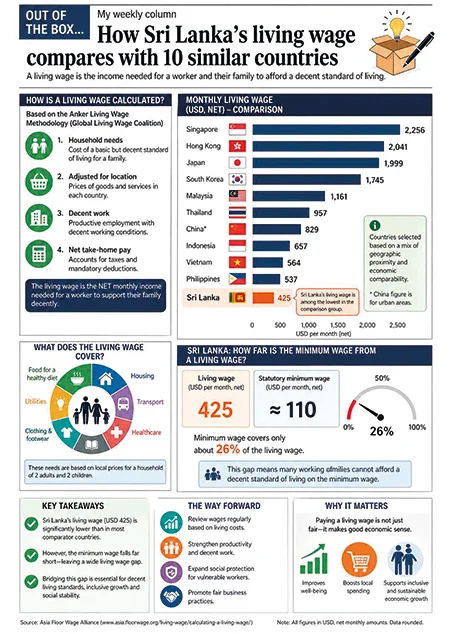 Sri Lanka has been the subject of several living wage studies, notably for the tea estate sector and for urban and rural areas, using the Anker methodology.
In the tea estate sector, an updated 2024 Anker report estimates the cost of a “basic but decent” standard of living for a typical family at about LKR 78,067 per month (approximately USD 260), implying a gross living wage of LKR 48,584 per month (USD 160) and a net, take-home living wage of LKR 44,357.
For urban Sri Lanka, the Anker Living Wage Reference Value was originally set at LKR 84,231 per month in April 2022, corresponding to a net living wage of LKR 77,492 plus social security contributions. After cumulative inflation of about 36.9 percent between April 2022 and June 2025, the updated gross urban living wage is estimated at approximately LKR 115,291 per month (around USD 385), consisting of a net living wage of LKR 106,068 and social security contributions of LKR 9,223
These Sri Lankan figures are explicitly derived from cost-of-living calculations: they incorporate the cost of food, housing, utilities, health, education, and other essentials at local prices and then convert these into wages per adult worker, assuming roughly 1.7–1.8 full-time earners per family. Because living wage estimates are indexed to actual price dynamics, periods of high inflation, as Sri Lanka experienced in 2022–2023, translate almost mechanically into sharp upward revisions in living wages, underlining the tight coupling between living wage levels and the evolving cost of living.
Comparative living wages: Sri Lanka and other countries
Cross-country comparisons require careful normalisation because living wages reflect local prices, family structures, and social norms, but several datasets provide a structured basis for comparison. [asia.floorwage](https://asia.floorwage.org/living-wage/calculating-a-living-wage/)
The Asia Floor Wage Alliance, for example, publishes a regional living wage benchmark expressed in purchasing power parity (PPP) terms, with a 2024 benchmark of 1,750.54 PPP dollars per month converted into local currencies using country-specific PPP exchange rates.
Using this PPP-based approach, the 2024 living wage equivalent for Sri Lanka is estimated at around LKR 158,353 per month, assuming a PPP exchange rate of about 90.5 Sri Lankan rupees per PPP dollar.
This PPP-normalised figure is substantially higher than the Anker 2024–2025 estate-sector and urban living wage estimates in nominal rupees, partly because the Asia Floor Wage benchmark is set to ensure a more harmonised standard across Asian garment-producing economies and uses a single PPP wage target.
These figures indicate that, within this PPP-based framework, Sri Lanka’s living wage in local currency is relatively high compared to countries such as India and Bangladesh, but the comparison reflects both different PPP exchange rates and domestic price structures.
From a cost-of-living perspective, this pattern is consistent with Sri Lanka being a lower-middle-income country with relatively higher prices for some essentials compared with low-income South Asian economies, especially after recent macroeconomic and inflationary shocks.
Global patterns and high-income economies
Global datasets covering more than 200 countries show that typical-family living wage levels, whether calculated in PPP or nominal terms, tend to correlate positively with national income levels, with North America, Western Europe, and Australia displaying the highest living wage values.
In this global distribution, living wages in middle- and low-income regions of Asia, Africa, and Latin America are lower in absolute terms, though the ratio of living wage to median wages or statutory minimum wages can be high, underscoring the gap between decent-work standards and prevailing labour market outcomes.
Interestingly, some studies note that rural living wage estimates can be relatively high in poorer countries because limited infrastructure and service availability raise the cost of accessing a given standard of living, such as safe water, transport, and education.
For Sri Lanka, rural Anker living wage benchmarks similarly reveal the importance of non-food costs, such as transportation to schools, health facilities, and workplaces, in shaping the total family budget, despite lower nominal rents in many rural areas.
Living wage, social policy, and Sri Lanka’s development trajectory
The emerging international consensus around a living wage is rooted in the human rights-based notion of a “decent life” rather than a subsistence minimum or an arbitrarily set statutory floor.
From a social science perspective, incorporating living wage benchmarks into wage-setting institutions, collective bargaining, and social dialogue reorients labour markets toward social reproduction, intergenerational mobility, and social cohesion, rather than merely cost competitiveness.
For Sri Lanka, where recent crises have eroded real wages and increased household vulnerability, living wage estimates such as the Anker urban and estate-sector benchmarks provide an analytically rigorous yardstick for evaluating whether current wage policies and social transfers are adequate relative to the actual cost of a basic but decent life.
Comparisons with regional PPP-based benchmarks like the Asia Floor Wage suggest that, while Sri Lanka’s living wage requirement in local currency is relatively high, the country also faces significant affordability challenges, especially for low-paid workers in export sectors and informal employment, whose earnings often fall short of these normative thresholds.
In policy terms, the living wage framework highlights the need for coordinated approaches that combine wage-setting reforms, inflation-sensitive social protection, and productivity-enhancing investments, so that rising living-cost-consistent wages do not simply translate into inflationary spirals or employment losses.
For empirical research in Sri Lanka, these benchmarks open avenues for micro-level analysis of wage gaps, household coping strategies, gendered labour outcomes, and the distributional effects of macroeconomic adjustment, all anchored to a transparent and internationally recognised living wage methodology.
(The writer, a senior Chartered Accountant and professional banker, is Professor at SLIIT, Malabe. The views and opinions expressed in this article are personal.)

Flour up by Rs 5

HNB Life hosts first sales convention under new brand

22nd Anniversary Gala …action-packed event

Stafford Motors power MCA G Division for 15th consecutive year

Group Country Manager for India and South Asia

Rs 1 bn needed to remove unauthorised constructions in Akurana Town

‘Dates have the highest sugar content to fight Coronavirus’

Sunday Island 27 December – Headlines

#SundayIsland 17th December – Headlines

Sunday Island – 28th March

Sunday Island Headlines – 21 March

Sunday Island – 21st February – Headlines
-

 News7 days ago
Lanka faces crisis of conscience over fate of animals: Call for compassion, law reform, and ethical responsibility
-
 News6 days ago
Whistleblowers ask Treasury Chief to resign over theft of USD 2.5 mn
-

 News6 days ago
No cyber hack: Fintech expert exposes shocking legacy flaws that led to $2.5 million theft
-

 News3 days ago
BIA drug bust: 25 monks including three masterminds arrested
-

 Business4 days ago
Nestlé Lanka Announces Change in Leadership
-

 News3 days ago
Banks alert customers to phishing attacks
-
 News4 days ago
Hackers steal $3.2 Mn from Finance Ministry
-
 News24 hours ago
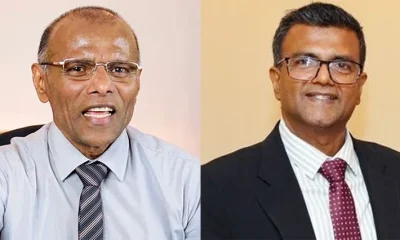
Treasury chief’s citizenship details sought from Australia