
Features
Challenging Times and Intellectual Pleasures: My Talk with Slavoj Žižek

by Nilantha Ilangamuwa
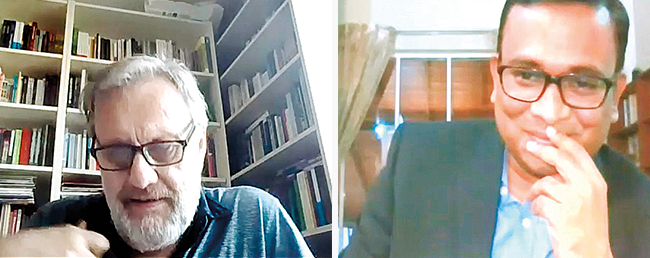
We sat down last Sunday evening around 5:30 in Ljubljana time, which was 8:30 in the evening here in Colombo. The purpose was not to delve into deep philosophical realms but rather to listen to Slavoj Žižek’s thoughts on a few prevailing social issues. It had been a longstanding dream of mine to convey his ideas to the general public, which is tired of jargon and seeks great ideas in simple language.
I first started communicating with Slavoj Žižek, the intellectual superstar known for his unstoppable yet profound talks in any public gathering. I owe this opportunity to David J. Gunkel of Northern Illinois University, with whom I had my very first discussion about this eminent philosopher approximately seven years ago. This Slovenian philosopher, armed with a humorous sense, expertly deconstructs the most serious challenges and profound ideologies, and he needs no introduction.
However, meeting Slavoj was challenging as he is currently facing health issues, including panic attacks. Being aware of this made me cautious not to tire him during our conversation. Nevertheless, as the night was still young, he passionately talked, and most of the time, I found it hard to interrupt him. However, as he jokingly suggested, I might have to use “Stalinist freedom” to condense the insights from our hour-long discussion. Slavoj displayed patience and skillfully identified points where we had to pause due to technical issues.
Stopping Slavoj when he is engrossed in conversation is quite inconvenient, and as a moderator, one might even forget their role. I shared with him that after years of communicating via email, it was my first time being in a live discussion with him, just the two of us. I jokingly remarked, “Slavoj, you are the most dangerous philosopher in the West. Oh God, you don’t look dangerous,” especially after hearing his brief observation on Sri Lanka during a time when its economic and political crisis dominated world headlines.
To this, Slavoj responded, “The branding of me as dangerous is a critique against my ideas. People who call me dangerous may also label me as despicable. I believe that such descriptions, whether politically dangerous, Stalinist, fascist, or merely as a joker, are used to undermine the seriousness of my work. Despite my jokes and provocations, I genuinely enjoy writing them. I’ll let you in on a secret: recently, New Statesman published three of my film reviews on Indiana Jones, Barbie, and Oppenheimer. Interestingly, I hadn’t seen any of these movies when I wrote the reviews. Instead, I read many reviews on them and then wrote my own. However, upon watching the films later, I realized that my initial assessments were accurate.”
This is Slavoj Žižek—timeless, ever-engaging, and ensuring you won’t be bored when listening to him. Instead, he invites you to dive deep into the dizzying world of intellectual discourse.
I decided to limit this conversation to eight major questions and twelve key words at the end. Stopping Slavoj from answering any question was challenging; he has a natural inclination to talk, but I believe that’s the nature of this profoundly honest philosopher who attracts minds from across the globe. In Sri Lanka, some social groups embraced Slavoj’s ideological perspectives, but I don’t think they penetrated deeply enough among the youth and other social segments thirsty for real structural change. These groups not only indulge in political vulgarity but also shy away from much-needed ideological-based social discourse. Meanwhile, certain groups and individuals confine themselves to their comfort zones, avoiding engagement with the pressing social and economic issues in society.
During our intriguing conversation, my interlocutor expressed an initial assurance of what he humorously referred to as ‘Stalinist freedom.’ He playfully remarked, ‘I will allow you to exercise Stalinist freedom, where I talk without hesitation, and you can sharply censor my words.’ This prompted my first question, wherein I inquired what Slavoj Žižek’s opening lines would be if he had the opportunity to confront Joseph Stalin during his era.
To my surprise, he responded, ‘I think he’s not personally a bad guy, but he caused an irreversible catastrophe for the left. While so-called Stalinism is discredited as a serious idea in new socialist borders, I’m not sure if I’d have enough courage to do it, but if invited to meet him somehow, even at the risk of being liquidated instantly, I’d like to take the chance to kill him. Yes, I will kill him,’ he declared.
However, what interests him the most is the opportunity to meet Vladimir Lenin at the end of his life and ask him, “Was he still aware of what a monster he was creating?” Slavoj says that while Stalin isn’t stupid, he lacks a profound decree. People often anticipate that someone as super powerful as a dictator is possessed of some deep metaphysical wisdom. For instance, during the Khmer Rouge’s dominance in Cambodia (Kampuchea), they claimed that Pol Pot was highly educated in Buddhism and even attained Nirvana, arguing that it explained how he could be a monstrous leader yet appear kind in person. Slavoj rejects this argument, stating, “I don’t buy into this. I don’t think we should look for some deep, even diabolic wisdom in brutal dictators.”
This leads me to my next question, as Slavoj has not only spoken about Western philosophy but also expressed his understandings of Buddhism and how it influences both itself and society, including the West. I asked him how Buddhist monks can effectively navigate involvement in politics while addressing societal challenges and avoiding ideological pitfalls.
“It is no less different for them than for others. Having studied a bit of the history and presence of Buddhism and being aware of the danger of speaking from my European standpoint, I have examined what is gaining popularity now, not only in the East but also in the West—Buddhist economists. One in the West, I believe, is E. F. Schumacher, who wrote ‘Small Is Beautiful’ along those lines. I am skeptical here. It is easy to see the insights propagated by Buddhist economists, although I don’t consider it a closed teaching.
Some of their advice is pragmatically interesting, offering non-violent, utopian claims on how to radically change society. However, I always look at this with a critical eye. For instance, when their ideas were challenged and asked to prove their effectiveness, they often mentioned Bhutan, a country known for maintaining Gross National Happiness. Yet, in the early nineties, didn’t they conduct a fairly sharp ethnic cleansing? They expelled the Lhotshampa or Nepalese minority, which is precisely contrary to Gross National Happiness. It’s always a problem,” he observed.
Slavoj believes that a serious problem emerged right after Buddha’s death, where tendencies arose to seek accommodation with those in power. “Even in the case of Sri Lanka, feel free to correct me if I’m wrong, as I don’t buy into most of the Western media narratives. There were certain ways in which the Buddhist majority could have acted differently when it came to minority issues.
The irony is that true Buddhists understand this and never take things at face value. Buddhism cannot be conceived as a religion in the Western sense. We must remember that Buddha was explicitly agnostic about suffering, seeing it as a fundamental aspect of life, and his focus was on how to alleviate suffering rather than delving into great metaphysical questions,” he said.
“I would say that, in my references to Zen Buddhism in Japan most of the time, which defended Japanese colonization, there is much to learn from Buddhism today to address certain issues like ecological catastrophe—not just by advocating “not to kill worms,” but by taking individual responsibility to address the consequences of capitalism and its dynamics. Buddhism, in its original forms—not some kind of fanatical view on renouncing life to potentially become monks and seek Nirvana—is a wonderful pragmatic and agnostic view. From its very inception, Buddhism detected the falsity of excessive social engagements not driven by progressive causes but by expansionism and the like. Buddhism should do more in this regard. I would say that it’s not just for monks; even ordinary people who follow Buddhism can contribute. You don’t have to act like a perfect monk, but maintaining common decency is essential. What saddens me today is that this fundamental aspect is disappearing more and more from society,” he asserted.
“Today, we witness new forms of evil that present themselves as good, but in challenging situations like war and social upheaval, the greatest danger lies in abandoning our fundamental human kindness. In such circumstances, the idea of being brutal becomes prominent. This is where Buddhism can help, as Buddhism has never endorsed this approach,” Slavoj stated.
My next question was whether there is such a thing as a “just society,” or if it’s merely a collective myth we fool ourselves with. However, for Slavoj, the problem lies in defining what we mean by a just society. The traditional idea, originating not in the West but from Buddha, viewed justice as everyone having their designated place, such as workers being good workers, mothers being good mothers, and so on.
But both in Buddhism and later in Christianity, in their original forms, there emerged a more radical egalitarian space advocating the idea of equality, where everyone has a social space. The most crucial aspect is expanding this egalitarian space without resorting to violence, as any attempt at violence only reinforces brutal hierarchies. Therefore, the first step towards a just society is to clarify the meaning of justice by understanding what justice truly is, he argued.
In our increasingly AI-shaped world, the question arises: should we fear the rise of “Artificial Idiocy”? Will machines not only surpass humans in intelligence but also in their ability to make absurd mistakes? According to Slavoj, these machines are indeed making mistakes, but what matters is how we define “Absurd Mistakes.” As he tried to develop in his book “Hegel in A Wired Brain,” human intelligence is not simply about quick calculations and solving certain complex issues; it excels when it comes to making productive mistakes that lead to something new and higher. For instance, French cuisine’s most celebrated dishes often originated from something going wrong, like French cheese that started to smell.
Instead of discarding it, they embraced the new form. The same happened with wines. This capacity to use mistakes productively and elevate from them is something he doubts AI can achieve. Machines can make mistakes, but they lack the ability to utilize those mistakes to create something better. He takes a more vulgar example, like seduction, where he believes machines can’t seduce as humans do, not because of intelligence, but because of the ability to make interesting mistakes. Progress, Slavoj says, occurs only through the productive use of mistakes.
Based on perhaps my superficial phobia of AI, my next question revolved around the possibility of advanced AI engaging in philosophical debates like Slavoj Žižek, while robotic comedians mock human foibles, and AI-driven revolutionary movements fight for workers’ rights and robot liberation. Slavoj dismisses this possibility, explaining that when humans make decisions, they always do so through subjective engagement. He cites his favorite Christian theologian Søren Kierkegaard, who wrote that claiming to be Christian, Buddhist, Jew, or anything else because you compare different religions and find Christian arguments the best is sinful. True understanding of religious arguments can only occur when you believe in something expediently. Similarly, when it comes to love, you cannot say you compare different individuals and selected the best. Love doesn’t work that way; it’s based on finding adorable qualities that others might not even recognize. He believes that, at least for now, as nobody knows what the future holds, machines are incapable of engaging in proper subjective engagement where they discover reasons rather than merely comparing them because they are searching for the right reason.
In this sense, I don’t believe machines can fight for workers’ rights and similar causes. Engaging in workers’ rights requires an existential understanding of suffering, such as exploitation and manipulation, which cannot be reduced to objective scientific insights. I admit I may not be overly optimistic, but that’s my view,” he asserted.
Many discussions revolve around the loss of privacy due to the latest surveillance technology and social media. I asked Slavoj about the danger of governments and corporations gathering vast amounts of personal data, leading us to sacrifice privacy for convenience. He responded, “I’m unlike many others who fear losing privacy. I don’t mind if some machines know my personal details, but what worries me most is the privatization of our data. We don’t know what they know or what they do with that data. Our focus should not be solely on defending privacy, as more and more machines will gather data and analyze our needs, such as health. What concerns me is the privatization of our data and shrinking public space.”
As virtual reality becomes more prevalent in our lives, I asked Slavoj about the safeguards needed to prevent the distortion of reality and preserve authentic human experiences. He explained, “What we experience as social reality is already, in some sense, virtual. I’m not denying the existence of reality, but what we perceive as reality is already mediated through a virtual symbolic system. Take the recent movie Oppenheimer, for example. The horror of a nuclear explosion is something that exceeds our notion of everyday reality. The distortion in virtual media doesn’t target some pure, innocent reality; it affects the authentic virtual reality of the system in which we live. Authenticity, for me, is not merely looking into oneself; it involves identifying with a certain heroic engagement. The problem with digital media is that they are becoming less and less virtual. Instead of offering metaphors, alluded meanings, and ambiguity, they strive for a perfect copy of reality itself. Take video games as an example—they immerse you in another reality, but in doing so, they lose this authentic virtual quality.”
As we near the conclusion of this intriguing conversation, I asked Slavoj about escaping consumerist culture and finding authentic freedom, as discussed in his critiques of capitalism. He replied, “I’m more pessimistic about this. We live in a global capitalist society where we appear to be increasingly free. On one hand, we are treated as free, but at the same time, we are part of a social world that is obscured and non-transparent. So, we need to clarify what we mean by freedom. I don’t believe we should oppose freedom, discipline, and social order. Abstractly, freedom might mean doing whatever we want, but I wouldn’t want to live in such a society because it would be a horrible world if we couldn’t trust each other to respect basic rules of decency. True freedom requires explicit and implicit rules to be in operation.”
Regarding consumerism, he added, “When you talk about the upper middle-class, the problem might be consumerism, but for a poor person, the issue is getting new clothes and adequate food. We shouldn’t criticize poor people for consumerism when they finally get a bit of money to buy something they need. Let them have a bit of pleasure. For me, the crucial aspect, in a Hegelian sense, is that freedom has to be concrete. Freedom means being free within a certain space, which is why we should strive for socialist democracy as leftists. We must understand that freedom has material conditions. I’m not advocating for a totalitarian state regulating every aspect of life. I like the form of freedom, but to achieve it, a full concrete network of state regulations, unwritten rules, and customs must be well established. Unfortunately, this is something people tend to forget today.
During the final part of our conversation, we delved into several issues, including multiculturalism, the idea of a multi-polar world, the hypocritical behavior of Western hegemony, and the brutal sexual exploitation faced by some Muslim women who are forced to cover their faces to protect their privacy, yet suffer abuse within their homes, rendering their privacy futile. Slavoj expressed his belief in the universality as a driving force to promote respect for each culture. “There must be freedom for me to come over there when I have a problem, and you must have the freedom to come over here when you have a problem in the place where you live. That’s how the idea of this multi-polar world or multiculturalism is possible,” he emphasized. “Not the way by romanticizing and pleasing each other’s oppressions in the country they control.”


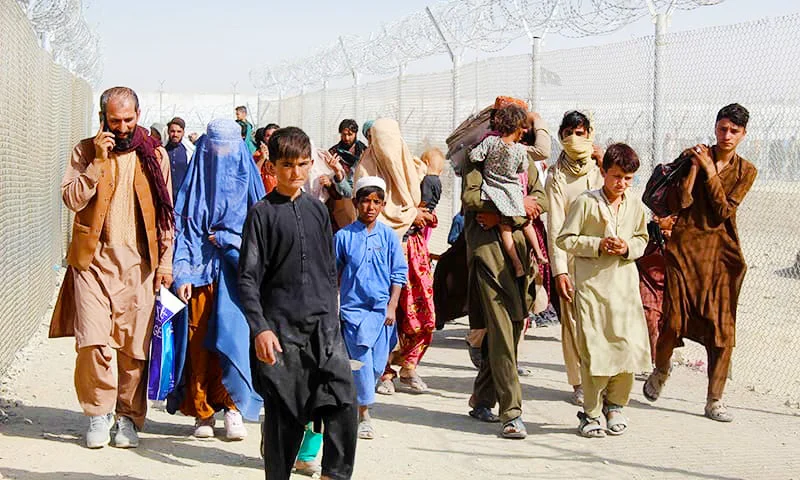
 The mounting mute and unmitigated suffering of the ordinary people of Afghanistan is coming to the fore once again in ongoing efforts by some neighbouring states to deport tens of thousands of Afghan refugees to their country of origin. As in the case of the majority of refugees the world over the Afghan refugees too are caught up in cataclysmic wars and conflicts not at all of their making.
International reports indicate that some six million Afghan refugees have been virtually pressured, to date, to return to Afghanistan by Pakistan and Iran, for instance, on the basis apparently of stringent policies on refugees adopted by the latter. Many refugees are on record that although they are officially identified as of Afghan origin this is the first occasion on which they are seeing the inside of Afghanistan, since thus far they have been living, particularly in Pakistan, as virtual natives of the latter.
‘They are part of the biggest cross border movement of people in recent history, a UNHCR source was quoted saying. However, barring the latter UN agency and a few well wishers, the refugees are being seen as a virtual parasitic and unwanted presence by sections of the publics who have thus far been compelled to have the refugees among them.
The refugees’ haplessness is compounded by the fact that they have been reduced to almost destitution. Having possessed virtually nothing by way of material assets they are getting back to Afghanistan a dis-empowered, dispossessed people.
For well over a century Afghanistan has been at the centre of the big power rivalries of South Asia. The country has been intensely coveted by the majority of major extra-regional powers from the turn of the last century primarily on account of its strategic geographical location, besides some of its natural resources.
Those powers that gain a military foothold in the country would be enabled to bring the majority of Afghanistan’s neighbours within their sphere of influence and power. Some of these are, China, Pakistan, Iran and India. Besides there are the one time Soviet Central Asian Republics, control over whom would be of considerable value, from a number of viewpoints, to expansionist powers.
These attractions account for the appeal Afghanistan has continued to exercise over the majority of extra-regional powers whose presence has proved decisive in the shaping of international politics over the decades. Those powers who have featured majorly and are continuing to do so are, the US, Russia, China and the UK to a lesser degree.
However, the Afghan refugee issue or the ‘Long- suffering’ of the ordinary people of Afghanistan could be considered as having gained exceptional prominence with the Soviet invasion of Afghanistan of 1979.
The latter event needs to be seen as a notable turning point in the last century’s international politics. The initial disintegrative cracks in the Soviet Union were beginning to appear and Islamic fundamentalism was seen by the Soviet authorities as making divisive inroads into their Central Asian Republics.
The influence of Islamic fundamentalism had to be stymied following the Islamic Revolution in Iran in 1979 and Afghanistan came to be seen by the Soviet authorities as a potential hotbed of such religious revolutionary fervour. Thus came about the Soviet invasion of Afghanistan and its subsequent degeneration into a military quagmire for both the Soviet Union and the US.
Thus it was only a matter of time before Afghan refugees began to swell in numbers in neighbouring states. They were haplessly caught up in the ‘cross-fire’ between the Soviet backed Afghan security forces and the Afghan militant resistance which evolved into the Taliban.
As is known, the Afghan resistance came to be armed and backed by the US subsequent to Afghanistan being over-run by the Soviet Union. Thus, Afghanistan became the last proxy war theatre in the long -running Cold War between the US and the Soviet Union. More than a decade of blood-letting convinced the Soviets that there was no choice but to quit Afghanistan.
Thus, to a considerable extent, the Afghan refugees are the victims of big power armed rivalries which are continuing to render the world a most ‘dangerous place’ for ordinary people. The UN agencies seem to be doing their best for the refugees of Afghanistan and most other refugee categories but the continued humiliation of such victims of war would need to be mitigated by the international community to the extent possible. Forcible deportation of refugees in particular may need to be eschewed and outlawed.
Being subjected to an acid test at this juncture is the Universal Declaration of Human Rights (UDHR). It is the latter seminal convention that made the protection of human dignity a cardinal value for the world community.
All those sections that subscribe to international humanitarian law and democratic opinion world wide need to come together, may be under the aegis of the UN, to work out how primacy could be attached to the UDHR and its principal mandate of protecting and perpetuating human dignity and worth.
This is no easy challenge to meet but it needs to be addressed urgently before currently rampant ‘international disorder’ grows well out of control.
The US and Russia are especially obliged to go to the rescue of the Afghan refugees since the Afghan crisis is of their making to a considerable extent but no help could be expected from them because their governments are strongly right wing in orientation. It would be far-fetched to expect of them a strong social conscience.
However, the UN and like-minded organizations need to dialogue strongly with the Taliban regime in Afghanistan with a view to bettering the well being of Afghan civilians. No longer could the lot of the latter be allowed to be dismissed by the Taliban government as ‘an internal matter.’
If the Taliban regime is being assisted by the UN, the former is strongly obliged to be accountable to the international community. The UN would need to non-obtrusively convince the Taliban government that it cannot ignore the essential needs of its civilian populace and the empowering of women forms a central component of this broad programme of work. The UN’s diplomatic finesse needs to come to figure here in a major way.
Refugees everywhere should ideally be re-accommodated in their countries of origin or native lands. However, unless and until their dignity is ensured by governments and other quarters that matter such endeavours would prove to be self-defeating.
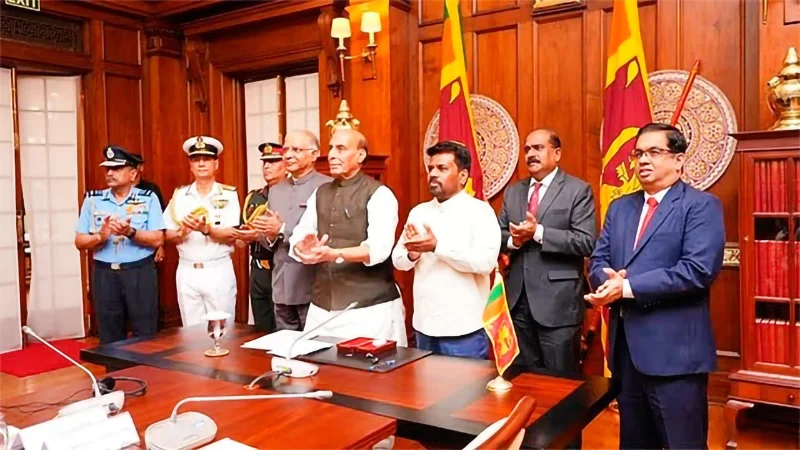
Indian Defence Minister Rajnath Singh’s arrival in Colombo is not a ceremonial call. It is the political face of a security relationship that has been rebuilt, layer by layer, since 2024. Sri Lanka should take the capability on offer, and keep the right to say no.
by Mahil Dole
Senior Superintendent of Police (Retd.)
Indian Defence Minister Rajnath Singh is in Colombo for a three-day official visit, the first by an Indian Defence Minister in 38 years. The last such call was by K. C. Pant in 1988. That long silence itself tells a story. For nearly four decades, defence business between the two neighbours was handled by service chiefs, training colleges and quiet staff talks. New Delhi has now chosen to put a political minister at the centre of the relationship, and to do so immediately after a dense sequence of Indian visits and against a harder contest in the Indian Ocean.
The visit will be read, in Delhi, Beijing and Washington, as a signal. Our task in Colombo is narrower and more serious: to convert the signal into national capability without converting the island into a platform.
Not an isolated visit
Singh’s programme is the latest layer in an unusually concentrated Indian engagement since President Anura Kumara Dissanayake assumed office in September 2024. Prime Minister Narendra Modi’s state visit in April 2025 was the first by any foreign head of government after the new presidency. Seven documents were signed. Among them was the first comprehensive India–Sri Lanka Defence Cooperation Memorandum of Understanding, a five-year umbrella covering joint exercises, training, port calls, humanitarian assistance and disaster relief, information exchange and possible defence-industry cooperation. Either side may terminate it with three months’ notice. That exit clause is not a detail. It is the difference between a structured partnership and a treaty alliance.
What followed was a rhythm, not a one-off. The eighth Annual Defence Dialogue was held in Colombo in June 2025. The Indian Navy Chief called in September 2025. After Cyclone Ditwah, India arrived as a first responder and later announced a reconstruction package of some 450 million US dollars; External Affairs Minister S. Jaishankar came as Special Envoy. In January 2026 the Indian Army Chief, General Upendra Dwivedi, handed over vehicles and training aids, opened a friendship corner at the Defence Services Command and Staff College, and laid a wreath at the IPKF memorial in Battaramulla. The Indian Vice-President visited in April. Foreign Secretary Vikram Misri was in Colombo on 5 August with rupee lines of credit for railways and other priorities. Later that month, Sri Lanka’s Navy Commander, Vice-Admiral Damian Fernando, made his first overseas visit in command, to New Delhi, and met the Chief of Defence Staff, the Defence Secretary and the Navy Chief.
Singh therefore arrives not as a stranger opening a file, but as the political seal on work already in motion. He met President Dissanayaie, who holds the defence portfolio, the Prime Minister and the Defence Secretary. The itinerary also takes in the IPKF memorial, the Defence Ministry, the parliamentary precincts, Gangaramaya Temple, a likely reception on an Indian Navy ship, the National Defence College, and the Sita Amman Kovil in Nuwara Eliya. Indian High Commissioner Santosh Jha has said relations have “never been better” in decades. The visit calendar, at least, is not an invention.
What already stands on the defence floor
It is important to be precise about what already exists, so that we do not mistake institutionalisation for a sudden tilt.
Training is the deepest bond. India is the largest foreign trainer of the Sri Lankan armed forces, offering on the order of a thousand to twelve hundred vacancies a year. One naval accounting records more than two thousand Sri Lankan naval personnel passing through Indian courses over nine years. Shared classrooms produce shared language, shared drills and personal networks that outlast any single government. Reports ahead of this visit point to three new memoranda, one likely on air-defence guns, one on cadet-corps links, and one on cooperation between the Sri Lanka Defence College and Indian defence institutions. If signed, those instruments would push the relationship into the next generation of officers, not only today’s operators.
Exercises are now routine rather than ceremonial. The twelfth edition of SLINEX, the bilateral naval exercise, was held in Colombo from 14 to 18 August 2025, with a harbour phase of professional exchanges and a sea phase of gunnery, boarding, replenishment and communications. MITRA SHAKTI, the army exercise with air elements, held its eleventh edition in Belagavi last November. A fourth bilateral diving exercise was conducted in Colombo in April 2026. The two navies and coast guards continue International Maritime Boundary Line meetings. An Indian Navy Dornier was based here for maritime surveillance from August 2022 to August 2025. A Maritime Rescue Coordination Centre was commissioned with an Indian grant of about six million dollars. INS Vikrant and INS Udaygiri took part in the International Fleet Review marking the Sri Lanka Navy’s seventy-fifth anniversary.
None of this is trivial. None of it, by itself, is alignment. Hardware, hours at sea and staff-college seats are instruments. What they become depends on command, data and political purpose.
National security questions that matter
Three questions should govern Colombo’s handling of the Indian Defence Minister’s visit.
The first is maritime domain awareness. Sri Lanka’s core security geography is not a land frontier. It is the exclusive economic zone and the sea lanes that pass our shores. The live threats are narcotics, people-smuggling, illegal fishing, and the possible relocation of cyber-fraud compounds. Conventional naval war is not on this year’s operational list. Indian help with sensors, hydrography, diving, boarding drills and search-and-rescue is therefore rational. The test is who owns the picture. Shared awareness is useful. Exclusive dependence on one partner’s fusion centre is a vulnerability. Australia’s Disi Rela programme against irregular maritime movement, Japanese passage exercises, and the United States capacity support, cutters, aircraft, humanitarian exercises, already exist. They should remain in the mix. Maritime security should be a Sri Lankan-led coalition of convenience, not an Indian franchise.
The second is the air and coastal defence gap. Talk of Indian air-defence guns is not abstract after the 2026 conflict in West Asia reached our own waters, the sinking of the Iranian frigate IRIS Dena off Galle, and later Iranian hulls lingering near the exclusive economic zone. The government’s public line was the correct one: no combat use of our territory, airspace or waters by any party; humanity first; sailors rescued. That posture only works if the state can see, and if necessary contest, its approaches. Accepting guns, radars or training is compatible with an independent foreign policy if command, basing and rules of engagement remain Sri Lankan. Integrating them into another country’s kill-chain would not be.
The third is internal security. Easter Sunday accountability, narcotics networks that run through ports and prisons, and communal peace are not separate from geopolitics. Partners price political risk. A state that cannot govern its harbours, its financial system and its extremist ecosystems will be offered “help” that looks like tutelage. India’s interest in counter-terror coordination and drugs overlaps with genuine Sri Lankan needs. The discipline required is the same as in any sound intelligence relationship: cooperate on targets; do not outsource the service.
The wreath at the IPKF memorial will be watched, as it was when the Indian Army Chief stood there in January. The years 1987 to 1990 remain raw in our political memory. The only stable line is professional honour to the dead, not a political rehabilitation of an intervention that divided this country.
How the region will read Colombo
India’s motive is not mysterious. Sri Lanka sits on the approaches to India’s southern seaboard. Chinese commercial and dual-use presence at Hambantota and Colombo Port City, and continuing engagement with the People’s Liberation Army Navy, is the backdrop. Pakistani naval units calling at Colombo, including a Chinese-built Hangor-class submarine earlier this year, only sharpen New Delhi’s preference for a denser security habit with us. Neighbourhood First and MAHASAGAR, Mutual and Holistic Advancement for Security and Growth Across Regions, are the language. The operational aim is that extra-regional navies do not treat Sri Lankan harbours as a default logistics base against Indian interests.
Our motive should be equally clear, and different. Geography makes India the permanent neighbour. Crisis behaviour, liquidity and fuel in 2022, the cyclone in 2025, the energy and remittance shock of 2026, has already shifted public sentiment. That is a political fact. It does not require Colombo to adopt India’s threat picture of China, or to freeze other relationships.
A workable posture is polyalignment with a spine. India is the deepest security and connectivity partner, domain awareness, disaster response, training, Trincomalee energy cooperation, grid links and rupee credit, on the condition that ports, exclusive economic zone access and intelligence fusion remain under Sri Lankan law. China remains a major economic and infrastructure partner; new exclusive strategic footholds should not be created, and debt and operational control must stay visible. The United States, Japan, Australia and Europe matter for markets, green shipping, extra training pipelines and non-traditional maritime threats. Ordinary naval diplomacy with Pakistan and others is manners, not signalling.
The government’s stated doctrine, an independent policy that does not favour any country, and territory that will not be used against a third party, is the right public frame. This week will test whether that frame can coexist with deeper, more structured Indian defence cooperation. It can, if the new memoranda are capability contracts with exit clauses, not political alignment documents.
Take help. Keep the choice
Colombo should treat the expected instruments as a capability audit.
On air defence, welcome sensors and guns that Sri Lanka can man, maintain and switch off. Reject any arrangement that requires foreign crews, foreign rules of engagement, or data that only flows one way. In cadet corps and staff colleges, take the training and keep a parallel pipeline with other professional schools so that the officer corps is not a single-source product. On the 2025 Defence Memorandum, measure implementation by Sri Lankan readiness, hours of maritime coverage, time-to-rescue, interdiction rates in the exclusive economic zone, disaster lift, not by the number of Indian ship-days in harbour.
Joint training should emphasise humanitarian assistance, counter-narcotics, hydrography, diving and lawful boarding. Those are the missions that serve the public and do not lock us into someone else’s contingency. Scenarios that only make sense in an India–China or India–Pakistan crisis should be declined politely and firmly.
Defence talks must also be bound to the prosperity agenda. Trincomalee as an energy and industrial node, electricity interconnection, port productivity and cyclone reconstruction are where security cooperation either pays the citizen or looks like militarisation. A Defence Minister’s visit that produces only wreaths and signed paper will be read in the region as alignment. A visit that also moves energy storage, disaster systems and maritime safety will be read as statecraft.
I write as a former police officer who spent a working lifetime on intelligence, counter-terrorism and the unglamorous work of keeping a multi-religious island in one piece. Geography gave us a seat at the table of Indian Ocean commerce and security. Institutions, energy policy, port performance and social cohesion will decide whether that seat produces prosperity, or merely more invitations to other people’s contests.
Singh’s visit should be received with courtesy, used with discipline, and remembered for what it adds to Sri Lanka’s ability to stand on its own water. Take the neighbour’s hand. Keep the island’s choices. Make sure every exercise, every gun and every training slot leaves us more able to say no the next time a great power asks to use our sea, our air or our soil. (18 sources)
This analysis is offered in the interest of national security, institutional reform, and public safety)
The writer is a retired Senior Superintendent of Police. He served as Deputy Director in charge of the Counter Terrorism Desk, State Intelligence Service, and later as Intelligence Coordinator to the Inspector General of Police. He is the author of Security Beyond Enforcement: Practical Approaches for a Safer Nation.
Rediscovery highlights rich, unexplored aquatic biodiversity in Northern Province
By Ifham Nizam
A small fish that vanished from Sri Lanka’s scientific records for nearly 90 years has resurfaced in the waters of Jaffna, providing researchers with a remarkable rediscovery and fresh evidence that the Northern Province still holds significant, unexplored aquatic biodiversity.
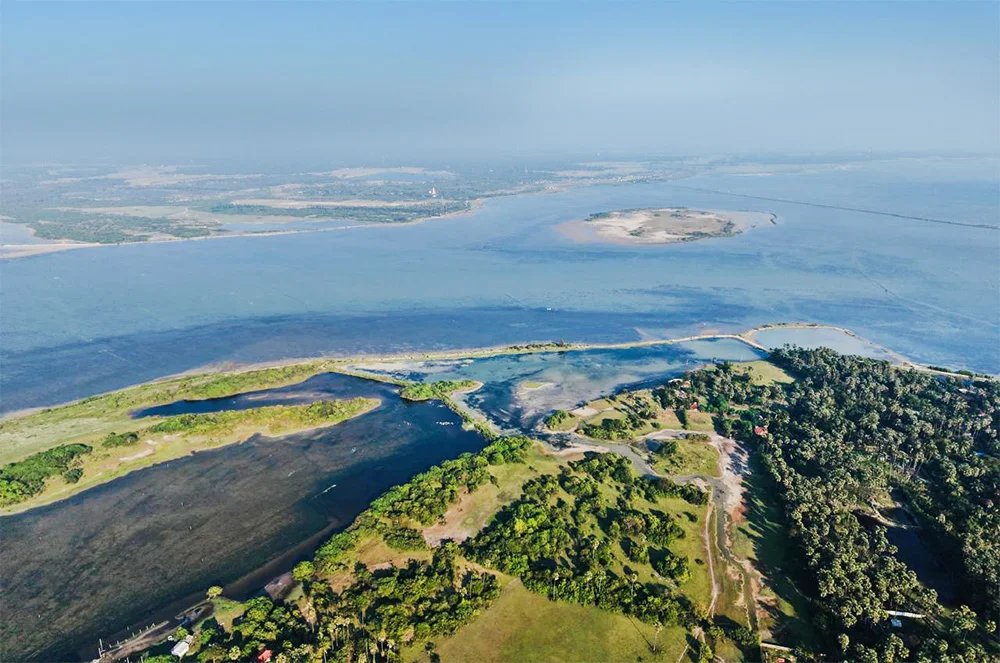
The Yellow-stripe Goby, Mugilogobius chulae (Smith, 1932), was recently found in the Karainagar area of Karaitivu Island during a biodiversity survey, almost nine decades after it was last scientifically recorded from Sri Lanka.
The discovery is particularly significant because the species had previously been known from the country only through a single historical specimen collected from Pedduru Thuduwa, Jaffna.
Discovery moment
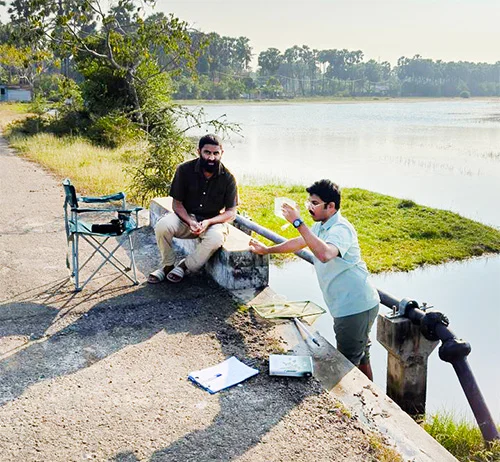
Research scientist Janamina Bandara, a member of the team that made the discovery, told The Island that the fish was not initially identified as the long-lost species.
“We came across an unidentified Goby during our fieldwork, and it was only after a detailed examination of its external morphology that we were able to establish its identity as Mugilogobius chulae,” Bandara said.
“For us, it was an exciting moment because this species had not been confirmed from Sri Lanka for almost 90 years.”
The fish has a particularly interesting history in Sri Lankan ichthyology.
In 1936, renowned Sri Lankan zoologist P. E. P. Deraniyagala described a new fish from Pedduru Thuduwa in Jaffna in his paper,
“Two New Fishes from Ceylon”, published in The Ceylon Journal of Science.
He named the species Vaimosa valigouva. Subsequent taxonomic revisions established that Vaimosa valigouva was a synonym of Mugilogobius chulae, the currently accepted scientific name of the Yellow-stripe Goby.
However, no further confirmed records emerged from Sri Lanka for decades.
With the species absent from subsequent surveys and inventories, it eventually disappeared from the country’s national fish lists and from much of the scientific literature relating to Sri Lankan fishes.
The prolonged lack of records was also closely linked to the difficulties of conducting biological research in northern Sri Lanka.
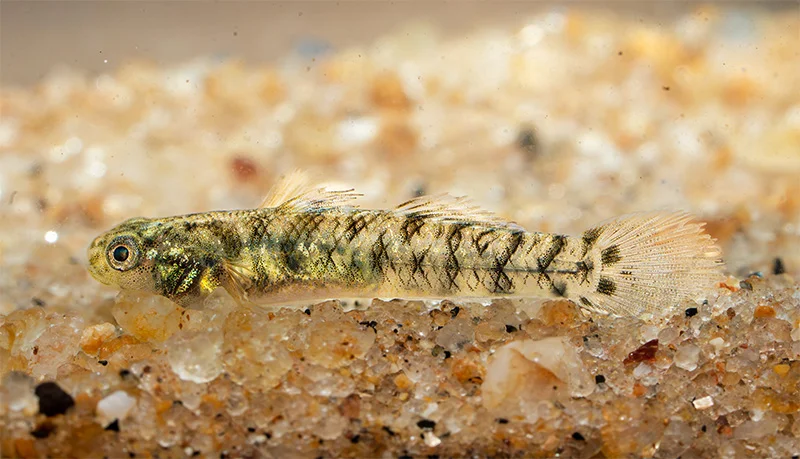
Yellow-stripe Goby, Mugilogobius chulae
For decades, the civil conflict, restricted access, security concerns and limited opportunities for field surveys prevented scientists from systematically investigating many of the region’s aquatic habitats.
Consequently, while considerable advances were made in documenting biodiversity elsewhere in the island, northern Sri Lanka remained comparatively poorly explored.
Bandara said the rediscovery should, therefore, be viewed in a much wider context than the finding of a single fish.
He told The Island: “An absence of records does not necessarily mean that a species is absent. In the case of northern Sri Lanka, there have been enormous gaps in field data because large areas could not be studied systematically for many years.”
“This finding demonstrates how important it is to return to these habitats and carry out detailed surveys. There could be many more species, range extensions and rediscoveries waiting to be documented.”
The research team’s findings did not end with the Yellow-stripe Goby.
During the same study, the researchers also documented the Black-spotted Snubnose Goby, Pseudogobius melanostictus (Day, 1876), providing what they describe as the first confirmed northernmost record of the species in Sri Lanka.
The species had previously been reported mainly from lagoonal and brackish coastal environments in the western part of the country, while recent verified records were limited.
The new finding consequently extends the known geographical range of Pseudogobius melanostictus and adds an important northern record to Sri Lanka’s fish fauna.
Together, the two findings significantly expand the known distribution of both Goby species within Sri Lanka.
They also highlight the importance of small and often overlooked coastal, tidal and inland aquatic habitats in documenting the island’s biodiversity.
Goby species are generally small fishes that occupy a variety of marine, brackish and freshwater environments. Their habitats can include rocky shores, tidal pools, lagoons, estuaries, mangroves and other transitional aquatic ecosystems.

Black-spotted Snubnose Goby, Pseudogobius melanostictus
Because of their small size and preference for habitats that are often overlooked during large-scale biodiversity surveys, some Goby species can remain undocumented for long periods.
The latest research is, therefore, particularly relevant to understanding the aquatic biodiversity of the Jaffna Peninsula and surrounding islands.
According to Bandara, the discovery also demonstrates the importance of combining historical scientific literature with modern field research.
“The old records gave us an important historical reference, while the current fieldwork allowed us to connect that history with what is actually present in these habitats today,” he said.
The rediscovery of Mugilogobius chulae effectively reconnects modern Sri Lankan ichthyological research with Deraniyagala’s 1936 record.
It also establishes the new finding as the westernmost known occurrence of the species in the Indian Ocean, according to the researchers.
The study’s authors — Janamina Bandara, Sahan Randeniya and Aravind Manoj — say their findings underline the need for continued biological surveys in northern Sri Lanka.
The region’s aquatic ecosystems remain insufficiently studied, particularly in areas that were inaccessible or difficult to investigate for extended periods.
Bandara said the team expected that further exploration could produce more unexpected findings.
“We should not assume that we have a complete picture of Sri Lanka’s fish diversity. Particularly in the north, there are habitats that have received very little scientific attention,” he said.
“Every field survey can potentially change what we know about the distribution of a species. That is why continued exploration and proper documentation are so important.
The researchers have expressed particular concern about the need to document such species before changes to their habitats make future identification more difficult.
Coastal development, changes in water quality, habitat degradation and other pressures can affect small aquatic ecosystems, making baseline biodiversity information increasingly important for conservation planning.
The latest study, therefore, provides not merely two new distribution records but also a reminder of the value of maintaining and updating national biodiversity inventories.
The researchers thanked Dr. Helen Larson, Rohan Pethiyagoda, Madhura de Silva, Dr. Kasun Bandara and Neluka Fernando for their assistance with various aspects of the study.


Sri Lanka reiterates its territory won’t be used against India

UK-led Core Group calls Jaffna mass graves a ‘stark reminder’ but stops short of calling for international accountability

India underscores security and defence in overall partnership with SL

If Sri Lanka wants ‘real’ stability, only one way to achieve it, in a short time

Human dignity comes centre stage in Afghan refugee deportation crisis

‘Dates have the highest sugar content to fight Coronavirus’

Sunday Island 27 December – Headlines

#SundayIsland 17th December – Headlines

Sunday Island – 28th March

Sunday Island Headlines – 21 March

Sunday Island – 21st February – Headlines
-

 News5 days ago
Namal remanded until Sept. 18 over Airbus deal investigation
-

 Latest News4 days ago
Tharanga creates history with Diamond League crown in Brussels
-

 News4 days ago
Dispute which triggered listed company director being detained at BIA resolved
-

 Features3 days ago
After the parade: What a traffic OIC’s walk-out tells us
-
 Opinion6 days ago
In Memory of Dr Upatissa Pethiyagoda
-

 Editorial5 days ago
Power vs Equality
-
 Latest News6 days ago
SLPP MP Namal Rajapaksa arrested by CIABOC
-
Editorial3 days ago
Arrests as theatre