
News
CP Leader warns of danger of being at mercy of the dollar with it likely to lose its world reserve currency status

Suggests looking at India and China as alternative options
By Rathindra Kuruwita
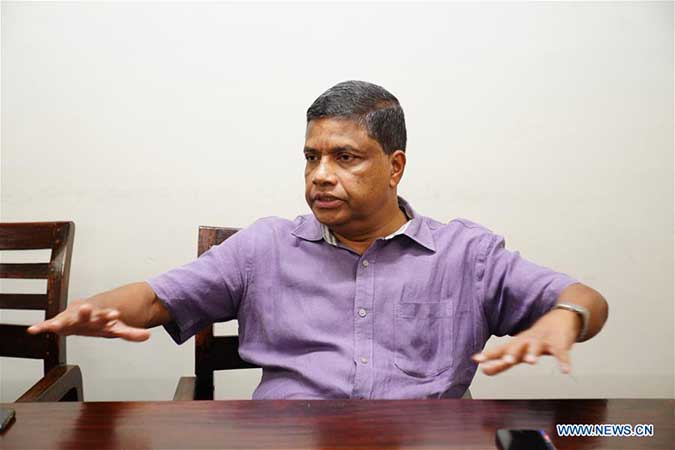
The United States has printed trillions of dollars in the past year and Sri Lanka will be at the mercy of its volatility unless it looks at ways to reduce its dependence on the dollar, General Secretary of the Communist Party of Sri Lanka (CPSL) Dr. G. Weerasinghe told The Island on Wednesday.
The CPSL recently released a policy manifesto, Idirimagin Idiriyata, at the party’s 80th anniversary and proposed an alternative development mechanism.
After several centuries, the centre of world economy has shifted to Asia, and it has opened up new developmental avenues for Sri Lanka, General Secretary of the Communist Party said. Speaking about the Idirimagin Idiriyata policy manifesto the CPSL launched on 03 July, he said that most Sri Lankan economists are western oriented and ignore new world trends.
“In the last 20-30 years, many Asian economies took off, but we couldn’t get on the bus. This is because our entire economy is oriented to the West. We don’t even think what the Chinese, Indian, Korean or Japanese market wants. Clearly they don’t need our tea or garments. We have to figure out what these new markets want,” he said. Dr. Weerasinghe added that China is the main business partner with 140 countries in the world. China and India do a lot of business together, despite the frequent clamouring by Indian media, he said. “China is the biggest market in the world. China has a 500 million strong middle class. We have to also seriously think of India, which is the most populous country in the world. What about ASEAN? CPSL calls for a reorientation of Sri Lanka’s trade policy,” he said.
The CPSL General Secretary said that de-dollarization and the availability of new payment platforms are also developments that Sri Lanka should look at. In recent years, it has become evident that the United States and a few of its allies are manipulating international institutions that were meant to be apolitical, he said.
“They are also using sanctions to punish countries that do not bow down to the West. They are misusing the fact that the U.S. Dollar is the reserve currency of the world. They have also used payment platforms like SWIFT which was said to be beyond politics. A lot of countries have seen what happened to Iran and Russia and are worried that the same fate would befall them. Most major powers in the world are thinking about using alternative currencies to do business between each other. They have also looked at payment gateways like Mir,” he said.
Dr. Weerasinghe said that the US and EU imposed sanctions on about 6000 products on Russia following the Ukrainian war. Without being daunted, it rearranged its economy towards Asia and have managed to escape economic collapse. This made many major powers realize that the US and EU can only influence them, if U.S. dollars are used for trade.
“De-dollarization has gained momentum ever since. Russia, Iran and a few other countries have been kicked out of SWIFT,” he said.
Dr. Weerasinghe said that Sri Lanka has now decided that the Chinese Yuan and the Indian rupee can be used for trade. Some elements are insisting that this would be bad for the country without giving a rational explanation, he said.
The CP General Secretary mentioned that there are a few new development banks in the world, i.e. the BRICS bank and the AAIB. Sri Lanka only depends on the World Bank, IMF, etc., and these establishments have been tools of the West to impose its hegemony on the rest of the world, he said.
Dr. Weerasinghe added that until 1978, Sri Lanka took a number of progressive steps to defeat colonialism, and to industrialize. It attempted to formulate its own drug policy with Dr. Senaka Bibile, which is now widely respected around the world.
However, everything changed after 1977 and the problems created from the shift in the economic policy culminated with the current economic crisis, he said.
“Almost all governments, since 1977, have followed policies that were inimical to the agriculture and manufacturing sectors. We moved to low paying and low-productivity service jobs. It is a well-known fact that all nations that joined the developed nations club in the last 60 years focused on labour intensive manufacturing and boosting agricultural productivity. This is the history of development, but we have decided to ignore, it since 1977,” he said, adding that the institutions set up to ensure adherence to the Washington Consensus, i.e. World Bank and the IMF dictates, had encouraged deindustrialization in Sri Lanka.
“In fact, a 2003 agreement we signed with the IMF says that the Sri Lankan government will not take steps to develop industrialization,” he said.
The CPSL General Secretary said that as the state had lost both tax and non-tax revenue, it was compelled to borrow, especially from the International Sovereign Bond (ISB) markets.
“We started borrowing from these markets in 2007. Up until 2015, we borrowed about 30 percent of our total debt from ISBs. Between 2015 and 2019, we borrowed over 13 billion US dollars from these markets. These bonds are held by companies based in the US and the EU. They are literally poli mudalalis (loan sharks). Borrowing from these markets has ruined us. However, there is a big campaign by the West and its local allies to place the blame on China,” he said.




Senior DIG among those slated for transfer
By Shamindra Ferdinando
The National Police Commission (NPC) is expected to take up Police Headquarters recommendation to transfer a group of police officers responsible for a major ‘Ice’ bust at the Colombo port recently.
NPC sources told The Island that recommendation in respect of transfers was received last week. Sources said that though the NPC was scheduled to meet today (01), whether IGP Priyantha Weerasooriya’s recommendation would be discussed and decided today was not known.
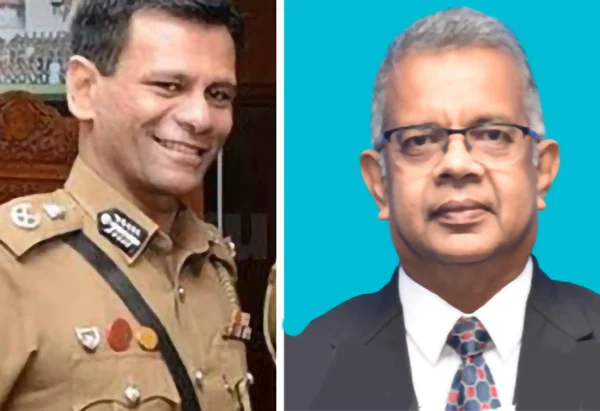
Members of the NPC are retired High Court Judge Lalith Ekanayake (Chairman), K. Karunaharan, Dilshan Kapila Jayasuriya, A.A.M. Illiyas and Jayantha Jayasinghe
The IGP directed the Special Investigation Unit (SIU) to probe those who carried out the 31 August, 2026 raid that resulted in the detection of 463 kgs of ‘Ice’ concealed in a container that arrived from Pakistan.
The US Embassy declined to comment on the probe though it declared that the largest ever narcotics detection was made on intelligence made available by the US Drug Enforcement Administration (DEA).
The officers investigated for what an authoritative Headquarters source called shortcomings and lapses on the part of the raiding party, belonged to the Central Crime Investigation Bureau (CCIB). Senior DIG Ranmal Kodituwakku who, on behalf of the CCIB, received information directly from the DEA, is among those Police Headquarters wanted to transfer.
CCIB carried out the raid after having obtained a search order from the Aluthgama Magistrate court. Among the suspects taken in this connection are three Pakistani nationals.

* First Reading of the Budget on 7 October
The Committee on Parliamentary Business has decided that the Second Reading of the Appropriation Bill for the year 2027 (Budget Speech/presentation of Budget proposals) will take place on 12 November, followed by the Second Reading debate from 13 November to 14 December.
Secretary General of Parliament Kushani Rohanadeera said this had been decided at a meeting of the Committee on Parliamentary Business held recently under the chairmanship of Speaker Dr. Jagath Wickramaratne.
Accordingly, the Appropriation Bill was scheduled to be presented to Parliament for its First Reading on 7 October, the Secretary General said.
It was also decided that the Second Reading of the Appropriation Bill (Budget Speech) would be delivered by President Anura Kumara Dissanayake, in his capacity as the Minister in charge of Finance, on Thursday, 12 November, 2026.
Thereafter, the Second Reading debate will be held for seven days, from 13 November to 20 November. Accordingly, the vote on the Second Reading will be held at 6.00 pm on 20 November.
Thereafter, the Committee Stage debate will be held for 19 days, from 21 November to 14 December , with the vote on the Third Reading of the Budget scheduled for 6.00 pm on 14 December.
During this period, the Budget debate will be held every day, including Saturdays, except on public holidays and Sundays. Parliament is scheduled to meet at 9.30 am on each of these days.
From 9.30 am to 10.00 am each day, time will be allocated for the Parliamentary business specified under Standing Order 22(1) to (6). Thereafter, five Questions for Oral Answers will be taken up from 10.00 am to 10.30 am, followed by one question under Standing Order 27(2) from 10.30 am to 11.00 am.
Accordingly, the debate is scheduled to be held from 11.00 am to 6.00 pm on all days, except the two days on which votes are scheduled to be taken, Motions at the Adjournment Time will be taken up for debate from 6.00 pm to 6.30 pm, based on a 50:50 time allocation between the Government and the Opposition, the Secretary General stated.
It was also approved that during the Second Reading debate, 60% of the debate time will be allocated to the Government and 40% to the Opposition, while during the Committee Stage debate, 40% will be allocated to the Government and 60% to the Opposition.
Furthermore, if a division is called for on an Expenditure Head, relating to a Ministry, the relevant vote will be held at 6.00 pm at the conclusion of the proceedings on the respective day.
News
CB Governor confident over timely disbursement of next IMF tranche; hands post-2027 programme decisions to govt.


By Sanath Nanayakkare
Central Bank Governor Dr. Nandalal Weerasinghe addressed queries on the nation’s IMF bailout programme yesterday and indicated that Sri Lanka expects to reach a Staff-Level Agreement with the Fund shortly, clearing the path for the next tranche of funding under the $3 billion EFF arrangement before the end of the year.
Answering questions on Sri Lanka’s economic path, after the current programme expires in March 2027, Dr. Weerasinghe clarified that seeking a follow-up IMF arrangement was entirely a policy decision for the government rather than the Central Bank, maintaining the institutional boundary between Central Bank operations and political decision-making.
The Governor remained firm in his projection that the national economy would expand by around 4 percent throughout 2026, demonstrating economic resilience, even amid external volatilities, such as high oil prices.
Dr. Weerasinghe expressed confidence in the domestic economy’s underlying momentum. While international financial institutions and multilateral agencies had pegged Sri Lanka’s growth prospects at more conservative levels, typically around 3.0 to 3.5 percent, he emphasised that CBSL’s projections are grounded in continuous analysis of real-time indicators.
“When you compare with several other agencies, their growth projections hover around 3 to 3.5 percent. However, the economy is already growing at around 4 percent. In our projections, the economy will maintain this growth rate of around 4 percent throughout the year,” Governor Weerasinghe said.
He noted that despite mid-year quarter adjustments due to volatile oil prices, real economic indicators, including steady credit expansion across the commercial banking sector and sustained industrial and service activity, indicate that the growth trajectory remains firmly on track above the 4 percent benchmark.
Reiterating the Central Bank’s primary mandate, Dr. Weerasinghe noted that monetary policy actions remained focused on anchoring inflation and curtailing excess demand to prevent runaway price spikes.
On inflation targeting, the Governor mentioned that CBSL had submitted a technical recommendation to the Ministry of Finance to maintain an inflation target of 5 percent (+ or – 2 percent band) over the next three-year horizon.
Responding to inquiries on differing target forecasts announced by external agencies such as the IMF, Dr. Weerasinghe underscored that the Central Bank’s recommendations stem strictly from domestic technical and empirical evaluations.
“Our recommendation is based on pure technical and empirical analysis considering the country’s specific situation. We have recommended maintaining a 5 percent target for the next three years, and the government has accepted this recommendation,” he added.
Regarding foreign exchange management, the Governor noted that the Central Bank continues its active market intervention strategy aimed at smoothing out undue exchange rate volatility rather than resisting natural market trends.
Dr. Weerasinghe concluded that while the short-to-medium-term outlook remained assured, the combination of a steady 4 percent growth target and proactive fiscal measures would firmly anchor macroeconomic stability through 2026 and beyond.

Sri Lanka bowl first in semi final clash against India

Trump hints US could strike Iran, warns time coming

Showers or thundershowers will occur at most part of the island after 1.00 p.m.

US-assisted ‘Ice’ detection: NPC to examine IGP’s move to transfer drug-busting team

2027 Budget to be held from 12 Nov. to 14 Dec.

CB Governor confident over timely disbursement of next IMF tranche; hands post-2027 programme decisions to govt.

‘Dates have the highest sugar content to fight Coronavirus’

Sunday Island 27 December – Headlines

#SundayIsland 17th December – Headlines

Sunday Island – 28th March

Sunday Island Headlines – 21 March

Sunday Island – 21st February – Headlines
-

 Editorial5 days ago
Birth of a bad law
-

 Features6 days ago
Beyond traditional jobs: Why Sri Lanka needs to facilitate the gig economy
-

 News3 days ago
Police remove Thileepan statue in Jaffna
-
 Latest News6 days ago
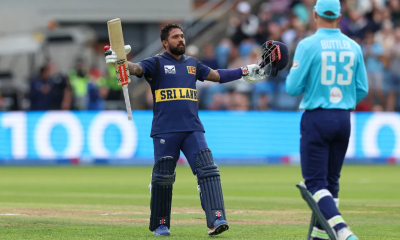
Kusal, Wellalage star as Sri Lanka defend 322 in Headingley thriller
-

 News5 days ago
TIN mandatory for key transactions from Nov. 1
-

 Features3 days ago
The 22nd Amendment, constitutional recovery and illiberal slippage
-

 Features3 days ago
Of foreigners as CEOs of Lankan ventures
-

 News3 days ago
Sajith rejects Jt. Opp. protest sabotage claim; SJB TU chief demands remedial action