
Latest News
Duckett, Stokes revive England in chase of 371

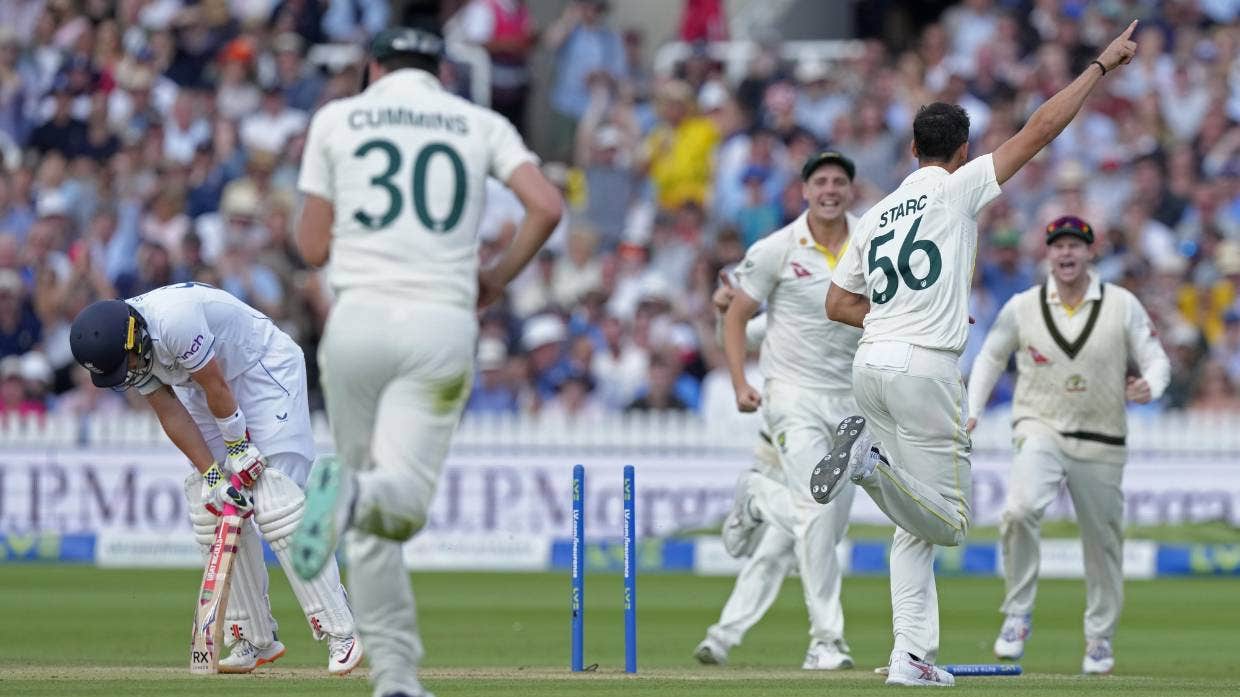
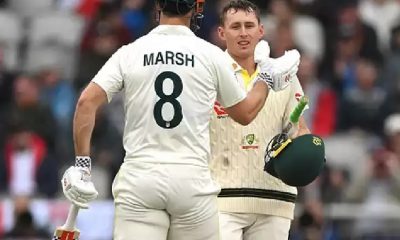
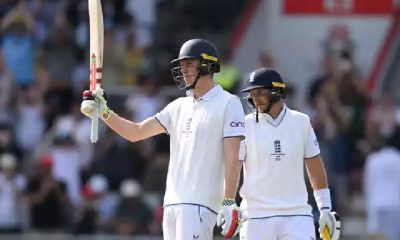
Ben Duckett’s half-century and his unbroken 69-run partnership with Ben Stokes led England’s recovery in the final session on Day 4 after Mitchell Starc and Pat Cummins combined to rattle the hosts early in their chase of 371. After Stuart Broad’s four-wicket haul bowled Australia out for 279, England had slipped to 45/4. But Duckett, who was the beneficiary of a controversial ruling from the third umpire late in the day, helped the hosts to 114/4 at Stumps on Saturday (July 1), with the hosts needing 257 more to win the Lord’s Test and square the series.
An innocuous delivery which was heading down the leg side gave Starc his first wicket as Zak Crawley got a faint tickle through to the ‘keeper. Duckett, who was put down by Cameron Green (a very tough chance) in the opening over, also managed to overturn a leg-before decision. But the left-arm pacer struck in his next, with beauty that swung in late into Ollie Pope and uprooted the middle stump. Joe Root and Duckett then built a steady partnership – rotating the strike well, with the former also scoring a couple of boundaries.
Cummins sowed the seeds of doubt with short balls in the 13th over and there was immediately a change in the atmosphere. Root, hit on his forearm, fended the next one to Warner at first slip to depart for 18. Harry Brook got off the mark with a confident straight drive over Cummins’ head. But he got a terrific delivery soon after, one that pitched on a length, seamed away, beat the outside edge and crashed onto the stumps.
Stokes and Duckett put their heads down and built a steady partnership to aid England’s recovery. They kept the pacemen at bay before taking on part-timer Travis Head. Stokes came down the track to hit a six while Duckett went over mid-on for a boundary as the two batters did not allow the spinner to settle down. They also rotated the strike well, picking up the singles and twos to ensure England weren’t bogged down as they maintained a decent scoring rate.
The introduction of Green saw Australia turn to short balls again but Duckett was up to the task, scoring a couple of boundaries, and also put away a loose ball from Starc for a four. Green, however, troubled Stokes with his short length deliveries and nearly dismissed the England skipper, with the ball just dropping wide of gully. In late drama, Duckett was given not out after being caught at fine leg by Starc off Green, with the third umpire ruling that the ball made contact with the ground when the catch was about to be completed.
Earlier, Khawaja and Smith were untroubled in the first hour, making most of the sunny conditions as they stretched the lead past 250 and extended their stand past 50. James Anderson, who wasn’t effective, was taken off the attack after only three overs. Josh Tongue and Ollie Robinson, who bowled in tandem, came up with a barrage of short deliveries. Smith and Khawaja were disciplined with their shot selection against the short deliveries but they also had a few uncomfortable moments.
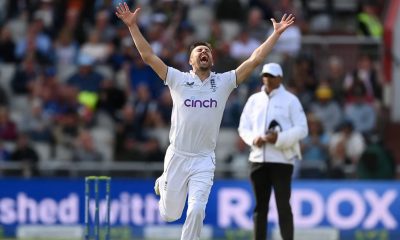
It was Stuart Broad, introduced after the drinks break, who made the breakthrough as he had Khawaja off a top edge to end a 64-run stand. Smith handed a catch in the deep trying to guide a short one from Tongue in the gap. Head, dropped by Anderson on 0, had a short stay as he too fell to a short ball from Broad, with Joe Root taking a splendid one-handed catch at short leg. Alex Carey and Green kept the England bowlers at bay as they added 25 before the Lunch break to stretch the lead past 300.
It was an attritional second session with England being relentless with their short-ball strategy while Carey and Green were happy to play the waiting game. Eventually, it was England who came out on top in the game of patience as Robinson’s short-pitched balls got the better of Green and Carey in quick succession after a 42-run partnership that came off 123 deliveries.
Ben Stokes, who bowled right from the start of the post-lunch session, delivered 12 overs on the trot and was struggling with his knee, but continued nevertheless. He eventually accounted for Josh Hazlewood’s wicket, after Broad, who replaced Robinson (nine successive overs) dismissed Cummins. Nathan Lyon, who walked out to bat to a huge reception, added 15 runs with Starc before being the last to be dismissed as Broad finished with four.
Brief scores:
Australia 416 & 279 (Usman Khawaja 77, Steven Smith 34; Stuart Broad 4-65, Ollie Robinson 2-48) lead England 325 & 114/4 (Ben Duckett 50*, Ben Stokes 29*; Pat Cummins 2-20, Mitchell Starc 2-40) by 256 runs.







Latest News
Man charged with attempted Trump assassination indicted for assaulting Secret Service officer
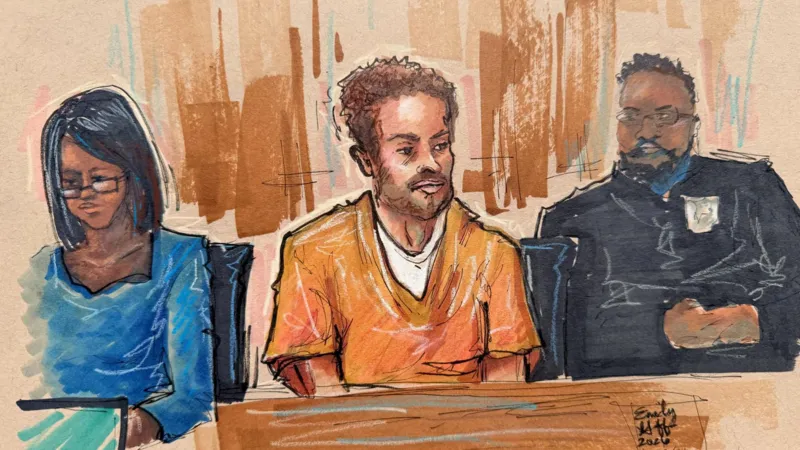
The California man who allegedly tried to assassinate President Donald Trump at a Washington gala has been indicted on a fourth charge of assaulting a US officer or employee with a deadly weapon.
The new charge comes in the wake of questions over whether a Secret Service officer – who was shot but not seriously wounded in the attack at the White House Correspondents Dinner on 25 April – was hit by crossfire from another officer.
US Attorney Jeanine Pirro signed off on the new indictment unsealed on Tuesday, which supersedes the previous charges.
Cole Tomas Allen, 31, appeared in court in Washington DC last week. He has not yet entered a plea.
According to court documents filed on Tuesday, a grand jury also indicted Allen on charges of attempting to assassinate the US president as well as two firearms offences – transportation of a firearm and ammunition in interstate commerce with intent to commit a felony, and using, carrying, brandishing and discharging a firearm during a crime.
Allen was previously charged on those counts last week via criminal complaint.
The suspect was carrying a semi-automatic handgun, a pump-action shotgun and three knives as he allegedly rushed through a security checkpoint one floor above the basement venue at the Washington Hilton hotel on 25 April, prosecutors have said.
After gunfire rang out, Trump, Vice-President JD Vance, cabinet members and other White House officials were rushed from the hotel ballroom as dinner attendees sheltered under tables.
The incident has sparked a White House security review.
The Torrance, California , man studied at the prestigious California Institute of Technology, and worshipped at the Pasadena United Reformed Church in the Los Angeles area.
Federal campaign finance records show he donated $25 to a Democratic Party political action committee in support of Kamala Harris for president in 2024.
He allegedly sent an email to his family shortly before the attack that said, “Administration officials… are targets, prioritised from highest-ranking to lowest”, according to court records.
“I would still go through most everyone here to get to the targets if it were absolutely necessary,” he allegedly added.
Allen, who remains in custody, could face life in prison if found guilty.
[BBC]
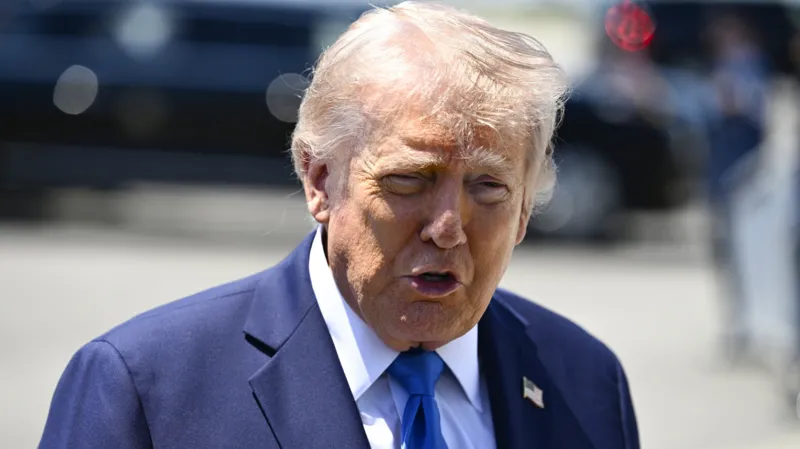
The US operation to guide stranded vessels through the Strait of Hormuz will be paused for a “short period of time”, President Donald Trump announced on Tuesday evening.
Trump said that “Project Freedom”, which began days earlier, would be halted by “mutual agreement” because “great progress” had been made toward a deal with Iran.
Iranian state media characterised it as a victory, saying the pause demonstrated that Trump “retreated” after “continued failures” to reopen the vital waterway for global shipping.
The US president’s announcement came as Secretary of State Marco Rubio said the initial US-Israeli offensive in Iran – Operation Epic Fury – was over after achieving its objectives.
In a post on social media, Trump said that he had made the decision “based on the request of Pakistan”, which has acted as an intermediary between the US and Iran. He added that the US blockade of Iranian ports would remain in place.
Trump’s announcement may surprise some. It undercuts a day’s worth of messaging from Rubio, defence secretary Pete Hegseth and Joint Chiefs chairman Gen. Dan Caine – all of whom vowed that the operation would ensure freedom of navigation and commerce in the Strait of Hormuz and Persian Gulf.
“We would prefer the path of peace. What the president [Donald Trump] would prefer is a deal,” Rubio told reporters on Tuesday.
What happens next is unclear. The administration had stressed that Project Freedom was a “separate and distinct” campaign from the blockade, which is meant to pressure Iran economically.
Project Freedom was meant to help restore the flow of oil from the region and the global economy’s eventual return to normalcy by guiding stranded ships out of the Gulf through the largely closed waterway. But if during the “pause”, global shipping firms and the insurance companies working with them are stymied by Iranian interference, it will be difficult for Trump to claim that objective has been achieved.
On the other hand, the administration may hope that freezing Project Freedom – which the Iranians strongly objected to – helps bring them to the negotiating table again.
Rubio’s comments earlier in the day came after a spate of attacks in the Strait of Hormuz raised fears the ceasefire between the US and Iran was in jeopardy.
Tehran did not commented on Rubio’s statement, but Iran’s parliamentary speaker Mohammad Ghalibaf earlier said: “We know well that the continuation of the status quo is intolerable for America, while we are just getting started.”
Ghalibaf, Iran’s top negotiator in last month’s talks with the US, said, “Shipping security and energy transit have been jeopardised by the US and its allies with the ceasefire violations and blockade. However, their evil acts will fail”.
Late on Tuesday the UK Maritime Trade Operations (UKMTO) said a verified source had told it that a cargo vessel has been struck “by an unknown projectile” in the Strait of Hormuz. Further details were not immediately available.
Earlier in the day the UAE said its air defences were engaging missiles and drones from Iran for a second day in a row. On Monday it accused Iran of firing missiles and drones including a strike on an oil port in the emirate of Fujairah which is located outside the Strait of Hormuz, calling it a “dangerous escalation”.
Iran on Tuesday denied launching any attacks on the UAE, with a military spokesman saying that, “If such an action had been taken, we would have announced it firmly and clearly”.
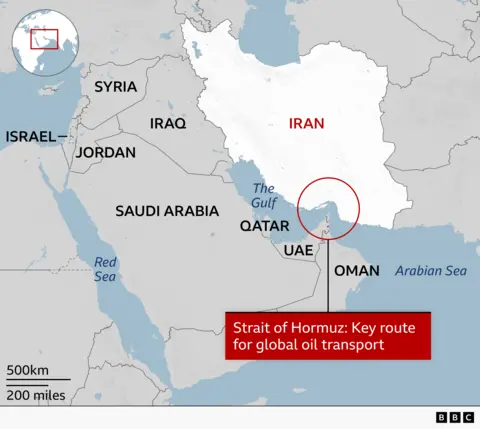
Operation Epic Fury began on 28 February when the US and Israel launched a wave of air strikes on Iran. Tehran responded by blocking the crucial waterway through which 20% of the world’s oil and liquefied natural gas usually passes.
In early April, the US and Iran announced a ceasefire under which Iran ended its drone and missile strikes on Gulf countries including the UAE, but few vessels have been able to transit the strait since then. The US also imposed its own blockade on Iranian ports.
On Monday, the US said it had attacked seven Iranian fast boats in the strait while Iran said it had fired warning shots at a US vessel. Both sides denied the respective claims. Two commercial ships reported attacks and one said it had successfully exited the strait under a US military escort, as part of Donald Trump’s plan to unblock the strait.
Speaking at the White House, Rubio said that while Trump wanted a deal, “That is so far not the route that Iran has chosen” adding: “What that may lead to in the future is speculative.”
He said US and Israeli attacks on Iran had caused “generational destruction to their economy” and the country’s leaders should “check themselves before they wreck themselves in the direction that they’re going”.
Hegseth said the ceasefire with Iran was “not over”.
“Right now the ceasefire certainly holds, but we’re going to be watching very, very closely,” Hegseth said during a press conference on Tuesday.
Caine said that while Iran had attacked US forces 10 times since a ceasefire began, these attacks were “below the threshold” of resuming fighting “at this point”.
Trump was later asked by reporters what would constitute a breach of the ceasefire by Iran. “You’ll find out because I’ll let you know,” he responded. He also said he believed a negotiated settlement with Iran to end the conflict was still possible.
The various comments from American officials suggest that the US has little desire or appetite to return to full-scale operations – further disturbing markets, sending prices skyrocketing and meeting opposition from large swathes of Americans.
Trump also has said he is discussing the strait’s reopening with Japan and expects to have a positive conversation with Chinese President Xi Jinping about it when he visits China next week.
[BBC]
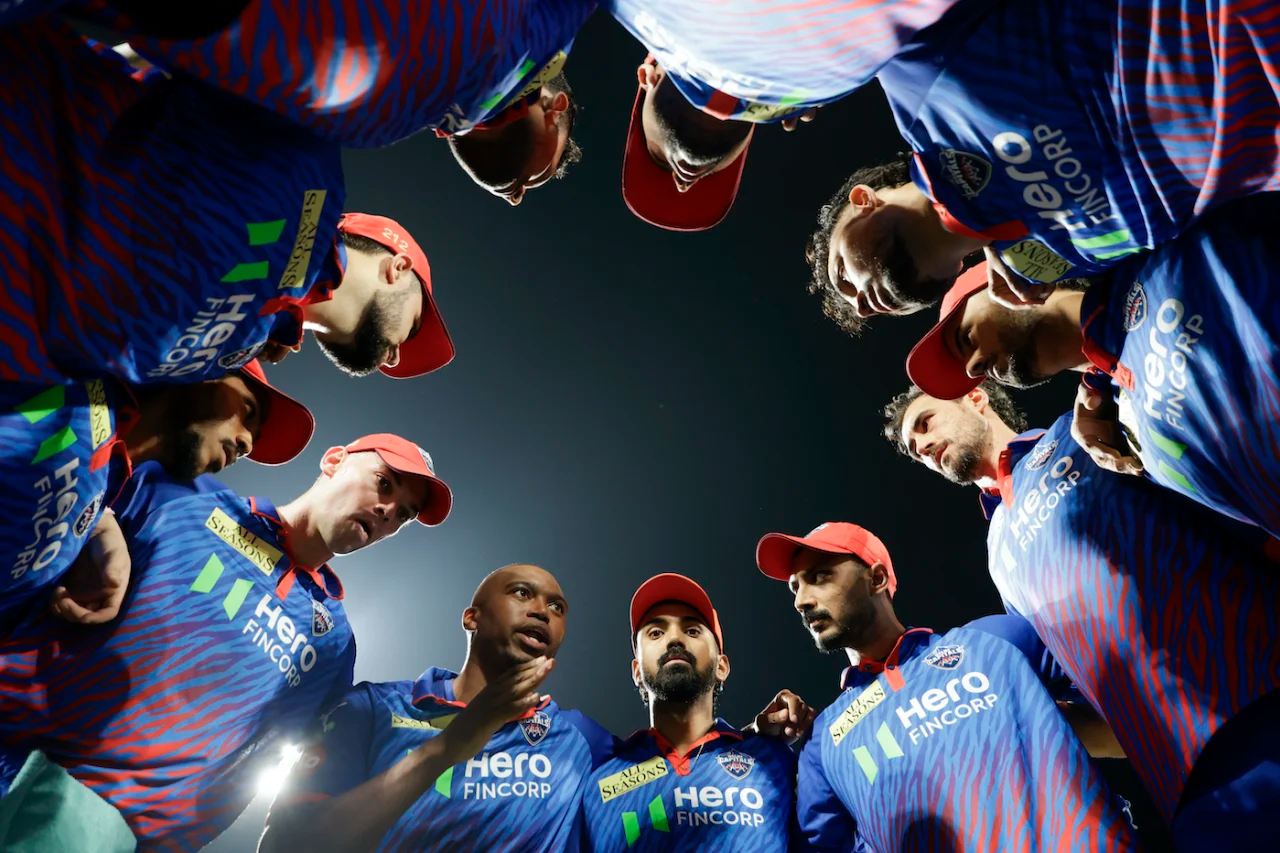
Chennai Super Kings came into IPL 2026 with a dodgy look about their bowling attack. They lost three games straight where their bowlers picked up 10 for 588 at an economy rate of 11.37. Since then, there has been an absolutely stunning turnaround. Over the last seven games, CSK’s bowlers have scooped up 51 wickets – only Gujarat Titans (52) have more – at an economy rate of 8.15 – which no-one can match.
Given first use of a slow pitch, Akeal Hosein (4-0-19-1) and Noor Ahmad (3-0-22-2) took charge of proceedings. Delhi Capitals could only put up 155 for 7, which proved too little as the surface got better to bat on in the second innings. Sanju Samson, who has contributed 24% of CSK’s runs this year, finished things off with 87 not out off 52 balls. Kartik Sharma, growing in confidence, was alongside him, with 41 off 31.
Both captains expected the pitch to be slow. The scoring pattern of the first four overs confirmed it. Fifteen dot balls. Six boundaries. Three singles and a wicket with the batter trying to force the pace. In conditions where the ball comes onto the bat, KL Rahul and Pathum Nissanka might have been able to hit the gap with the shots they played off good length balls. On this one, as much as they tried, they just found the fielder. Worse, they found themselves having to hold their shape for longer and even that didn’t always work.
With two right-handed openers, CSK had no hesitation in handing the ball to Hosein. When Nissanka fell though, DC sent Nitish Rana out in an effort to either hit Hosein out of the attack or prevent him from coming on. This is how much of a no-no matching a left-arm spinner with a left-handed batter is. But CSK bucked tradition. They gave Akeal a third over. He provided Rahul’s wicket and in the end Rana got to face only one ball from Akeal. A dot ball. DC came out of the powerplay 37 for 2. Akeal finished with figures of 4-0-19-1, which is exceptional considering he bowled only one over outside the field restrictions.
Axar Patel has 33 runs this season. Twenty-six of those came in one innings. And his strike rate is 97. It is a massive drop. The DC captain was one of the bright spots last season, their fourth-highest scorer with 263 at a very healthy strike rate of 157. He was in the middle when his team needed to rebuild and his wicket – the third that CSK took in a space of 19 balls between overs 8 and 11 – had an impact on the total they put up.
DC’s first five wickets scored 69 off 66. Sameer Rizvi, Impact Player-ed in because this was definitely an emergency, and Tristan Stubbs together put on 65 off 42 balls. Stubbs seemed to be factoring in the slowness of the pitch into his movements much better, handling Noor’s mystery spin and Gurjapneet Singh’s extra bounce with ease. Rizvi at the other end showed how batters could play against Anshul Kamboj, one of the season’s best death bowlers. He knew Kamboj liked to come around the wicket and target the wide line with yorkers. So he moved across his stumps a little bit, sweeping, slicing and smashing him down the ground.
One part of this plan was premeditation – the movement across his stumps – the other was instinct. Rizvi consciously tried to keep his shot options open, and not just target leg side. Until this match, Kamboj from around the wicket in this IPL has been box office: 63 balls, 93 runs, three sixes, eight wickets. In this game, he struggled: 12 balls, 34 runs, five sixes, no wickets. Meanwhile, Jamie Overton, one of CSK’s best bowlers, bowled only one over and spent time off the field as well.
Being in the form of his life is one thing, but to go out there knowing he is his team’s best hope for runs and managing risk accordingly is something else. Samson has always had aura. Now he has the output. For the first three games this season, he made 22 runs at an average of 7.33 and a strike rate of 116. The next seven, he’s made 380 at an average of 95 and strike rate of 172.
The six he hit first ball against Axar highlighted that the pitch was no longer a problem. A little bit of rain while the match was going on had freshened it up, making the ball come onto the bat better. Even so, DC had threats. Lungi Ngidi returning from a head injury aced his match-up against Ruturaj Gaikwad, dismissing him for a third time in 17 balls for just 10 runs in T20 cricket.
Samson held fire initially. He was 22 off 22 at the eighth over. Ten balls later, he was on fifty. Eventually, he was even entertaining thoughts of a hundred. A highlight of his game was the way he took down spin – 12 off 10 against Axar with one six and 25 off 9 against Kuldeep Yadav with three sixes and a four. CSK won a 12 vs 11 game – because they didn’t even need the impact player – with 15 balls remaining and got a net run-rate boost that could be vital as the season nears the playoffs.
Brief scores:
Chennai Super Kings 159 for 2in 17.3 overs (Sanju Samson 87*, Urvil Patel 17, Kartik Sharma 41*; Axar Patel 1-25, Lungi Ngidi 1-30) beat Delhi Capitals 155 for 7 in 20 overs (Pathum Nissanka 19, KL Rahul 12, Nitish Rana 15, Karun Nair 13, Tristan Stubbs 38, Sameer Rizvi 40, Ashutosh Sharma 14; Akeal Hosein 1-19, Mukesh Choudhari 1-31, Noor Ahamed 2-33, Gurjapneet Singh 1-29, Jamie Overton 1-05) by eight wickets
[Cricinfo]

Man charged with attempted Trump assassination indicted for assaulting Secret Service officer

Vivek Ramaswamy wins Republican nomination for Ohio governor

Trump says US to pause operation to guide vessels through Strait of Hormuz

Samson, Kartik, spinners set up Chennai Super King’s clinical win

State Banquet Hosted by the President for the Maldivian President and Delegation

Heavy showers above 100 mm are likely at some places in the Sabaragamuwa, Central, Uva and North-central provinces.

‘Dates have the highest sugar content to fight Coronavirus’

Sunday Island 27 December – Headlines

#SundayIsland 17th December – Headlines

Sunday Island – 28th March

Sunday Island Headlines – 21 March

Sunday Island – 21st February – Headlines
-

 News6 days ago
Rooftop Solar at Crossroads as Sri Lanka Shifts to Distributed Energy Future
-
 News5 days ago
“Three-in-one blood pressure pill can significantly reduce risk of recurrent strokes”
-
 News1 day ago
CJ urged to inquire into AKD’s remarks on May 25 court verdict
-

 News2 days ago
USD 3.7 bn H’tota refinery: China won’t launch project without bigger local market share
-

 News5 days ago
Alarm raised over plan to share Lanka’s biometric data with blacklisted Indian firm
-

 News3 days ago
Easter Sunday Case: Ex-SIS Chief concealed intel, former Defence Secy tells court
-
 News4 days ago
Ten corruption cases set for court in May, verdict ordered in one case – President
-

 News5 days ago
USD 2.5 mn fraud probe: Interdicted MoF official found dead at home