Connect with us

Latest News

Gardner’s 8 strikes down England

Published

on

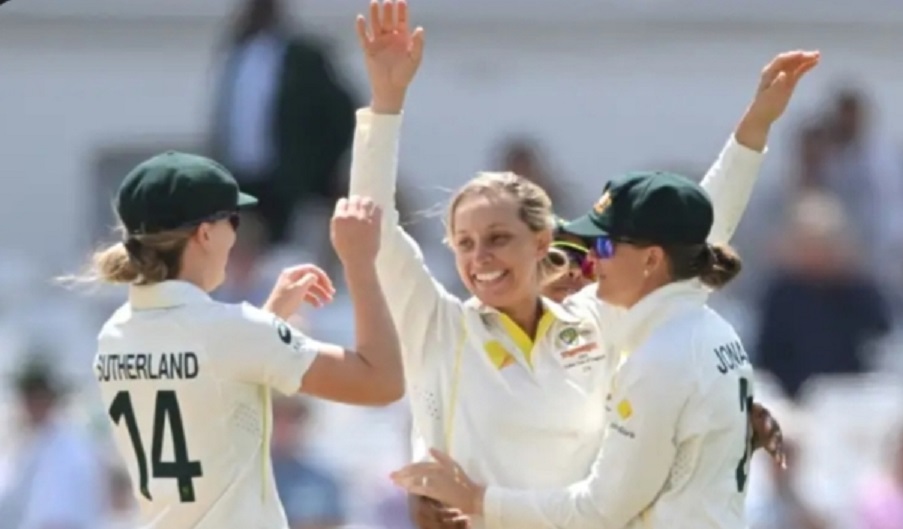
Ash Gardner returned her career best figures - 8 for 66 (pic Cricbuzz)

Ashleigh Gardner’s brilliant 8 for 66, inclusive of a fifer on the fifth morning itself, helped Australia to a four-point lead in the multi-format Women’s Ashes with a convincing 89-run victory in the one-off Test at Trent Bridge. Half-centurion Danni Wyatt offered some resistance but Gardner took under a session to bundle out the five remaining wickets as she went on to register Australia’s best match haul of 12 for 165 in women’s Tests and the second-best of all-time.

While Wyatt held one end up, she found little support at the other to keep going. The wrecker-in-chief for Australia was Gardner, who first had Kate Cross nicking behind after adding just six to her overnight score and then got wicketkeeper-bat Amy Jones stumped for only four. just as England went past the 150 mark.

Sophie Ecclestone dropped anchor long enough for Wyatt to get to her maiden fifty on Test debut, but Gardner, bowling her ninth over on the trot, struck her on the pads. Ecclestone availed a review, only to be given the marching orders again.

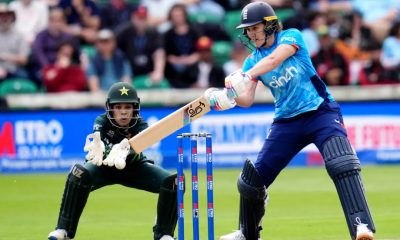
With the win only two wickets away, Healy handed Gardner a tenth successive over and the wily off-spinner wrapped up the proceedings quickly. Lauren Filer was guilty of playing down the wrong line, and was bowled trying to defend as the ball that beat the outside edge to crash into her off-stump. One delivery later, Wyatt was struck on pads in front, attempting to sweep the final ball of the over. A desperate review also couldn’t save her as Australia marched to a famous 89-run victory.

Having restricted Australia to 257 in their second innings on Day 4, England had begun their chase of 268 on a rather positive session but the Gardner-inspired comeback with the ball in the final hour of play – including a fatal collapse of 4 for 18 – saw the hosts hitting survival mode. Australia never took their foot off the pedal and took just 20 overs on the final morning to keep England to just 178 in reply.

Brief scores:

Australia 473 (Annabel Sutherland 137, Ellyse Perry 99; Sophie Ecclestone 5-129) & 258 (Beth Mooney 85, Alyssa Healy 50; Sophie Ecclestone 5-63) beat England 463 (Tammy Beaumont 208, Nat Sciver-Brunt 78; Ashleigh Gardner 4-99, Tahlia McGrath 3-24 & 178 (Danielle Wyatt 54; Ashleigh Gardner 8-66) by 89 runs 

(Cricbuzz)


Latest News

West Indies, Sri Lanka and the two sides of pressure

Published

on

By

Deandra Dottin was brought to tears after being taken for runs at a critical juncture [Cricinfo]

If you want to know the kind of pressure West Indies have put themselves under at the 3036 T20 Women’s World Cup, watch Deandra Dottin during her second over against Scotland.

West Indies were defending 34 off the last three overs and Darcey Carter, albeit with an injury that was hampering her running, was on 50 and her sixth-wicket partnership with Ailsa Lister had grown to 45. Dottin was playing her 150th T20I and her match contribution was approaching negative territory. She scored 14 off 16 before being stumped in the midst of a middle-order strangle and her first over, which was the second of the innings, cost 13. With the spinners bowled out on a surface where they were more effective, Hayley Matthews had to turn to Dottin, who was her most experienced bowling hand.

With Lister on strike and pouncing on anything on off stump, Dottin’s plan was to cramp her for room. Her first delivery went down leg. As did her second. And her third. The first legitimate ball of the over was outside off and Lister ran one. Then Dottin overcompensated, went too far outside off and Carter swung and edged for four. Dottin dropped it shorter. Carter was beaten as she tried to pull. Dottin went even shorter and Carter cut for another four. Twelve runs came off the first four balls and Scotland’s requirement was cut to 23 off 15 balls and Dottin realised what she was doing.

Mid-over, Dottin broke down into an ugly cry. Tears poured from her as she scowled at the situation. Matthews and Chinelle Henry had to form a protective shield and coax her back from the brink. Whatever they said worked and Dottin fired in a yorker and another full ball that found the edge to close out the over well but the enormity of the situation had clearly affected her. What exactly was going on?

“It was just about the nerves that were going around. Being one of the leaders in the team, Hayley, myself, and a couple others just went and made her realise that she’s probably one of the best death bowlers we have in the team,” Henry said at the post-match press conference. “It was just about backing her skills, and she came out of that over pretty well. Deandra is one of those persons who is very emotional, a very passionate person who wears her heart on her sleeve. It’s just about trying to get her to remember that she is one of the best players we have to be out there at this moment. There were a lot of emotions going around at that time.”

That Matthews, once Dottin’s junior, and Henry, who was herself not fully fit after she sustained an injury in the warm-up match and then missed the first game, had to convince one of their most decorated players of her worth tells you as much as you need to know about West Indies’ insecurity.

It’s also worth remembering that Dottin has a history when it comes to hysterics. In 2017, when West Indies were bowled out for their second-lowest total of 48 by South Africa in the ODI World Cup in Leicester, Dottin also sobbed. Then, she was dismissed for a duck and conceded 23 off 3.2 overs, including the winning runs.

That tournament took place a year after West Indies were crowned T20 World Cup champions in 2016 but they were not even close to being in the running for the ODI cup. They finished sixth of the eight teams competing, and won only two of their seven matches. Since then, Dottin has tried to end her relationship with West Indies and retired in 2022, saying that “the current climate and team environment has been non-conducive to my ability to thrive and reignite my passion.” Two years later, she reversed that decision and said she was returning “enthusiastic about mentoring younger players and contributing to the overall development of women’s cricket in our region.”

“Because she cares so much, it breaks her when she can’t do what she wants for the team” Hayley Matthews on Deandra Dottin

She played the 2024 T20 World Cup, where West Indies reached the semi-final, and was their leading run-scorer at the event, so it may be a case of unfinished business that brought on the waterworks against Scotland. “Because she cares so much, it breaks her when she can’t do what she wants for the team,” Matthews told the post-match broadcast.

It’s fair to read that as a desperation to do well, and it seems to run through West Indies. After defeating defending champions New Zealand, thanks to a long-in-the-making career-best 90* from their most-capped T20I player, Shermaine Campbelle, they may have thought the hardest bit was over. But Scotland have recent history ofdumping West Indies out of tournaments and beat them in the ODI World Cup Qualifier last April. Losing to them would complicate matters, especially with matches against the hosts and before that Sri Lanka, who beat West Indies in a series in March, to come.

If you want to know what kind of pressure Sri Lanka have been able to absorb, watch the way Nilakshika Silva batted against New Zealand.

Sri Lanka had been downed by a massive 87 runs in the tournament opener by England. Their coach Jamie Siddons was so angry he could barely unclench his jaw to speak afterwards and chasing 151 against New Zealand, they slipped from 45 without loss in the powerplay to 55 for 4 in the ninth over. Their best batters were back in the dugout, or so we thought.

Nilakshika, who is 36 years old and had just one half-century to her name in 115 T20Is before this, should have been dismissed for 1 when she top-edged a sweep off Amelia Kerr. Inexplicably, New Zealand’s catching has been slippery throughout and the ball burst through Bree Illing’s hands at short fine. It took Nilakshika 12 balls before she found the boundary for the first time, off none other than New Zealand’s oldest hand on the day, Sophie Devine.

Sri Lanka needed 65 runs off 42 balls, with four wickets down and should have been favourites but on a seven-match losing streak at T20 World Cups, their odds were long. Nilashika didn’t care. She went after Devine again, this time in the field, when she sent Rosemary Mair towards Devine at deep midwicket, and over her for six. The Sri Lankan team sat huddled together, cheering every run as though it was the winning one. Chamari Athapaththu, the captain on whom the team was thought to revolve and who hit the innings’ only other maximum, sat alone, as though in meditation, watching.

She would not have enjoyed what she saw next. Nilakshika urged Kavisha Dilhari to try and take two runs off the last ball of the 15th over but Dilhari was ball-watching. She stayed at the non-striker’s end as Nilakshika joined her and then sacrificed herself so her senior partner could bat on. Sri Lanka needed 46 runs off 30 balls and the onus rested on Nilakshika and young wicket-keeper Kaushini Nuthyangana. The next over only yielded seven runs, a light drizzle enveloped the ground and maybe Athapaththu looked away. She didn’t have to.

Nilakshika’s excellent use of the crease and her ability to make room for herself brought three more boundaries, including a lap over short fine, a gorgeously timed cover drive and a sweep as she charged down to meet Melie Kerr’s last ball. Very few people would have known Nilakshika had that kind of big-match temperament in here but someone did: her bowling coach. “When Silva is fielding, she is mid-off, mid-off both sides, so she is running more than anyone else and she has done a lot of awesome work,” Chamila Gamage said afterwards. “Today, under pressure, it is a fantastic thing for us because we lost the first game and we needed to win this match, otherwise we can’t go to the semi-finals. I thought she batted really well under pressure.”

Nilkashika barely celebrated her fifty, which came with 14 runs still needed off 12 balls but let her emotions out when Nuthyangana smeared the winning runs over the on-side. She looked skywards several times while her team-mates hugged and fist-bumped and whooped on the side and even then, there seemed a restraint to her jubilation. Job done, more jobs to do, perhaps?

And that is what sets up the first match of Super Sunday as a West Indian side who are clearly feeling the heat take on a Sri Lankan team strutting around coolly. A place in the semi-final is on the cards for both. Victory for West Indies will see them take a massive step towards the final four but a Sri Lanka win keeps the group that many thought was a foregone conclusion before the tournament, tasty.

The crunch match between West Indies and Sri Lanka takes place in Bristol and starts at 10.30am.

[Cricinfo]

Continue Reading

Latest News

Lewis, Prendergast fifties in vain as Melie magic helps New Zealand win a thriller

Published

on

By

Melie Kerr's double-wicket over turned the game on its head [Cricinfo]

New Zealand had another poor day in the field and were nearly embarrassed by Ireland on a glorious sunny day in Southampton before the defending champions held their nerve and kept their semi-final chances alive with their first win of the tournament. It was far from a convincing day for New Zealand, who were reduced to 10 for 3 and 110 for 5 before the middle-order lifted them to 140. Ireland also kept New Zealand sweating for much of the 20 overs in the chase until the magic arm of Melie Kerr broke the century stand between Orla Prendergast and Gaby Lewis to bring the equation to 25 needed from 12.

Ireland needed 18 from eight balls once Lewis fell in the penultimate over, and the two new batters found it much tougher to nail the big shots. Louise Little and Leah Paul brought it down to 15 off the last over that was given to Suzie Bates, who was playing her first game of this World Cup, having replaced Sophie Devine, who fell sick just before the game. The lack of pace from Bates meant Paul and Little couldn’t find a boundary, and they fell short by four runs when they needed six off the last ball.

Now fourth in Group 2, New Zealand will know better than anyone that they will need far better performances to make the knockouts, as their last league game will be against England after they meet Scotland next.

At the helm for Ireland was Prendergast, who first dented New Zealand with her new-ball burst before her 45-ball half-century took Ireland agonisingly close, only three days after they gave England a scare too. New Zealand’s hero also turned out to be their allrounder Melie, who first pulled them out of a hole and picked two crucial wickets in the end.

New Zealand were in deep trouble early and lots had to do with Prendergast, who kept going for the top of middle stump and was rewarded twice. Isabella Gaze fell first when she missed a scoop on the first ball of the second over for just 1. That she fell the very next delivery after Georgia Plimmer had handed a catch straight to mid-off made the score 6 for 2.

Maddy Green had eaten up five dots and when she charged against Prendergast at the start of the third over, New Zealand had slipped to 10 for 3. Prendergast was, however, taken off after two overs that fetched her figures of 2 for 6 with eight dot balls. It was Melie who rescued them along with Brooke Halliday as the captain stepped out against the spinners regularly to rotate the strike and find boundaries while also scooping and cutting Arlene Kelly for back-to-back boundaries in the last over of the powerplay to lift the scoring rate.

Halliday was largely kept quiet at the start as Ireland bowled smartly to their fields. But Melie perished too, holing out to deep midwicket for 30 off 24 as the Ireland spinners took the pace off considerably to make hitting a lot tougher. While Halliday largely anchored, Isabella Sharp started to find the gaps more frequently as at last one boundary was hit from overs 10 to 13 to lift the run rate from under six to 6.61.

But Ireland fought back and dried up the boundaries for the next 35 balls while also removing the set batters. Halliday had just received some medical treatment and swept one straight to short fine leg for 34 in the 17th over before Sharp holed out to long-off for 36 off 28. Bates, batting at No. 7 for the first time in T20Is in her 19-year career, finally broke the boundary drought with a reverse lap and also ended the innings with a desperate six pulled from way outside off after exposing her stumps.

Left-arm quick Bree Illing gave New Zealand’s defence a fiery start with her pace close to 120kph and her height making things uncomfortable for Ireland’s top-order. She nailed an inswinging yorker to remove Amy Hunter for 2 before Prendergast and Lewis saw through her remaining three overs, which were bowled on the trot.

The rest of the attack didn’t look as threatening, which the duo of Prendergast and Lewis capitalised on, especially by stepping out and making room to find the gaps. Prendergast also got a life when a leaping Nensi Patel got a hand to a slice at point but only got fingertips. The pressure on New Zealand was visible as the runs kept coming and wickets eluded them by fine margins.

Lewis survived a loud lbw appeal on 25 off Melie in the ninth over and New Zealand lost a review as ball-tracking showed the ball was missing leg stump. Prendergast was given out lbw off Jess Kerr three overs later but a review saved her as ball-tracking again showed the ball going down leg. The duo picked a boundary each off Nensi in the next over to reduce the equation to 59 from 42. With only five bowlers at their disposal, the match was slipping out of New Zealand’s hands.

Melie had two overs left and she brought herself back for the 14th and Prendergast’s six off her on the leg side made it 50 from 36. That soon became 34 from 24 but Melie’s last attempt in the 18th over finally worked for New Zealand. She had Prendergast hole out to deep midwicket while Rebecca Stokell hit one to cover two balls later. The four-run over had turned the tables on Ireland. With 25 to get from 12, Lewis took charge as the set batter but she skied one to cover after a boundary and the match was now New Zealand’s to lose. Bates came on for the finishing touches with the ball too and only a streak of singles and doubles off her bowling found Ireland short.

SCORES:
New Zealand Women  140 for 6 in 20 overs  (Melie Kerr 30, Sharp 36, Brooke Halliday 34, Izzy Sharp 36, Suzie Bates 19*; Aaimee Maguire 1-32, Orla Prendergast 2-26, Arlene Kelly 1-25, Cara Murray 2-26) beat Ireland 136 for 4 in 20 overs (Orla Prendergast 59, Gaby Lewis 58; Rosemary Mair 1-31, Bree Illing 1-18,  Melie Kerr 2-23) by four runs

[Cricinfo]

Continue Reading

Business

Asia’s richest man Ambani announces what could be India’s biggest share sale

Published

on

By

Mukesh Ambani is one of the world's richest men with an estimated worth of $90.6bn according to Forbes [BBC]

Jio Platforms, the telecom unit of billionaire Mukesh Ambani’s Reliance Industries, has announced what analysts say could be one of India’s biggest share sales.

The company’s board has approved a draft prospectus for the initial public offering (IPO), Ambani said at Reliance’s annual shareholder meeting on Friday.

India’s largest telecom operator, which has more than 500 million subscribers, is expected to raise around $4bn (£3.02bn), according to media reports.

Investors will be watching the listing closely as a test of appetite for new offerings after months of volatility in the country’s stock markets.

“The proposed listing of Jio will demonstrate to the world that India can build technology companies of global scale, global capability, and global value,” Ambani, one of the world’s richest men, said.

Launched in 2016, Jio shook up India’s telecom sector with low-cost mobile data plans, soon racking up millions of users. The company has since expanded into areas including cloud computing, enterprise services and artificial intelligence.

Last year, Jio and rival Bharti Airtel signed separate deals with Elon Musk’s SpaceX to bring the Starlink internet service to India.

The IPO comes after a year-long wait for Jio to go public. Last year, Ambani had said the company would be listed in the first half of 2026.

Unlike the secondary markets, where investors buy and sell existing stocks of companies, IPOs are used by privately held firms to sell their shares to investors for the first time, and debut on the public markets.

The Jio IPO was announced a day after the National Stock Exchange (NSE) filed papers for its long-awaited market debut, adding momentum to India’s capital markets.

While details of the offer price and valuation have not yet been disclosed, media reports have estimated that the NSE IPO could raise around more than $3bn.

Together, the Jio and NSE listings would be among India’s largest IPOs in recent years, rivalling Hyundai Motor India’s $3.3bn blockbuster share sale two years ago.

Jio’s listing is especially a close watch for investors and analysts who say a successful offering could boost sentiments in India’s IPO market after a recent slowdown in new listings.

Bloomberg via Getty Images An information sign for sim cards at a Reliance Jio Infocomm Ltd. store, a subsidiary of Jio Platform Ltd., in New Delhi, India, on Thursday, Nov. 6, 2025. I
Launched in 2016, Jio has emerged as one of India’s biggest telecom operators [BBC]


In recent years, Jio has expanded its ambitions beyond telecommunications into artificial intelligence and digital infrastructure.

Earlier this month, Meta announced it would lease capacity at an AI enabled data center being built by Reliance in the western state of Gujarat. The facility is expected to have a capacity of 168 megawatts.

The agreement builds on a partnership that began in 2020, when Meta invested $5.7bn in Jio.

Since then, the companies have broadened their collaboration, including initiatives aimed at making Meta’s open-source AI models more accessible to Indian businesses and developers.

Investment bank Jefferies estimated in November that Jio was worth around $180bn, potentially making it one of the world’s most valuable telecoms companies.

The listing would also be a landmark moment for the Reliance group, marking the first major public offering by one of its businesses since Reliance Petroleum was listed in 2006.

[BBC]

Continue Reading

Trending