
News
ADB approves USD 350 million loan for economic stabilisation in Sri Lanka


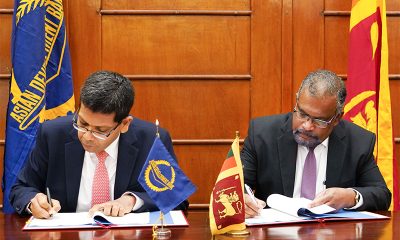
The Asian Development Bank (ADB) on Monday (29) approved a 350 million U.S. Dollar special policy-based loan to provide budget support to Sri Lanka for economic stabilisation, the ADB said in a press release.
The Bank said that the programme is part of a broader package of financial assistance anchored by the International Monetary Fund’s (IMF) Extended Fund Facility for the country, which aims to stabilise the economy and lay the foundation for economic recovery and sustained growth.
It said Sri Lanka is facing a severe and unprecedented economic crisis and that high inflation has eroded purchasing power, livelihoods have been affected, and past development gains have been reversed.
“ADB is concerned about the deep crisis in the country and its impact on the people of Sri Lanka, especially the poor and the vulnerable, particularly women,” said ADB President Masatsugu Asakawa. “ADB is committed to standing with Sri Lanka as it addresses its present challenges and strides toward economic stabilization, sustainable recovery, and inclusive growth.”
Sri Lanka has embarked on bold reforms to address the causes of both internal and external imbalances and return to a sustainable debt trajectory, the Bank said.
The country faces a long road to recovery and must remain steadfast in the implementation of necessary reforms, which include enhancing tax revenue collection, strengthening public financial management, improving performance of state-owned enterprises, ensuring autonomy and independence of the central bank, safeguarding financial sector stability, and bolstering governance frameworks, it said.
As these measures are implemented, it is essential to ensure that adequate social protection is provided and implementing governance reforms and anticorruption measures will be critical, the ADB said.
Transparency and open communication will be crucial in building agreement around the reforms and the ADB will proactively engage with the government, other stakeholders, and development partners to help address structural impediments and plan future support, the bank said in the press release.
In 2022, in close coordination with development partners, ADB repurposed 334 million dollars of existing loans as emergency response to support the import of essential items such as fertiliser, medicines, chemicals for water treatment, working capital for small and medium-sized enterprises, and cash transfers to the most poor and vulnerable.
Trade finance lines through ADB Trade and Supply Chain Finance Program supported the import of essential items during the crisis.









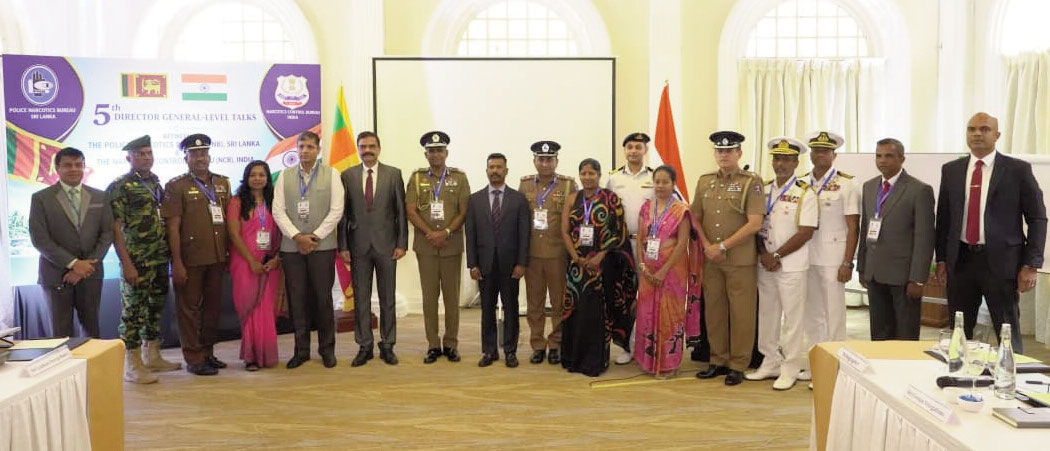
India and Sri Lanka have agreed to further strengthen cooperation between their narcotics law-enforcement agencies to counter the growing challenges posed by illicit drug trafficking, particularly through maritime routes.
The agreement was reached at the fifth DG-level talks between the narcotics control agencies of the two countries held in Colombo last Thursday.
The Indian delegation was led by Narcotics Control Bureau Deputy Director General R. Sudhakar, while the Sri Lankan delegation was headed by Police Narcotics Bureau DIG K.D.G.L. Ashoka Dharmasena.
The talks brought together officials from a range of agencies, including the Tamil Nadu Police, Indian Coast Guard and Ministry of External Affairs on the Indian side, and Sri Lanka Customs, Coast Guard, Navy, Attorney General’s Department, Special Task Force, Government Analyst’s Department, NDDCB and Financial Intelligence Unit on the Sri Lankan side.
The two sides reviewed emerging trends in drug trafficking, with particular attention to maritime routes, the tracing of organised criminal networks and coordination in intelligence gathering and investigations.
They also exchanged actionable intelligence on drug trafficking operatives, routes and methods.
The talks followed President Anura Kumara Dissanayake’s September 9 call for India’s fullest support in combating illicit drug trafficking in the Indian Ocean during his meeting with Indian Defence Minister Rajnath Singh in Colombo.

A 30-year-old man was arrested by prison officials on Wednesday (23) for allegedly using a mobile phone to record a prison bus transporting suspects and inmates from the Kandy Court Complex to Dumbulla Prison.
The suspect, a resident of Ukuwela, Matale, was subsequently handed over to the Kandy Headquarters Police for further investigation.
During police questioning, the suspect reportedly said he had gone to the Kandy Court Complex to secure bail for a friend who had been arrested and produced before court in connection with a drug-related offence.
He reportedly told police that after learning that his friend could not be released on bail, he had intended to record the inmate being taken to prison. However, he claimed that he abandoned the plan after another person warned him against doing so.
Prison officials, however, said the suspect was caught in the act of allegedly recording the prison bus and the detainees. They subsequently took him into custody and transported him to the Kandy Headquarters Police in the same prison bus.
An investigation into the incident is being conducted under the direction of Kandy HQI CI Rasika Sampath Pathirana.

The US Embassy in Sri Lanka, through the US Department of State’s Office of Cooperative Threat Reduction and in partnership with the Atlantic Council, conducted a three-day training September 9–11 in Colombo to strengthen Sri Lanka’s ability to detect and respond to maritime sanctions evasion that threatens US security interests and legitimate global commerce.
More than 40 officials from the Sri Lanka Atomic Energy Regulatory Council, Central Bank of Sri Lanka, Sri Lanka Coast Guard, Merchant Shipping Secretariat, Sri Lanka Ports Authority, Ministry of Defence, and the Sri Lanka Navy, built proficiency in using tools to identify suspicious vessels and deceptive shipping practices, assess sanctions and proliferation risks, and strengthen interagency coordination when potentially illicit maritime activity is detected in or near Sri Lankan waters.
“Sri Lanka sits at a strategic crossroads for global commerce, bringing both tremendous opportunity and the need for vigilance,” said US Ambassador to Sri Lanka Eric Meyer. “As sanctions-evasion networks increasingly exploit commercial shipping, the United States is taking decisive action to counter these networks and sharing US expertise with our Sri Lankan partners to protect legitimate trade, secure critical waters, and strengthen regional security.”
Through presentations and tabletop exercises led by sanctions and maritime security experts from the Atlantic Council, participants examined tactics used to conceal illicit maritime activity, including manipulation of vessel identification and tracking information, opaque ownership structures, ship-to-ship transfers, falsified documentation, and other deceptive practices designed to obscure a vessel’s identity, ownership, cargo, origin, or destination.
Participants were also briefed on the risks facing shipping agents, bunkering (fuel) providers, and other service providers that knowingly or unknowingly support sanctioned vessels. The United States has previously designated entities—including brokers, fuel suppliers, and cargo certifiers—for facilitating the operations of sanctioned vessels, underscoring that providing services such as fuel, food, or provisions to a sanctioned vessel can expose companies and individuals to US sanctions risk, including potential civil or criminal penalties.
The workshop addressed US sanctions and applicable United Nations Security Council sanctions, giving participants practical experience identifying warning signs, conducting due diligence on vessels and associated entities, assessing financial and proliferation risks, and coordinating responses across Sri Lankan government agencies.
Sanctions-evasion networks increasingly rely on complex international shipping and financial structures to disguise illicit activity and exploit legitimate commerce. As a major Indian Ocean transshipment hub, Sri Lanka’s ability to secure its ports and waters against illicit maritime activity is critical to legitimate trade, and US-Sri Lankan cooperation is helping strengthen that security across the region.

India, Sri Lanka step up cooperation against drug trafficking

Man arrested for filming prison bus near Kandy Court

US trains Lankan officials to detect maritime sanctions evasion

Canada seizes 57kg of drugs bound for Lanka

A fresh chapter for the George Keyt Foundation: A renewed commitment to the Sri Lankan art ecosystem

Sri Lanka-China Society marks 45 years of friendship

‘Dates have the highest sugar content to fight Coronavirus’

Sunday Island 27 December – Headlines

#SundayIsland 17th December – Headlines

Sunday Island – 28th March

Sunday Island Headlines – 21 March

Sunday Island – 21st February – Headlines
-

 News7 days ago
Shanakiyan urges urgent action over reported death sentence for Lankan in Saudi Arabia
-

 News6 days ago
Namal Rajapaksa Buddhist gambit fails, bail denied
-

 Features6 days ago
Why the spelling Sri Lankan names in English vary
-

 Features6 days ago
Three bands, a new identity: Sri Lankan wolf snake recognised as distinct species
-

 Business6 days ago
SLIIT holds largest-ever convocation
-

 News6 days ago
Vehicle prices drop by up to Rs. 1 mn, says importers’ body
-

 News6 days ago
Govt monitors reported Saudi death sentence – Foreign Ministry
-

 Business6 days ago
All-new Bolero MaXX Pik-Up unveiled in Lanka