
Latest News
US approves first transfer of seized Russian funds to Ukraine


United States Attorney General Merrick Garland has authorised the first transfer of funds seized from Russian oligarchs to aid Ukraine.
In a statement on Wednesday, Garland said the money seized from Russian oligarch Konstantin Malofeyev will go towards the war-torn country, which Russia invaded on February 24, 2022.
(Aljazeera)



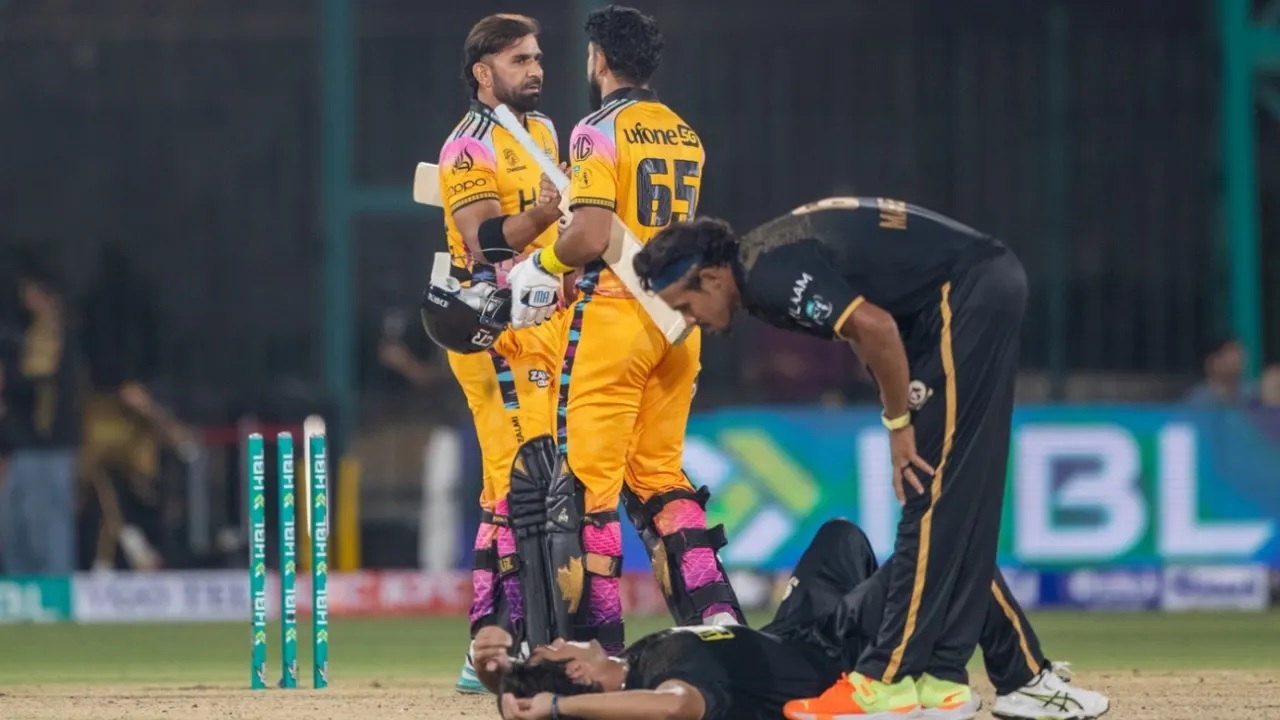
The Pakistan Super League will have a popular winner this season. It is either Peshawar Zalmi and their adored leader Babar Azam triumphing at what is his home ground, or Hyderabad Kingsmen, a flawed side that has caught fire at the right moments to defy odds to stay alive until the very end.
In Zalmi, there is a team that, with its relentless consistency all tournament, cricketing logic dictates should be the favourites. But in Kingsmen, there is a team Pakistanis can relate to so deeply, one that starts poorly, fixates on impossible scenarios, takes advantage of net run rates, and pulls victories out of dead-and-buried scenarios with what feels like unstoppable momentum on its side. This is the team for whom Pakistani logic will promise that the favourites tag is just another mere obstacle to bulldoze past.
Zalmi have the ingredients a league-winning side needs to possess. The top two run-scorers in the league, as well as the top wicket-taker, all wear yellow. Babar and Kusal Mendis’ phenomenal consistency frees up Mohammad Haris at the top for a free hit in the powerplay, and sets up enough of a platform to take the pressure off the rest.
Sufiyan Muqim, well clear of everybody else on the wickets chart, can derail any batting line-up in his current form, while Iftikhar Ahmed has proved a surprise success with the ball this year. In Ali Raza, Zalmi have perhaps the most valuable emerging player, and certainly the quickest. Oh, and Bangladesh fast bowler Nahid Rana is back for the final after being given dispensation by the BCB.
But Kingsmen, how do you analyse this side? They have Hunain Shah, the scripter of so many of their great moments. That inswinging yorker against Rawalpindiz that secured qualification, those five more in the final over against Islamabad United to seal one of the great PSL wins. They have Usman Khan, no torque and all muscle, like a Bentley stripped for parts and repurposed as a crude battering ram, a cricketing specimen that just isn’t meant to be successful, and has somehow found its ecological niche over the past fortnight.
They have Marnus Labuschagne, a captain who had never put on a T20 armband before, yet lost himself in the magic of Friday night, charging across the field before emotion overcame him. Someone who has, over the past month, come to understand what cricket in Pakistan is all about, and thrown himself into it with the zeal of a convert.
Momentum and destiny, all appears to lie with the Kingsmen. They have now won seven of their last eight, and found multiple matchwinners in that time. They may not have the completeness of Zalmi, but they will perhaps sense that adversity hasn’t touched their opposition in the way it has tested them. If they can turn this into a game of nerves, Kingsmen have the experience to come through in a way Zalmi might not.
Most importantly, though, a PSL season largely lost to empty stadiums offered a reminder on Friday of how much match-going crowds add to the value of a contest. Most of this season may not have been a classic, but with spectators now watching on, the league is quickly making up for lost time.
Babar Azam is the leading run-scorer of the tournament, one run away from becoming the leading run-scorer in any PSL season. Having endured the roughest patch of his career, something appears to have finally clicked for his T20 game. Across this season, he has become a complete T20 batter rather than the staid accumulator he was for much of his career. Mendis’ form may have helped, but Babar’s form has only grown. In front of an adoring crowd that will, in large part, have come to see him, the Zalmi captain has the chance to secure a legacy-building win that may yet give his international career a second wind.
He may not be in the touch Kingsmen wish, but few would barrack against Glenn Maxwell in the biggest games. So far, Maxwell has played little more than a bit-part role, primarily with the ball, where he has offered genuine value. However, when Kingsmen battled to stay alive in their final group game, he offered a well-timed reminder of how high his ceiling remains in a 37-ball onslaught that fetched 70, and gave his side the cushion to get the huge net run rate win they needed. Pakistani cricket loves a wildcard, and in Maxwell, Kingsmen have the ultimate ace they can play on Sunday.
Rana has arrived in Pakistan and will take his place in the starting XI. That could squeeze Khurram Shahzad out. No other changes are expected.
Peshawar Zalmi (probable) Mohammad Haris (wk), Babar Azam (capt), Kusal Mendis, Michael Bracewell, Abdul Samad, Aaron Hardie, Iftikhar Ahmed, Farhan Yousaf, Nahid Rana, Sufyan Moqim, Mohammad Basit
Kingsmen will go in with an unchanged side.
Hyderabad Kingsmen (probable): Maaz Sadaqat, Marnus Labuschagne (capt), Saim Ayub, Usman Khan (wk), Glenn Maxwell, Kusal Perera, Irfan Khan, Hassan Khan, Hunain Shah, Mohammad Ali, Akif Javed
[Cricinfo]
Latest News
Heat Index at ‘Caution level’ at some places in the Northern, North-central, Eastern, Sabaragamuwa, North-western provinces and in Colombo, Gampaha and Monaragala districts during the day time
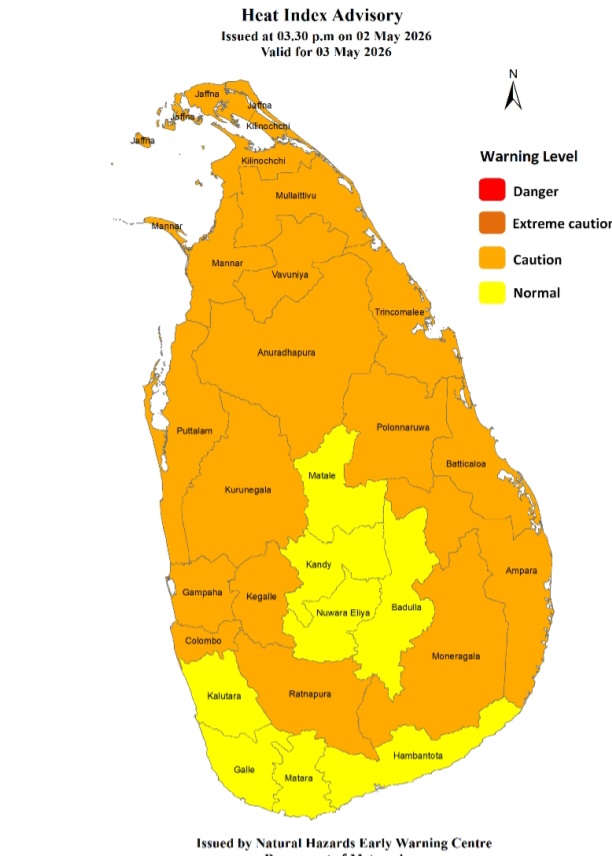
Warm Weather Advisory
Issued by the Natural Hazards Early Warning Centre
Issued at 3.30 p.m. on 02 May 2026, valid for 03 May 2026
The Heat index, the temperature felt on human body is likely to increase up to ‘Caution level’ at some places in the Northern, North-central, Eastern, Sabaragamuwa, North-western provinces and in Colombo, Gampaha and Monaragala districts during the day time.
The Heat Index Forecast is calculated by using relative humidity and maximum temperature and this is the condition that is felt on your body. This is not the forecast of maximum temperature. It is generated by the Department of Meteorology for the next day period and prepared by using global numerical weather prediction model data.

Effect of the heat index on the human body is mentioned in the above table and it is prepared on the advice of the Ministry of Health and Indigenous Medical Services.
ACTION REQUIRED
Job sites: Stay hydrated and takes breaks in the shade as often as possible.
Indoors: Check up on the elderly and the sick.
Vehicles: Never leave children unattended.
Outdoors: Limit strenuous outdoor activities, find shade and stay hydrated.
Dress: Wear lightweight and white or light-colored clothing.
Note:
In addition, please refer to advisories issued by the Disaster Preparedness & Response Division, Ministry of Health in this regard as well. For further clarifications please contact 011-7446491.

Somali pirates have hijacked an oil tanker off the coast of Yemen, according to multiple Somali security officials that spoke with the BBC.
The Yemeni coastguard earlier said the tanker MT Eureka had been hijacked and was headed towards Somalia. Sources said it was overrun by pirates in the Gulf of Aden, near the port of Qana.
The pirates departed a remote coastal area near the seaside town of Qandala, which sits on the Gulf of Aden, according to three separate security officials from the semi-autonomous Puntland region who spoke with the BBC.
It marks the second hijacking of an oil tanker in the area in a 10-day period, following the hijacking of Honor 25 by Somali pirates on April 22.
Honor 25 was carrying 18,500 barrels of oil bound for Mogadishu.
MT Eureka was sailing on the flag of the west African nation of Togo prior to the hijacking and was overrun by the gunmen at 5:00 AM local time (03:00 BST) this morning, the security official went on to tell the BBC.
It is now sailing in the Gulf of Aden between Yemen and Somalia, and is expected to anchor in Somali waters in the coming hours.
In a separate incident, the United Kingdom Maritime Transportation Operation (UKMTO) reported on Friday that “armed persons” on a “skiff” approached a bulk carrier near Al-Mukala, Yemen.
Those armed persons departed a remote coastal area near the fishing town of Caluula (Alula), according to three separate security officials. Caluula is 209km (130 miles) from where hijackers departed to seize the MT Eureka.
The two separate incidents indicate piracy is expanding across Somalia’s vast coastline, which is the longest in mainland Africa at 3,333km (2071 miles).
Today’s hijacking marks the fourth successful pirate hijacking in two weeks.
Somali authorities and the European Union Naval Force (EUNAVFOR), which oversees anti piracy operations in Somali waters, are yet to address the latest hijacking.
Somali piracy, which was on the decline since 2011, has surged again since late 2023, when Houthi rebels began attacking ships in the Gulf of Aden and Red Sea. The attacks forced international navies to instead tackle the Houthi threat, thus allowing armed groups on the Somali coast to take advantage of the security lapse.
“The on-going crisis with the pirates is much worse than many realize. There are increasing movements (of armed groups) all over the coast” a security official from the semi-autonomous Puntland region told the BBC.
[BBC]

Zalmi favourites in final but Kingsmen arrive with odds-defying juju
Showers will occur at several places in the Western, Sabaragamuwa, Central, North-western, North-central and Eastern provinces and in Badulla, Galle and Matara districts after 2.00 pm.

Easter Sunday Case: Ex-SIS Chief concealed intel, former Defence Secy tells court

NCPA gets up to seven child violence complaints daily

AKD’s May Day vow: Crackdown looms as corrupt face day of reckoning

Israel, Lanka hold talks on strengthening bilateral cooperation

‘Dates have the highest sugar content to fight Coronavirus’

Sunday Island 27 December – Headlines

#SundayIsland 17th December – Headlines

Sunday Island – 28th March

Sunday Island Headlines – 21 March

Sunday Island – 21st February – Headlines
-

 News5 days ago
Treasury chief’s citizenship details sought from Australia
-

 News7 days ago
BIA drug bust: 25 monks including three masterminds arrested
-

 News4 days ago
Rooftop Solar at Crossroads as Sri Lanka Shifts to Distributed Energy Future
-

 News7 days ago
Banks alert customers to phishing attacks
-
 News6 days ago
Govt. assures UN of readiness to introduce ‘vetting process’ for troops on overseas missions
-

 News3 days ago
“Three-in-one blood pressure pill can significantly reduce risk of recurrent strokes”
-

 Business6 days ago
ADB-backed grid upgrade tender signals next phase of Sri Lanka’s energy transition
-

 News5 days ago
Central Province one before last in AL results