
Features
The genius of we lost Karunaratna Abeysekara, forever 40 years ago


By Dr Upul Wijayawardhana
Forty years ago, on 20th April 1983, we lost for ever the genius of the Sinhala wordsmith extraordinaire, whose life was cut short suddenly and prematurely at age of only 52 years. It is said that those with creativity, like him, reach their maximum potential in their fifties but, sadly, it was not to be although the legacy he left behind makes us feel as if he lived a century!
Considering his prodigious productivity in a span lasting less than four decades, it is hard even to imagine what he would have achieved had he lived at least a decade more, as he requested. Interestingly, in a moving poem printed in Kalpana in October 1982 six months before his death giving the impression that he had a premonition, titled ‘Ayachanayak’ (Request), he makes an appeal to the ‘Life-giver’ for an extension of 10 years, so that he may see his son grow up and can contribute to Sinhala literature in many ways, writing for the unity of the nation. It is not without humour either, as he states that all he wants is the extension and does not care even if it makes him look aged!
He is a wordsmith extraordinaire indeed, as he excelled in both the written and the spoken word; a rare achievement. He showed his talents in the written word by being among the great poets of the ‘Colombo Era,’ a sought-after scriptwriter for Sinhala cinema and, most importantly, a lyricist of lasting influence; perhaps, the greatest we ever had. He demonstrated his prowess of the spoken word as a newsreader, a presenter of programmes and concerts but he is best remembered for his unforgettable commentaries, the way he moved the entire nation to tears at SWRD’s funeral becoming part of broadcasting legend.
He was born in Ratmale, a little village south of Matara on June 3, 1930, the eldest of 10 children of Podiappuhami and Premawathi Abeysekara. The family moved to Colombo where his father started a small business but they moved back temporarily to their village during World War II which gave Karu the opportunity to study Sinhala, Pali, and Sanskrit under Venerable Ananda of Galkanda Vihara, which laid the foundation for the mastery with words.
On return to Colombo, he entered Nalanda College where his teacher was the poet U A S Perera, better known as “Siriayya” who conducted “Lama Pitiya” in Radio Ceylon, which was a life-changing event. This drew him to broadcasting, taking part in “Lama Pitiya” from the age of 12. He continued to study oriental languages under Venerable Dehigaspe Pannasara of Vidyodaya Pirivena whilst continuing his studies in English at Nalanda.
Karunaratna Abeysekara became a pioneer in many fields having faced the most crucial decision of his life in 1950, when he had to choose between admission to Peradeniya University, for a degree, or join Radio Ceylon as a relief announcer, earning seven rupees a day. He opted for the latter as he felt that was the only way he could support his younger siblings, his father’s business being not lucrative. This move not only allowed him to support his siblings admirably but also build a very successful broadcasting career.
He was a brilliant newsreader but outshone all others as a commentator. In the era before television, we were at the mercy of commentators to visualise any important event. Whereas others described what was happening, he painted the picture in our minds with his unmatched eloquence. I still remember listening to his commentary when Queen Elizabeth visited us in 1954 and painting the picture of the procession in my mind.
What has often been overlooked is the fact that it was Karunaratna Abeysekara who pioneered cricket commentary in Sinhala, the very first being a report on the Anada-Nalanda Big-match he gave on Saraswathi Mandapaya. He quickly switched to live commentary and is credited with coining many Sinhala cricket terms which are in current usage. No doubt the enthusiasm for and the popularity of cricket, the ‘coloniser’s game,’ in the villages is in no mean measure due to the commentaries in Sinhala which he pioneered in his inimitable style which enabled the listeners to visualize the game long before the advent of television.
Invariably, due to the inspiration from Siriayya, he was drawn to children’s programmes and Saraswathi Mandapaya, he hosted on Sunday evenings, became the star of children’s programmes and to me and my generation he became our beloved Karuayya. I had the fortune of participating regularly and helping Karuayya from 1957 to 1964, being introduced to him by his brother Daya and my good friend Buddhadasa Bodhinayaka. We would help by sorting out letters, writing features and reading scripts live etc. which gave us the grounding in broadcasting.
Karuayya
arrived about half an hour before the programme goes live on-air and penned a couple of songs, which were set to music by Master D D Denny to be sung by the children who became the leading musicians later. Saraswathi Mandapaya was the incubator for a generation of not only budding singers but also lyricists and script writers, far too many to mention by name. Just one example: Nanda Malini’s famous song “Budusadu, Budusadu, Sandun gasak wennam” written by Asoka Colombage with music by D D Danny, she sang first in Saraswathi Mandapaya.
He is rightly credited as the creator of the genre of Sinhala children’s songs and his compositions like Sarungale, Lenage pitameda iri tuna ende kauda mage amme, Dan nivadukale hinda ne iskole, Mamai Raja kale vihilu keru Andare, Surathal ape denila vana mal kele pipeela are perineal favourites. Some of his children’s songs have become so popular, adult singers have recoded them subsequently.
On retiring from the National Service, he joined the Commercial Service of Radio Ceylon where he revolutionised advertising by coining catchy slogans and introducing memorable jingles which are played even today. He was ethical to the core, ensuring that products he advertised stood to scrutiny, often visiting the manufacturers to make sure. This, unfortunately, is a practice unknown today, with celebrities selling their souls for cash, endorsing any product.
He was in great demand to present concerts and, in fact, many attended to see Karuayya as much as for the concert itself. When he commenced the proceedings, immaculately dressed with hair combed with Brylcream and a wide smile below the thin moustache, crowds roared with applause as he raised his hands and said “Ayubowan” His introductions were crisp and concise, describing a lot in a few words.
Of course, he is best remembered as a lyricist though he did not get universal acclaim. Some critics took objection to his style whilst others attempted to belittle him by saying he writes lyrics for Hindi tunes, disregarding the fact that often lyricists write words to a tune created by a musician and that doing this is more difficult than writing free lyrics. He had the remarkable ability to pen a song in a few minutes and the complimentary remarks, referring to this, made by Dharmadasa Walpola and Milton Perera in interviews, that he often wrote songs for them by the side of his car, on a piece of paper kept on the bonnet, were used by critics to belittle him. He disregarded them by saying: “I write my songs not for critical acclaim but for the sole purpose of the enjoyment of listeners, without them having to turn the pages of a dictionary!” Paradoxically now, 40 years after his death, critics are falling over each other to praise his lyrical style; simple though beautiful and musical words, arranged rhythmically to subtly convey, meanings often very deep, which brought about a sea change in Sinhala music for the masses!
He coined many new words and phrases but his genius was in the ability to transform even harsh words to be musical as illustrated by the Jothipala song “Sal Sapu Na Kumudu Saman Nilmahanel mal athare, Kidaram male pava suwanda digahere”. Leaving aside the simple but philosophical message conveyed later in the lyrics of this haunting song, the genius is in the introduction so beautifully to the lyric of Kidaram mala, the flower of the Stink Lily! The songs he penned still dominating the airwaves, despite the vast changes in the broadcast media since his death, stands testimony to his philosophy. The young, who have no idea whose compositions they are, join the old in singing his songs, made immortal by the vast number of talented Sinhala singers, most of whom he nurtured.
In my humble opinion, Karunaratna Abeysekara is the best lyricists Sri Lanka has ever had as his versatility is beyond compare. Even doubters would agree that his versatility remains unchallenged as he had the capability to suit the lyric to the singer’s style and even to suit the actor, for film songs. His lyrics could be anything from children to classical, funny to provocative but he was at his best when it came to romance, probably because of his own turbulent love affair with Raniakka before marriage. Erani Herath, like many millions in the country, had fallen in love with his voice initially which later blossomed into a romance, objected to by her elders who kept her a virtual prisoner. Her mother prevented her from listening to the radio first and then kept newspapers away from her, when she realized that he was communicating through poems in newspapers! One day, Tilakasiri Fernado has been waiting in studio 10 of Radio Ceylon for Karuayya as he was one song short for his programme the same evening. When the plight was explained, Karuayya vented the pent-up feelings by writing immediately ‘Enna mada nale, gos pawasanna duka mage; Yannata heki obata pamani sirageyata ege’ which has become a classic, wherein he requests the wind to convey his sadness and love to her as it is only the wind that can reach her prison uniterrupted!
In turn, Karuayya extended a helping hand to others in romantic difficulties too. When there were problems with Sanath Nadasiri’s romance with Malkanthi Pieris, he wrote the beautiful song “Ma hada asapuwa, kusumin sarasuwa, e Malbara dethai” Malbara hinting at Malkanthi! When Milton Perera had difficulty in expressing his love to Kalyani and appealed to Karuayya, he obliged with “Kalyaniye oba nasu kathawak kiyannam” with Milton declaring his love over the airwaves and thousands of lovers using it since to overcome their difficulties of romantic expression!
When Dileepa was born, after a gap of ten years, Karuayya was overjoyed and had been lying down on a mat between the two beds occupied by his wife and mother, when he got the sudden urge to pen a song. He got up and wrote “Dileepa podi puthu, saneepayata nidi, Mawage ukul yahane” which was printed in Silumina. Seeing this Clarence Wijewardene has approached Karuayya and had said he will pay anything for the song! In an interview Karuayya mentioned that this and “Enna mada nale” are his favourite songs. Shortly before his death, Karuayya had been listening to a radio programme where they had discussed “Enna mada nale” and Raniakka mentioned in an interview that Karuayya was very pleased and had commented “It is a haunting song.” It is a small mercy that he could listen to his favourite as the last.
No one knows how many songs Karunaratna Abeysekara wrote in his short but fruitful lifetime as he wrote songs for many including my wife, Primrose and even he did not keep a count. The figure of 2000 often quoted is a gross underestimate and may refer only to film songs as he wrote lyrics for over 300 films. Though he was paid for film songs, he never charged a cent from the multitude of artistes he wrote songs for. Almost every artiste of that era had the career launch or their breakout with a song penned by Karunaratna Abeysekara. He must have written thousands for radio musical programmes, Saraswathi Mandapaya and for recordings by artists which remain uncounted. Before the introduction of television, more than half the songs in SLBC library had been written by him.
Though the first song he composed for a film was “Kataragame Devige bime, Ruhunu janapade” screening of Sirisena Wimalaweera’s film Asoka was delayed, Varada Kageda being released ahead, two songs of which remain popular to this day: “Dalula prema gase” and “Piyalee kedila wetuna nebul Saman male” both sung by Mohideen Baig. It is said that seven other lyricists failed to satisfy Nimal Mendis for his composition for the film Kalu Diya Dahara but Karuayya succeeded with “Master Sir“
Some critics consider his best lyrics for a film are in Kurulu Bedda, with music by R Muthusamy and sterling performances by Punya Heendeniya and D R Nanayakkara, which include “Aruna Udaye” the first film song of Milton Perera, “Oya belma, oya kelma, nilupul nethe” by Lata and Dharmadasa Walpola. However, my personal choice is Daskama, the only film Edwin Samaradiwakara provided music for. “Ipida mere” sung by Amaradewa is a synopsis of Buddhism and has become a classic but there are many other beautiful songs too, masterfully crafted, and beautifully sung: “Honda Kala ada” by Mohideen Baig, “Goyam paseela kumbure” by Indrani Wijebandara, “Devlova devsepa” by Indrani Wijebandara and Mallika Kahavita, as well as GSB Rani Perera’s “Mada diye pipunata” and “Turu wadulu tule, sandalu thale, kekulu sele surathale; Mukulu obe, vikulu dange, lelena dalu palakale“, a song which demonstrates how simple words could be melodically threaded.
He excelled in writing about inanimate objects; perhaps, the only lyricist to do so. “Awile semada” is about a candle, “Basicale” is about the bicycle, “Sarungale” is about a kite and “Naga lovin gena apu Bulathatha” is about sheaf of Betel, a song that runs through all the associated rituals, reminding us about our old traditions. Often, he made use of life-events to pen a song. Whilst having dinner in a Chinese restaurant, the waiter has dropped a tray earning a public reprimand from the manager which prompted, the moment he got home, to write “Wedakarala ewara nometha deviyane – Mokotada ma duppathwe ipadune“
He wrote songs for artistes with widely varying styles with equal success, few eternal favourites being: “Kedelle ativu kirille wage demapiiyan sevane” for Mignone and Jetliners which has become the favourite at weddings, “Piyumehi peni bothi wanabambaru” for C T Fernando, “Mal yahanawaki loke, nave chandraloke” for M S Fernando, “Sulange pavee ee wetha yawee ma pathu pathum” and “Oruwaka pawena re ganaandure” for Milton Mallawarachchi, “Diya podak wemin thol wiyaluna pipaseta” for HR Jothipala, “Neela jalase rangana hansa kumari” for Sisira Senarathna, “Namal komali” for Indrani Wijebandara though she grabbed the limelight with the song “Hithannako aiye, denwath heddennnako aiye” from the film Suraya, also written by Karunaratna Abeysekara.
He was so proliferous, sometimes, had written different lyrics for the same tune. Having forgotten that he had written “Me bhavayedi mulu diya daye” for Narada Dissasekara, he had written “Tajmahalak thanawanna ne mata” for H R Jothipala, both becoming very popular and, interestingly, both artistes choosing each as their favourite song!
His younger brother, Gunaratna too was a reputed lyricist and one day Jothipala had come to their place to get a song on Anangaya (Cupid) written and as Karuayya was away, Gunaratna wrote him “Anangaya man” which became a hit. When Milton Perera approached Karuayya about this, he had written “Supemlove kusum sara malsara” highlighting the failures of Anangaya which resulted in a rebuttal from Gunaratna. When there were a few exchanges of songs, many began wondering whether there is a rivalry between Jothipala & Milton or Karunaratna & Gunaratna, the speculation being put to rest by the brothers co-writing “Api santhosen inne, Duka sokhaya ne danne, Aiyya malli wage” which was duetted by Jothipala and Milton!
During Vesak, from every Dansela to Pandal “Obe ragi mana kelambedo” sung by Mohideen Baig is heard, this being among many songs with Buddhist themes Karunaratna Abeysekara composed but it is often forgotten that he wrote on Jesus Christ too: “Bethlehem pure, Dilindu gawahale“. Mohideen Baig’s strong voice often amplified the message in songs like “Sinahawen ho kathawen be maninnata minisa” and “Ma oba wenuweni Bharatha menige pa sevane wedune” describes Baig’s life story.
Lata mentioned in an interview that wherever in the world, when she sang “Perdiga muthuetayai me, Loke sirideru Siri Lanka” the audience stood to attention, no surprise as it ends with: “Negisitiya heka eksathwi, Bedigiyoth rata yaye sunwee“. However, Karunaratna Abeysekara’s most opportune message from the grave comes from Mohideen Baig’s song “Giri hel mudune Manel nopipe, Hiru nonagi awaragirehe” which ends with:
“Dinu jathiya vatina Sinhale, Abhimanaya wu deya Sinhale
E niga sirithe galee, Ha noga endinu delee
Parasiritheni oba Hela meni, eida soketa heluwe”


 It was a few years back that a former President of Sri Lanka took it on himself to pronounce SAARC ‘dead’. Since then there have been other sections of Sri Lankan opinion that have joined the critics of SAARC and taken the solemn stance that SAARC has indeed died what may be called a natural death.
Their fatalism is understandable. SAARC has failed to meet at heads of government or state level for the past several years to take the SAARC process notably forward. Regional cooperation has more or less been only an appealing idea. No substantive concrete projects have taken off to make the idea a hard reality. ‘Inner paralysis’ seems to be SAARC’s lot. Hence the fatalism in these circles.
However, being one of the worst cash-strapped regions of the world and a teemingly populated one with people virtually left to their devices, what choices do the ‘SAARC Eight’ have other than to try their best to band together and continue with their cooperation efforts, however small they may be?
There is no escaping the mounting debt trap for many of these countries and bankrupt Sri Lanka is a glaring example, but ‘throwing in the towel’ and abandoning themselves entirely to the diktats of the strongest economies and their agencies will prove a ‘living death’ for many countries in the SAARC fold.
The gains may be meagre but giving-up on SAARC cooperation in full would prove self-defeating for the organization and South Asia. Right now, the collective intention ought to be to salvage what the region could from the tenuous cooperative efforts. Moreover, such initiatives could go some distance to generate a degree of goodwill among the Eight and help in sustaining a dialogue process.
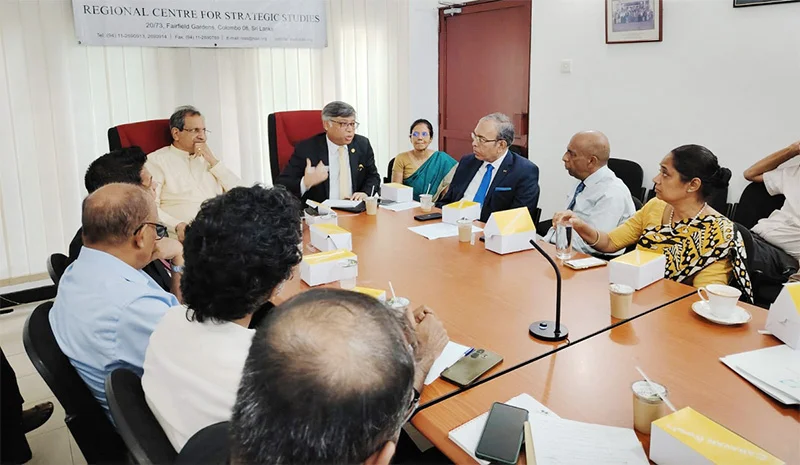
Given this backdrop it proved ‘a stich in time’ for the Regional Centre for Strategic Studies (RCSS), Colombo, to recently host the SAARC Secretary General Ambassador Md. Golam Sarwar to a round table discussion on the unifying potential of SAARC and its future possibilities, besides other related issue areas.
Held on June 24th and moderated by RCSS Executive Director and former ambassador Ravinatha Aryasinha, the forum brought together a vibrant, wide ranging audience comprising academicians, diplomats, senior public servants, civil society activists and many others. Following the presentation by Ambassador Golam Sarwar titled, ‘Reigniting SAARC: Achievements, Challenges and the Way Ahead’, a lively Q&A followed.
The above forum could be described as an act of lighting the proverbial ‘candle’ rather than ‘cursing the darkness.’ It surely is a ‘darkness’ that could be seen as daunting considering that the region’s pivotal powers, India and Pakistan, are failing to act in a spirit of accord but are engaged in bitter finger-pointing on a number of questions of vital importance to SAARC.
On the other hand, what is the rest of the region doing to bring the above sides together? It is disappointing that to date the rest of SAARC has failed to launch a major diplomatic drive to bring peace between the feuding regional heavyweights. It needs to act without delay and establish its earnestness and this effort would need to prove SAARC’s staying power in the unfolding months and even years.
In assessing SAARC’s seeming failure local opinion in particular has failed to factor in what could be described as weak leadership. Since Sheikh Mujibur Rahman of Bangladesh, the founding father of SAARC, the region has failed to produce a visionary leader who could advance the SAARC cause with charisma and drive.
Among other reasons, weak leadership accounts considerably for the faltering and stuttering status, as it were, of SAARC. Badly needed are leaders who could go the extra mile, think less of narrow national interests and work diligently towards the collective well being of the region but SAARC’s millions of ordinary people have been made to wait in vain for leaders of such stature. Instead, they have been burdened with politicians who seem to be relishing the apparently moribund state of SAARC.
Looking back, it could be said that it was the dynamic leadership factor that led to the launching of the Non-Aligned Movement and for its sustenance for a few decades. True, it could be seen in some quarters that NAM is no more, but as in the case of SAARC, the former too has been unfortunate to be burdened over the years with politicians who lack the vision and drive to unflaggingly advance the fortunes of the South. NAM and SAARC lack the dynamism and vision of leaders of the stature of Jawaharlal Nehru, for example, to give them the required guidance and intellectual depth.
The reasons are complex for there not being among us currently political leaders with the vision and the steadfast commitment to advance the legitimate interests of the South. However, it could be stated with conviction that the majority of Southern leaders have too easily caved in to the demands of the global North and its financial agencies.
These leaders have failed to see, for instance, that the largely market economy oriented Northern governments would not view with favour a centrist economic model that attaches priority to the interests of the dis-empowered publics of the South. This realization ought to have dawned on the current government in Sri Lanka, for instance, some while ago but it has no choice but to abide by IMF dictates since economic survival at present is unthinkable without the latter’s succour.
Accordingly for SAARC this should be the time for some soul-searching. Priority needs to be attached to ending the feuding between India and Pakistan since at present the material fortunes of the region hinge largely on these regional giants giving peaceful relations among them a try. This is no easy challenge to meet but some daring, visionary diplomacy needs to take hold among the rest of SAARC.
There is some sense in SAARC bringing the peoples of the region together through programs that address their best collective interests. A meeting of minds among SAARC nations could enable SAARC and its agencies to build a region-wide people’s movement for progressive political and economic change that could in turn lead to the region’s political leaders sensitizing themselves more to the neglected needs of their publics.
However, the time is ‘now’ for the initiation of these progressive changes and the voice of SAARC well wishers would need to drown out those of their critics.
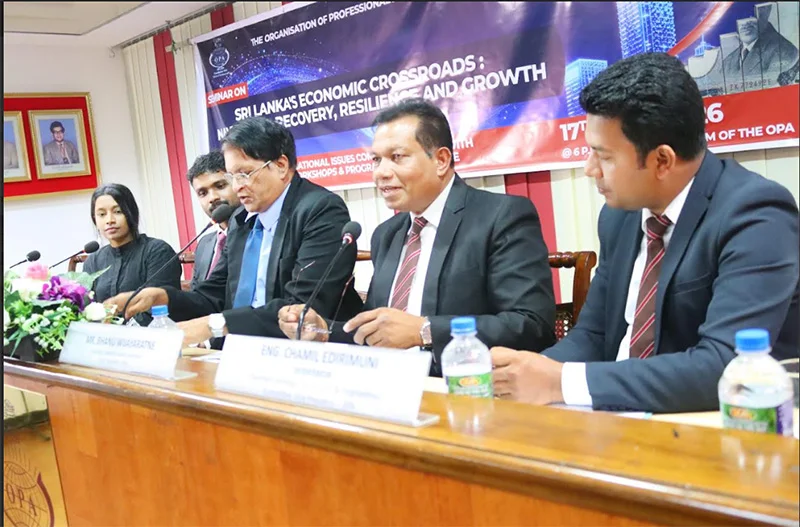
A seminar, “Sri Lanka’s Economic Crossroads: Navigating Recovery, Resilience and Growth” was recently held by the Organisation of Professional Associations of Sri Lanka (OPA) at the OPA Auditorium, bringing together economists, OPA members, and professionals from diverse fields for an insightful discussion on Sri Lanka’s economic recovery and future growth prospects.
The event was held under the patronage of Jayantha Gallehewa, President of the OPA, and was jointly organised by the National Issues Committee (NIC) and the Seminars, Workshops and Programmes Committee of the OPA. The event reaffirmed the organisation’s commitment to advancing professional excellence, fostering insightful intellectual engagement, facilitating interdisciplinary knowledge exchange and creating a constructive platform for informed dialogue on issues of national importance.
The panel of speakers comprised Dr. Harsha Aturupane, Lead Economist and Programme Leader for Human Development at the World Bank for Sri Lanka and the Maldives; Dr. Achinthya Koswatta, Senior Lecturer in Economics at the Open University of Sri Lanka, and Anushan Kapilan, Lead Economist at Verité Research.
In his welcome address, the President of the OPA emphasised that Sri Lanka was at a critical juncture in its economic recovery journey where sustained reforms, effective implementation, and collective national commitment are essential to achieving long-term stability, resilience and inclusive growth. He noted that the country had experienced one of the most severe economic crises in its history with the economy contracting by 7.8 percent in 2022 and a further 11.5 percent in 2023, resulting in significant economic and social challenges.
Delivering his introductory remarks Bhanu Wijeyaratne, Vice President of the OPA and Chairman of the National Issues Committee, underscored the need to move beyond short-term economic stabilisation towards a comprehensive agenda of structural transformation. He observed that the economic crisis had revealed deep-rooted weaknesses within the economy, including persistent fiscal pressures, rising public debt, foreign exchange limitations, and insufficient diversification of the export base. He stressed that addressing these challenges through strategic reforms, institutional strengthening and long-term economic planning would be essential to establishing a more resilient and competitive economy.
While acknowledging recent positive developments, including improved inflation management, tourism recovery and signs of economic stabilisation, Wijeyaratne stressed the need to advance reforms aimed at strengthening fiscal discipline, enhancing productivity, improving competitiveness, developing human capital and reinforcing governance and institutional effectiveness.
He further highlighted the important role of professionals, businesses, academia and other stakeholders in contributing to evidence-based dialogue and supporting Sri Lanka’s journey towards a resilient, inclusive and sustainable economic future.
Delivering the keynote presentation, Dr. Harsha Aturupane provided a comprehensive assessment of Sri Lanka’s economic prospects within the broader context of global economic transformation. He argued that Sri Lanka functioned as a small open economy whose performance is significantly influenced by developments in the global marketplace. External factors could not be controlled, and the country must strengthen its domestic capacity and resilience to respond effectively to international economic shifts, he noted.
Tracing the evolution of global economic systems, Dr. Aturupane highlighted the transition from ideological divisions between state-controlled and market-oriented economies towards increasingly pragmatic approaches focused on growth, competitiveness and development. He noted that Sri Lanka’s own economic journey reflects a similar evolution, with contemporary policy debates now centred on practical solutions for sustainable economic progress.
The presentation also examined the transformative impact of globalisation. Dr. Aturupane observed that global economic integration had enabled several East Asian economies, including South Korea, Singapore, Taiwan and Hong Kong, to achieve remarkable economic advancement through export-led growth strategies. Sri Lanka similarly benefited from this process through the expansion of its apparel industry and increased integration into global value chains.
Turning to Sri Lanka’s recovery programme, Dr. Aturupane emphasised that the ongoing stabilisation process should be viewed as a national programme supported by the International Monetary Fund rather than solely as an IMF initiative. He observed that strong worker remittances, improved tourism earnings, enhanced government revenue mobilisation and prudent import management have contributed significantly to economic stabilisation.
Despite this progress, he cautioned that rebuilding foreign exchange reserves and meeting future debt obligations remain major challenges. He underscored the need to strengthen export performance, attract investment and generate sustainable foreign exchange earnings to ensure long-term economic resilience.
The discussion also focused on monetary stability, inflation management and exchange-rate policy. Dr. Aturupane stressed that maintaining price stability was fundamental to sustainable growth and household welfare, while sound monetary policy remains essential for preserving economic confidence.
Looking beyond stabilisation, he argued that Sri Lanka must transition towards a broader economic transformation agenda. Sustainable growth, he noted, will depend on expanding productive capacity through investment, technological advancement, innovation, skills development and structural reforms.
Among the key constraints identified was the high cost of energy, which continues to affect competitiveness and investment attractiveness. Dr. Aturupane emphasised the importance of improving efficiency and affordability within the energy sector to enhance Sri Lanka’s business environment.
He further highlighted the social dimensions of the crisis, noting the rise in poverty and economic vulnerability among households. Strengthening social protection systems and ensuring inclusive growth, he argued, must remain central components of the national development agenda.
Another critical challenge identified was Sri Lanka’s demographic transition. With an ageing population, outward migration and evolving labour market dynamics, the country is increasingly confronting labour shortages in several sectors. Dr. Aturupane suggested that greater automation, increased labour-force participation and strategic workforce planning would be necessary to address these emerging realities.
Concluding his presentation, he emphasised the need to improve governance, strengthen institutions, enhance competitiveness and create an enabling environment for private sector investment. Sri Lanka’s future success, he noted, will depend on its ability to move decisively beyond crisis management towards a development model founded on resilience, innovation, productivity and inclusive growth.
Dr. Achinthya Koswatta reiterated the importance of policy consistency and predictability in fostering investment and industrial development. She observed that frequent policy changes create uncertainty and discourage long-term investment decisions, whereas stable and coherent policy frameworks build confidence and support sustainable economic transformation.
Meanwhile, Anushan Kapilan highlighted the substantial progress achieved in restoring macroeconomic stability following the recent crisis. He noted significant improvements in fiscal performance, including increased government revenue, reduced reliance on debt financing and a historically low fiscal deficit.
He further observed that public debt levels are declining faster than anticipated, economic growth has exceeded expectations and inflation has been brought under control more rapidly than forecast. Nevertheless, he cautioned that the recovery remains uneven, particularly within the industrial sector and that many households have yet to experience a meaningful improvement in living standards.
The seminar was expertly coordinated by Eng. Chamil Edirimuni, Vice President of the OPA and Chairman of the Seminars, Workshops and Programmes Committee, while the technical moderation and interactive discussion session were facilitated by Bhanu Wijeyaratne, Vice President of the OPA and Chairman of the National Issues Committee.
The event was attended by Tisara De Silva, President-Elect of the OPA, Eng. Ravi Rupasinghe, General Secretary, Past Presidents, members of the Executive Council, representatives of the General Forum and professionals representing a wide range of disciplines.
The seminar concluded with a vibrant exchange of ideas and perspectives, reaffirming the importance of evidence-based policy dialogue, institutional collaboration and collective national commitment in advancing Sri Lanka’s economic recovery, resilience and sustainable growth.

 Yes, for UK-based presenter and artiste Samantha Kay, home is where the heart – and the roots – are. And her roots run deep in Sri Lanka.
In an exclusive interview with The Island, Samantha says “I’m proud to be Sri Lankan. My mum is from Kandy and my dad is from Colombo, so Sri Lanka has always held a very special place in my heart.
“Whenever I visit Sri Lanka, I love spending time on the beautiful south coast, especially Hikkaduwa and Mirissa. It’s somewhere I always feel connected to my roots and completely at peace.”
Now living in Bournemouth, on the south coast of England, where, she says, she is lucky to be close to some of the UK’s most beautiful beaches, including the iconic Sandbanks, Samantha has built a career that refuses to fit into one box.
She is a radio presenter, podcast host, singer-songwriter, personal trainer and life coach.
“I genuinely love the variety because every role allows me to connect with people and, hopefully, make a positive difference in someone’s day.”
Of course, music has taken her far.
One of her proudest achievements, she says, was releasing a song with 90s music icon Angie Brown, which reached No. 9 in the UK Club Charts.
She also reached the final stages of The X Factor and performed at Wembley Stadium in front of thousands.
Beyond music, Samantha competed in bikini bodybuilding across the UK, winning several titles. “It taught me discipline, resilience and self-belief,” she recalls.
Today, her focus is on radio, podcasting and coaching women. Her podcast encourages people to live life on their own terms rather than feeling pressured to follow society’s expectations.
Says Samantha: “Whether someone is single, changing careers, travelling solo or simply trying to find their purpose, I want them to know that it’s never too late to create a life that feels authentic. If you’ve ever felt like you don’t fit into the box, maybe you were never meant to.”
Samantha Kay also spent a year in Dubai, performing at five-star hotels, including FIVE, and coaching at the iconic outdoor gym on Palm Jumeirah.
“I taught strength and conditioning classes, and hosted wellness retreats, combining my passion for music, health and inspiring others.”
However, with family matters calling her back to the UK, she made the choice to return. “Family comes first,” she says.
Looking ahead, Samantha plans to grow her radio and podcast work, release more music, and expand her wellness retreats.
“My biggest passion is helping people, especially women, build confidence and believe in themselves,” she says.
“Wherever my career takes me, I hope to continue inspiring others to live with courage, kindness and authenticity, while never forgetting my Sri Lankan roots.”

Current El Niño Status in Sri Lanka

A few showers may occur in the Western, Sabaragamuwa and North-western provinces and in Kandy, Nuwara-Eliya, Galle and Matara districts.

Argentina face fine for Falklands banner in semi-final win

US launches fresh strikes on Iran as Trump warns Tehran it ‘better behave’

Govt. move to extend retirement ages of top judges: Opp. complains to UN

Dengue surge pushes hospitals to the brink as cases near 70,000

‘Dates have the highest sugar content to fight Coronavirus’

Sunday Island 27 December – Headlines

#SundayIsland 17th December – Headlines

Sunday Island – 28th March

Sunday Island Headlines – 21 March

Sunday Island – 21st February – Headlines
-
 News6 days ago
Herath warns prospective migrant workers not to get fleeced by racketeers
-
 Features4 days ago
Prison riots and politics: NPP’s biggest challenge and Sri Lanka’s biggest opportunity
-

 Editorial5 days ago
What’s the world coming to?
-
 Foreign News6 days ago
Tensions erupt in Indian state after 11-year-old raped and murdered
-
 Features6 days ago
Devanesan Annan – in Memoriam
-
Editorial6 days ago
Punishment in hellholes
-
 Features1 day ago
Dirty Money
-
 News7 days ago
Representatives of the Organization of Professional Associations (OPA) of Sri Lanka meet the Prime Minister