
News
Prez should explain why he scrapped time-tested exchange controls – NFF

By Shamindra Ferdinando
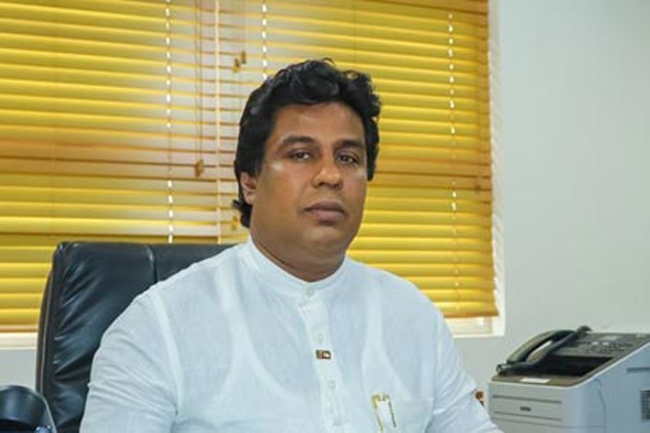
President Ranil Wickremesinghe, who is also the Finance Minister, should take immediate steps to restore the provisions of Exchange Control Act (ECA) of 1953 as part of the overall efforts to stabilise the national economy, NFF MP Jayantha Samaraweera told The Island yesterday (09).
The former State Minister said that furthermore UNP leader Wickremesinghe owed an explanation as to why his government introduced the current Foreign Exchange Act in 2017. The Kalutara District lawmaker said that President Wickremesinghe couldn’t remain silent as it was his government that disposed of the Exchange
Control Act of 1953, thereby paving the way for exporters to park export proceeds running into billions of dollars abroad.Responding to queries, MP Samaraweera said that he had raised the accountability on the part of President Wickremesinghe in parliament on March 08.
Acknowledging that though the economic situation had slightly improved over the past several weeks, MP Samaraweera said that Wickremesinghe-Rajapaksa government should take remedial measures to plug the loopholes or face the consequences. “The current Exchange Act introduced during Ravi Karunanayake’s tenure as the Finance Minister is perhaps one of the major reasons for the continuing crisis,” the former JVPer said.
The issue at hand was whether somebody in the yahapalana government benefited by repealing the time-tested exchange control laws, MP Samaraweera asked, underscoring the need to examine this matter carefully. “The possibility of a conspiracy cannot be ruled out. All of us know how the UNP perpetrated Treasury bond scams, twice, in Feb 2015 and March 2016. The new Exchange Control Act was enacted in the wake of Treasury bond scams,” MP Samaraweera pointed out.
Referring to a statement made by Trade Minister Nalin Fernando in Parliament on Wednesday, MP Samaraweera said that the government had lost the wherewithal to meet its basic obligations as it didn’t have foreign exchange.
Now, the UNP leader who created an environment for exporters not only to stash away export proceeds overseas and oversaw the Treasury bond scams, held the finance portfolio, MP Samaraweera said. Wickremesinghe should set a deadline for restoring the old Foreign Exchange Act, the MP said, recalling how the UNP leader publicly acknowledged the need to amend the 2017 Act.
MP Samaraweera told parliament on Wednesday President Wickremesinghe couldn’t afford to turn a blind eye to the declaration made by Justice Minister Dr. Wijeyadasa Rajapakse, PC, early last December on the basis of disclosure made by the US-based Global Financial Integrity watchdog that as much as USD 58 bn were parked overseas.
The MP pointed out that in addition to Minister Rajapakse, Opposition lawmakers Vasudeva Nanayakkara, Wimal Weerawansa and Gevindu Cumaratunga, in Parliament, estimated the stashed amount at over USD 35 bn, MP Jayaweera said. The trio has alleged that the Exchange Control Act No 12 of 2017, enacted during the yahapalana administration, allowed exporters to keep funds overseas.
MP Jayaweera said that President Wickremesinghe should inform the parliament without further delay how he intended to address the issue. “We obtained about USD 4 bn in 2022 from India. On top of that Sri Lanka owes the world as much as USD 53 bn. No one should forget that the situation stabilised to an extent as a result of Sri Lanka halting debt servicing,” MP Samaweera said.
Asked why President Gotabaya Rajapaksa’s government didn’t amend the yahapalana Exchange Control Act, MP Samaraweera said that NFF leader Wimal Weerawansa had taken up the issue with the Cabinet-of-Ministers. However, Basil Rajapaksa, who succeeded Mahinda Rajapaksa as the Finance Minister in June 2021 had dismissed the NFF’s recommendation, MP Samaraweera said, adding that Basil had declared that restrictions would discourage exporters. In fact, General Secretary of the Democratic Left Front (DLF) Vasudeva Nanayakkara proposed the introduction of a ‘QR’ system in 2021 in view of the foreign exchange crisis, MP Jayaweera said. That proposal, too, was rejected by Basil Rajapaksa, he said.
The MP stressed the need to tackle quite a formidable challenge posed by well-organised influential public–private sector partnership engaged in ‘over invoicing’ and ‘under invoicing’, with the blessing of successive governments. That too contributed to the forex crisis, the MP said.


News
Cabinet aporives recruitment of Nursing Instructors for Nursing Schools under the Ministry of Health and Mass Media on Contract Basis


There are 17 nursing schools under the Ministry of Health and Mass Media including the postgraduate primary nursing school.
There are 142 vacancies in the posts of Grade I / Special Grade Nursing Officer (Education) as on 31.03.2026 in those schools while 24 officers are to be promoted to the special grade on 31.12.2025 owing to the vacancies existing in the post of Special
Grade Nursing Officer (Education). Therefore, the number of vacancies is to be 166.
In addition, there are 24 vacancies in the post of Special Grade Nursing Officer (Education).
Although at present action has been taken to upgrade the nursing schools to nursing colleges and upgrade the nursing diploma course to nursing degree course, no action has been taken so far to carry out recruitment for the training relevant to the appointment for the post of Grade I / Special Grade Nursing Officer (Education).
Accordingly, the Cabinet of Ministers granted approval to the resolution furnished by the Minister of Health and Mass Media to recruit retired nursing instructors and nursing instructors who served in the nursing schools belonging to the three armed forces and are retired or have resigned legitimately from service to the post of Grade I / Special Grade Nursing Officer (Education) on contract basis.
Latest News
Signing agreement for the establishment of BIMSTEC Technology Transfer Facility in Sri Lanka
It has been decided to establish a BIMSTEC technology transfer facility in Sri Lanka by entering into a Host Country Agreement at the second leaders’ summit of BIMSTEC (Bay of Bengal
Initiative for Multi-Sectoral Technical and Economic Cooperation) held in New Delhi, India, in 2008, with the objective of enhancing regional cooperation.
The relevant cooperation agreement was signed by the member countries at the 5th BIMSTEC summit on 30-03-2022 in Colombo.
The prime objective of this technology transfer facility is to provide technology, capacity building, and management of intellectual property for the micro, small, and medium-scale
enterprises of the BIMSTEC member countries.
According to the cooperation agreement, an agreement should be entered into between Sri Lanka, as the host country, and BIMSTEC Secretariat for formalizing the legal status, privileges, and immunities of the technology transfer facility.
The drafted agreement has received the relevant institutional approval and legal clearance.
Accordingly, the Cabinet of Ministers has approved the resolution furnished by the Minister of Science and Technology to sign the proposed agreement.
News
The cabinet approves agreement on mutual legal cooperation in criminal matters between the Republic of Sri Lanka and the Republic of Korea
Approval has been granted at the cabinet meeting held on 11-12-2023 to sign an agreement between the Republic of Korea and the Government of Sri Lanka regarding mutual cooperation
in criminal matters.
However, according to the aforementioned approval, the relevant agreement could not be signed between both parties.
Through this agreement, opportunities will be provided
for mutual assistance to other countries in handing over judicial documents and collecting evidence for the use of criminal case matters.
Accordingly, the Cabinet of Ministers has approved the resolution provided by the Minister of Justice and National Integration to sign an agreement between the Republic of Korea and the Government of Sri Lanka to cooperate in criminal matters.

Cabinet aporives recruitment of Nursing Instructors for Nursing Schools under the Ministry of Health and Mass Media on Contract Basis
Signing agreement for the establishment of BIMSTEC Technology Transfer Facility in Sri Lanka
The cabinet approves agreement on mutual legal cooperation in criminal matters between the Republic of Sri Lanka and the Republic of Korea

Misbah-ul-Haq resigns as Pakistan selector after Test squad upheaval
Amendment of the Quarantine and Prevention of Diseases Ordinance No. 3 of 1897
Cabinet approves donation of USD One Million to the Government of Nepal

‘Dates have the highest sugar content to fight Coronavirus’

Sunday Island 27 December – Headlines

#SundayIsland 17th December – Headlines

Sunday Island – 28th March

Sunday Island Headlines – 21 March

Sunday Island – 21st February – Headlines
-

 News5 days ago
Eight politicians in drug kingpin probe
-

 Features3 days ago
“Wrap Me Up in My Blazer”— A Gentlemanly Bradby Reminiscence
-

 Business5 days ago
Sri Lanka opens up: A new season of direct connectivity
-
 Features7 days ago
Insights from Chieftains of Uva: Genealogy of two Kandyan Families – Part II
-

 Features5 days ago
Redefining ageing in Sri Lanka
-
 Latest News5 days ago
Nepal-Tibet floods: What happened, what caused them and who is missing?
-

 Editorial7 days ago
Warning of power cuts: El Niño and corruption
-

 Features7 days ago
Export diversification: Missing the wood for the trees – Part I