Foreign News
Nobel Prize-winning activist sentenced to 10 years in jail
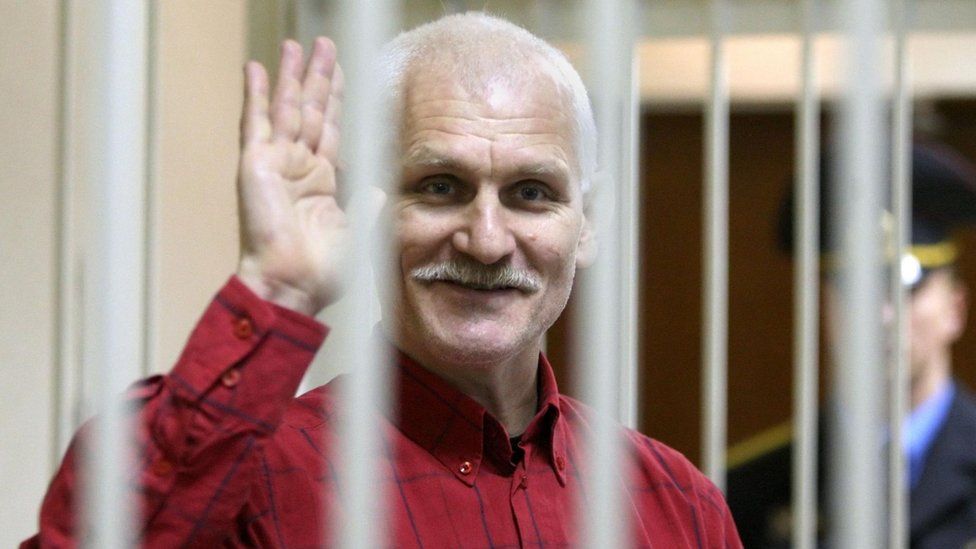
BBC reported that a court in Belarus has sentenced Nobel Peace Prize winner Ales Bialiatski to 10 years in prison.
He was arrested in 2021 and convicted of smuggling and financing “actions grossly violating public order”, the Viasna human rights group said.
Supporters of Bialiatski, 60, say the authoritarian regime of Belarusian leader Alexander Lukashenko is trying to silence him.
Bialiatski was one of three winners of the 2022 Nobel Peace Prize.

Foreign News
More than 30 dead after Myanmar military air strike hits hospital
At least 34 people have died and dozens more are injured after air strikes from Myanmar’s military hit a hospital in the country’s west on Wednesday night, according to ground sources.
The hospital is located in Mrauk-U town in Rakhine state, an area controlled by the Arakan Army – one of the strongest ethnic armies fighting the country’s military regime.
Thousands have died and millions have been displaced since the military seized power in a coup in 2021 and triggered a civil war.
In recent months, the military has intensified air strikes to take back territory from ethnic armies. It has also developed paragliders to drop bombs on its enemies.
The Myanmar military has not commented on the strikes, which come as the country prepares to vote later this month in its first election since the coup.
However, pro-military accounts on Telegram claim the strikes this week were not aimed at civilians.
Khaing Thukha, a spokesperson for the Arakan Army, told the BBC that most of the casualties were patients at the hospital.
“This is the latest vicious attack by the terrorist military targeting civilian places,” he said, adding that the military “must take responsibility” for bombing civilians.
The Arakan Army health department said the strike, which occurred at around 21:00 (14:30 GMT), killed 10 patients on the spot and injured many others.
Photos believed to be from the scene have been circulating on social media showing missing roofs across parts of the building complex, broken hospital beds and debris strewn across the ground.
The junta has been locked in a years-long bloody conflict with ethnic militias, at one point losing control of more than half the country.
But recent influx of technology and equipment from China and Russia seems to have helped it turn the tide. The junta has made significant gains through a campaign of airstrikes and heavy bombardment.
Earlier this year, more than 20 people were killed after an army motorised paraglider dropped two bombs on a crowd protesting at a religious festival.
Civil liberties have also shrunk dramatically under the junta. Tens of thousands of political dissidents have been arrested, rights groups estimate.
Myanmar’s junta has called for a general election on 28 December, touting it as a pathway to political stability.
But critics say the election will be neither free nor fair, but will instead offer the junta a guise of legitimacy. Tom Andrews, the United Nations’ human rights expert on Myanmar, has called it a “sham election”.
In recent weeks the junta has arrested civilians accused of disrupting the vote, including one man who authorities said had sent out anti-election messages on Facebook.
The junta also said on Monday that it was looking for 10 activists involved in an anti-election protest.
Ethnic armies and other opposition groups have pledged to boycott the polls.
At least one election candidate in in central Myanmar’s Magway Region was detained by an anti-junta group, the Associated Press reported.
[BBC]
Features
A wage for housework? India’s sweeping experiment in paying women
In a village in the central Indian state of Madhya Pradesh, a woman receives a small but steady sum each month – not wages, for she has no formal job, but an unconditional cash transfer from the government.
Premila Bhalavi says the money covers medicines, vegetables and her son’s school fees. The sum, 1,500 rupees ($16: £12), may be small, but its effect – predictable income, a sense of control and a taste of independence – is anything but.
Her story is increasingly common. Across India, 118 million adult women in 12 states now receive unconditional cash transfers from their governments, making India the site of one of the world’s largest and least-studied social-policy experiments.
Long accustomed to subsidising grain, fuel and rural jobs, India has stumbled into something more radical: paying adult women simply because they keep households running, bear the burden of unpaid care and form an electorate too large to ignore.
Eligibility filters vary – age thresholds, income caps and exclusions for families with government employees, taxpayers or owners of cars or large plots of land.
“The unconditional cash transfers signal a significant expansion of Indian states’ welfare regimes in favour of women,” Prabha Kotiswaran, a professor of law and social justice at King’s College London, told the BBC.
The transfers range from 1,000-2,500 rupees ($12-$30) a month – meagre sums, worth roughly 5-12% of household income, but regular. With 300 million women now holding bank accounts, transfers have become administratively simple.
Women typically spend the money on household and family needs – children’s education, groceries, cooking gas, medical and emergency expenses, retiring small debts and occasional personal items like gold or small comforts.
What sets India apart from Mexico, Brazil or Indonesia – countries with large conditional cash-transfer schemes – is the absence of conditions: the money arrives whether or not a child attends school or a household falls below the poverty line.

Goa was the first state to launch an unconditional cash transfer scheme to women in 2013. The phenomenon picked up just before the pandemic in 2020, when north-eastern Assam rolled out a scheme for vulnerable women. Since then these transfers have turned into a political juggernaut.
The recent wave of unconditional cash transfers targets adult women, with some states acknowledging their unpaid domestic and care work. Tamil Nadu frames its payments as a “rights grant” while West Bengal’s scheme similarly recognises women’s unpaid contributions.
In other states, the recognition is implicit: policymakers expect women to use the transfers for household and family welfare, say experts.
This focus on women’s economic role has also shaped politics: in 2021, Tamil actor-turned-politician Kamal Haasan promised “salaries for housewives”. (His fledgling party lost.) By 2024, pledges of women-focused cash transfers helped deliver victories to political parties in Maharashtra, Jharkhand, Odisha, Haryana and Andhra Pradesh.
In the recent elections in Bihar, the political power of cash transfers was on stark display. In the weeks before polling in the country’s poorest state, the government transferred 10,000 rupees ($112; £85) to 7.5 million female bank accounts under a livelihood-generation scheme. Women voted in larger numbers than men, decisively shaping the outcome.
Critics called it blatant vote-buying, but the result was clear: women helped the Bharatiya Janata Party (BJP)-led coalition secure a landslide victory. Many believe this cash infusion was a reminder of how financial support can be used as political leverage.
Yet Bihar is only one piece of a much larger picture. Across India, unconditional cash transfers are reaching tens of millions of women on a regular basis.
Maharashtra alone promises benefits for 25 million women; Odisha’s scheme reaches 71% of its female voters.
In some policy circles, the schemes are derided as vote-buying freebies. They also put pressure on state finances: 12 states are set to spend around $18bn on such payouts this fiscal year. A report by think-tank PRS Legislative Research notes that half of these states face revenue deficits – this happens when a state borrows to pay regular expenses without creating assets.
But many argue they also reflect a slow recognition of something India’s feminists have argued for decades: the economic value of unpaid domestic and care work.
Women in India spent nearly five hours a day on such work in 2024 – more than three times the time spent by men, according to the latest Time Use Survey. This lopsided burden helps explain India’s stubbornly low female labour-force participation. The cash transfers, at least, acknowledge the imbalance, experts say.
Do they work?
Evidence is still thin but instructive. A 2025 study in Maharashtra found that 30% of eligible women did not register – sometimes because of documentation problems, sometimes out of a sense of self-sufficiency. But among those who did, nearly all controlled their own bank accounts.

A 2023 survey in West Bengal found that 90% operated their accounts themselves and 86% decided how to spend the money. Most used it for food, education and medical costs; hardly transformative, but the regularity offered security and a sense of agency.
More detailed work by Prof Kotiswaran and colleagues shows mixed outcomes.
In Assam, most women spent the money on essentials; many appreciated the dignity it afforded, but few linked it to recognition of unpaid work, and most would still prefer paid jobs.
In Tamil Nadu, women getting the money spoke of peace of mind, reduced marital conflict and newfound confidence – a rare social dividend. In Karnataka, beneficiaries reported eating better, gaining more say in household decisions and wanting higher payments.
Yet only a sliver understood the scheme as compensation for unpaid care work; messaging had not travelled. Even so, women said the money allowed them to question politicians and manage emergencies. Across studies, the majority of women had full control of the cash.
“The evidence shows that the cash transfers are tremendously useful for women to meet their own immediate needs and those of their households. They also restore dignity to women who are otherwise financially dependent on their husbands for every minor expense,” Prof Kotiswaran says.
Importantly, none of the surveys finds evidence that the money discourages women from seeking paid work or entrench gender roles – the two big feminist fears, according to a report by Prof Kotiswaran along with Gale Andrew and Madhusree Jana.
Nor have they reduced women’s unpaid workload, the researchers find. They do, however, strengthen financial autonomy and modestly strengthen bargaining power. They are neither panacea nor poison: they are useful but limited tools, operating in a patriarchal society where cash alone cannot undo structural inequities.

What next?
The emerging research offers clear hints.
Eligibility rules should be simplified, especially for women doing heavy unpaid care work. Transfers should remain unconditional and independent of marital status.
But messaging should emphasise women’s rights and the value of unpaid work, and financial-literacy efforts must deepen, researchers say. And cash transfers cannot substitute for employment opportunities; many women say what they really want is work that pays and respect that endures.
“If the transfers are coupled with messaging on the recognition of women’s unpaid work, they could potentially disrupt the gendered division of labour when paid employment opportunities become available,” says Prof Kotiswaran.
India’s quiet cash transfers revolution is still in its early chapters. But it already shows that small, regular sums – paid directly to women – can shift power in subtle, significant ways.
Whether this becomes a path to empowerment or merely a new form of political patronage will depend on what India chooses to build around the money.
[BBC]
Foreign News
Indonesia counts human cost as more climate change warnings sounded
Nearly 1,000 people have been killed, and close to one million displaced, Indonesia has said a week after torrential rains triggered catastrophic floods and landslides.
The National Disaster Management Agency (BNPB) reported late on Sunday that 961 people had been killed, with 234 people missing and about 5,000 injured across the Aceh, North Sumatra and West Sumatra provinces.
The agency also recorded damage to more than 156,000 homes, and 975,075 people had taken refuge in temporary shelters.
Floodwaters have begun to recede in several coastal districts, although large areas in the central highlands are still cut off, BNPB said. However, heavy rain is forecast for parts of the island in the coming days, raising concerns for displaced people.
Indonesia’s rainy season, which usually peaks between November and April, frequently brings severe flooding.
Environmental groups and disaster specialists have warned for years that rapid deforestation, unregulated development and degraded river basins have increased the risks.
Several other countries in Southeast Asia, including Sri Lanka and Thailand, have been hit hard by storms and floods in recent weeks.
Risk to billions
The Asian Water Development Outlook 2025, published by the Asian Development Bank (ADB) on Monday, warned that the impact of climate change on Asia’s water systems poses a risk to billions.
The research said accelerating ecosystem decline and funding shortfalls for investment in critical water infrastructure threaten to plunge many in the sprawling region into water insecurity.
That could jeopardise gains over the past 12 years that have seen more than 60 percent of Asia-Pacific’s population – about 2.7 billion people – escape extreme water insecurity, the report says.
“Asia’s water story is a tale of two realities, with monumental achievements on water security coupled with rising risks that could undermine this progress,” said Norio Saito, the ADB’s senior director for water and urban development.
“Without water security, there is no development,” Saito said, adding that the report showed that urgent action was needed to restore ecosystem health, strengthen resilience, improve water governance, and deploy innovative finance to deliver long-term water security.
Rising disaster threat
The report said extreme weather events such as storm surges, rising sea levels, and saltwater intrusion, along with rising water-related disasters, threaten the region, which already accounts for more than 40 percent of the world’s floods.
That includes the disasters that ravaged Indonesia and other countries in the region in recent weeks.
From 2013 to 2023, the Asia Pacific region experienced 244 major floods, 104 droughts, and 101 severe storms, causing widespread damage to life and property and undermining crucial development gains.
The report said accelerating ecosystem decline was also a serious threat to water security in the region, with rivers, aquifers, wetlands and forests that sustain long-term water security deteriorating rapidly.
It said water ecosystems were deteriorating or stagnating in 30 of the 50 Asian countries it looked at, as they face threats from pollution, unchecked development and the conversion of land to other uses.
Under investment in water infrastructure is another threat to water security.
Asian nations will need to spend $4 trillion for water and sanitation between now and 2040, an outlay of about $250bn a year, the report said.
Currently, governments are collectively spending about 40 percent of that, an annual shortfall of more than $150bn.
[Aljazeera]
-
News4 days agoOver 35,000 drug offenders nabbed in 36 days
-
Features2 days agoFinally, Mahinda Yapa sets the record straight
-
Business6 days agoLOLC Finance Factoring powers business growth
-
News3 days agoCyclone Ditwah leaves Sri Lanka’s biodiversity in ruins: Top scientist warns of unseen ecological disaster
-
News6 days agoCPC delegation meets JVP for talks on disaster response
-
News6 days agoA 6th Year Accolade: The Eternal Opulence of My Fair Lady
-
News4 days agoRising water level in Malwathu Oya triggers alert in Thanthirimale
-
Features5 days agoThe Catastrophic Impact of Tropical Cyclone Ditwah on Sri Lanka: