
2023-03-01



Weather
Afternoon showers expected in the Uva and Sabaragamuwa provinces and in Hambantota, Nuwara-Eliya and Ampara districts

WEATHER FORECAST FOR 05 MARCH 2026
Issued at 05.30 a.m. on 05 March 2026. by the Department of Meteorology
Misty conditions can be expected at some places in the Western, Sabaragamuwa, Central, Southern, Uva, North-western and North-central provinces and in Mannar and Vavuniya districts during the early hours of the morning.
Showers or thundershowers are likely at a few places in the Uva and Sabaragamuwa provinces and in Hambantota, Nuwara-Eliya and Ampara districts after 2.00 p.m. Mainly dry weather will prevail over the other parts of the island.
The United States government has announced it is collaborating with Ecuador to combat “terrorists” in the South American country.
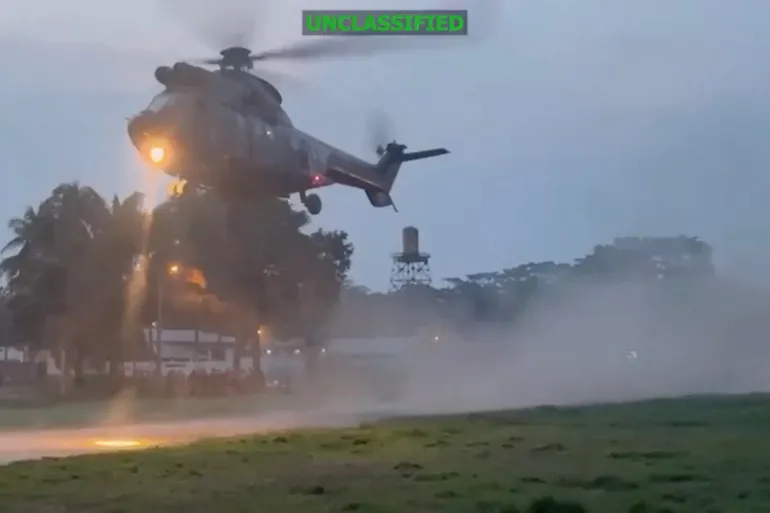
On Wednesday, US Southern Command, the military unit overseeing operations in Central and South America, posted that joint efforts had already begun in Ecuador.
“On March 3, Ecuadorian and US military forces launched operations against Designated Terrorist Organizations in Ecuador,” General Francis Donovan said.
“The operations are a powerful example of the commitment of partners in Latin America and the Caribbean to combat the scourge of narco-terrorism.”
The statement was accompanied by video footage of military helicopters taking off, as well as black-and-white aerial surveillance imagery of figures boarding helicopters on the ground.
The announcement appears to be part of US President Donald Trump’s broader push against criminal networks and drug cartels in Latin America.
The scope of the Ecuadorian operation is not yet known, but several US news outlets have reported that it is so far limited to supporting Ecuadorian troops through logistics and intelligence, citing government sources.
At a Wednesday news briefing, White House Press Secretary Karoline Leavitt praised the joint operation.
“Together, we are taking decisive action to confront narco-terrorists who have long inflicted terror, violence and corruption on citizens throughout the hemisphere,” she told reporters.
Since taking office for a second term last year, Trump has moved to label multiple prominent cartels as “foreign terrorist organisations”, a term typically reserved for armed groups with political aims.
His administration has paired those labels with an increasingly militaristic approach to combatting drug trafficking, including through the bombing of suspected smuggling vessels.
Critics have pointed out, however, that drug trafficking is considered a crime under international law, not an act of war, and that such lethal actions can be considered extrajudicial killings.
At least 44 aerial strikes have been carried out against alleged drug-smuggling boats and other maritime vessels in the Caribbean Sea and eastern Pacific Ocean.
The result has been 150 known deaths. The identities of the victims have yet to be confirmed by US officials, and no charges against them have been made public.
Two survivors who were recovered from an October attack on a submarine were quickly repatriated to their home countries, Ecuador and Colombia, where they were subsequently released.
Some families from Colombia and Trinidad and Tobago, meanwhile, have claimed that the deceased were fishermen or informal workers transiting between Venezuela and nearby islands, not drug traffickers.
The Trump administration has also launched military actions on Venezuelan soil, one in late December and a second on January 3. In both cases, it justified the strikes as law enforcement actions against drug traffickers.
The first targeted a dock allegedly used by the transnational gang Tren de Aragua. The second culminated in the abduction of Venezuelan President Nicolas Maduro, who was subsequently imprisoned and charged with drug trafficking and weapons charges in a US federal court.
That operation was likewise condemned as a violation of international law, with experts at the United Nations warning that it was “part of a broader and deeply troubling pattern” of unprovoked military aggression.
The Trump administration, however, has suggested it plans to expand its military operations against suspected drug traffickers to other land-based targets. The announcement from Ecuador suggests a new front for its military offensive.
Wednesday’s announcement comes two days after General Donovan, the head of the US Southern Command, visited Ecuadorian President Daniel Noboa and his defence ministers on March 2 in the capital of Quito.
Since the outbreak of the COVID-19 pandemic in 2020, Ecuador has seen a spike in homicides and other violent crimes, as criminal networks make inroads in the country.
Previously, Ecuador had some of the lowest rates of violent crime in the region, earning the country a reputation as an “island of peace” in Latin America.
But experts say the leap can be attributed to a number of factors, including high youth unemployment during the pandemic, economic instability, and a desire to exploit Ecuador’s strategic location on the Pacific coast, between major cocaine producers like Colombia and Peru.
Noboa, a right-wing leader who has been in office since 2023, campaigned for re-election last year on the pledge that he would tamp down on the uptick in crime. He has become closely associated with the “mano dura” or “iron fist” approach to law enforcement.
Trump too has encouraged Latin American leaders to be more aggressive in their handling of criminal networks, and both Noboa and Trump have threatened Colombia, led by left-wing leader Gustavo Petro, for allegedly failing to comply.
On March 1, for instance, Noboa plans to raise tariffs on Colombian imports to 50 percent as punishment for failing to crack down on cocaine trafficking.
On Wednesday, General Donovan praised the Ecuadorian military for their “unwavering commitment” to the fight “against narco-terrorists in their country”.
“Together, we are taking decisive action to confront narco-terrorists who have long inflicted terror, violence, and corruption on citizens throughout the hemisphere,” he said in a statement.
President Noboa, who has hosted Trump administration officials like Homeland Security Secretary Kristi Noem multiple times over the past year, also welcomed the increased collaboration.
“We are beginning a new phase in the fight against drug trafficking and illegal mining,” Noboa wrote on social media on March 2.
“The security of Ecuadorians is our priority, and we will fight for peace in every corner of the country. To achieve this peace, we must act decisively against criminals, wherever they may be.”
Still, critics responded to Wednesday’s announcement with scepticism and alarm about the increasing US military operations overseas.
Brian Finucane, a senior adviser at the International Crisis Group think tank, wrote on social media that the US has yet to clarify what its role in the joint operations was and what its targets were.
“My sense is that some in the administration have been itching to put US military boots on the ground somewhere for an operation against ‘narco-terrorists’ and then publicly brag about it,” Finucane said.
“Ecuador was more amenable than, say, Mexico.”
[Aljazeera]

Of 180 member crew, 30 rescued by Sri Lanka Navy
Iran warship IRIS Dena (F75), returning home after participating in the Indian International Fleet Review, and MILAN 2026 international naval exercises, has been sunk off Sri Lanka. The US, Russia and Iran were among 74 participants.
Speculation is rife that the US attacked the vessel in international waters as part of the continuing offensive action under Operation Epic Fury, launched on 28 February. Before the attack in the Indian ocean, President Trump declared that the Iranian Navy Headquarters and nine Navy vessels had been destroyed.
The ill-fated Moudge-class frigate participated in the Indian exercises with the US Navy’s Arleigh Burke-class guided-missile destroyer USS Pinckney (DDG-91) and the Marshal Shaposhnikov, a Udaloy-class frigate of the Russian Navy. Sri Lanka also participated in the exercises. SLNS Sagara and Israeli built Fast Missile Vessel Nandimithra represented Sri Lanka. Forty two warships and submarines and 29 aircraft had been involved.
At the time of the attack, the domestically built vessel was crewed by 180 officers and men.
The US Embassy here did not respond to The Island media query whether the US sank IRIS Dena . The Island was unable to get in touch with Iranian Ambassador in Colombo Alireza Delkhosh though he earlier indicated his availability later in the day.
Minister of Foreign Affairs, Foreign Employment and Tourism, Vijitha Herath, told the Parliament yesterday that the Sri Lanka Navy and the Sri Lanka Air Force had acted in less than an hour of receiving the distressed signal at 5.08 am.
According to the Minister, the first naval craft was dispatched by 6 am, followed by a second vessel at 7 am, while Air Force units joined the mission, including the deployment of a surveillance aircraft to support search operations.
Approximately 180 personnel were believed to have been on board the stricken vessel. Of them, around 30 were reported to be in critical condition.
“To save the lives of those 30 persons, we intervened immediately,” Minister Herath said, adding that the rescued crew members were being transported to Karapitiya Hospital for urgent medical treatment. Some had already arrived by the time of his statement.
SLPP MP Namal Rajapaksa asked whether the Iranian ship had been attacked within Sri Lanka’s Exclusive Economic Zone (EEZ).
Responding to questions raised by Opposition MPs, including NDF Badulla District MP Chamara Sampath Dassanayake, who alleged that the Iranian vessel may have been struck in Sri Lankan waters, the Minister said the ship had been outside Sri Lanka’s maritime boundary when it issued the distress call.
MP Dassanayake queried whether the frigate had been hit as part of the ongoing military escalation involving the United States and Israel against Iran. There was no immediate confirmation from the government regarding the cause of the emergency.
Minister Herath stressed that Sri Lanka’s intervention was guided solely by humanitarian considerations and international obligations.
“We are bound by the International Convention on Maritime Search and Rescue (SAR) of 1979, which we have signed,” he told Parliament.
Under the convention, a signatory state is required to respond to maritime emergencies, regardless of nationality, the cause of the incident, or whether it occurs beyond its own territorial waters.
“According to this convention, if a vessel, or its crew, encounters danger beyond our territorial limits, we are obligated to intervene and protect those lives on humanitarian grounds,” Minister Herath said, adding Sri Lanka had acted immediately to prevent loss of life and had taken all urgent and necessary measures as a responsible state.
The Minister noted that the incident highlighted broader regional security vulnerabilities in maritime safety amid escalating tensions in the region. “A regional military situation would also have an impact on our country. The government’s position is that a negotiated solution must be pursued,” he said.
He also disclosed that President Anura Kumara Dissanayake had held a telephone discussion on Tuesday night with the leadership of the United Arab Emirates regarding the evolving regional situation.
Rescue operations were continuing at the time of going to press.
By Saman Indrajith and Shamindra Ferdinando

Afternoon showers expected in the Uva and Sabaragamuwa provinces and in Hambantota, Nuwara-Eliya and Ampara districts

Trump administration launches US military operation in Ecuador

US sinks Iranian warship off Galle returning from Indian naval exercise

Justice Kumudini complains of male domination at senior levels, absence of a woman head of BASL

No qualified printer to head Government Printing Department

Wildlife Dept. fails on elephant fence management: Withanage

‘Dates have the highest sugar content to fight Coronavirus’

Sunday Island 27 December – Headlines

#SundayIsland 17th December – Headlines

Sunday Island – 28th March

Sunday Island Headlines – 21 March

Sunday Island – 21st February – Headlines
-
 Features3 days ago
Brilliant Navy officer no more
-
 Opinion6 days ago
Jamming and re-setting the world: What is the role of Donald Trump?
-
 Features6 days ago
An innocent bystander or a passive onlooker?
-
 Opinion3 days ago
Sri Lanka – world’s worst facilities for cricket fans
-

 Business6 days ago
An efficacious strategy to boost exports of Sri Lanka in medium term
-

 Features4 days ago
Overseas visits to drum up foreign assistance for Sri Lanka
-
 Features4 days ago
Sri Lanka to Host First-Ever World Congress on Snakes in Landmark Scientific Milestone
-

 Features3 days ago
A life in colour and song: Rajika Gamage’s new bird guide captures Sri Lanka’s avian soul