
Foreign News
77 arrested in violent protests over police killing of teenager

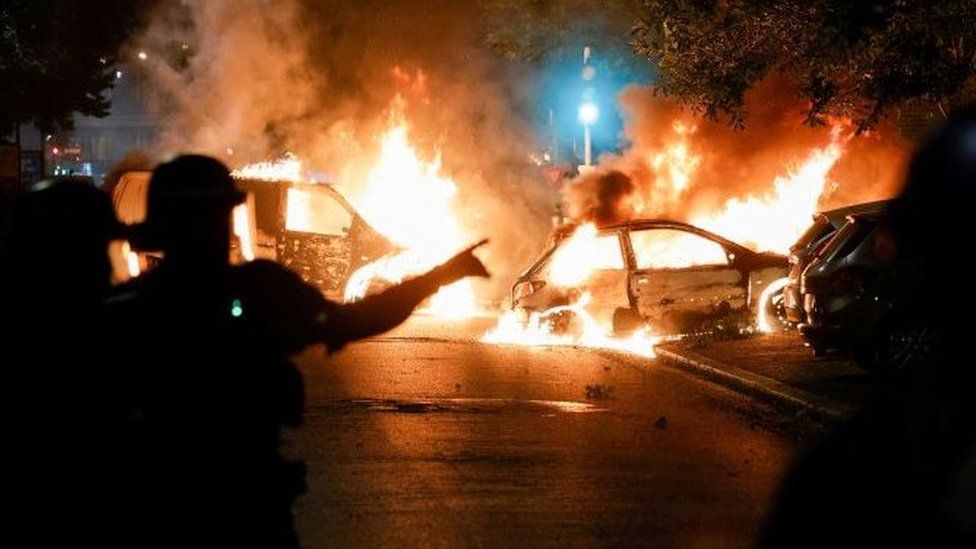
At least 77 people have been arrested in France during a second night of unrest triggered by the fatal shooting of a 17-year-old driver by police.
The teenager, named as Nahel M, was shot at point-blank range as he refused a traffic stop and drove away. Videos shared on social media showed cars being set alight and shops being ransacked on Wednesday across Paris.
A prison in Fresnes was also attacked with fireworks by rioters overnight, AFP reported. The news agency said videos showed about 20 young men attacking the entrance to the prison with fireworks and projectiles. Videos shared to social media showed an alarm sounding during the attack.
Meanwhile, in Nanterre, the Paris area Nahel was from, authorities were forced to partially withdraw, Le Monde reported.
The violence was particularly concentrated around the Pablo-Picasso district there, where young people took to the streets after the sun set. “They’re backing off! Let’s go guys, let’s go, death to cops!” one yelled, while various cars and rubbish bins were set alight. While the violence was concentrated in that district, protesters targeted other regions across Paris, with many firing fireworks into police stations.
In the northern city of Lille, footage posted online showed people inside the town hall of the Mons-en-Barœul suburb setting documents and chairs alight.
And elsewhere, in the western town of Rennes, about 300 people gathered to pay tribute to the teen – some of whom also lit fires and were dispersed by police.
On Tuesday, French President Emmanuel Macron said the shooting of Nahel was “unforgivable”. But his comments drew an angry reaction from police unions, who accused him of rushing to judge the officers involved. The Alliance Police union called for them to be presumed innocent until found guilty, while the rival Unité SGP Police also spoke of political interventions that encouraged “anti-cop hatred”.
Interior Minister Gérald Darmanin said he would be taking legal action against another group, France Police, after it published what he called an “unacceptable and abject” tweet seeking to justify the teenager’s killing. The now deleted tweet said “bravo” to the officers who “opened fire on a young criminal” and blamed the teen’s parents for his death, claiming they had been “unable to educate their son”.
(BBC)


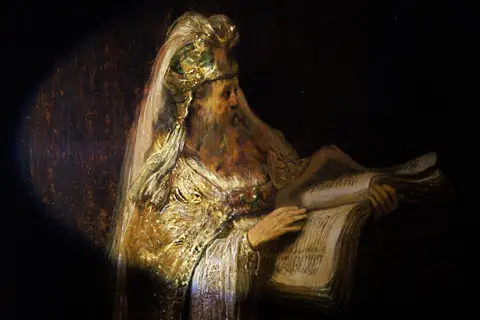
A long lost painting by Rembrandt has been rediscovered and authenticated by experts, after its whereabouts were unknown for decades.
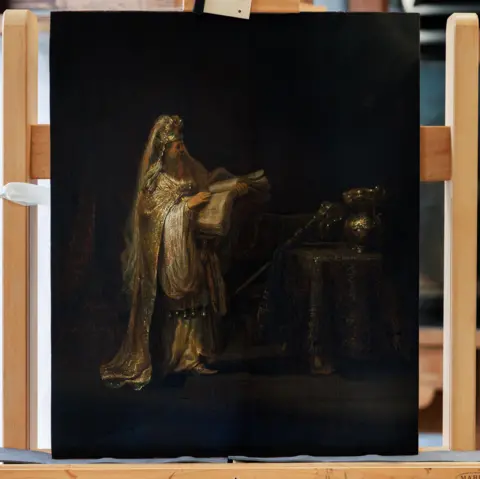
Rembrandt’s Vision of Zacharias in the Temple, from 1633, was excluded from a list of the Dutch master’s works in 1960, and disappeared after being sold to a private collector the following year.
But it resurfaced when its owners presented it for tests at the Rijksmuseum in Amsterdam, which undertook a two-year examination.
“When I saw it in our studio when it was restored, I was immediately struck by the incredible power it has,” Rijksmuseum director Taco Dibbits said.
The Rijksmuseum receives many emails from people asking for information about paintings they have inherited or bought, Dibbits said. In this case, they knew it could be something special.
“It came to us via email and one of our curators thought, this is really an interesting image, we’ve known about the painting for over 100 years but we’ve never seen it.”
The museum confirmed the authenticity after studying the paints, which fit with those used by Rembrandt during that period, and the painting technique and build-up of layers, which are also comparable with his other early works.
The signature is original and the wooden panel dates from the correct period, the researchers said.
“Materials analysis, stylistic and thematic similarities, alterations made by Rembrandt, and the overall quality of the painting all support the conclusion that this painting is a genuine work,” the gallery said.
The painting has all the hallmarks of Rembrandt at the “peak” of the early part of his career, Dibbits said.
“It’s very high quality. Sometimes with Rembrandt’s portraits you feel that he’s producing in quantity, but with this painting you really feel that he dedicated his soul to it.”
The museum will put the painting on public view from Wednesday.
Its value is not known, but the world record auction price for a Rembrandt painting is £20m, set in 2009.
Other Rembrandt paintings to be sold in recent years include one for £8.6m in 2019, a self-portrait for £12.6m in 2020, and another once-lost Rembrandt work for £11m in 2023.
In 2015, a Rembrandt painting was given a price tag of £35m by the UK government after being sold privately.
Last month, a drawing of a lion by the artist sold for $18m (£13m).
[BBC]
Rembrandt was 27 when he created the painting, which depicts the Biblical scene when priest Zacharias is told by the Archangel Gabriel that despite their age, he and his wife will have a son, John the Baptist.
The museum said Rembrandt had given the Biblical story an innovative twist. Instead of depicting the Archangel Gabriel visibly, he only suggested his presence. In doing so, he departed from established visual traditions and introduced a new way of representing this subject.
Rembrandt deliberately chose the decisive moment, just before Gabriel reveals his true identity.
It is one of the few history paintings Rembrandt created during this period. At the time, he was primarily producing portraits, which were highly lucrative.
[BBC]
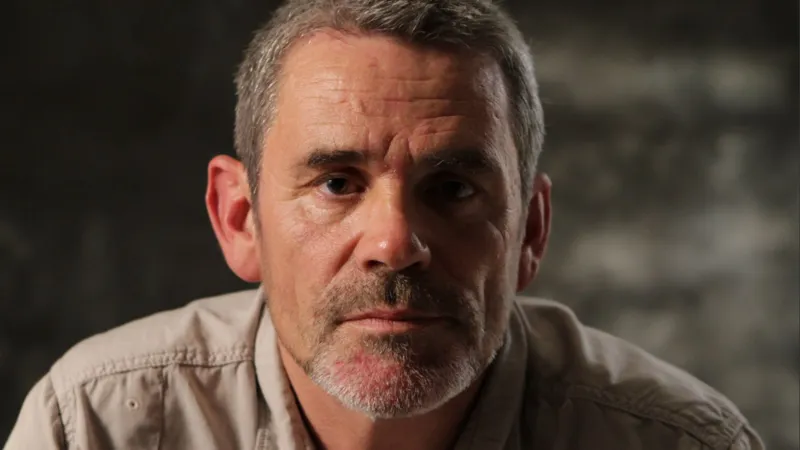
Tributes have been paid to the war photographer Paul Conroy who has died at the age of 61.
He covered conflicts around the world and was wounded in the Syrian army’s bombardment of Homs, which killed his Sunday Times colleague Marie Colvin in 2012.
Their fateful assignment was depicted in the 2018 movie A Private War, with the actor Jamie Dornan playing Conroy.
The Liverpool-born photographer died from a heart attack on Saturday in Devon, where he had lived, his brother Alan told the BBC.
“He did all his life what he wanted to do to make a difference – he found great pleasure in exposing wrongs,” Alan added.
BBC newsreader Clive Myrie posted that he was “utterly devastated” by the news, describing Conroy as “a wonderful photojournalist and a wonderful human being”.
“I counted him as a friend and a decent, principled and kind man. My brutha you will be sorely missed. RIP”
Lindsey Hilsum, international editor at Channel 4, added: “All of us who knew and loved him are devastated.”
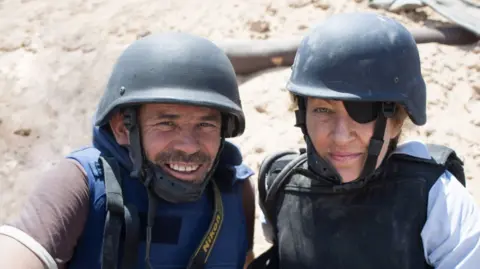
Conroy also spent seven years with the Royal Artillery as a soldier before becoming a professional photographer and was a trustee of the Frontline Club for media professionals, diplomats and aid workers.
Its founder Vaughan Smith, who was also in the Army, said: “He was one of the characters – those people who stand out because everybody adores them and they make you feel better.”
The 2018 documentary Under the Wire was made about Conroy’s escape from the 2012 bombardment of a makeshift media centre in Homs, where his colleagues Marie Colvin and Remi Ochlik were killed.
Referring to the Syrians who were killed in the area, he said: “These beautiful people who were being slaughtered, I wanted to tell their story.”
He only realised how badly injured he was when he returned to the UK.
“Obviously I knew I had a huge hole in the back of my leg,” he said.
“But in London I found out I also had a great big piece of shrapnel wedged under my kidneys. I had 23 operations on my leg and others on my abdomen and back. I was in hospital for five months.”
Conroy worked in Libya and Ukraine and had recently returned from an assignment in Cuba.
He also took photos for the British singer Joss Stone and wrote music with her.
She said she was “so grateful to have known him and honoured to call him my friend”.
“I wouldn’t be the person I am today without Paul. Paul Conroy was a legend. A wonderful person through and through. Always standing up for what was right. Always there for those in need.”
He leaves behind a wife, three sons and grandchildren.
[BBC]
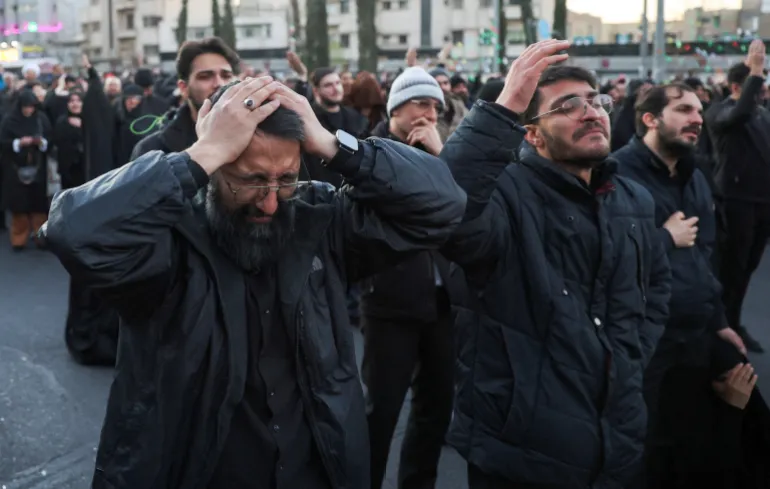
Iran has begun 40 days of mourning after Supreme Leader Ayatollah Ali Khamenei was killed in ongoing attacks by the United States and Israel, according to Iranian state media.
Top security officials were also killed in Saturday’s strikes, along with Khamenei’s daughter, son-in-law and grandson. The killings mark one of the most significant blows to Iran’s leadership since the 1979 Islamic revolution.
President Masoud Pezeshkian condemned the killing as “a great crime”, according to a statement from his office. He also declared seven days of public holidays in addition to the 40-day mourning period.
Reporting from Tehran, Al Jazeera’s Tohid Asadi said people were pouring into the streets of the capital following the news of Khamenei’s killing.
“There will be expected ceremonies,” he said, noting they would likely take place amid continuing bombardment across the country.
Protests denouncing Khamenei’s killing were also reported elsewhere, including Shiraz, Yasuj and Lorestan.
Footage aired by Iranian state media showed supporters mourning at the shrine of Imam Reza in Mashhad, with several people seen crying and collapsing in grief.
The killing also led to protests in neighbouring Iraq, which declared three days of public mourning. In Baghdad, protesters confronted security forces in the heavily fortified Green Zone, which houses Iraqi government buildings and foreign embassies.
Videos verified by Al Jazeera showed demonstrators waving flags and shouting slogans, with witnesses saying some were attempting to mobilise towards the US Embassy. Footage also showed protesters blocking vehicles at a roundabout near one of the entrances to the area.

There was also a protest in the Pakistani city of Karachi, where footage, verified by Al Jazeera, showed people setting fire to and smashing the windows of the US consulate.
However, there have also been reports of celebrations in Iran, with the Reuters news agency quoting witnesses as saying some people had taken to the streets in Tehran, the nearby city of Karaj and the central city of Isfahan.
Meanwhile, the official IRNA news agency reported that a three-person council, consisting of the country’s president, the chief of the judiciary, and one of the jurists of the Guardian Council, will temporarily assume all leadership duties in the country. The body will temporarily oversee the country until a new supreme leader is elected.
Khamenei assumed leadership of Iran in 1989 following the death of Ayatollah Ruhollah Khomeini, who had led the Islamic revolution a decade earlier.
While Khomeini was regarded as the ideological force behind the revolution that ended the Pahlavi monarchy, Khamenei went on to shape Iran’s military and paramilitary apparatus, strengthening both its domestic control and its regional influence.
Meanwhile, the Islamic Revolutionary Guard Corps (IRGC) pledged revenge and said it had launched strikes on 27 bases hosting US troops in the region, as well as Israeli military facilities in Tel Aviv.
[Aljazeera]

Trump says Iran war projected to last 4 to 5 weeks, could go ‘far longer’

Qatar downs two Iranian fighter jets as conflict widens

Jammu and Kashmir’s long road to India cricketing glory

Rembrandt painting worth millions rediscovered after 65 years

Zimbabwe, West Indies delayed from returning home following West Asia airspace closure

Dry weather will prevail in most parts of the island

‘Dates have the highest sugar content to fight Coronavirus’

Sunday Island 27 December – Headlines

#SundayIsland 17th December – Headlines

Sunday Island – 28th March

Sunday Island Headlines – 21 March

Sunday Island – 21st February – Headlines
-
 Opinion4 days ago
Jamming and re-setting the world: What is the role of Donald Trump?
-
 Features4 days ago
An innocent bystander or a passive onlooker?
-
 Features5 days ago
Ratmalana Airport: The Truth, The Whole Truth, And Nothing But The Truth
-
 Features6 days ago
Building on Sand: The Indian market trap
-
 Opinion6 days ago
Future must be won
-

 Business6 days ago
Dialog partners with Xiaomi to introduce Redmi Note 15 5G Series in Sri Lanka
-
 Business5 days ago
IRCSL transforms Sri Lanka’s insurance industry with first-ever Centralized Insurance Data Repository
-
 Opinion1 day ago
Sri Lanka – world’s worst facilities for cricket fans