
Latest News
116,000 Scholarships under the Presidential Scholarship Program – 2024

- Rs.824 Million Allocated for G.C.E. (A/L) Students.
- Rs.3, 600 Million for 100,000 Students from Grade 1 to Grade 11.
- Rs.288 Million for Student Monks and Sheela Matha.
- Rs.720 Million for G.C.E. (A/L) Students in ICT.
- Schools Not Yet Applied for Scholarships Urged to Apply Soon- President’s Fund.
One Hundred and sixteen thousand (116,000) scholarships are to be awarded for the year 2024 under the “Presidential Scholarship Program”, which is implemented according to the concept of President Ranil Wickremesinghe, for the upliftment of the education of the children of the underprivileged.
Accordingly, Rs. 824 million has been allocated for the scholarship program, which will provide Rs. 6000 per month for 24 months to 6000 students studying for their G.C.E. (A/L)s. Additionally, Rs. 3600 million has been allocated for a scholarship program that grants Rs. 3000 per month for 12 months to 100,000 students from grade 1 to grade 11.
In addition, Rs. 288 million has been allocated for the scholarship program offered to student monks, Seela Matha, and lay students studying in Piriven and Seela Matha educational institutes. Furthermore, Rs. 720 million has been allocated for the scholarship program jointly offered by the Regulatory Commission and the President’s Fund for students studying telecommunication as a subject for the G.C.E. (A/L) examination.
Accordingly, in addition to the existing scholarship programs, more than Rs. 5000 million will be allocated to students for these scholarship programs.
Under the two scholarship programs implemented for G.C.E. (A/L) students and children from grade 1 to grade 11, the following allocations will be made: 242 G.C.E. (A/L) students in four education zones of the Colombo district and 4866 students from grade 1 to grade 11 will receive scholarships. Additionally, 240 G.C.E. (A/L) students in four education zones of the Gampaha district and 6234 students from grade 1 to grade 11 will be awarded scholarships. In the Kalutara district, 180 G.C.E. (A/L) students in three education zones and 4390 students from grade 1 to grade 11 will receive scholarships.
In the Jaffna district, 300 G.C.E. (A/L) students and 3544 students from grade 1 to grade 11 in five education zones will be awarded scholarships. In the Mannar district, 120 G.C.E. (A/L) students and 1030 students from grade 1 to grade 11 in two education zones will receive scholarships. For the Vavuniya district, 120 G.C.E. (A/L) students and 1298 students from grade 1 to grade 11 in two education zones will receive scholarships. In the Mullaitivu district, 120 G.C.E. (A/L) students and 1028 students from grade 1 to grade 11 in two education zones will be awarded scholarships. In the Kilinochchi district, 120 G.C.E. (A/L) students and 956 students from grade 1 to grade 11 in two education zones will receive scholarships.
364 G.C.E. (A/L) students and 8392 students from grade 1 to grade 11 in 6 education zones of the Kurunegala district, 120 G.C.E. (A/L) students, and 4046 students from grade 1 to grade 11 in 2 education zones of the Puttalam district will receive scholarships.
300 G.C.E. (A/L) students and 3436 students from grade 1 to grade 11 in 5 education zones of the Batticaloa district, 420 G.C.E. (A/L) students and 4340 students from grade1 to grade 11 in 7 education zones of the Ampara district, and 300 G.C.E. (A/L) students and 2972 students from grade 1 to grade 11 in 5 education zones of the Trincomalee district will receive scholarships.
360 G.C.E. (A/L) students and 5410 students from grade 1 to grade 11 in education zones of the Badulla district, 240 G.C.E. (A/L) students, and 2994 students from grade 1 to grade 11 in 4 education zones of the Monaragala district will be awarded scholarships, while 240 G.C.E. (A/L) students and 5642 students from grade 1 to grade 11 in 4 education zones of the Ratnapura district, and 180 G.C.E. (A/L) students, and 4524 students from grade 1 to grade 11 in 3 education zones of the Kegalle district, scholarships will be provided.
360 G.C.E. (A/L) students and 6472 students from grade 1 to grade 11 in 6 education zones of the Kandy district, 240 G.C.E. (A/L) students, and 2894 students from grade 1 to grade1 11 in 4 education zones of the Matale district, and 300 G.C.E. (A/L) students and 4940 students from grade 1 to grade 11 5 education zones of the Nuwara Eliya district will receive scholarships.
240 G.C.E. (A /L) students and 4410 students from Grade 1 to grade 11 in 4 education zones of the Galle district, 240 G.C.E. (A/L) students, and 3644 students from grade 1 to grade 11 in 4 education zones of the Matara district, and 180 G.C.E. (A/L) students, and 3330 students from grade1 to grade 11 in 3 education zones of the Hambantota district will be awarded scholarships.
On behalf of 300 G.C.E. (A/L) students and 5360 students from grade 1 to grade 11 in 5 education zones of the Anuradhapura district, and 177 G.C.E. (A/L) students, and 2456 students from grade 1 to grade 11 in 3 education zones of the Polonnaruwa district will be awarded scholarships.
The President’s Fund will arrange scholarships for all selected students at the school level. Each school will receive scholarships based on its student enrolment, with details available from the Zonal Education Office. A list of schools yet to apply for scholarships has also been provided to the Zonal Education Offices. Therefore, schools that have not yet applied are urged to do so promptly.
In addition to the on-going scholarship programs, a ceremony chaired by President Ranil Wickremesinghe will soon award 5,000 scholarships to student monks at Piriven and Sheela Matha educational institutes in Colombo.
(PMD)





Like every year, Pushpraj Rimal, a tour planner and taxi driver in Nepal’s capital, Kathmandu, was looking forward to September for his business to boom.
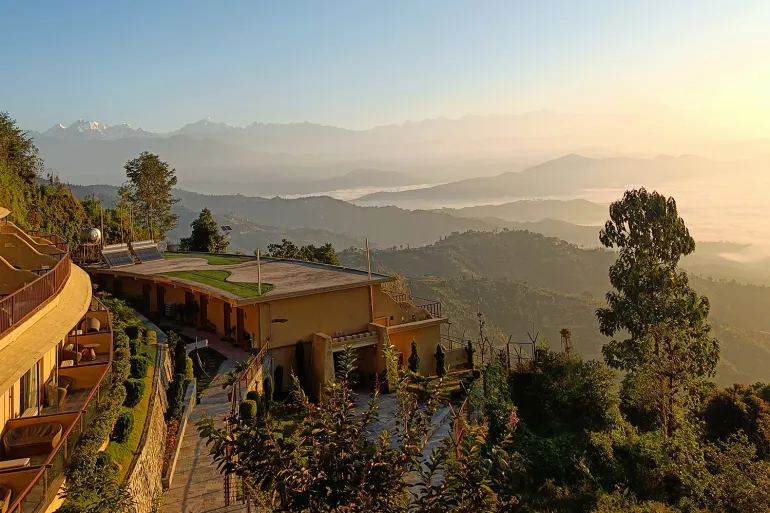
But what he got instead was a series of cancellations by tourists after catastrophic floods last month killed more than 1,450 people and destroyed key highways, deeply impacting the Himalayan nation heavily dependent on tourism.
“It is still a lockdown kind of situation,” the 42-year-old told Al Jazeera nearly a month after the disaster.
Pushpraj, who speaks Nepali and Hindi, works on commission for several hotels and trekking companies in Kathmandu and the scenic town of Pokhara, known for its lake nestled in the Annapurna mountain range. Pokhara also serves as a base for Himalayan trekkers.
Nepal’s tourist season peaks after the monsoon ends in August and the skies are clearer. Tourism attracts thousands of international travellers, accounting for nearly 8 percent of Nepal’s gross domestic product and employs more than 1 million people.
Last year, Nepal saw more than 1.15 million tourists visiting the country, nearly a third of them during the September-November season.
But the floods this year, triggered by a glacial mountain collapse along the Nepal-Tibet border in the north, have pushed tourists away from the unaffected areas as well.
“I had rented two cars for two months, but I have done one fourth of the business I usually do in a season. Tourists generally start pouring in from September, but most of them have cancelled this year,” he said.
“I will get no commissions from the hotels or trek organisers, nor has the taxi business worked well. … I am now waiting for the season to end.”
Rimal has two children, Hema, 14, and Rahul, 12, whom he had promised a tablet this Dussain, a prominent Hindu festival that usually falls in October. “But it seems impossible now. I will have to break their hearts and my promise to them for the very first time.”
(Aljazeera)

World javelin leader Rumesh Tharanga lived up to his reputation to win Sri Lanka a highly anticipated gold medal, beating wet weather and track conditions at the Asia Games in Nagoya Japan a little while ago.
He took the lead with a massive 88.33 metres effort in his penultimate throw before sealing the contest with 88.55 metres throw.
He beat a strong field inclusive of reigning Olympic champion Arshad Nadeem of Pakistan. (Reemus Fernando)

Sri Lankan javelin star Rumesh Tharanga is on the cusp of winning the men’s javelin throw gold medal at the Asian Games in Nagoya, Japan, after producing a leading throw of 88.33 metres.
Tharanga’s effort has placed him at the top of the standings with one attemp remaining.
The 88.33m throw once again underlined the Tharanga’s consistency at the highest level and has put him firmly in contention to add another major international title to his growing collection of honours.

Washout against Afghanistan sends India into semi-finals

‘Still a lockdown’: Deadly floods hit Nepal tourism as peak season begins

Tharanga wins highly anticipated Asian Games gold

Tharanga on cusp of Asian Games Gold

Rain threat looms over lopsided India vs Afghanistan quarter-final

Out, not-out, out: England secure bizarre run-out in Oval victory

‘Dates have the highest sugar content to fight Coronavirus’

Sunday Island 27 December – Headlines

#SundayIsland 17th December – Headlines

Sunday Island – 28th March

Sunday Island Headlines – 21 March

Sunday Island – 21st February – Headlines
-

 News6 days ago
Mastermind Naufer Moulavi among 15 found guilty
-
 Midweek Review6 days ago
Thileepan’s fast unto death: An authentic narrative that many missed
-
 News7 days ago
Protest against setting up of cement factory in highly populated area near BIA
-

 Editorial7 days ago
Trouble beginning in earnest
-

 Latest News5 days ago
Showers above 100 mm are likely at some places in the Western, Sabaragamuwa, Central and North-western provinces and in Galle and Matara Districts
-
Editorial6 days ago
Big Bad Bills
-
 News7 days ago
Police may seek clarification from US
-
 News7 days ago
Govt. confident of 2/3 majority despite NPP split speculation