
News
Zuhair raps govt. for listing of Muslim organisations and individuals

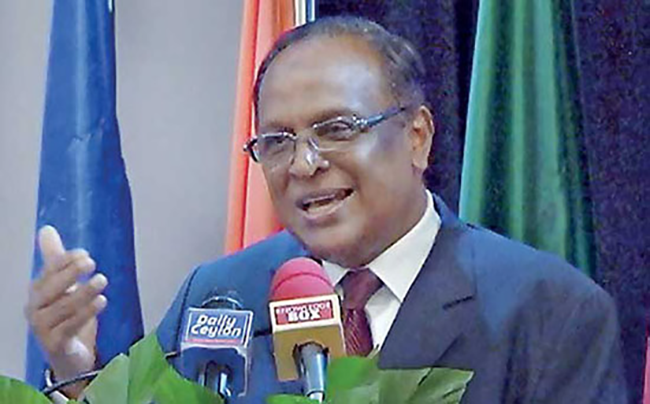
Former lawmaker M M Zuhair, PC, has questioned the rationale behind the government alleging that 156 Sri Lankan Muslims and six Muslim organisations funded, or were associates of al-Qaeda or ISIL. One-time Sri Lanka’s Ambassador in Teheran said that Sri Lanka’s list of designated persons, and organisations, violated UN Security Council resolution 2253 of 2015.
Zuhair has said in a media statement: “While welcoming President Ranil Wickremesinghe’s statement at the recent annual conference of the Orgnisation of Professional Associations (OPA) on the need to “sort out the problems among the ethnic groups, as this has gone on for too long, as the war was over in 2009, and there is no need to fight again”, it is time that the President and his government do not permit unacceptable and unauthorised procedures being adopted to marginalize and ostracise minority community institutions, and individuals, under cover of national security, as we fear certain measures being unlawfully pursued will enhance radicalisation and counter radicalisation, in the country, leading to conflicts.
At this time of dire economic crisis, confronting the country, attributed by some to the ‘curse of all religious groups’, the urgent need is the unity of all the communities, as well as the economic support of all countries!
But why is the Foreign Ministry, through its competent authority, misusing, in its 1st August 2022 listing, the UN Security Council (SC) resolutions 1267 of 1999 and eight related subsequent SC resolutions, including resolution 2253 of 2015, the last in the series as quoted by the Sri Lankan authorities? The clear purpose of the Security Council resolutions was to control funding the terrorist entities, originally the then Taliban and later the Al-Qaeda and the Islamic State of Iraq and Levant (ISIL). How can the six Sri Lankan Muslim Organisations, and 156 Sri Lankan Muslims, be accused of funding any foreign terrorist entities or being associates of Al-Qaeda or ISIL?
Surely the Foreign Ministry has no proof that any one of these Sri Lankan entities, or persons, had funded the Taliban, the Al-Qaeda, or the ISIL, at any time, even though these entities, as originally resolved by the Security Council, had ceased to exist!
UN Security Council resolution 2253 of 2015 has unequivocally identified the target group of the resolution, in Section 2 as the ‘ISIL’, ‘Ai-Qaeda’ and associated individuals, groups, undertakings and entities’. The listing criteria are set out in Section 3 and are far beyond any fisherman’s hook! Is it the position of the Sri Lankan Foreign Ministry that the six, plus 156 Sri Lankan Muslim organisations and persons, are associates of terror outfits, ISIL or Al-Qaeda, thereby exposing Sri Lanka wrongfully for actions, including sanctions and damage claims by individuals, countries or the international community?
Then DIG of the CID, Ravi Seneviratne, gave evidence before the Parliamentary Select Committee that probed the Easter Sunday attacks of 21/04/2019 that there was no evidence of any links between Sri Lanka’s Easter Sunday suicide bombers and the ISIL or the Ai-Qaeda. The Defence Ministry has, on a number of instances, refuted foreign media allegations and assumptions attempting such links with foreign terror outfits. The Catholic Church has time and again pointed to elements seeking to net in the ISIS to take responsibility for the Easter attacks, for days after 21/04. The attempt was to show a non-existing link.
The 1st August 2022 listing of designated persons, purportedly under Article 41 of the UN Charter, is invalid and of no force or avail in law for several other reasons as well, including that Article 41 is entirely for the extraordinary UN objective of preventing wars and conflicts between nations and not to harass, humiliate or terrorise persons and organisations totally unconnected to ISIL or Al-Qaeda as defined in paragraph numbered 2 and the listing criteria in paragraph 3 of the Security Council resolution 2253 of 2015, not renewed thereafter because the two anti-Islamic entities have been killed and cremated.
In addition, several provisions in the gazetted regulations are violative of international laws, the provisions of the Constitution of Sri Lanka and Security Council resolution 2253 of 2015. The violations may become issues in the International Court of Justice in Hague, the UN Human Rights Council in Geneva and the Human Rights Commission of Sri Lanka in Colombo, unless the listing of Muslim organisations and individuals are promptly reviewed and cancelled. “



In terms of the provisions of the Establishments Code on payment of festival advance to government officers, there’s a possibility of obtaining rupees 10,000/- as an advance for celebrating festivals of Theipongal, Ramazan, Sinhala and Hindu New Year, Wesak, Deepavali, and Christmas as well as for pilgrimages (Sri Paada pilgrimage and Hajj pilgrimage).
Provisions have been given to recover the said advance in 08 installments or if required earlier without interest. It has been proposed by the Budget 2026 to increase the said festival advance up to rupees 15,000/-.
Accordingly, the Cabinet of Ministers granted approval to the proposal submitted by the Minister of Public Administration, Provincial Councils and Local governments to revise the relevant provisions so that the festival advance can be increased up to rupees 15,000/- .
As per the approval given by the cabinet meeting held on 02-06-2025, action is being taken at present to offer the underutilized lands/properties of the Sri Lanka State Plantation Corporation, the Janatha Etate Development Board, and the Elkaduwa Plantation Company which are under the Ministry of Plantation and Community Infrastructure which have been identified under stage one to suitable investors.
Accordingly, the Cabinet of Ministers has approved the proposal presented by the Minister of Plantations and Community Infrastructure to provide following lands/properties on a lease basis to the suitable investors for optimal utilization following the prescribed procurement procedure.
• underutilized lands/properties identified under stage two owned by the Sri Lanka State Plantation Corporation, the Janatha Estate Development Board, and the Elkaduwa Plantation
Company,
• The Mawarala watte land and the Tea factory 40.48 hectares in extent, located in Matara District belonging to the Tea Shakthi Fund.
• The underutilized land of 1,541 hectares in extent of Kondachchi Estate is enjoyed by the Sri Lanka Cashew Corporation.
The drafting of the National Fisheries and Aquaculture Policy has commenced with the objective of equitable distribution of the benefits of the fisheries industry and the sustainable management of fisheries and aquaculture. This policy has been updated from time to time according to current requirements. However, steps have not been taken to obtain the approval of the Cabinet of Ministers for that purpose.
According to the policy declaration of the present government, ‘Vistas of Prosperity and Splendor’ the National Fisheries and Aquaculture Policy has been redrafted, updating the aforementioned policy in line with the economic and development objectives of the government.
The recommendations of the Department of National Planning have been received for the drafted policy.
Accordingly, the Cabinet of Ministers has approved the proposal presented by the Minister of Fisheries, Aquaculture, and Marine
Resources to implement the National Fisheries and Aquaculture Policy, integrating it with other relevant policies.

Lanka Premier League draft set to take place on March 22

Trump to meet Venezuelan opposition leader Machado at the White House

Festival advance for government officers to be increased
Providing underutilized lands/properties to suitable investors for optimal utilization.
Implementation of the National Fisheries and Aquaculture Policy

Expressions of Interest called to develop selected locations within the Pelawatte Sugar Factory premises

‘Dates have the highest sugar content to fight Coronavirus’

Sunday Island 27 December – Headlines

#SundayIsland 17th December – Headlines

Sunday Island – 28th March

Sunday Island Headlines – 21 March

Sunday Island – 21st February – Headlines
-

 News3 days ago
Sajith: Ashoka Chakra replaces Dharmachakra in Buddhism textbook
-

 Business3 days ago
Dialog and UnionPay International Join Forces to Elevate Sri Lanka’s Digital Payment Landscape
-

 Features3 days ago
The Paradox of Trump Power: Contested Authoritarian at Home, Uncontested Bully Abroad
-

 Features3 days ago
Subject:Whatever happened to (my) three million dollars?
-

 News2 days ago
Level I landslide early warnings issued to the Districts of Badulla, Kandy, Matale and Nuwara-Eliya extended
-

 News2 days ago
National Communication Programme for Child Health Promotion (SBCC) has been launched. – PM
-

 News3 days ago
65 withdrawn cases re-filed by Govt, PM tells Parliament
-

 Opinion5 days ago
The minstrel monk and Rafiki, the old mandrill in The Lion King – II