
Latest News
WWC 2025: New Zealand look to build on momentum against under-fire Sri Lanka

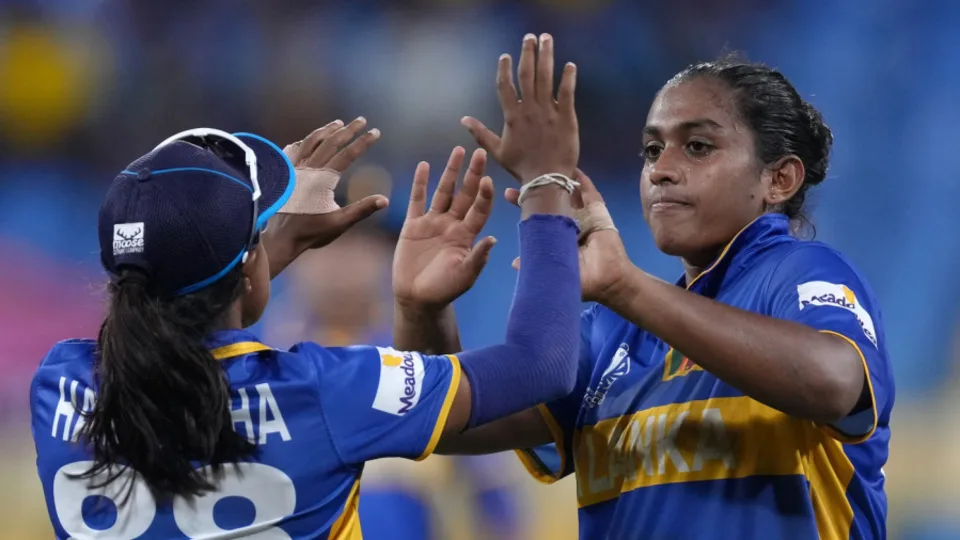
Someone find a power pylon, a generator… even a car battery would do. Attach the wires to Sri Lanka’s Women’s World Cup 2025 campaign. Two games (and one washout) in, it desperately needs to be shocked to life. Although they are playing at home, this World Cup schedule was always going to be a challenge – they were playing the teams they have struggled most against in their first three games. And so far, only that point from the washout against Australia is keeping some sort of hope alive.
New Zealand have had a rough start to the tournament too, thumped by Australia in their opener, before South Africa strode past them with relative ease. But they do, more recently, have that win against Bangladesh to hold them over. Their campaign doesn’t quite need the defibrillator as badly as Sri Lanka do. But a loss in Colombo today would be a major blow to their hopes of qualifying for the semi-final, with South Africa and England now rolling into serious form, while Australia and India have more-or-less played like the tournament favourites they were expected to be.
The problem for New Zealand, is that Sri Lanka have beaten them in their most-recent ODI series in Sri Lanka – a three-match series in Galle in 2023, which Sri Lanka won 2-1. The problem for Sri Lanka, is that both those ODI victories had been founded on truly epic performances from Chamari Athapaththu, with the 140 not out off 80 balls in the conversation for being her best innings ever.
In any case, New Zealand’s batting – however lacklustre by their own standards – is in significantly better shape this tournament than Sri Lanka’s has been. All three New Zealand innings have produced totals between 225 and 240. Against England on Saturday, Sri Lanka nosedived to 164 at this very venue.
New Zealand meanwhile, are fresh from rolling Bangladesh over for 127. That performance was more a result of their seamers – Jess Kerr and Lea Tahuhu taking three apiece – where it is spin that usually decides matches at Khettarama. Legspinner Amelia Kerr has five wickets in the tournament, but may need a little more support from the other spinners than she has had so far, if New Zealand are to make a statement today [Tuesday].
Sri Lanka will be extremely wary of Ameliya Kerr’s bowling, given she averages 24.62 in Asia. But this tournament is yet to see the best of Kerr the batter, and perhaps their stop in Sri Lanka is the place to change that. She has played only three innings on the island – in that 2023 series. But she did hit a 108 off 106 balls in the only match of that series that New Zealand won. It’s not as if she’s been especially bereft of form, having made some starts at No. 3 this World Cup. But each of those innings has been slightly laboured. Kerr firing at first-drop would make New Zealand a much more daunting opposition towards the end of this tournament.
Sri Lanka batter Hasini Perera has attracted a little bit of criticism over the past week or so. While Sri Lanka’s top order fails, she has been an easy target, partly because of her long-term record. After 53 ODI innings, Hasini has a high score of 46. She has, this year, been asked to sacrifice her preferences for the team, however. Sri Lanka see Vishmi Gunaratne as an investment in the future, and have sent her down to No. 4, where, it is hoped, she will have a greater chance of success in this development phase of this career. And Hasini, who averages a respectable 33 at No. 4, has been asked to open. She top-scored for Sri Lanka in the loss to England, so clearly she is not out of her depth at the top of the order. But she needs a good score – a fifty ideally – to fend the critics off.
Colombo’s weather continues to be as it has been in the last two weeks – humid, hot, with frequent showers rolling through. Expect the track to take good turn again, as it did on Saturday.
Sri Lanka will think about Dewmi Vihanga’s place in the XI. She offers offspin and some hitting with the bat, which is why Sri Lanka picked her against England ahead of another seamer. But she does also tend to be a liability in the field. Seamer Malki Madara, who impressed in the tri-series earlier in the year, also waits in the squad.
Sri Lanka (possible): Hasini Perera, Chamari Athapaththu (capt), Harshith Samarawickrama, Vishmi Gunaratne, Kavisha Dihari, Nilakshika Silva, Anushka Sanjeewani (wk), Dewmi Vihanga/Malki Madara/Achini Kulasuriya, Sugandika Kumari, Udeshika Prabodhani, Inoka Ranaweera
New Zealand may retain their winning XI.
New Zealand (possible): Suzie Bates, Georgia Plimmer, Amelia Kerr, Sophie Devine (capt), Brooke Halliday, Maddy Green, Isabella Gaze (wk), Jess Kerr, Rosemary Mair, Lea Tahuhu, Eden Carson
[Cricinfo]


After three one-sided, low-scoring encounters, the fourth T20I between India and Sri Lanka exploded into a run-fest in Thiruvananthapuram, with both sides posting their highest totals in women’s T20Is. India’s big score of 221 for 2 proved too much for Sri Lanka, who fell short by 30 runs, handing the hosts a 4-0 series lead with one match remaining. India missed two catching opportunities and a stumping chance, while Sri Lanka gave away three, but the batting dominance was decisive.
Smriti Mandhana and Shafali Verma set the tone with blistering half-centuries to power India’s innings, while Chamari Athapaththu kept Sri Lanka in the chase with a fighting 52. Despite a few late cameo efforts, the visitors couldn’t overcome India’s dominant batting display.
Shafali and Mandhana delivered a masterclass in aggressive opening batting, putting together 162 runs off just 92 balls – the highest opening partnership for India in women’s T20Is. Shafali continued her purple patch with a third successive T20I half-century, while Mandhana, who had managed only 40 runs in the first three matches, roared back to form. The innings also saw Mandhana climb to the top of the charts for most runs (1,703) in women’s internationals in a calendar year, underlining her dominance.
India’s openers were relentless from the outset, racing to 61 without loss in the powerplay with 12 boundaries. Shafali’s innings was built on control and placement – her first six came only after her fifty, a loft over long-off in the 11th over – and she finished with 12 fours and a six.
Mandhana, meanwhile, struck 11 fours and three sixes, though her innings briefly dipped in tempo. After racing to 24 off 14 balls, she moved to 28 off 24 during a short lull before accelerating sharply to reach her half-century off 35 deliveries. From there, she cut loose, using the feet to loft the spinners and driving straight with authority.
The contest decisively tilted in overs 11 to 13, when India tore into the attack. The 11th over went for 15 runs, followed by a 20-run 12th and an 18-run 13th, each featuring two fours and a six. Any hopes Sri Lanka had of restricting the damage vanished as India surged from 85 for no loss to 120 in just two overs.
India brought up 150 in only 14.2 overs, making light of the Sri Lanka captain’s assessment at the toss that 140 would be a competitive total.
Sri Lanka had to wait 92 balls for their first breakthrough and struck again in the following over, the 17th, but any momentum was swiftly snuffed out by Richa Ghosh. With Harleen Deol replacing Jemimah Rodrigues, who was recovering from a mild fever, India promoted Ghosh to No. 3 for the death overs – a move that paid rich dividends. Having faced just one delivery in the series before this match, Ghosh made an impact, blasting 40 off 16 balls and adding an unbroken 53-run stand with Harmanpreet Kaur.
Ghosh announced herself by heaving her second ball over Nimasha Meepage’s head for four. After a relatively quiet 17th over, she found her range against the same bowler, striking two more boundaries. The onslaught peaked against Kavisha Dilhari, one of Sri Lanka’s more experienced bowlers, as Ghosh went into overdrive. She smoked three sixes and a four to plunder 23 runs from the 19th over, punishing anything in her hitting arc and underlining India’s ruthless finish.
Sri Lanka began their chase aggressively, with Hasini Perera taking charge. She tore into Renuka Singh’s first over, hitting three boundaries, while Arundhati Reddy, making a comeback in place of the rested Kranti Gaud, conceded 17 off the second over. By the end of four, Sri Lanka had raced to 52 for 0, with the opening stand between Perera and Athapaththu putting on 59 runs off 34 balls.
Athapaththu struck the chase’s first six, charging down the track and clearing long-off off Deepti Sharma in the third over. Both left-handers punished anything too full or short, though Perera fell in the sixth over, holing out to Harmanpreet at mid-off off Reddy’s offcutter.
Athapaththu kept the momentum going, adding 57 runs off 46 balls with Imesha Dulani for the second wicket. Athapaththu moved from 20 off 15 balls to fifty in the next 19 deliveries, hitting three sixes and as many fours. However, her innings ended when she mistimed a charge over the off side, gifting a catch to Mandhana at long-off off Vaishnavi Sharma. At that stage, Sri Lanka needed 106 runs from 42 balls. Despite a few late cameos, the chase fell short.
On a night dominated by big scores, Vaishnavi emerged as the standout bowler, picking up two crucial wickets for just 24 runs. Introduced into the attack after the powerplay, she began by floating the ball outside off stump to entice the batters before gradually attacking the stumps and testing the left-handers with clever variations.
After dismissing Athapaththu in the 13th over, she also removed Harshitha Samarawickrama for a 13-ball 20 in the 17th, when the batter looked threatening. Her disciplined lines and sharp changes of pace helped India keep Sri Lanka’s scoring in check.
Brief scores:
India Women 221 for 2 in 20 overs (Smriti Mandhana 80, Shafali Verma 79, Richa Ghosh 40*, Harmanpreet Kaur16*; Malsha Shehani 1-32, Nimasha Meepage 1-40) beat Sri Lanka Women 191 for 6 in 20 overs (Chamari Athapaththu 52, Hasini Perera 33, Imesha Dulani 29, Harshitha Samarawickrama 20, Kavisha Dilhari 13, Nilakshika de Silva 23*; Arundhati Reddy 2-42, Vaishnavi Sharma 2-24, Shree Charani 1-46) by 30 runs
(Cricinfo)

Polls have opened in Myanmar’s first general election since the country’s military toppled Nobel laureate Aung San Suu Kyi’s democratically elected government in a 2021 coup.
The heavily restricted election on Sunday is taking place in about a third of the Southeast Asian nation’s 330 townships, with large areas inaccessible amid a raging civil war between the military and an array of opposition forces.
Following the initial phase, two rounds of voting will be held on January 11 and January 25, while voting has been cancelled in 65 townships altogether.
“This means that at least 20 percent of the country is disenfranchised at this stage,” said Al Jazeera’s Tony Cheng, reporting from Myanmar’s largest city, Yangon. “The big question is going to be here in the cities, what is the turnout going to be like?”
In Yangon, polling stations opened at 6am on Sunday (23:30 GMT, Saturday), and once the sun was up, “we’ve seen a relatively regular flow of voters come in,” said Cheng.
“But the voters are generally middle aged, and we haven’t seen many young people. When you look at the ballot, there are only few choices. The vast majority of those choices are military parties,” he said.
The election has been derided by critics – including the United Nations, some Western countries and human rights groups – as an exercise that is not free, fair or credible, with anti-military political parties not competing.
Aung San Suu Kyi, who was deposed by the military months after her National League for Democracy (NLD) won the last general election by a landslide in 2020, remains in detention, and her party has been dissolved.
The pro-military Union Solidarity and Development Party (USDP) is widely expected to emerge as the largest party.
The military, which has governed Myanmar since 2021, said the vote is a chance for a new start, politically and economically, for the nation of 55 million people, with Senior General Min Aung Hlaing consistently framing the polls as a path to reconciliation.
Dressed in civilian clothes, the military chief cast his ballot shortly after polling stations opened in Naypyidaw, the country’s capital. He then held up an ink-soaked figure and smiled widely.
Voters must dip a finger into indelible ink after casting a ballot to ensure they do not vote more than once.
He told reporters afterwards that the elections are free and fair, and the vote was not tarnished because it is being held by the military.
The state-run Global New Light of Myanmar, in an opinion piece on Sunday, said the poll would open a new chapter and “serve as bridge for the people of Myanmar to reach a prosperous future”.
Earlier, it reported that election observers from Russia, China, Belarus, Kazakhstan, Cambodia, Vietnam, Nicaragua and India have flown into the country ahead of the polls.
But with fighting still raging in many areas of the country, the UN’s Special Rapporteur on Myanmar, Tom Andrews called on the international community to reject the military-run poll.
“An election organised by a junta that continues to bomb civilians, jail political leaders and criminalise all forms of dissent is not an election – it is a theatre of the absurd performed at gunpoint,” Andrews said in a statement.
“This is not a pathway out of Myanmar’s crisis. It is a ploy that will perpetuate repression, division and conflict,” he said.
The civil war, which was triggered by the 2021 coup, has killed an estimated 90,000 people, displaced 3.5 million and left some 22 million people in need of humanitarian assistance.
According to the Assistance Association for Political Prisoners, more than 22,000 people are currently detained for political offences.
In downtown Yangon, stations were cordoned off overnight, with security staff posted outside, while armed officers guarded traffic intersections. Election officials set up equipment and installed electronic voting machines, which are being used for the first time in Myanmar.
The machines will not allow write-in candidates or spoiled ballots.
Among a trickle of early voters in the city was 45-year-old Swe Maw, who dismissed international criticism.
“It’s not an important matter,” he told the AFP news agency. “There are always people who like and dislike.”
In the central Mandalay region, 40-year-old Moe Moe Myint said it was “impossible for this election to be free and fair”.
“How can we support a junta-run election when this military has destroyed our lives?” she told AFP. “We are homeless, hiding in jungles, and living between life and death,” she added.
The second round of polling will take place in two weeks’ time, before the third and final round on January 25.
Dates for counting votes and announcing election results have not been declared.
Analysts say the military’s attempt to establish a stable administration in the midst of an expansive conflict is fraught with risk, and that significant international recognition is unlikely for any military-controlled government.
“The outcome is hardly in doubt: a resounding USDP victory and a continuation of army rule with a thin civilian veneer,” wrote Richard Horsey, an analyst at the International Crisis Group in a briefing earlier this month.
“But it will in no way ease Myanmar’s political crisis or weaken the resolve of a determined armed resistance. Instead, it will likely harden political divisions and prolong Myanmar’s state failure. The new administration, which will take power in April 2026, will have few better options, little credibility and likely no feasible strategy for moving the country in a positive direction,” he added.

[Aljazeera]

Family sources have confirmed that the interment of singer Latha Walpola will be performed at the General Cemetery Borella on Wednesday (31 December).

Showers expected at times in the Northern, Eastern, Central, North-central and Uva provinces

Dr. Bellana: “I was removed as NHSL Deputy Director for exposing Rs. 900 mn fraud”

BIA unions demand bonuses equal to five months’ basic salaries

People warned of rising water levels at Kotmale reservoir

Lahore Aitchison College students visit Pakistan High Commission, Colombo

GMOA may take up Dr. Bellana’s issue at ex-co

‘Dates have the highest sugar content to fight Coronavirus’

Sunday Island 27 December – Headlines

#SundayIsland 17th December – Headlines

Sunday Island – 28th March

Sunday Island Headlines – 21 March

Sunday Island – 21st February – Headlines
-

 News5 days ago
British MP calls on Foreign Secretary to expand sanction package against ‘Sri Lankan war criminals’
-

 Sports5 days ago
Chief selector’s remarks disappointing says Mickey Arthur
-
 News4 days ago
Street vendors banned from Kandy City
-

 News6 days ago
Sri Lanka’s coastline faces unfolding catastrophe: Expert
-

 Opinion5 days ago
Disasters do not destroy nations; the refusal to change does
-

 News4 days ago
Lankan aircrew fly daring UN Medevac in hostile conditions in Africa
-
 Sports6 days ago
Life after the armband for Asalanka
-
 Midweek Review6 days ago
Year ends with the NPP govt. on the back foot