
News
What are the factors guiding voter preference in Sri Lanka?


European Union funded survey reveals
A research report titled Factors Guiding Voter Preference in Elections in Sri Lanka, commissioned by the National Peace Council under the European Union funded project “Active Citizens for Elections and Democracy”, was launched on 27 June in Colombo.
The text of the EU, Colombo statement: “The study conducted by Dr. Mahesh Senanayake and Ms. Crishni Silva of the University of Colombo offers valuable insights into the key drivers of voter behaviour within Sri Lanka’s dynamic political context. It examines how factors such as economic concerns, perceptions of leadership, trust in public institutions and prevailing social issues influence electoral decisions.
The research showed that voters overwhelmingly prioritised candidates who would offer clear strategies to address the economic crisis, fight corruption and ensure good governance. 93 percent of respondents indicated they would vote based on a candidate’s ability to resolve the economic crisis. 83 percent prioritised candidates committed to tackling corruption. 86 percent favoured candidates with strong educational backgrounds, signalling a preference for qualified, competent leaders over political dynasties.
The study also found a decline in the effectiveness of political patronage, with nearly 50 percent of voters rejecting transactional politics such as food aid distribution, government job promises and infrastructure projects for electoral gain. This indicates a shift towards issue-based and policy driven decision making.
Voters are also moving away from identity-based politics, with factors such as ethnicity, religion and age – once dominant in elections – now less influential. A significant percentage of voters focused instead on leadership qualities, governance policies and economic strategies.
The launch event brought together a diverse group of participants, including academics, policymakers, political actors, project partners and media personnel.
Project Manager, Ben Perinpanayagam, who introduced the Active Citizens for Elections and Democracy (ACED) project outlined its objectives to safeguard enabling civic space and promote political pluralism and inclusion by sharing and applying locally generated knowledge. The project is a collaborative initiative led by NPC in partnership with People’s Action for Free and Fair Elections (PAFFREL), the Association of War Affected Women (AWAW), the Centre for Communication Training (CCT), and Women and Democracy (W&D) in the Maldives. With funding from the European Union, the project seeks to enhance electoral integrity, strengthen civic engagement, and improve democratic processes in Sri Lanka and the Maldives.
Dr. Johann H. Hesse, Head of Cooperation of the Delegation of the European Union to Sri Lanka, addressed the audience as the special guest. He reaffirmed the EU’s continued support to democracy, governance and citizen empowerment in Sri Lanka. He explained the EU’s rationale for funding initiatives such as ACED noting that democracy, rule of law and human rights are central values enshrined in EU Treaties.
Dr. Hesse referred to past EU election observation missions in Sri Lanka, including last year’s presidential election observation and expert missions for parliamentary elections. These engagements, he said, reflected the EU’s belief in supporting democratic processes worldwide. He also referenced the disclaimer in the report noting that while the EU funded the research, it was not responsible for the opinions or political content, which belonged solely to the authors and those involved.
In conclusion, Dr. Hesse emphasised the two way process of democracy with bottom up values and top down responsiveness. He raised the inclusion of women in politics as a critical area needing improvement, referencing international conventions, such as CEDAW and recommendations from election observation missions. He encouraged these themes to be explored in follow up workshops and commended NPC for its initiative and successful completion of the research.
Special invitee, Secretary to the Prime Minister, Pradeep Saputhanthri, acknowledged the government’s perspective on strengthening democratic institutions and enhancing citizen trust. He emphasised that Sri Lanka was a democracy and understanding the electorate was vital. A survey of this nature was not merely an academic exercise but a diagnostic tool. He expressed his appreciation to the research team, stating that without such research, understanding of political trends would be based on speculation. “Research must be an evidence-based exercise and this study is highly beneficial to society,” he said.
Mr. Saputhanthri highlighted that findings from the report were clearly reflected in recent presidential and parliamentary elections. He stressed that this report provided invaluable insight to political parties to understand voter sentiment, the media to shape public discourse and the public as a mirror of its collective expectations. He noted a significant shift from patronage politics to policy-driven culture, with voters maturing and demanding concrete solutions rather than mere election promises. Additionally, he emphasised the call for fundamental system change, urging all stakeholders – government, private sector and civil society – to collaborate and build trust.
A key highlight of the event was the presentation of the research methodology and findings by Dr. Mahesh Senanayake and Ms. Crishni Silva. They detailed their use of conjoint analysis to determine what matters most to voters during elections, offering a data-driven foundation for understanding voter behaviour. Enumerators who conducted fieldwork shared their experiences, offering authentic insights into community engagement and the diversity of voter perspectives encountered. The event also featured responses from political party representatives, who reflected on how the study’s insights could shape future policies and electoral strategies.
The study is available on the NPC website at https://www.peace-srilanka.org/news-media/publications


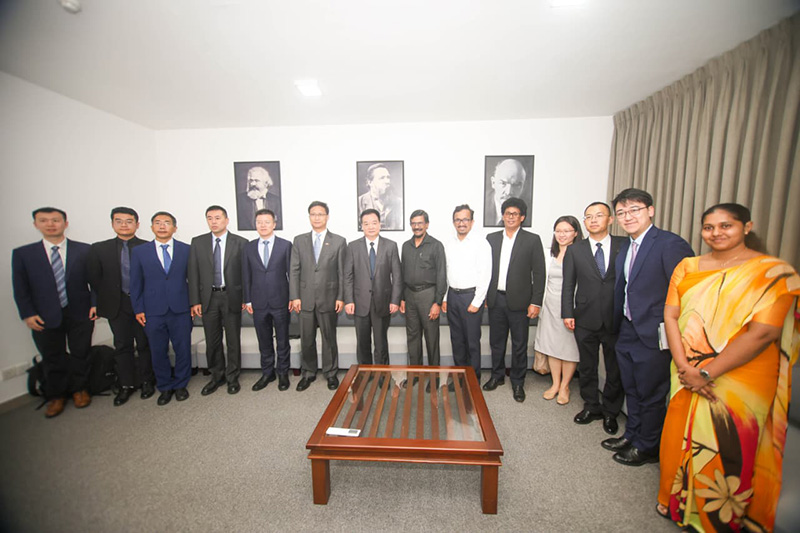
A high-level delegation of the Communist Party of China (CPC) met with senior leaders of the JVP, including its General Secretary, Comrade Tilvin Silva, on Tuesday at the JVP’s main headquarters, reaffirming long-standing ties and exploring avenues for expanded cooperation.
The Chinese delegation was led by Wang Junzheng, a member of the 20th Central Committee of the CPC and Secretary of the Communist Party Committee of the Xizang Autonomous Region. The delegation also included Qi Zhenhong, Chinese Ambassador to Sri Lanka, and Peng Xiubin, Director General of the Bureau for Southeast and South Asian Affairs of the International Department of the CPC Central Committee, among others. Representing the JVP were Politburo member and Minister of Industry and Entrepreneurship Development Sunil Handunnetti, Central Committee member and Minister of Trade, Commerce, Food Security and Cooperative Development Wasantha Samarasinghe, along with several party representatives.
Discussions focused on the long-standing friendship and cooperation between the CPC and the JVP, as well as the history of the JVP and Sri Lanka’s current political context. The two sides also reviewed cooperation activities undertaken in 2025 in line with the Memoranda of Understanding signed during President Anura Kumara Dissanayake’s recent visit to China.
During the meeting, Tilvin Silva expressed gratitude and appreciation for the assistance provided by the Chinese government to communities affected by Cyclone Ditwah in Sri Lanka. In response, Wang Junzheng reaffirmed China’s commitment to continuing such support in the future.
Wang also briefed the JVP leadership on developments within the CPC, noting the successful conclusion of the Fourth Plenary Session of the 20th Central Committee held last October, as well as a related programme conducted in Sri Lanka on Tuesday. He further shared insights on China’s 15th Five-Year Plan, which is currently under active discussion within the country.

The Sri Lanka Aviation Unit operating under the United Nations (UN) mandate in the Central African Republic (CAR) has successfully carried out a critical Casualty Evacuation (CASEVAC) mission, under extremely hostile and volatile conditions.
The mission had been launched in response to an urgent request to evacuate two United Nations personnel who had sustained combat-related injuries in the Zemio area, the Sri Lanka Air Force (SLAF) said.
Accordingly, the evacuation has been conducted using a Mi-17 helicopter (UNO 325P).
The aircraft was captained by Wing Commander Nelson De Silva, with Flight
Lieutenant Arunoda Ekanayake serving as co-pilot.
The aircrew comprised Squadron Leader Sandeepa Wijayathunga, Sergeant WCN Senevirathne, and Corporal DVPM Rodrigo. The Aeromedical Evacuation Team included Group Captain Sujith Perera, Flight Sergeant KW Sumedha, and Flight Sergeant RDH Karunadasa, who provided critical in-flight medical care to the casualties, the SLAF stated.
The extraction site was located approximately 20 kilometres northeast of the Zemio Permanent Operating Base (POB) and posed significant operational challenges.
They included extremely dusty landing conditions, an unstable and rapidly evolving tactical environment, and the requirement for a precision landing under constant threat, the SLAF said.
Despite these constraints, the aircrew demonstrated remarkable courage, sound judgement, and outstanding airmanship throughout the operation.
A comprehensive threat assessment conducted by the aircraft commander, taking into account the critical condition of the casualties, reflected exceptional adaptability and operational decision-making, the statement added.
According to the SLAF, the total flight duration of the mission was one hour and 45 minutes. The injured personnel were safely evacuated from the hostile location and successfully transported to Bangui for advanced medical treatment.

Sri Lanka will mark National Safety Day today (26) with countrywide religious observances, a national moment of silence and the main state commemoration at the Peraliya Tsunami Memorial in Galle, officials said yesterday.
The annual observance, declared in the aftermath of the 2004 Indian Ocean tsunami that claimed over 35,000 lives and left more than 5,000 people missing, is held each year to honour victims of the tsunami and other disasters, while reinforcing public awareness on disaster preparedness.
Disaster Management Centre (DMC) Director General Retired Major General Sudantha Ranasinghe said the 2025 programme would be conducted with due consideration to prevailing weather conditions caused by the Ditwah cyclone, with district-level multi-religious observances planned across the country.
“National Safety Day is a moment of remembrance and reflection. It also reminds us of the importance of preparedness, early warning and community resilience,” he said.
The main national commemoration will take place at the Peraliya Tsunami Memorial from 8.30 a.m. to 11.00 a.m., with the participation of government representatives, religious leaders, disaster survivors and families of victims.
Secretary to the Ministry of Defence Air Vice Marshal (Retd) Sampath Thuyacontha said a two-minute silence will be observed nationwide from 9.25 am to 9.27 am today, in memory of all those who lost their lives to the tsunami and other disasters.
“All institutions and members of the public are requested to observe this moment of silence as a mark of respect and national solidarity,” he said.
DMC Additional Director General Pradeep Kodippili urged the media to provide wide coverage to the main commemoration in Galle as well as district-level programmes organised through District Secretariats.
“Media support and public participation are essential to ensure that the lessons of past disasters remain alive and that a culture of safety is strengthened across the country,” Kodippili said.
National Safety Day has been observed annually on December 26 since 2005.
By Ifham Nizam ✍️

Selective transparency

CPC delegation meets JVP leadership in Colombo

eChannelling introduces ‘eHomecare’ as SL’s first doctor-led elderly care service

NDB shows strong growth, rising investment potential

Sri Lankan tea sees a week of robust activity

Export earnings report $ 15.8 billion underscoring Sri Lanka’s trade competitiveness

‘Dates have the highest sugar content to fight Coronavirus’

Sunday Island 27 December – Headlines

#SundayIsland 17th December – Headlines

Sunday Island – 28th March

Sunday Island Headlines – 21 March

Sunday Island – 21st February – Headlines
-

 News4 days ago
Members of Lankan Community in Washington D.C. donates to ‘Rebuilding Sri Lanka’ Flood Relief Fund
-

 Latest News7 days ago
Landslide early warnings issued to the districts of Badulla, Kandy, Kurunegala, Matale and Nuwara-Eliya extended till 8AM on Sunday (21)
-

 News2 days ago
British MP calls on Foreign Secretary to expand sanction package against ‘Sri Lankan war criminals’
-

 Business6 days ago
Browns Investments sells luxury Maldivian resort for USD 57.5 mn.
-

 News5 days ago
Air quality deteriorating in Sri Lanka
-

 News5 days ago
Cardinal urges govt. not to weaken key socio-cultural institutions
-
 Features6 days ago
Hatton Plantations and WNPS PLANT Launch 24 km Riparian Forest Corridor
-
 Features6 days ago
Another Christmas, Another Disaster, Another Recovery Mountain to Climb