
Sports
‘We can turn the tables on England. This series is 50-50’ – Mahela Jayawardene

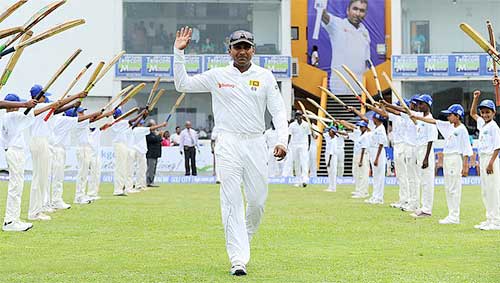
Jayawardene isn’t keen on taking up a permanent role in the Sri Lankan setup despite his status(Getty)
Sri Lanka are raring to go ahead of facing an under-prepared England for a two-Test series, and the hosts see an opportunity for an upset.
England head into the series without Jofra Archer and Ben Stokes and with less than two days of match practice, while Sri Lanka are keen to bounce-back after a series defeat to South Africa.
Sportsmail’s Nasser Hussain caught up with Sri Lanka legend and Mumbai Indians coach Mahela Jayawardene ahead of the series.
NH:
I know Sri Lanka have asked you in the past, and you felt they hadn’t taken on board some of your proposals, but in the long term would you like to coach the national side?
MJ:
For me the biggest hurdle is to be involved full-time, whether it’s franchise cricket or a national team. I don’t see myself being a coach who’s going to be involved with one team for 12 months a year. That’s not enjoyable for me.
It’s got nothing to do with Sri Lanka Cricket as such, and I’ve always said I’m happy to contribute and help the team — as long as what I see is wrong has been corrected. It hasn’t happened over the years.
I don’t want to walk in and be a figure in a process where I know the system hasn’t allowed cricketers or the team to evolve.
NH:
The talent in Sri Lanka has always been remarkable. What is it like at the moment?
MJ:
The raw ingredients are there. It’s just that a lot of the guys struggle with the pathway after school. The domestic structure has so many teams, so the quality gets diluted pretty quickly, and people make wrong decisions.
Not all the coaches are good enough, so we lose a lot of talent in that process. It’s not a professional setup at that level, and a lot of the guys give up and do other things, like league cricket in Australia or England.
NH:
Is Test cricket still financially viable in Sri Lanka?
MJ:
We still have an appetite for Test cricket. Because of the history of Sri Lanka’s Test team, they all want to play cricket at that level. But if you don’t improve and evolve, five or 10 years down the line we will have guys who only want to play white-ball cricket.
The recent T20 Lankan Premier League was good. We’ve needed something like that for the last 10 years, to make the game at that level financially viable.
NH:
The Test team have just come back from South Africa with a lot of injuries. Where are they at the moment?
MJ:
I was pretty pleased with the way they started in South Africa, putting nearly 400 on the board at Centurion. But the bowlers broke down, and that was a real issue. Guys who played at the LPL still had niggles, and they went into the second Test quite depleted.
For the English tour, we’ve got Angelo Mathews coming back after the injury, and Dinesh Chandimal should be fit as well — two experienced guys in the middle order to support Dimuth Karunaratne at the top. It’s about that discipline in the longer format: how do you cope with pressure for four to five days?
NH:
Any promising players England fans might not have heard of?
MJ:
It’s unfortunate that Dhananjaya de Silva has a long-term injury, but Kusal Mendis is a talent, and has scored seven hundreds in his short Test career. He knows how to go big.
And Sri Lankan have found two all-rounders: Wanindu Hasaranga, the leg-spinner, who bats at seven, and seamer Dasun Shanaka, who bowled really well in South Africa.
NH:
Is Mickey Arthur the right man to coach them at the moment?
MJ:
Yeah, he’s one of those guys who’s quite methodical and regimental, but he’s a good coach — a players’ coach. We need to give Mickey some time with the team, because he’s proven himself with a lot of international teams.
NH:
And he tends to speak his mind. He did an interview the other day when he said ‘I don’t think the pitch at Galle will turn: I know it will turn.’ Are you expecting a bunsen burner at Galle?
MJ:
You know Galle: it’s going to slow down, and start turning. So those first two days are crucial, and after that it’s going to be a grind. It will be quite interesting to see how the second Test match is going to pan out, because you’re playing at the same venue.
They’ll definitely make sure Sri Lanka have that advantage of playing at Galle, but the England boys have played there many times.
NH:
Where do you see England at the moment, and in particular their playing of spin. Is that still a nemesis for them?
MJ:
I think it can be. It depends on the tempo they want to play. The modern England team plays at a different tempo, but you still need someone to grind out an innings — Cooky (Alastair Cook) has done that in the past. Someone has to do that now, whether it’s Rooty (Joe Root) or someone else.
The other guys are much more high-tempo players, so how you balance that is crucial. And which way do you go with the bowlers? You don’t have the pace of Jofra (Archer), so who’s going to take up that role on a slow wicket? Sometimes you need extra firepower to get something going.
NH:
As you say, there’s no Jofra, no Ben Stokes, and Moeen Ali is ill. Is this an opportunity for Sri Lanka, on a turner, to get payback for England’s 3-0 win there in 2018?
MJ:
Yeah, it is. Even though Sri Lanka didn’t do well in South Africa, they’ll see this as a very good opportunity.
The first two days will set the tone. But England have two good experienced bowlers in Broady (Stuart Broad) and Jimmy (Anderson), who understand what needs to be done in these conditions. They will fall back on them. It’ll be interesting to se if they pick both in the same Test.
NH:
How much did the 3-0 defeat hurt Sri Lanka, and how much is it feeding into their mindset now?
MJ:
It did hurt Sri Lanka a lot, although it feels like a lifetime ago now. They had opportunities in that series, but never grabbed them, and England had that experience to control sessions. They were dominant.
But these two Test matches are at Galle, whereas last time it was in three different places, and Sri Lanka have a much better record at Galle. It will suit the current group of players. I don’t think Sri Lanka will be thinking too much about last time around.
NH:
Do you worry about the mental and physical wellbeing of players when they’re spending so much time in bubbles?
MJ:
Yeah, that’s something you have to look at. We used to have three weeks’ R&R with our families between tours, but now they’re straight into another bubble.
That’s when player management is important. When you see guys who aren’t mentally fresh, you might have to let them go home for two or three weeks. Going bubble to bubble is always going to have an impact. If this runs through 2021, that’s going to be a long stretch for a lot of cricketers.
NH:
When I went to Sri Lanka, England were never favourites. Do you see this England as favourites?
MJ:
With Stokes missing, England don’t have that same experience in the top order, so I make it 50-50. I don’t think they’re going as favourites. I think Sri Lanka have something in them. (Daily Mail)


UNDER 19 DIVISION 1 TIER A
Trinity reached 223 for five wickets at stumps on the second day as Dimantha Mahavithana anchored the innings with an unbeaten century after Royal poated a a mammoth 493 for nine wickets declared in the Under 19 Division I Tier ‘A’ semi-final at Surrey ground on Thursday.
Scores
Royal 328 for 4 overnight 493 for 9 dec in 119.3 overs (Hirun Liyanarachchi 78, Dushen Udawela 105, Vimath Dinsara 68, Ramiru Perera 57, Udantha Gangewatta 98, Himaru Deshan 29; Sethmika Senevirathne 4/111)
Trinity 223 for 5 in 53 overs (Dimantha Mahavithana 125, Puleesha Thilakarathne 32, Chaniru Senarathne 20, Malika Vithanage 22n.o.;Himaru Deshan 2/63, Ramiru Perera 2/68) (RF)
Latest News
Mukul Choudhary stuns Kolkata Knight Riders to seal last-ball thriller for Lucknow Super Giants

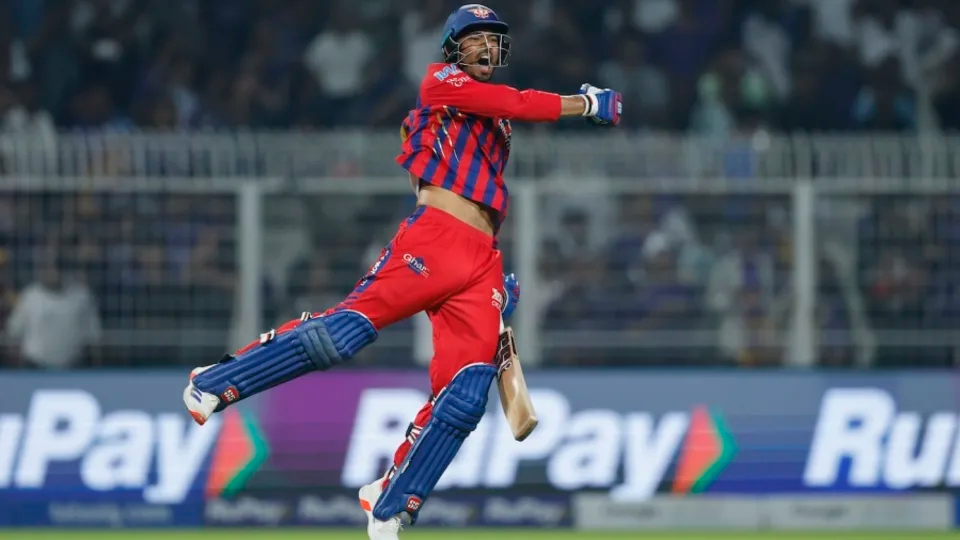
In the lead-up to IPL 2026, Lucknow Super Giants coach Justin Langer believed that rookie <ukul Choudhary had the potential to become the “scariest” finisher in India. The 21-year-old showcased his potential and power in only his third IPL game, bashing a 25-ball half-century, which snatched victory for LSG from Kolkata Knight Riders’ grasp.
When Choudhary came into bat, LSG were 104 for 5 in the 13th over in pursuit of 182. Choudhary watched them slump further to 125 for 6 and then 128 for 7. He was on 2 off eight balls at one point. But with LSG needing 54 off 24 balls, he single-handedly won it for them. Only one other batter – Kieron Pollard in 2013 – has scored more than 50 runs in the last four overs of a successful IPL chase.
It was anybody’s game when LSG required 14 off the final over, with three wickets in hand. After Avesh Khan got a single off the first ball, Choudhary monstered Arora over square leg for six. Arora then responded with two dots, but a barely believable six off the next ball – a near wide yorker – brought the equation to one off one.
Choudhary swung and missed the slower bouncer, but he scampered across for a leg-bye and completed a stunning turnaround for LSG. A new star was born in the IPL.
At the halfway stage of the game, Rovman Powell said this wasn’t a typical Eden Gardens pitch. As the game wore on, the deliveries dug into the surface, especially the slower ones, were difficult to put away. Aiden Markram, Mitchell Marsh, Nicholas Pooran and Rishabh Pant were all done in by steepling bounce.
Arora had bounced out Markram and Marsh with the new ball, but when he tried something similar against Choudhary with the older one, Choudhary muscled him over square leg. When Arora tried to york him next ball, Choudhary helicoptered the seamer over long-on. Of the seven sixes Choudhary hit in 27 balls, this was the pick of the lot. “MS Dhoni, eat your heart out! The helicopter shot is back,” Faf du Plessis said on commentary
But still KKR were favourites with 42 to defend off 18 balls. Until Choudhary intervened again. He tonked Kartik Tyagi for a brace of sixes and reduced the equation to 30 needed off 12 balls.
Cameron Green, who had earlier bested Pant with a slower bouncer, bowled that variation to Choudhary and drew a mis-hit, but it fell into no-man’s land. Choudhary missed another slower bouncer next ball, but struck back to hit Green for 6,4,6 in his next four balls.
Choudhary then whacked another slower short ball from Arora for six in the final over. Arora responded by switching his angle to around the wicket and nailed two wide yorkers. He marginally missed his mark the next ball, but Choudhary scythed it flat and hard over cover with his fast hands to stun KKR.
Earlier Ayush Badoni had laid the platform, from which Choudhary launched, for LSG with a contrasting 54. Coming in at No.4, Badoni helped LSG overcome an early wobble with his calculative approach. He was particularly circumspect against Sunil Narine, who had recovered from an illness that had put him out of KKR’s previous game, scoring only eight off ten balls from him. In all, Narine conceded just 13 runs in his four overs for the wicket of Mohammed Shami.
Badoni found runs from elsewhere. He took 26 off 12 balls from Tyagi and Navdeep Saini, the weaker links in the KKR attack. He brought up his half-century, off 33 balls, when he carted left-arm spinner Anukul Roy over midwicket for six. Next ball, however, Roy hid the ball away from Badoni’s reach and had him holing out to wide long-off.
Prince Yadav had struck in his first over when he had Finn Allen caught at deep third by Digvesh Rathi in controversial circumstances. After a few replays, Allen was given out for 9 off 8, but later another replay suggested that Rathi’s foot was touching the boundary when he was holding the ball with both hands.
KKR captain Ajikya Rahane and Angkrish Raghuvansh, who was promoted to No.3 ahead of Green, then countered the early blow with an 84-run partnership off 52 balls. Rahane manufactured swinging room and pumped both Rathi and M Siddharth for fours over cover.
Raghuvanshi was slow to start: he was on 6 off 12 balls at one point, but shifted gears when he lined up Avesh Khan for 4,6,4 in the last over of the powerplay.
LSG’s spinners Rathi and Siddharth then loosened KKR’s grip on the game by taking out Rahane and Raghuvanshi in successive overs.
Green needed 14 balls to find the boundary and in all managed only three fours and a six in the 24 balls he faced. Rovman Powell, who retained his place in KKR’s XI, was more fluent, finishing with an unbeaten 39 off 24 balls.
KKR went 31 balls without a boundary until Powell charged at Siddharth and cracked him over his head for six. Then when Prince missed his yorker, his drilled drive down the ground left both the bowler and the umpire in the firing line.
KKR were firm favourites – they had an 86% chance of beating LSG after 36 overs in the game – but Choudhary flipped the script and overpowered the hosts.
Brief scores:
Lucknow Super Giants 182 for 7 in 20 overs (Mitchell Marsh 15, Aiden Markram 22, Rishbah Pant 10, Ayush Badoni 54, Nicholas Pooran 13, Mukul Choudhary 54*; Anukul Roy 2-32, Vaibhav Arora 2-38, Sunil Narine 1-13, Kartik Tyagi 1-31, Cameron Green 1-28) beat Kolkata Knight Riders 181 for 4 in 20 overs (Angkrish Raghuvanshi 45, Ajinkya Rahane 41, Cameron Green 32*, Rovman Powell 39*; Prince Yadav 1-47, Manimaran Siddharth 1-34, Digvesh Rathi 1-25, AveshKhan 1-44) by three wickets
[Cricinfo]
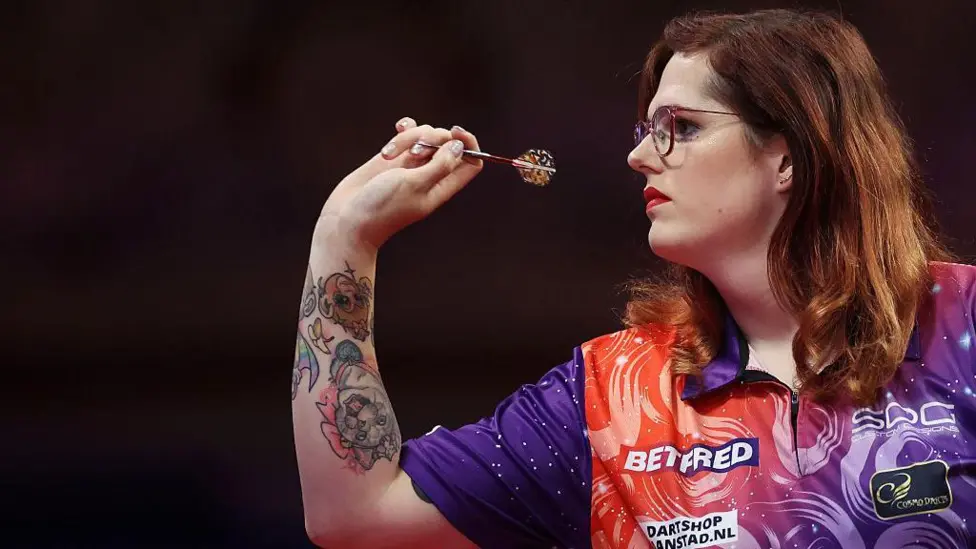
The Darts Regulation Authority has banned transgender women from competing in its women’s events with immediate effect.
The DRA, which governs the Professional Darts Corporation (PDC), said “only biological females should be eligible to compete in women’s tournaments regulated by DRA Rules”.
It comes after the DRA completed a review of its Trans and Gender Diverse Policy, which began in 2025.
Noa-Lynn van Leuven, who in 2024 became the first transgender woman to compete in the PDC World Championship, said the decision had “effectively retired her”.
She remains eligible to play in open tournaments for men and women.
“I just got an email and apparently I just got retired, not by choice but because I am no longer allowed to compete,” Van Leuven said in a video posted on Instagram.
“The DRA just decided that trans women are no longer allowed in women’s events which basically means I am out.
“Everyday it is getting harder for trans people to exist, to compete. If you think this stops with me, it doesn’t. We just want to be.”
Sex-based rights charity Sex Matters said “men’s physical advantages in darts may be small but they all add up”.
“Darts is a male-dominated world, played in pubs and clubs, and the top darts players are all men. That’s why women need their own tournaments.
“The Darts Regulation Authority followed the lead of the old, unfair IOC [International Olympic Committee] policy, so it’s great to see this rapid return to fairness for women players.”
The DRA said it “seeks to be inclusive” and it encouraged “all players – irrespective of their biological sex, legal sex, and/or gender identity” to continue competing in open tournaments.
It said its decision is based on legal advice and a commissioned report by Dr Emma Hilton – an academic developmental biologist who has published several papers on sex and categories in sport.
Dr Hilton’s report concluded “that multiple, small-magnitude sex differences accumulate to generate male advantage over females in darts”.
Last year, the World Darts Federation (WDF) banned transgender women from competing in its women’s tournaments.
Last month, the president of the IOC, Kirsty Coventry, announced a blanket ban on transgender women, as well as athletes with differences in sex development (DSD) from the 2028 Los Angeles Games.
(BBC)

PM on inspection tour of newly renovated Colombo Central Bus Stand

Israel to hold direct talks with Lebanon but no ceasefire, Netanyahu says

Sun directly overhead Nagawilluwa, Galgamuwa, Sigiriya, Palugasdamana and Mankerni about 12:11 noon today (10)

Showers expected in the Western, Sabaragamuwa, Southern and Uva provinces and in Kandy and Nuwara-Eliya districts after 2.00 p.m

Opposition tells Minister Kumara Jayakody to resign

Coal tender scandal: FSP to move court against illegal deals

‘Dates have the highest sugar content to fight Coronavirus’

Sunday Island 27 December – Headlines

#SundayIsland 17th December – Headlines

Sunday Island – 28th March

Sunday Island Headlines – 21 March

Sunday Island – 21st February – Headlines
-

 Features5 days ago
Ranjith Siyambalapitiya turns custodian of a rare living collection
-

 News5 days ago
Global ‘Walk for Peace’ to be held in Lanka
-

 News3 days ago
Lankan-origin actress Subashini found dead in India
-

 Features5 days ago
Beyond the Blue Skies: A Tribute to Captain Elmo Jayawardena
-

 Features5 days ago
Aspects of Ceylon/Sri Lanka Foreign Relations – 1948 to 1976
-

 Business1 day ago
Hayleys Mobility introduces Premium OMODA C9 PHEV
-

 News1 day ago
AG: Coal procurement full of irregularities
-

 Sports1 day ago
DS to face St. Anthony’s in ‘Bridges of Brotherhood’ cricket encounter