
News
UN says women among most vulnerable to crisis in Lanka

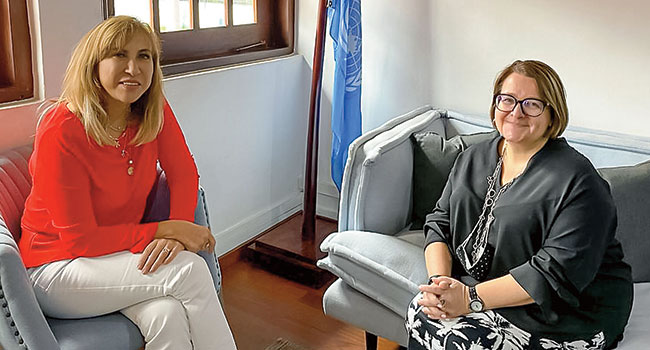
As Sri Lanka experiences an unprecedented economic crisis – including spiraling inflation and a shortage of basic necessities – women are among the most vulnerable to its impacts, the United Nations (UN) said.
The UN said this is particularly true of UN Women’s key stakeholder groups including women heads of households, women affected by conflict, and women who lack access to resources, protection, and opportunities for full economic empowerment.
The Officer-in-Charge for UN Women Asia and the Pacific, Sarah Knibbs, met with key partners to advocate for the equitable prioritization of women’s needs and rights in all measures taken to respond to and recover from the current crisis, and for their equal participation in developing and implementing the same.
During her visit, she highlighted that “in line with global analysis, the current economic crisis is very likely to be detrimental to the present status of women and girls, and reverse the limited gains made in relation to their health, wellbeing, rights and opportunities”.
The scarcity of essential food and medicine, along with potential austerity measures resulting from economic recovery processes will have far-reaching consequences for many Sri Lankans, including many women who are already vulnerable to socio-economic shocks, with limited access to resources or social protection. Cuts to social protection schemes will also deprive many women of the meagre allowances available to them, and will have ripple effects on the wellbeing of their children and other household members.
Additionally, while both women and men are affected by job losses during times of crisis, evidence shows that women are often laid off first. For instance, a new UN Women study ‘Gender Disparities and Labour Market Challenges’; shows that between 2019 and 2020, female employment in Sri Lanka declined by nearly 8 percent in the 600 firms that were surveyed, driven mainly by the halving of skilled female employment in the hospitality sector by 47 percent. However, following the COVID-19 lockdowns, male employment in the hospitality sector increased by a considerable 14 percent.
In meetings with key partners, Knibbs highlighted key priorities to ensure a gender-responsive response to and recovery from the crisis.
Firstly, she stressed the need for gender responsive policies, highlighting that “Crises have gender-specific impacts that disproportionately burden women. Investments in gender-responsive research and adopting a transformative approach to designing economic and social policies that promote the realization of women’s rights is a crucial step towards inclusive recovery”.
Secondly, she highlighted the need for women’s equal participation in shaping these efforts. Globally, women’s participation in decision-making and recovery planning has proven effective in ensuring stable long-term recovery from crisis. However, throughout Sri Lanka’s history, women have been largely underrepresented in formal spaces of power.
Recognizing this, Knibbs stated that “in order to ensure that women’s needs are addressed in response and recovery efforts, it is essential that Sri Lankan women are included in all decision-making spheres”.
Thirdly, she highlighted the importance of gender-responsive national planning and budgeting processes, to ensure the needs of the most marginalized and vulnerable are prioritized and contribute to equal opportunities as the country works towards recovery.
Finally, she noted the importance of strengthening data collection and the use of sex-disaggregated data to assess the differential impact of the economic crisis on women and men, and to respond appropriately.
She assured partners that UN Women remains committed to supporting women and girls of Sri Lanka, and that it would strengthen its ongoing work with partners to ensure that Sri Lankan women have increasing income security, access to decent work and economic autonomy. Further, as UN Women works on implementing the Women, Peace and Security Agenda in the country, she emphasized the importance of women’s leadership in rebuilding societies during times of crisis.


In terms of the provisions of the Establishments Code on payment of festival advance to government officers, there’s a possibility of obtaining rupees 10,000/- as an advance for celebrating festivals of Theipongal, Ramazan, Sinhala and Hindu New Year, Wesak, Deepavali, and Christmas as well as for pilgrimages (Sri Paada pilgrimage and Hajj pilgrimage).
Provisions have been given to recover the said advance in 08 installments or if required earlier without interest. It has been proposed by the Budget 2026 to increase the said festival advance up to rupees 15,000/-.
Accordingly, the Cabinet of Ministers granted approval to the proposal submitted by the Minister of Public Administration, Provincial Councils and Local governments to revise the relevant provisions so that the festival advance can be increased up to rupees 15,000/- .
As per the approval given by the cabinet meeting held on 02-06-2025, action is being taken at present to offer the underutilized lands/properties of the Sri Lanka State Plantation Corporation, the Janatha Etate Development Board, and the Elkaduwa Plantation Company which are under the Ministry of Plantation and Community Infrastructure which have been identified under stage one to suitable investors.
Accordingly, the Cabinet of Ministers has approved the proposal presented by the Minister of Plantations and Community Infrastructure to provide following lands/properties on a lease basis to the suitable investors for optimal utilization following the prescribed procurement procedure.
• underutilized lands/properties identified under stage two owned by the Sri Lanka State Plantation Corporation, the Janatha Estate Development Board, and the Elkaduwa Plantation
Company,
• The Mawarala watte land and the Tea factory 40.48 hectares in extent, located in Matara District belonging to the Tea Shakthi Fund.
• The underutilized land of 1,541 hectares in extent of Kondachchi Estate is enjoyed by the Sri Lanka Cashew Corporation.
The drafting of the National Fisheries and Aquaculture Policy has commenced with the objective of equitable distribution of the benefits of the fisheries industry and the sustainable management of fisheries and aquaculture. This policy has been updated from time to time according to current requirements. However, steps have not been taken to obtain the approval of the Cabinet of Ministers for that purpose.
According to the policy declaration of the present government, ‘Vistas of Prosperity and Splendor’ the National Fisheries and Aquaculture Policy has been redrafted, updating the aforementioned policy in line with the economic and development objectives of the government.
The recommendations of the Department of National Planning have been received for the drafted policy.
Accordingly, the Cabinet of Ministers has approved the proposal presented by the Minister of Fisheries, Aquaculture, and Marine
Resources to implement the National Fisheries and Aquaculture Policy, integrating it with other relevant policies.

Lanka Premier League draft set to take place on March 22

Trump to meet Venezuelan opposition leader Machado at the White House

Festival advance for government officers to be increased
Providing underutilized lands/properties to suitable investors for optimal utilization.
Implementation of the National Fisheries and Aquaculture Policy

Expressions of Interest called to develop selected locations within the Pelawatte Sugar Factory premises

‘Dates have the highest sugar content to fight Coronavirus’

Sunday Island 27 December – Headlines

#SundayIsland 17th December – Headlines

Sunday Island – 28th March

Sunday Island Headlines – 21 March

Sunday Island – 21st February – Headlines
-
 News3 days ago
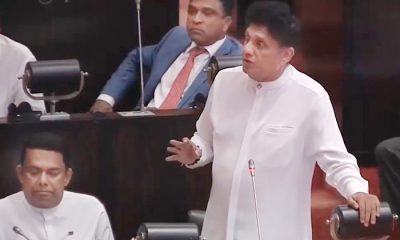
Sajith: Ashoka Chakra replaces Dharmachakra in Buddhism textbook
-

 Business3 days ago
Dialog and UnionPay International Join Forces to Elevate Sri Lanka’s Digital Payment Landscape
-

 Features3 days ago
The Paradox of Trump Power: Contested Authoritarian at Home, Uncontested Bully Abroad
-

 Features3 days ago
Subject:Whatever happened to (my) three million dollars?
-

 News3 days ago
Level I landslide early warnings issued to the Districts of Badulla, Kandy, Matale and Nuwara-Eliya extended
-

 News3 days ago
National Communication Programme for Child Health Promotion (SBCC) has been launched. – PM
-

 News3 days ago
65 withdrawn cases re-filed by Govt, PM tells Parliament
-

 Opinion5 days ago
The minstrel monk and Rafiki, the old mandrill in The Lion King – II