
Latest News
UK Supreme Court backs ‘biological’ definition of woman

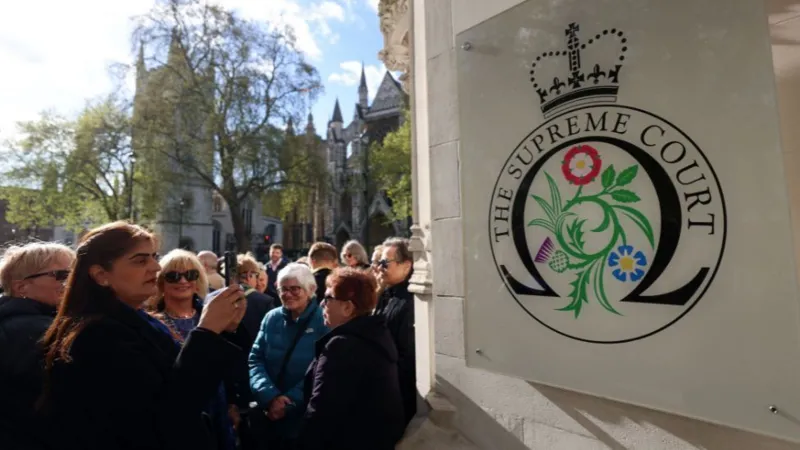
The UK Supreme Court has unanimously backed the biological definition of “woman” under the 2010 Equality Act.
It marks the culmination of a long-running legal battle which could have major implications for how sex-based rights apply across Scotland, England and Wales.
Judges sided with campaign group For Women Scotland, which brought a case against the Scottish government arguing that sex-based protections should only apply to people that are born female.
Judge Lord Hodge said the ruling should not be seen as a triumph of one side over the other, and stressed that the law still gives protection against discrimination to transgender people.
The Scottish government argued in court that transgender people with a gender recognition certificate (GRC) are entitled to the same sex-based protections as biological women.
The Supreme Court was asked to decide on the proper interpretation of the 2010 Equality Act, which applies across Britain.
Lord Hodge said the central question was how the words “woman” and “sex” are defined in the legislation.
He told the court: “The unanimous decision of this court is that the terms woman and sex in the Equality Act 2010 refer to a biological woman and biological sex.
“But we counsel against reading this judgement as a triumph of one or more groups in our society at the expense of another, it is not.”
He added that the legislation gives transgender people “protection, not only against discrimination through the protected characteristic of gender reassignment, but also against direct discrimination, indirect discrimination and harassment in substance in their acquired gender”.
Campaigners who brought the case against the Scottish government hugged each other and punched the air as they left the courtroom, with several of them in tears.
The Equality Act provides protection against discrimination on the basis of various characteristics, including “sex” and “gender reassignment”.
Judges at the Supreme Court in London were asked to rule on what that law means by “sex” – whether it means biological sex, or legal, “certificated” sex as defined by the 2004 Gender Recognition Act.
The Scottish government argued the 2004 legislation was clear that obtaining a GRC amounts to a change of sex “for all purposes”.
For Women Scotland argued for a “common sense” interpretation of the words man and woman, telling the court that sex is an “immutable biological state”.
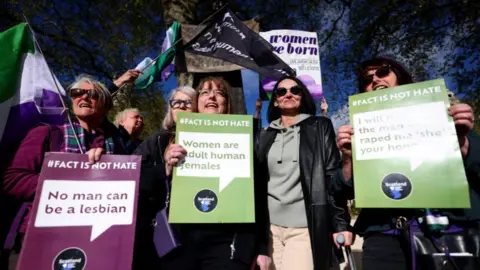
Outside the Supreme Court, For Women Scotland co-founder Susan Smith said: “Today the judges have said what we always believed to be the case, that women are protected by their biological sex.
“Sex is real and women can now feel safe that services and spaces designated for women are for women and we are enormously grateful to the Supreme Court for this ruling.”
A UK government spokesman said: “This ruling brings clarity and confidence, for women and service providers such as hospitals, refuges, and sports clubs.
“Single-sex spaces are protected in law and will always be protected by this government.”
Conservative leader Kemi Badenoch described the ruling as a “victory for all of the women who faced personal abuse or lost their jobs for stating the obvious”.
But Scottish Green MSP Maggie Chapman, a prominent campaigner for trans-rights, said: “This is a deeply concerning ruling for human rights and a huge blow to some of the most marginalised people in our society.
“It could remove important protections and will leave many trans people and their loved ones deeply anxious and worried about how their lives will be affected and about what will come next.”
The Scottish government has not yet commented on the ruling.
[BBC]


Australia captain Alyssa Healy will retire from all forms of cricket following the upcoming series against India.
The 35-year-old wicket-keeper has more than 7,000 runs and 275 dismissals to her name in all formats of the game and led Australia to a historic 16-0 whitewash of England 8n the Ashes in 2025.
She has won the World Cup twice, with the highest individual score of 170 in a World Cup final coming against England in 2022, and the T20 World Cup on six occasions.
Healy said: “I’m still passionate about playing for Australia, but I’ve somewhat lost that competitive edge that’s kept me driven since the start, so the time feels right to call it a day.
“I’ll genuinely miss my team-mates, singing the team song and walking out to open the batting for Australia. Representing my country has been an incredible honour and I’m grateful for one last series in the green and gold.”
Healy is married to Australia fast bowler Mitchell Starc and is the niece of another Australian great in wicket keeper Ian Healy. She also already has a successful broadcasting career as a pundit and commentator.
Todd Greenberg, Cricket Australia CEO said: “Alyssa is one of the all-time greats of the game and has made an immeasurable contribution both on and off the field over her 15-year career.
“We look forward to celebrating her achievements throughout the series against India.”
Australia host India in a Test match, three one-day internationals and three T20 matches in February and March
(BBC Sports)

About 550,000 accounts were blocked by Meta during the first days of Australia’s landmark social media ban for kids.
In December, a new law began requiring that the world’s most popular social media sites – including Instagram and Facebook – stop Australians aged under 16 from having accounts on their platforms.
The ban, which is being watched closely around the world, was justified by campaigners and the government as necessary to protect children from harmful content and algorithms.
Companies including Meta have said they agree more is needed to keep young people safe online. However they continue to argue for other measures, with some experts raising similar concerns.
“We call on the Australian government to engage with industry constructively to find a better way forward, such as incentivising all of industry to raise the standard in providing safe, privacy-preserving, age appropriate experiences online, instead of blanket bans,” Meta said in a blog update.
The company said it blocked 330,639 accounts on Instagram, 173,497 on Facebook, and 39,916 on Threads during it’s first week of compliance with the new law.
They again put the argument that age verification should happen at an app store level – something they suggested lowers the burden of compliance on both regulators and the apps themselves – and that exemptions for parental approval should be created.
“This is the only way to guarantee consistent, industry-wide protections for young people, no matter which apps they use, and to avoid the whack-a-mole effect of catching up with new apps that teens will migrate to in order to circumvent the social media ban law.”
Various governments, from the US state of Florida to the European Union, have been experimenting with limiting children’s use of social media. But, along with a higher age limit of 16, Australia is the first jurisdiction to deny an exemption for parental approval in a policy like this – making its laws the world’s strictest.
The policy is wildly popular with parents and envied by world leader, with the Tories this week pledging to follow suit if they win power at the next election, due before 2029.
However some experts have raised concerns that Australian kids can circumvent the ban with relative ease – either by tricking the technology that’s performing the age checks, or by finding other, potentially less safe, places on the net to gather.
And backed by some mental health advocates, many children have argued it robs young people of connection – particularly those from LGBTQ+, neurodivergent or rural communities – and will leave them less equipped to tackle the realities of life on the web.
(BBC)

They began with a scrappy last-ball win to kick off WPL 2026, but there was nothing scrappy about Royal Challengers Bengaluru’s (RCB) second win, over UP Warriorz, on Monday night.
Grace Harris tore into her former franchise with a breathtaking assault, sending the ball to all parts of the DY Patil Stadium. By the time she was out for a 40-ball 85, RCB needed just seven runs to win with 50 deliveries remaining.
In an effort similar to her opening-night honours, Lauren Bell swung the new ball and troubled Warriorz’s openers in her first two overs. In trying to break the stranglehold, Harleen Deol attempted to jailbreak in her third, but could only spoon a catch to Smriti Mandhana at mid-off for a 14-ball 11. And just like that, UP Warriorz had seen two different opening pairs come and go without giving them the start they were after.
She was denied a wicket in her first over – the sixth of the innings – when Meg Lanning’s swipe landed agonisingly short of Arundhati Reddy at backward square leg, but Shreyanka Patil had Lanning hack uncharacteristically to Radha Yadav at deep midwicket off her next.
In the same over, she also had a second wicket when Phoebe Litchfield flat-batted a short ball straight to Mandhana at mid-on, shortly after having reverse-swept her for six
Coming off a four-for and an unbeaten half-century against Mumbai Indians, de Klerk began with two wickets off her first two deliveries. Kiran Navgire fell first when she heaved a length ball to cow corner, while Shweta Sehrawat was brilliantly caught at backward point by Reddy. Warriorz were in all sorts of trouble at 50 for 5.
This was the perfect fire-and-ice combination on paper. But on Monday, they were both mellower and batted risk-free for much of their unbeaten 93-run partnership. Deandra Dottin signalled a change of intent when she went after Patil in her third over – the 15th – by muscling a length ball for six over long-on. That galvanised both batters to break free; Deepti Sharma gave the perfect finish by going after Patil in a 15-run final over that helped them finish with 143.
With two rookies in their top four, RCB could’ve chosen to play safe by having Gautami Naik partner Mandhana. But they took the aggressive route, and Harris justified that decision by muscling a 22-ball half-century as RCB wiped out 78 in the powerplay alone.

Showers in the Northern, North-central, Uva, Western, Eastern, Sabaragamuwa, North-western and Central provinces and Galle and Matara districts

Govt. extends ban on LTTE

Police obtain court order banning Wimal’s protest

Chinese Foreign Minister Wang Yi expresses optimism that Sri Lanka is on the right path to progres

India plans to restore northern regular train services to pre-Ditwah frequencies before traditional New Year 2026

Inauguration of first Bailey Bridge under Indian assistance package for post-Ditwah reconstruction

‘Dates have the highest sugar content to fight Coronavirus’

Sunday Island 27 December – Headlines

#SundayIsland 17th December – Headlines

Sunday Island – 28th March

Sunday Island Headlines – 21 March

Sunday Island – 21st February – Headlines
-

 News2 days ago
Sajith: Ashoka Chakra replaces Dharmachakra in Buddhism textbook
-

 Business2 days ago
Dialog and UnionPay International Join Forces to Elevate Sri Lanka’s Digital Payment Landscape
-

 Features2 days ago
The Paradox of Trump Power: Contested Authoritarian at Home, Uncontested Bully Abroad
-

 Features2 days ago
Subject:Whatever happened to (my) three million dollars?
-

 News2 days ago
Level I landslide early warnings issued to the Districts of Badulla, Kandy, Matale and Nuwara-Eliya extended
-

 News2 days ago
National Communication Programme for Child Health Promotion (SBCC) has been launched. – PM
-

 News2 days ago
65 withdrawn cases re-filed by Govt, PM tells Parliament
-

 Opinion4 days ago
The minstrel monk and Rafiki, the old mandrill in The Lion King – II