
News
Udaya seeks Court of Appeal intervention to prevent his arrest

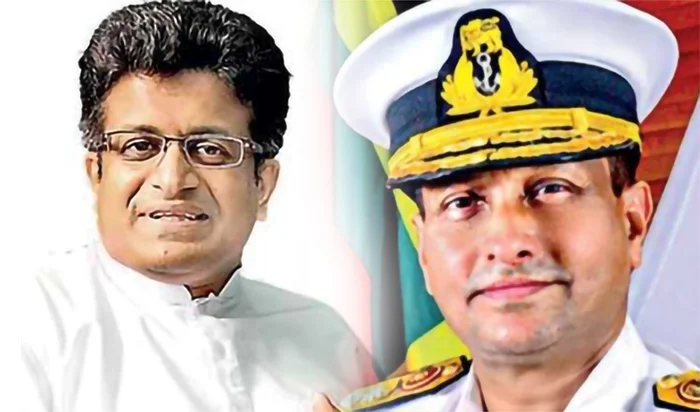
Comments on Ulugetenne’s case triggers probe against PHU Leader:
Pivithuru Hela Urumaya (PHU) leader Udaya Gammanpila has moved the Court of Appeal in a bid to prevent his arrest over views expressed regarding the remanding of former Navy Commander Admiral (retd.) Nishantha Ulugetenne. The Criminal Investigation Department (CID) arrested Ulugetenne, a former Ambassador to Cuba, on 28 July, over the alleged disappearance of a person named Shantha Samaraweera on the basis of a statement given by Selvathambi Mahendran, alias Bharathi, of the LTTE.
The former Minister and Attorney-at-Law filed his application in terms of Article 140 of the Constitution. Among the six respondents are Public Security Ministry Secretary retired SDIG Ravi Seneviratne, IGP Priyantha Weerasooriya, SDIG, CID, Asanka Karawita and CID Director SSP (retd.) Shani Abeysekera.
Gammanpila has submitted the application through his power of attorney holder Kahatapitiya Kankanamalage Sandyan Nalaka Perera. The ex-lawmaker sought the Court of Appeal intervention claiming that there was a bid to remand him for a period of one year in terms of the ICCPR (International Covenant on Civil and Political Rights) Act.
The ex-Minister said that the CID had found fault with him for commenting on the arrest of Ulugetenne on the basis of a statement made by an ex-LTTE cadre. The Petitioner asserted that he has a right to comment on the propriety of an arrest under Article 14 (1) (a) of the Constitution.
Gammanpila reiterated that the separatist movement and LTTE sympathisers, living here and abroad, sought to tarnish the image of the war-winning armed forces by the arrest of Ulugetenne.
Attorney-at-Law Achala Seneviratne, on 12 August, declared that they lodged a complaint against Gammanpila over the media briefing, as well as an interview given to a Sinhala newspaper. The lawyer alleged that Gammanpila, through his actions, sought to instill fear among the witnesses in this particular case involving Ulugetenne.
The CID has informed the Colombo Fort Magistrate’s Court that an investigation has been initiated to determine whether the remarks made by the former Minister amounted to an offence under Section 3(1) of the International Covenant on Civil and Political Rights (ICCPR) Act No 56 of 2007 and under Section 120 of the Penal Code. (SF)





News
Government’s objective is to ensure the continuous functioning of the country’s economic activities and essential services through effective energy management – President


President Anura Kumara Dissanayake stated that, in light of the challenges that have arisen due to the prevailing conflict situation in the Middle East, plans are being implemented to manage energy resources effectively while ensuring the uninterrupted continuation of the country’s economic activities and essential services.
The President made these remarks while participating in a discussion held on Monday (16) afternoon at the Presidential Secretariat to review the immediate measures required to ensure the country’s energy conservation and maintain the uninterrupted functioning of economic activities and essential services, in view of the current disruptions affecting energy supply.
During the discussion, which was attended by the relevant Ministers and Ministry Secretaries, special attention was focused on the measures required to ensure the uninterrupted continuation of public services in light of the prevailing situation.
Extensive discussions were also held on alternative methods that could be adopted in maintaining the operations of government offices. In this context, attention was drawn to the possibility of limiting energy consumption while continuing essential services by granting a one-day holiday for the public service.
Particular attention was also given to examining alternative measures that could be adopted to ensure the continued provision of services with minimal energy consumption, taking into account the specific nature and practical requirements of sectors such as education, health, tourism, fisheries, industry, agriculture, ports and shipping, airport services and digital services.
The President instructed a committee, comprising Ministry Secretaries and sectoral experts, to submit a report by the end of today to determine the fuel allocation required to maintain services in the key sectors.
In addition, the discussion highlighted the importance of making ministerial-level decisions regarding the practical feasibility of performing official duties from home under such circumstances. It was proposed that decisions on summoning officers to their workplaces be delegated to the heads of institutions and that appropriate methods be adopted to ensure the uninterrupted continuation of services.
In view of the prevailing situation, the President paid special attention to the challenges faced by farmers in the agricultural sector and by small and medium-sized industrialists in the industrial sector.
The President further emphasised that, in the current circumstances, the contribution and commitment of all are essential to minimise the potential impact on the country’s economy, while noting that certain groups may be provided with assistance through relief measures.
It was noted that the introduction of the QR system is intended to manage daily fuel consumption in response to the ongoing challenges. This system will allow for the daily analysis of fuel allocations, emphasising the importance of releasing fuel in a manner that safeguards the country’s energy conservation while supporting economic and service activities.
The discussion also highlighted the importance of using the QR system in an orderly manner during fuel distribution and the need for each Ministry to promptly provide all necessary data to the Ministry of Digital Economy. Accordingly, it was proposed that the relevant Ministries, together with the legally recognised petroleum institutions, work to further streamline the QR system.
In addition, it was proposed to temporarily suspend state celebrations in light of the prevailing situation and to establish a procedure for informing the private sector of any further measures the Government intends to take in this regard.
Prime Minister Dr. Harini Amarasuriya, Minister of Foreign Affairs, Foreign Employment and Tourism Vijitha Herath, Minister of Trade, Commerce, Food Security and Cooperative Development Wasantha Samarasinghe, Minister of Health and Mass Media Dr. Nalinda Jayatissa, Minister of Public Administration, Provincial Councils and Local Government Professor A.H.M.H. Abeyratne, Minister of Labour and Deputy Minister of Finance and Planning Dr. Anil Jayantha Fernando, Minister of Industries and Entrepreneurship Development Sunil Handunnetti, Minister of Transport, Highways and Urban Development Bimal Ratnayake, Secretary to the President Dr. Nandika Sanath Kumanayake, Governor of the Central Bank Dr. P. Nandalal Weerasinghe, Senior Advisor to the President on the Digital Economy Hans Wijesuriya, Senior Economic Advisor to the President Duminda Hulangamuwa and a group of officials, including the Secretaries of the relevant Ministries, participated in the discussion.
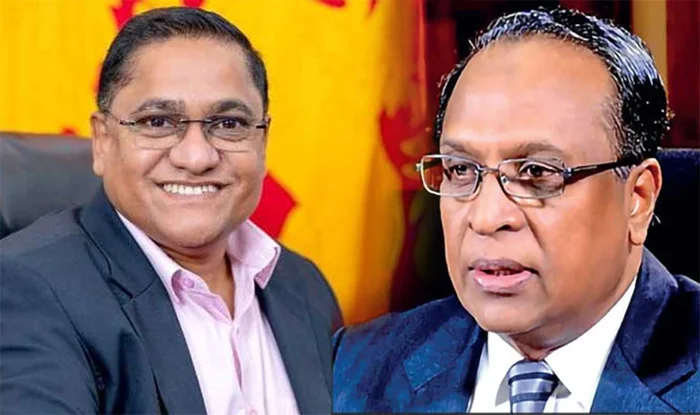
Zuhair castigates sponsors who failed to condemn aggressors
Foreign Minister Vijitha Herath said that the recently adopted United Nations Security Council (UNSC) resolution that strongly condemned Iran for, what it called, “egregious attacks” on its regional neighbours, was not fair as it did not make reference to Israeli-US initiating the latest conflict.
Herath said so in response to The Island query. He said that the government wouldn’t support country specific resolutions. Minister Herath described the resolution, adopted by a vote of 13 in favour, none against, and two abstentions (China, Russian Federation), as unbalanced. Sri Lanka refrained from co-sponsoring the resolution that had the backing of nearly 140 countries. Both India and Pakistan co-sponsored the resolution.
The JVPer reiterated that both sides should cease attacks and deal with the developing situation in terms of the UN Charter.
The Council condemned, “in the strongest terms,” Iran’s attacks against Bahrain, Kuwait, Oman, Qatar, Saudi Arabia, the United Arab Emirates and Jordan and reiterated its strong support for those countries’ sovereignty, territorial integrity and political independence.
Former Sri Lanka’s Ambassador in Iran, M.M. Zuhair, PC, said that those who co-sponsored the controversial resolution, and the UNSC that adopted it, conveniently failed to take into account unprovoked Israeli-US attack on Iran and the killing of over 1,400 civilians, including nearly 160 children and staff at a girls’ school. The former lawmaker said that the UN Security Council had failed in its fundamental duty to prevent or end the Israeli-US joint aggression on Iran or, at least, to condemn the unprovoked military action.
By Shamindra Ferdinando
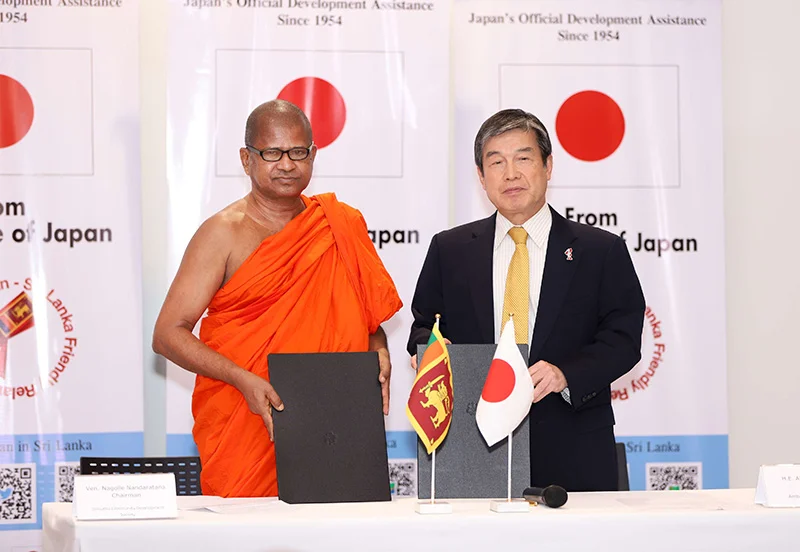
Japanese ambassador in Colombo Akio Isomata on 16 March signed a grant contract for reinforcing a bridge in Buttala under the scheme of “Grant Assistance for Grassroots Human Security Projects (GGP)”. The contract was signed with Ven. Nagolle Nandaratana, Chairman of DIMUTHU Community Development Society.
The text of the Japanese embassy press release: “The Government of Japan has provided USD 25,432 (approx. LKR 7.8 million) for a project implemented by the DIMUTHU Community Development Society. This grant will fund urgent reinforcement of the bridge abutments which were damaged by Cyclone Ditwah, and construction of retaining walls to safeguard the bridge, which ensures safe access of 3,200 residents to education and healthcare services.
Emphasising Japan’s focus on strengthening institutional frameworks to address natural disasters in Sri Lanka, Ambassador ISOMATA remarked: “As Sri Lanka moves on to the phase of recovery and reconstruction, Japan remains steadfast in its resolve to stand by the people of Sri Lanka”. Ambassador also said: “The project for which we signed today will not only contribute to the recovery and reconstruction of areas affected by Cyclone Ditwah and socio-economic development of the country, but will also stand as an enduring symbol of the unwavering friendship between the peoples of Japan and Sri Lanka.”
Commenting on the receiving of this grant assistance, Ven. Nagolle Nandaratana, Chairman of DIMUTHU community Development Society, stated, “Japan and Sri Lanka share a beautiful, long-standing friendship. Beyond just development, we’ve always admired the Japanese way of doing things—with precision, discipline, and kindness. This approach has truly been our guide in making our past collaborations, like our water projects and community buildings, such a lasting success.
Special thanks to the Ambassador, the hardworking Embassy team, and our coordinator for making this happen. “
Since 1989, Japan has been providing a total of USD 62 million in assistance for Sri Lanka through the GGP (Grant Assistance for Grassroots Human Security Projects) scheme.”

Pakistan lodge official complaint about Bangladesh’s review at end of chase

Showers or thundershowers will occur at several places in the Central, Sabaragamuwa, Southern and Uva provinces after 2.00 pm.

Government’s objective is to ensure the continuous functioning of the country’s economic activities and essential services through effective energy management – President

UN resolution on Iran ‘unbalanced’: FM Herath

Japan provides grant for reinforcement of Cyclone Ditwah damaged bridge

Australian HC debunks misleading travel risk claims for Sri Lanka

‘Dates have the highest sugar content to fight Coronavirus’

Sunday Island 27 December – Headlines

#SundayIsland 17th December – Headlines

Sunday Island – 28th March

Sunday Island Headlines – 21 March

Sunday Island – 21st February – Headlines
-

 Business6 days ago
BOI launches ‘Invest in Sri Lanka’ forum
-

 News5 days ago
Historic address by BASL President at the Supreme Court of India
-

 Sports5 days ago
The 147th Royal–Thomian and 175 Years of the School by the Sea
-

 Sports6 days ago
Royal start favourites in historic Battle of the Blues
-

 News6 days ago
CEBEU warns of operational disruptions amid uncertainty over CEB restructuring
-
 Features6 days ago
Indian Ocean zone of peace torpedoed!
-

 News5 days ago
Power sector reforms jolted by 40% pay hike demand
-

 News3 days ago
Crypto loopholes funnel Lankan funds abroad