
News
Two months after Prez called for report from CIABOC on Pandora Papers: Nirupama yet to appear before investigators

By Shamindra Ferdinando
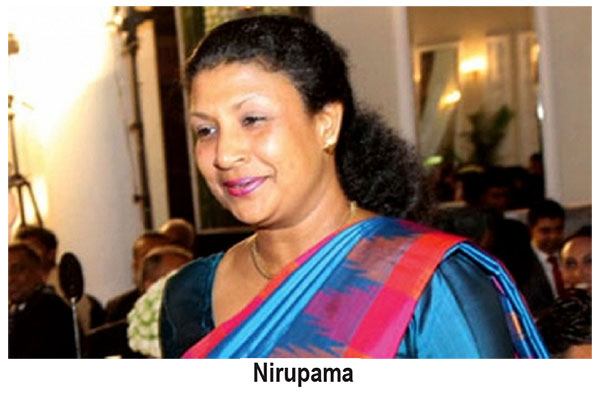
Former lawmaker Nirupama Rajapaksa, named in Pandora Papers that dealt with secret financial transactions, is yet to appear before the Commission to Investigate Allegations of Bribery or Corruptions (CIABOC).
Secretary to the CIABOC, Apsara Caldera yesterday (03) confirmed that the outfit hadn’t been able to obtain a statement from the former MP before it handed over an interim report on the issue at hand to President Gotabaya Rajapaksa.
President Gotabaya Rajapaksa on Oct. 06 asked for a report within a month from the CIABOC as regards disclosures pertaining to the financial dealings of Nirupama Rajapaksa and her husband Thirukumar Nadesan. The CIABOC recorded a lengthy statement from Nadesan.
Director General, CIABOC, High Court judge Damith Wijeyaratne was not available for comment yesterday.
The CIABOC promised to get back to The Island though DG’s Office failed to do so up to the time this edition went to press. The CIABOC consists of retired Supreme Court Justice Eva Wanasundera, retired Appeals Court Justice Deepali Wijesundera and retired DIG Chandra Nimal Wakista, one-time head of the State Intelligence Service (SIS).
According to the Pandora Papers, it is alleged that Nirupama Rajapaksa and Thirukumar Nadesan together controlled a shell company the couple used to acquire luxury apartments in London and Sydney and to make investments.
It is alleged that Nadesan set up other shell companies and trusts in various jurisdictions, and he used them to secure lucrative consulting contracts from foreign companies doing business with the Sri Lankan government and to buy artwork.
According to the Pandora Paper leaks, in 2018, one of the companies, Pacific Commodities, transferred 31 paintings and other South Asian art pieces to the Geneva Freeport, an ultra-secure warehouse where assets are not subject to taxes or duties.
In confidential emails to Asiaciti Trust, a Singapore-based offshore services provider, a long-time adviser of Nadesan’s put his overall wealth, as of 2011, at more than $160 million. ICIJ acknowledged that it couldn’t independently verify the figure. It was alleged that Asiaciti Trust managed some of Nadesan’s offshore companies and trusts, with assets valued at about $18 million, according to an ICIJ analysis.
Subsequently, Pandora Papers revealed transactions carried out by R. Paskaralingam one-time Ministry Secretary and advisor to late Presidents Ranasinghe Premadasa, and D.B. Wijetunga and former Prime Minister Ranil Wickremesinghe using similar loopholes.
JVP leader Anura Kumara Dissanayake told The Island that in spite of the seriousness of Pandora Papers revelations, the investigations were continuing at a snail’s pace. The government owed an explanation how the former MP evaded the police for so long. Lawmaker Dissanayake said that the government should have ordered a multi-agency inquiry instead of calling for an interim report from the CIABOC. The JVPer asked whether the government was genuine in its efforts to ascertain the truth as regards Pandora Papers’ disclosure.

Latest News
Cabinet approves relief meaures to persons affected due to the War situation in the Middle East


Approval has been granted at the Cabinet Meeting held on 30-03-2026 to provide relief by granting up to rupees 20/- per litre of 92 Octane Petrol, and up to rupees 100/- per litre of Auto Diesel utilized for public transport to minimize the impact on the day today life of the people and the entire economy as a result of escalation of fuel prices due to the war situation in the Middle East region.
Apart from that, the Cabinet of Ministers approved the resolution furnished by the President in his capacity as the Minister of Finance, Planning and Economic Development to grant the following relief for low – income generators, electricity consumers, farmers, fisheries community, and small tea planters who have been exposed to the direct impact of the energy price hike:
(i) Provision of an additional special allowance for April 2026 to low-income generating categories registered under the ‘Aswesuma’ Programme, irrespective of family size: • Providing rupees 7,500/- to a family in the extremely poor category
Providing rupees 5,000/- to a family in the poor category
Providing rupees 2,500/- to a family in the transitional category
(ii) Instead of transferring the additional cost borne for engaging thermal power plants for generating electricity due to the fuel price hike and prevailing dry weather circumstances to the electricity consumers, the additional cost is to be borne by the Government for a period of 03 months so that a relief can be provided to the electricity consumers utilizing below 90 units.
(iii) Increasing the fertilizer subsidiary of rupees 25,000/- per hectare given at present up to rupees 30,000/- per hectare for the Yala season and increasing the fertilizer subsidiary of rupees 15,000/- per hectare given for additional crops that are cultivated in the paddy fields up to rupees 18,000/- per hectare for the Yala season.
(iv) Provide a 50 kg sack of Urea required for the Yala season at a fixed price of Rupees 10,200/- for farmers through Agrarian Services Centres.
(v) Provide a subsidiary of Rupees 50/- per liter for up to 25 liters per day per single-day fishing vessel, for a maximum of 25 days per month, for a period of three (3) months.
(vi) Provide a one-time payment of Rupees 150,000/- per multi-day fishing vessel engaged in fishing activities during the next three (3) months.
(vii) Provide an additional one-time fertilizer allowance of Rs. 5,000 per 50 kg bag of fertilizer to small tea cultivators, in addition to the existing Rs. 4,000 fertilizer subsidy provided by the Sri Lanka Tea Board.

Under the Finance Act No. 35 of 2018 a tax has been imposed on the telecommunication towers and accordingly an annual tax amount of Rs. 200,000/- is levied from mobile network operators who possess telecommunication towers. However, it has been proposed in the Budget for 2026 that the said tax shall not be levied for a period of five (5) years in respect of telecommunication towers newly erected on or after 2026-01-01.
Accordingly, the Legal Draftsman has formulated a draft bill to amend the Finance Act No. 35 of 2018 including the provisions for taking necessary action, and the Attorney General has granted the clearance in the regard.
Hence, the Cabinet of Ministers approved the resolution furnished by the President in his capacity as the Minister of Finance, Planning and Economic Development to publish the said draft bill in the Government Gazette Notification and thereafter submit the same to the Parliament for its concurrence.

The cabinet of Ministers has approved the resolution furnished by the President in his capacity as the Minister of Finance, Planning, and Economic Development to publish the Value Added Tax (Amendment) Bill in the Government Gazette and thereafter submit it for the concurrence of the Parliament.

Cabinet approves relief meaures to persons affected due to the War situation in the Middle East

Amendments to the Finance Act No. 35 of 2018 to be Gazetted

Value Added Tax (Amendment) Bill to be Gazetted

H.M.J.M.Herath appointed Commissioner General of Registration of Persons

Water Resources Board Act, No. 29 of 1964, to be amended

Securing public sector employment opportunities for Athletes demonstrating National-Level sporting excellence

‘Dates have the highest sugar content to fight Coronavirus’

Sunday Island 27 December – Headlines

#SundayIsland 17th December – Headlines

Sunday Island – 28th March

Sunday Island Headlines – 21 March

Sunday Island – 21st February – Headlines
-

 Features3 days ago
Ranjith Siyambalapitiya turns custodian of a rare living collection
-

 News6 days ago
2025 GCE AL: 62% qualify for Uni entrance; results of 111 suspended
-

 News3 days ago
Global ‘Walk for Peace’ to be held in Lanka
-

 Business7 days ago
Hour of reckoning comes for SL’s power sector
-

 Editorial6 days ago
Search for Easter Sunday terror mastermind
-
 Opinion5 days ago
Hidden truth of Sri Lanka’s debt story: The untold narrative behind the report
-
Editorial7 days ago
Ideological confusion and identity crisis
-

 Opinion6 days ago
Is there hope for Palestine?