
Latest News
Trump signs Thailand-Cambodia ceasefire pact at ASEAN summit in Malaysia

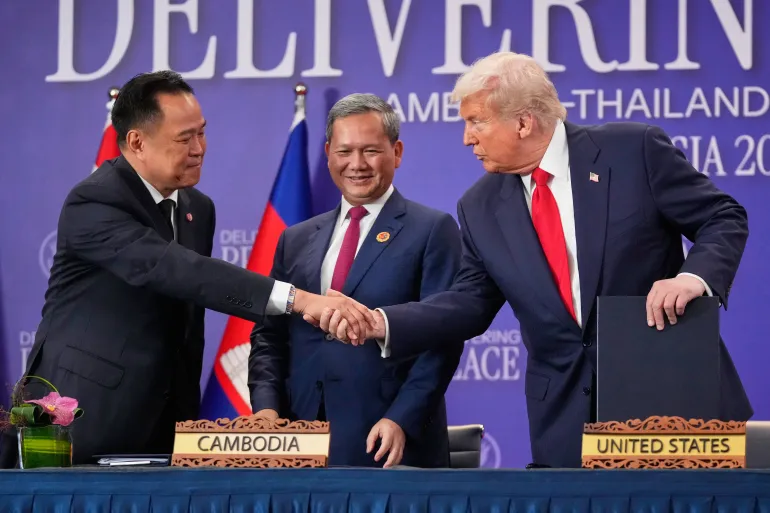
United States President Donald Trump has presided over the signing of a ceasefire between Thailand and Cambodia and announced several trade deals on his first visit to Asia since re-entering the White House.
Trump cosigned the ceasefire on Sunday with his Malaysian, Thai and Cambodian counterparts on the sidelines of the Association of Southeast Asian Nations (ASEAN) summit in Kuala Lumpur.
Thai Prime Minister Anutin Charnvirakul, Cambodian Prime Minister Hun Manet, and Malaysian Prime Minister Anwar Ibrahim joined Trump for a ceremony marking the deal, which builds on a ceasefire that halted deadly border fighting in July.
”We did something that a lot of people said couldn’t be done,” Trump said.
Anutin said the agreement created “the building blocks for a lasting peace”, while Hun Manet called it a “historic day”.
Anwar said the agreement “reminds us that reconciliation is not concession but an act of courage”.
The agreement follows a truce reached in July when Trump used the threat of higher tariffs against both countries to persuade them to end five days of fighting that killed dozens of people and displaced hundreds of thousands.
The first phase of the agreement involves Thailand’s release of 18 Cambodian soldiers and the removal of heavy weapons and landmines from the border region. Malaysian troops are to be deployed to ensure the fighting does not restart.
Territory along the 800km (500-mile) frontier between Thailand and Cambodia has been disputed for decades as a result of a vaguely defined French border treaty dating back to 1907.
The most recent conflict relates to a segment of territory near the border with Laos and another area that is home to several 1,000-year-old temples dating back to the Angkor Empire.
After signing the ceasefire on Sunday, Trump inked separate trade deals with Cambodia, Thailand and Malaysia as well as agreements on critical minerals with Bangkok and Kuala Lumpur.
Under the agreements, all three countries pledged to remove most trade barriers on US exports, particularly US agricultural products.
US tariffs on the three Southeast Asian countries remained at 19 percent.
Trump is on a six-day visit to Asia that is expected to culminate in his first face-to-face meeting with Chinese President Xi Jinping since 2019 on the sidelines of the Asia-Pacific Economic Cooperation forum in South Korea on Thursday.
Trump will depart for Japan on Monday, where he will meet newly sworn-in Prime Minister Sanae Takaichi. He will then travel to South Korea on Wednesday.

While the photo-op with Trump has come and gone, questions remain about the details of the ceasefire and whether it will hold.
Missing from the fanfare are any details about the border itself, said Sebastian Strangio, a journalist and author of Cambodia: From Pol Pot to Hun Sen and Beyond.
“They were never going to address the fundamental question, which is the disagreement on the demarcation of the border and disputes over specific territories,” Strangio told Al Jazeera.
“This was always going to be a hastily assembled deal to give Trump his political theatre and his ceremony. It was never going to be more than an elaborate version of the ceasefire deal they signed on July 28,” he said.
Strangio said the fact Trump has tied his personal prestige to the ceasefire could encourage the leaders of Cambodia and Thailand to enforce it but tensions remain high on the ground.
Sporadic violence has also broken out in the border region since the ceasefire, and a peace process will be complicated by the removal of landmines, he said.
Reporting from Sa Kaeo, Thailand, Al Jazeera’s Tony Cheng said the agreement signed on Sunday essentially reinforced “agreements that have already been made”.
Malaysian troops were supposed to deploy under the initial agreement signed in July but have not yet arrived, he said.
He said that while Thais welcomed “any kind of move towards peace”, they were viewing the agreement as “the beginning of the end” to the conflict rather than hailing it as having resolved the dispute in itself.
“The devil is going to be in the details of this agreement,” Cheng said.
He said the Thai military has been working to clear some disputed border areas at the same time as some villages have been building new bomb shelters in recent weeks.
“So people here are still concerned this could go either way,” he said.

Trump’s economic agreements with Malaysia, Cambodia and Thailand include significant economic commitments from the countries.
Thailand committed to buying $2.6bn a year in US farm products, $5.4bn a year of US energy products and 80 US aircraft worth $18.8bn, while Cambodia pledged to work with US aerospace company Boeing “in support of Cambodia’s aviation ecosystem development,” according to the White House.
Malaysia pledged to buy up to $3.4bn a year in liquefied natural gas from the US plus $200m a year of “coal and telecommunication products”, as well as 30 aircraft from the US with the option to buy 30 more, and to make capital fund investments in the US totalling $70bn.
Malaysia also said it would refrain from “banning, or imposing quotas on, exports to the United States of critical minerals or rare earth elements” and also ensure “no restrictions are imposed on the sale of rare earth magnets to US companies,” according to the White House.
Shiro Armstrong, a professor of economics at Australian National University’s Crawford School of Public Policy, said the deals undermined “ASEAN unity and the principle of equal treatment”.
“There was so much progress made in Malaysia’s leadership of ASEAN in coordinating a collective response that brought coherence to ASEAN’s multilateral principles, but these deals take the shine off that at the very least and potentially undermine everything that was achieved,” Armstrong told Al Jazeera.
“That means this deal was a very expensive one for a photo op. It’s difficult to understand what Malaysia gets from this and what they were thinking,” he added.
[Aljazeera]




Latest News
58,454 International aircraft movements in Sri Lanka in first 11months of 2025 – Ministry of Ports and Civil Aviation
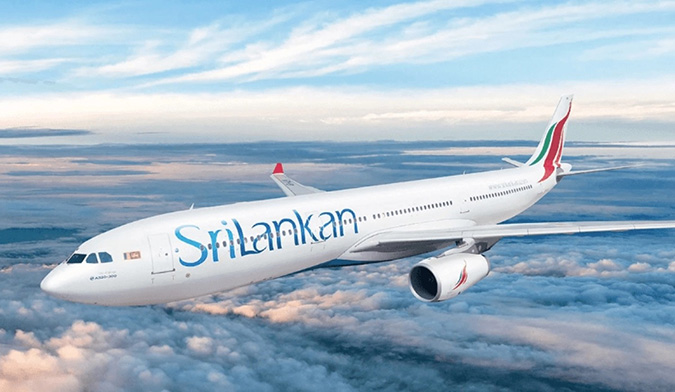
According to figures released by the Ministry of Ports and Civil Aviation there have been 58,454 international aircraft movements in the first 11 months of 2025 in Sri Lanka. [An aircraft movement refers to the count of take offs and landings at an airport]
The figures also confirm that tourist arrivals via air stands at 2.1 million.

Lasith Malinga has once more been retained as consultant bowling coach for Sri Lanka’s men’s team, as they prepare for the T20 World Cup they are due to co-host from early February.
Although this is only a 40-day appointment, running from December 15 to January 25, it is essentially a continuation of Malinga’s work with key bowlers in the national set-up. Malinga has worked officially as a fast-bowling consultant at least twice before, but has also worked unofficially with top bowlers over the years, and has been advising the coaching team led by Sanath Jayasuriya, over the past two years.
With round-arm bowlers Matheesha Pathirana and Nuwan Thushara both in Sri Lanka’s preliminary squad for the T20 World Cup, and likely to make the final 15, Malinga will be especially well-placed to assist.
“Sri Lanka Cricket aims to leverage Malinga’s vast international experience and renowned expertise in death bowling, particularly in the shortest format of the game to strengthen Sri Lanka’s preparations for the upcoming World Cup,” the board release said.
Sri Lanka are set to co-host their first men’s global tournament since 2012, from February 7. Three Sri Lankan venues will be used – Khettarama and SSC in Colombo, and Pallekele.
The T20 World Cup will run from February 7 to March 8. Sri Lanka are in Group B along with Australia, Ireland, Oman and Zimbabwe.
[Cricinfo]

The Inland Revenue Department has succeeded in collecting Rs. 2,203 billion in revenue in 2025, the highest amount recorded in its 93-year history. This represents a surplus of Rs. 33 billion over the revenue target for the year and a 15 per cent increase compared with the revenue collected in the previous year, stated Commissioner-General of Inland Revenue Ms Rukdevi Fernando.
She made these remarks at a discussion held on Tuesday (30) morning at the Department’s auditorium under the patronage of President Anura Kumara Dissanayake.
Marking the first occasion in the 93-year history of the Inland Revenue Department that a President has visited the Department, the President attended a meeting with the staff to review the progress achieved in 2025 and the new plans for 2026.
The President expressed his appreciation to all officers and staff of the Inland Revenue Department for surpassing the revenue expected by the Government and urged everyone to continue working towards a common objective in order to realise the economic transformation required for the country.
Emphasising that no individual is entitled to the privilege of evading taxes, the President stated that the era in which a tax culture prevailed based on personal or political affiliations has come to an end. He further stressed that the law will be enforced without hesitation, irrespective of status, against those who attempt to evade taxes.
The President also pointed out that tax collection is neither repression nor coercion but a legitimate right of the State, adding that necessary changes will be made to laws, regulations, designations and staffing in order to secure this contribution.
He further emphasised that the Government’s objective is to ensure that the benefits of these economic achievements flow to the people of the country. The Government is focusing on improving essential public services to enhance the quality of life, undertaking a new transformation of the transport system and providing adequate allocations for the development of the education and health sectors.
The President also highlighted the need for a targeted programme to properly collect the taxes due to the Government by addressing issues such as improving tax literacy, simplifying the tax system and filling staff shortages.
Ms Rukdevi Fernando stated that the professional competence and dedication of the Department’s officers were the key factors behind this success.
She further noted that a revenue target of Rs. 2,401 billion has been set for 2026 and that the Department expects to achieve this through programmes aimed at enhancing tax compliance and broadening the tax base.
In addition, she said that the Department plans to expand third-party data sharing, strengthen investigations into domestic and overseas assets, take over the RAMIS system, reinforce risk-based auditing, introduce e-invoicing, adopt modern technology for tax administration and enhance tax ethics in 2026.
Minister of Labour and Deputy Minister of Finance and Planning Dr Anil Jayantha Fernando, Deputy Minister of Economic Development Nishantha Jayaweera, Secretary to the President Dr Nandika Sanath Kumanayake, Commissioner-General of Inland Revenue Ms Rukdevi Fernando and senior officials and staff of the Department were present at the occasion.

58,454 International aircraft movements in Sri Lanka in first 11months of 2025 – Ministry of Ports and Civil Aviation

Lasith Malinga to work with the Sri Lanka Team in lead up to T20 World Cup

Highest revenue in 93-year history of Inland Revenue Department collected in 2025

Showers or thundershowers will occur at times in the Northern, Eastern, Central, North-central, North-western and Uva provinces

Israel to bar 37 aid groups from Gaza

Protests spread across Iran for third day after currency hits record low

‘Dates have the highest sugar content to fight Coronavirus’

Sunday Island 27 December – Headlines

#SundayIsland 17th December – Headlines

Sunday Island – 28th March

Sunday Island Headlines – 21 March

Sunday Island – 21st February – Headlines
-

 News7 days ago
British MP calls on Foreign Secretary to expand sanction package against ‘Sri Lankan war criminals’
-
 News6 days ago
Street vendors banned from Kandy City
-

 Sports7 days ago
Chief selector’s remarks disappointing says Mickey Arthur
-

 Opinion7 days ago
Disasters do not destroy nations; the refusal to change does
-

 Sports3 days ago
Gurusinha’s Boxing Day hundred celebrated in Melbourne
-

 News6 days ago
Lankan aircrew fly daring UN Medevac in hostile conditions in Africa
-

 Sports4 days ago
Time to close the Dickwella chapter
-
 Sports7 days ago
Royal record crushing innings win against Nalanda