
Foreign News
Thousands of Chinese lured abroad and forced to be scammers – now Beijing is cracking down


“Should I feel anything?” asks the beady-eyed man, sitting in a padded cell with handcuffs around his wrists.
He’s being grilled by Chinese investigators about the time he allegedly ordered a stranger to be killed – a human offering to celebrate his sworn brotherhood with a business partner.
“Wasn’t he a living, breathing person?” an investigator asks.
“I didn’t feel much,” the man maintains.
The scene may sound like it came straight out of a crime drama. In fact, it is part of a documentary on Chinese state media – a look inside the workings of the justice system almost unheard of in a country where court proceedings are largely kept out the public eye.
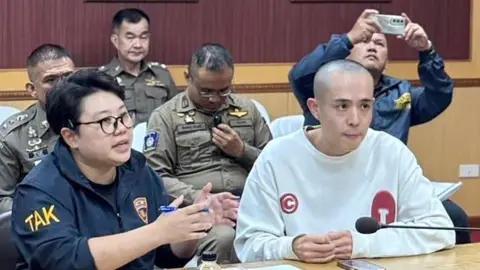
The handcuffed man answering questions is Chen Dawei, a member of the infamous Wei family, one of several powerful mafia groups that for years operated with impunity in Myanmar’s border town of Laukkaing.
His confession forms just one part of a months-long propaganda push by Chinese officials. It both warns Chinese people of South East Asia’s billion-dollar scam industry, and highlights the Chinese government’s crackdown on the men behind an industry which has trapped thousands, and stolen billions.
The message China wants to send, as one investigator puts it, is clear: “It’s to warn other people, no matter who you are, where you are, as long as you commit such heinous crimes against Chinese people, you will pay the price.”
Or, to use a Chinese idiom: kill the chicken to scare the monkey.
There are few chickens bigger than the Weis, Lius, Mings and Bais – Godfather-esque families who rose to power in Laukkaing in the early 2000s.
Under their rule, the impoverished backwater was transformed into a flashy hub of casinos and red-light districts.
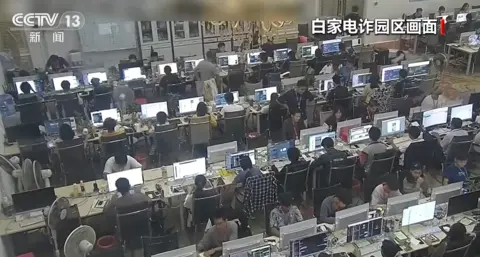
More recent are the scam farms – which hold people against their will, forcing them to defraud strangers online, or face brutal punishment or even death. Many of those trapped were Chinese and targeted people in China.
But the families’ empires came crashing down in 2023, when Myanmar authorities arrested them and handed them to China. Since then, Chinese courts have tried them for crimes ranging from fraud to human trafficking to homicide.

Examples are now being made out of the families: 11 members of the Ming clan and five of the Bais have been sentenced to death, while dozens have been given lengthy jail terms. Prosecution is under way for the Lius and the Weis.
Their ignominious falls from grace are clear in the documentaries they feature in, from the glint of their handcuffs to the colour of their prison uniforms.
It is a far cry from the lives they were living just two years ago.
The rise of Myanmar’s scam clans
The godfathers of Laukkaing rose to power after Min Aung Hlaing, who now heads Myanmar’s military government, led an operation to oust the town’s then-dominant warlord.
The military leader had been looking for co-operative allies, and Bai Suocheng – then a deputy of the warlord – fitted the bill.
Bai was appointed the chairman of Laukkaing district and his family came to command a 2,000-strong militia, Chinese media reported.
In the power vacuum left by these changes, a handful of families swooped in, securing military and political power.
According to Chinese investigators, the Wei family had one member of parliament and another military camp commander. Meanwhile, the Lius controlled key infrastructure like water and electricity and exerted strong influence over local security forces.

For years they made their money through gambling and prostitution.
But more recently they expanded to cyberscam operations, with each family controlling dozens of scam compounds and casinos that raked in billions of dollars.
While the families lived large with grand banquets and luxury cars, a culture of abominable violence thrived behind the walls of their scam compounds, Chinese authorities said.
Testimonies collected from freed workers point to a common pattern of abuse: fingers chopped off with knives, zaps of electric batons and regular beatings. Unco-operative workers were locked in small dark rooms and starved or beaten until they gave in.
China’s war on the ‘scamdemic’
Many of the Chinese workers had been lured there with lucrative job offers – no doubt tempting amid China’s economic slowdown and high youth unemployment.
Horror stories of such scam centres have seeped into daily chatter in China, from taxi rides to social media and pop culture.
No More Bets, a 2023 blockbuster about Chinese people trafficked to a foreign scam farm, kept millions of Chinese tourists away from Thailand – which has gained a reputation for being a transit hub to scam centres in Myanmar and Cambodia.

In January this year, the national spotlight was on Wang Xing, a small-time Chinese actor who had flown to Thailand for an acting gig, only to be taken to a scam centre across the border in Myanmar.
His family’s search for him went viral and he was ultimately rescued.
But Wang is in the lucky minority. Many Chinese people are still looking for their loved ones who have disappeared into South East Asia’s scam centres.
“My cousin was lured there four or five years ago. We haven’t heard from him at all. My aunt is in tears every day, it’s hard to describe her current condition,” a Weibo user wrote last month.
Selina Ho, associate professor specialising in Chinese politics at the National University of Singapore, tells the BBC that “by publicising the most recent crackdown, Chinese authorities are aiming to calm domestic sentiments and reassure the families of victims”.
The UN estimates that hundreds of thousands of people are still trapped in scam centres worldwide.
Much to Beijing’s chagrin, those running many such scam centres are often Chinese themselves.
This is common knowledge among Chinese citizens. “Once you’re abroad, the people you should least trust are your own countrymen,” reads a comment on Weibo.
“The fact that Chinese nationals are the masterminds behind many of these operations has been deeply damaging to China’s image on the international stage,” Ivan Franceschini, co-author of Scam: Inside Southeast Asia’s Cybercrime Compounds, tells the BBC.
As anxieties rise at home, Chinese authorities are eager to show their resolve in eradicating these massive scam networks.
Since 2023, Chinese and Myanmar authorities have arrested more than 57,000 Chinese nationals for their role in cyberscams, state media reported.
And they’ve made it clear that it’s not just the Godfathers they’re after. In October, China announced the prosecution of another syndicate which they described as a “new generation of power” in Laukkaing that’s “no less violent” than the infamous families.
In – yet another – state media documentary, a Chinese official investigating this syndicate recalled what his team leader had told him: “If this case can’t be solved, there will be a permanent stain on your career.”
For all the effort that China is putting into its crackdown and the ensuing publicity, the numbers offer some optimism: cyberscams reported in China have declined steadily over the past year, and authorities say such crimes have been “effectively curbed”.
As one official told documentary viewers, investigating scam gangs in Myanmar has made him realise “how happy we are in China, and how important a sense of security is to Chinese people”.
[BBC]


Britney Spears has been arrested in California under suspicion of driving under the influence.
The singer was detained by California Highway Patrol at around 21:30 local time (05:30 GMT) on Wednesday. A representative for her told the BBC: “This was an unfortunate incident that is completely inexcusable.”
She was released in the early hours of Thursday morning and is due to appear at Ventura County Superior Court on 4 May.
The reason for the singer’s arrest was confirmed to CBS, the BBC’s US partner, by the Ventura County Sheriff’s Office in southern California.
Spears’ representative told the BBC: “Britney is going to take the right steps and comply with the law and hopefully this can be the first step in long overdue change that needs to occur in Britney’s life.
“Hopefully, she can get the help and support she needs during this difficult time.
“Her boys are going to be spending time with her. Her loved ones are going to come up with an overdue needed plan to set her up for success for well being.”
The pop star appeared to have deleted her Instagram account on Thursday as news of her arrest broke.
Spears is one of the most successful pop stars ever, with hits such as Baby One More Time, Toxic, Everytime, Gimme More, Womanizer, and Stronger.
The singer said in January 2024 that she would “never return to the music industry”. Her last song was a duet with Elton John in 2022.
However, in a since-deleted social media post from earlier this year, Spears indicated that, although she would not perform in the US again, she was hoping to play live in the UK and Australia in the near future.
For 13 years until 2021, Spears was in a conservatorship – a legal guardianship that saw her finances and personal life controlled by her father.
The singer published her memoir in 2023 titled The Woman in Me, which saw her reflect on her career and detail her struggles living under the conservatorship.
Her ex-husband, Kevin Federline, released his own memoir, You Thought You Knew, at the end of 2025.
[BBC]

“It’s so good to be home.”
The statement sums up how almost 400 people felt after their flight from Dubai arrived in Dublin on Wednesday night.
The Emirates flight was the first in a number of days after the United States-Israeli attacks on Iran led to the closure of nearly all airspace in the Middle East.
One of the passengers, Norita Geary, said: “Everyone clapped when the plane landed and we all cheered.”
“It was unreal. I mean you see these things on television, you see them in movies but you just don’t think you’ll end up there yourself,” she added.
A second flight directly to Dublin from Dubai is scheduled for Thursday, with a further 400 passengers on it.

Rushali Lakhani said she is feeling “very happy” to be back [BBC]
Rushali Lakhani said she is “very happy” and “very grateful” to be back.
“It was quite a stressful time but grateful and thanking our lucky stars really.”
She said was “it was quite nerve wracking, we couldn’t really sleep much”.
“A lot of sleepless nights, a lot of bangs. There were no airplanes flying so whenever we heard some noises we knew that it wasn’t good news.”

So far 25,000 Irish citizens in the region have registered with the Department of Foreign Affairs – 2,000 of them have said they want to leave.
The Irish government has chartered a flight for Irish citizens from Muscat in Oman on Friday.
The Irish Embassy in the UAE thanked all those had registered but warned that registration is not an expression of interest in a flight.
Meanwhile, a flight chartered by the UK government which had been due to bring back some Britons stranded in the Middle East on Wednesday night did not take off as scheduled..
British citizens stuck in the Middle East have told the BBC there has been a lack of information about available routes to travel home.
The Foreign Office said two more chartered flights would depart by the end of the week.
Foreign Office officials said 138,000 British nationals in the Gulf had registered their presence, of whom 112,000 were in the UAE.
[BBC]

An eight-year-old Queensland girl has been killed after she was seriously injured in a snowmobile accident at a Japanese ski resort.
Chloe Jeffries, from the Gold Coast, was riding on a snowmobile with her mother in Hakuba Valley, Nagano prefecture, on Saturday when it overturned, trapping her underneath. She was airlifted to hospital but later died.
In a tribute from her netball club, Jeffries was remembered for her “beautiful nature” and “her cheeky, infectious smile”.
Tour operator Hakuba Lion Adventure said the vehicle flipped after going up an embankment along a forest road and that police were investigating. Jeffries is the fourth Australian to have died at a Japanese ski resort this year.

Showers or thundershowers are likely at a few places in the Southern province and in Rathnapura, and Kaluthara districts during evening or night.

‘IRIS Dena was Indian Navy guest, hit without warning’, Iran warns US of bitter regret

Risk of power cuts due to use of low-quality coal,PUCSL warns

Sajith demands clear statement from govt. about Iranian vessel sunk close to Galle and another located near Colombo port

Sri Lanka evacuates crew of second Iranian vessel after US sunk IRIS Dena

University of Wolverhampton confirms Ranil was officially invited

‘Dates have the highest sugar content to fight Coronavirus’

Sunday Island 27 December – Headlines

#SundayIsland 17th December – Headlines

Sunday Island – 28th March

Sunday Island Headlines – 21 March

Sunday Island – 21st February – Headlines
-

 Features4 days ago
Brilliant Navy officer no more
-

 Opinion4 days ago
Sri Lanka – world’s worst facilities for cricket fans
-

 Features4 days ago
A life in colour and song: Rajika Gamage’s new bird guide captures Sri Lanka’s avian soul
-

 Business2 days ago
Cabinet nod for the removal of Cess tax imposed on imported good
-

 Features5 days ago
Overseas visits to drum up foreign assistance for Sri Lanka
-
 Features5 days ago
Sri Lanka to Host First-Ever World Congress on Snakes in Landmark Scientific Milestone
-

 Latest News2 days ago
Around 140 people missing after Iranian navy ship sinks off coast of Sri Lanka
-

 News1 day ago
Legal experts decry move to demolish STC dining hall