
Latest News
The Men’s 100: Jos Buttler’s 70 leaves Northern Superchargers stuck in third


With the return of Sir James Anderson to the Manchester Originals‘ line-up, there was an extra frisson at Headingley for the local derby as the Northern Superchargers looked to record eight wins from eight for the women and men at their northern fortress. Alas for Harry Brook’s side, although they will still be in the Eliminator at the Kia Oval on Saturday, it was not to be.
Starting on the same points total as the Trent Rockets but with a significant deficit in net run rate, the Superchargers were looking for a big win to give themselves a decent chance of finishing second in the group stages.
The Originals won the toss and chose to field, with Anderson bowling the first ten, and rapidly picking up his first and second wickets in The Hundred, accompanied by a broad grin. He then had Brook dropped in the deep before seeing England’s white-ball captain try his falling-over scoop, the ball merely dribbling a few feet from the bat, Brook ending up on his bottom and Anderson in stitches.
Brook (20 off 20) was then caught off Scott Currie and Zak Crawley (17 off 17) holed out, and at 73 for 5 off 67 balls, the Originals were in the box seat.
Enter the 40-year-old Samit Patel, three years younger than Anderson perhaps, but still very much a senior citizen in professional cricketing terms. When he was dismissed off the penultimate delivery, he had pummeled four fours and three sixes in his 19-ball 42 and, along with David Miller (30 off 22), given the Superchargers something to defend despite Tom Aspinwall’s impressive 3 for 17.
The Superchargers’ opening pair of Jacob Duffy and Matthew Potts were tidy, Phil Salt (9 off 13) and Ben McKinney (6 off 8) struggling to break free but once they had gone, Jos Buttler and Rachin Ravindra (47* off 23) showed just why they are rated two of the best white-ball batters in the world, a thrilling partnership of 99 off 48 ensuring the Originals finished the competition on a high and consigning the Superchargers to a third-place group finish, barring a catastrophic defeat by the Rockets to the Phoenix tomorrow at Trent Bridge.
Buttler was imperious, smiting seven fours and five sixes in his 37-ball 70 before being bowled by Adil Rashid, at which point only 10 were needed off 21 balls. Rashid conceded 39 from his 20, the most he has ever leaked in The Hundred, and successive boundaries from Ravindra sealed the deal with seven wickets and 16 balls to spare.
Meerkat Match Hero Jos Buttler said: “The surface was a bit tricky, a bit slow. I thought we bowled exceptionally well apart from three or four balls and that allowed us to chase it down. We showed our best cricket in this last game when we were already out of the tournament, which is frustrating.
“Overall, over the course of the tournament, we left a lot out there. In a couple of games, we failed to get over the line and we are where we deserve to be in the end. Tonight we showed what we are truly capable of as a team.”
Brief scores:
Manchester Originals [Men] 140 for 3 in 84 balls (Jos Buttler 70, Rachin Ravindra 47*; Jacob Duffy 1-16, Tom Lawes 1-20, Adil Rashid 1-39) beat Northern Superchargers [Men] 139 for 8 in 100 balls (Zak Crawley 17, Harry Brook 20, David Miller 30, Samit Patel 42; James Anderson 2-30, Josh Tongue 2-26, Scott Currie 1-37, Tom Aspinwall 3-17) by seven wickets
[Cricinfo]

Latest News
Tri-Forces donate LKR. 372 million, a day’s pay of all ranks to ‘Rebuilding Sri Lanka’ Fund
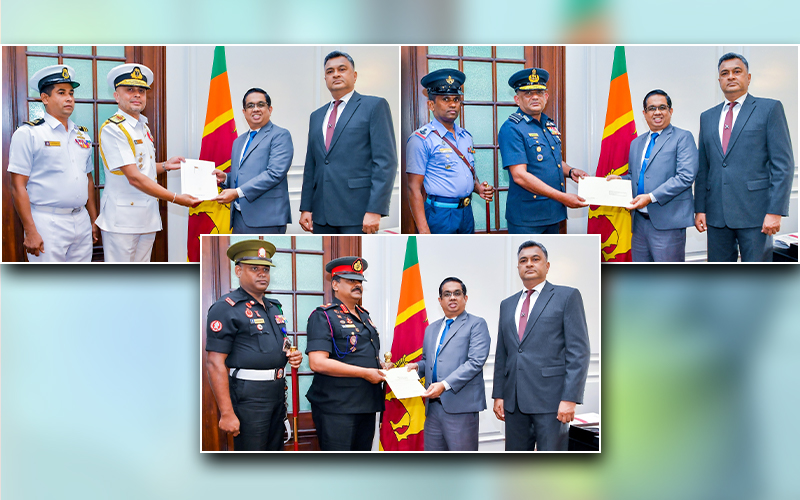
Members of all ranks from the Sri Lanka Army, Sri Lanka Navy and Sri Lanka Air Force have collectively donated a day’s basic salary to the ‘Rebuilding Sri Lanka’ Fund, which was established to restore livelihoods and rebuild the country following the devastation caused by Cyclone Ditwah.
Accordingly, the total contribution made by the Tri-Forces amounts to LKR. 372,776,918.28.
The cheques representing the financial contributions were handed over on Wednesday (31 December) at the Presidential Secretariat to the Secretary to the President, Dr. Nandika Sanath Kumanayake.
The donations comprised LKR. 250 million from the Commander of the Army, Major General Lasantha Rodrigo; LKR. 73,963,879.71 from the Commander of the Navy, Rear Admiral Kanchana Banagoda and LKR. 48,813,038.97 from the Commander of the Air Force, Air Marshal Vasu Bandu Edirisinghe.
Secretary to the Ministry of Defence, Air Vice Marshal Sampath Thuyacontha, was also present on the occasion.
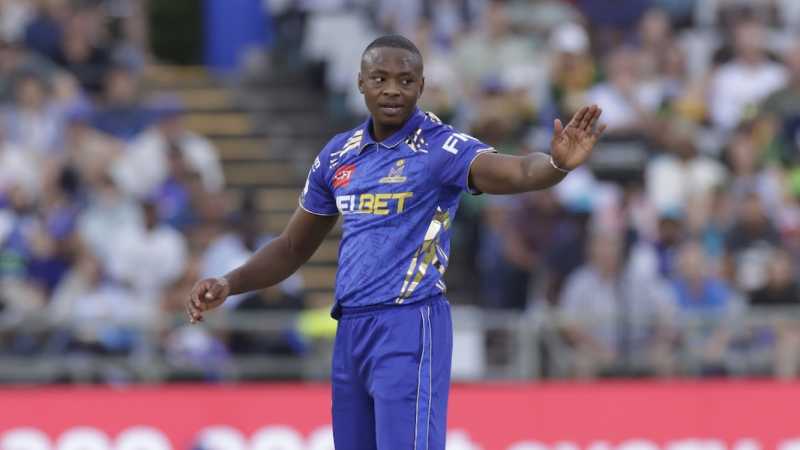
Kagiso Rabada, who returned to action on New Year’s Eve after almost ten weeks on the sidelines with a rib injury, will lead South Africa’s attack at the men’s T20 World Cup in India and Sri Lanka in February-March. Rabada, who took 2 for 48 on comeback for MI Cape Town (MICT) in the SA20, has been named alongside five other quicks: Anrich Nortje, Marco Jansen, Corbin Bosch, Lungi Ngidi and Kwena Maphaka complete South Africa’s pace battery.
Maphaka and Bosch are among seven players who will appear at a World Cup for the first time. The others are batters Dewald Brevis, Tony de Zorzi and Jason Smith, and allrounders George Linde and Donovan Ferreira.
South Africa will be led by regular T20 skipper Aiden Markram and will have only seven members of the squad that reached the final of the 2024 T20 World Cup. Quinton de Kock is back at the top of the order after making himself available for South Africa in October, while David Miller, Keshav Maharaj, Jansen, Rabada and Nortje were all in the XI that lost to India in Barbados in June 2024.
Of those not in the squad, Heinrich Klaasen has retired from international cricket while Reeza Hendricks, Ryan Rickelton, Tristan Stubbs, Ottneil Baartman, Gerald Coetzee, Bjorn Fortuin and Tabraiz Shamsi have missed out. All eight of these players are currently in action in T20 franchise leagues, with the first seven at the SA20 and Shamsi at the ILT20 and then the BBL.
Among the biggest talking points in the current squad is the addition of de Zorzi, who has not played in a month, since injuring his hamstring in an ODI against India in Raipur. De Zorzi had been in good form prior to that match, and is seen as someone who is suited to subcontinent conditions. He is part of the Durban’s Super Giants (DSG) squad in the SA20 but has yet to play a game.
Tony is recovering well,” Moroney said. “He’s working with a medical team and he will be fit and ready to go when we play the West Indies. He’s probably slotting in at number three.”
Moroney also explained the selectors’ thinking behind leaving out Rickelton and Stubbs.
“It was a big decision between Quinny de Kock and Ryan Rickelton and ultimately we’ve opted to go with Quinny de Kock in that opening berth along with Aiden Markram,” he said.
“On Stubbs, in theory what we’ve really looked for there is to make sure that we have that attacking middle order where the left-handed David Miller slots in for us ideally and then with [Dewald] Brevis and [Donovan] Ferreira complementing him on either side is our general plan.
“That’s what we’ve opted for with Stubbs not included in this tour, in this World Cup.”
Smith, who only has five international caps to his name, is also something of a surprise inclusion. Smith has recently enhanced his reputation as a finisher after an unbeaten 68 off 19 balls to send Dolphins into the playoff of the CSAT20 Challenge, and the 14-ball 41 for MICT against DSG in the SA20 opener. Smith also offers a seam-bowling option, though he has not bowled since October as he recovers from a niggle. MICT coach Robin Peterson confirmed Smith may start bowling towards the end of the competition.
“Jason brings us a lot of versatility and is able to bat nearly anywhere in the order,” Moroney said. “He also gives us that opportunity to go in in the powerplay. That’s something that we were looking at, to get that player movement, to give the coach the opportunity to be strategic and slot batters into different positions in the batting order. It definitely gives us that versatility that we look for.”
Left-arm quick Nandre Burger, Moroney said, was unlucky to miss out. Burger sustained a hamstring injury recently, but it wasn’t this as much as competition for slots that led to his non-selection, with Nortje selected instead.
“Nandre Burger was part of the selection [conversation] and we’ve opted to go with Anrich Nortje instead of a player like Nandre. He’s recovering and everything indicates that he’ll be fully fit, but from a selection point of view we’ve gone with Anrich.”
In the spin department, South Africa have stuck to their two left-arm spinners in Maharaj and Linde, while Markram and Ferreira (who also keeps wicket) will be the offspin options. The international career of left-arm wristspinner Shamsi, who recently won a case for a no-objection certificate against Cricket South Africa and is no longer centrally contracted, appears to be over.
The T20 World Cup will be the first white-ball tournament under all-format coach Shukri Conrad, who took over the limited-overs sides in July last year. His regular support staff of Ashwell Prince (batting coach), Piet Botha (bowling coach) and Kruger van Wyk (fielding coach) will be enhanced by Albie Morkel as a specialist T20 consultant. Morkel is currently part of the management team of Joburg Super Kings at the SA20.
All South Africa’s players will be involved in the SA20 for most of this month. They will then host West Indies for three T20Is before heading to India for the T20 World Cup. Their campaign starts against Canada on February 9. South Africa will also play Afghanistan, New Zealand and the UAE in the group stage.
South Africa squad for the T20 World Cup:
Aiden Markram (capt), Corbin Bosch, Dewald Brevis, Quinton de Kock (wk), Tony de Zorzi, Donovan Ferreira, Marco Jansen, George Linde, Keshav Maharaj, Kwena Maphaka, David Miller, Lungi Ngidi, Anrich Nortje, Kagiso Rabada, Jason Smith
(Cricinfo)
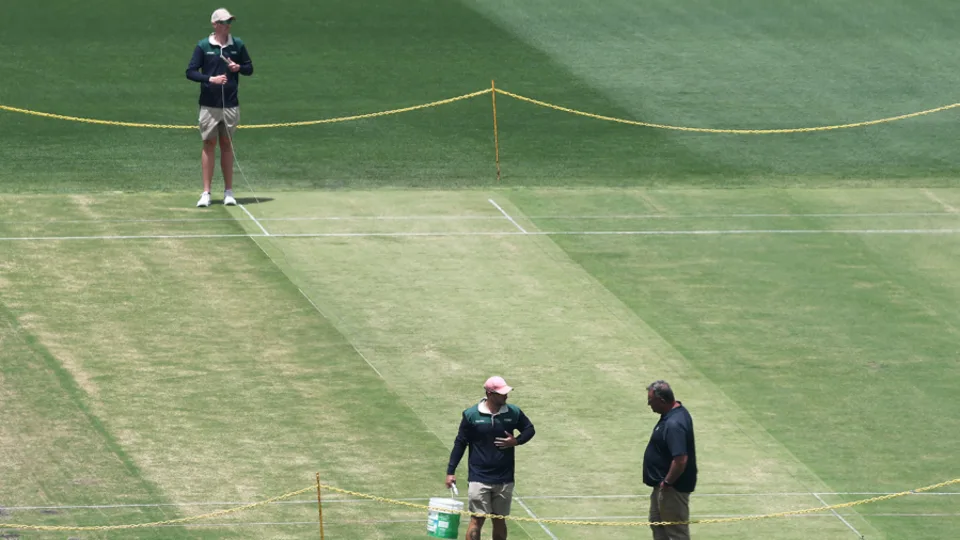
Todd Murphy is firming to play his first home Test, after the SCG’s head curator declared the pitch’s green covering would be near-irrelevant come day one.
With administrators still on edge after last week’s two day debacle in Melbourne, an extremely green SCG surface raised eyebrows in Sydney on Thursday.
But chief curator Adam Lewis insisted on Friday that should not be a concern, and he was hopeful Sydney would extend into a fifth day.
“You want to see green tinge three days out,” Lewis said. “If you’re not seeing any live grass three days out, then that’s when it’s a worry, … I’m really comfortable with where we’re sitting.
“We had a little bit of sun this morning. They’re saying a bit more sun tomorrow. That will take the greenness out of the pitch. We’re really happy with the pitches at the moment. We’re looking good.”
Lewis admitted he felt for MCG counterpart Matt Page last week, but said he felt no external pressure to ensure the fifth Test in Sydney went the distance.
It’s estimated that Cricket Australia (CA) has lost in the vicinity of AUD15 million in profits this summer, with the opening Test in Perth also finishing inside two days.
Even Prime Minister Anthony Albanese joked at a function with teams on Thursday night that they had to ensure the game went to day three, in order to support the McGrath Foundation fundraiser.
One of the hardest grounds in the world to bowl on between 2014 and 2023, last year’s SCG Test was over in just two-and-a-half days.
Lewis said that his ground staff would go with 6mm of grass this year compared to 7mm last season, while also reducing its density. That in itself generally acts to flatten out the wicket and produce less movement, while also inviting the chance of spin late in the match.
“We just thought … we could thin our density out a little bit,” Lewis said. “That’s what we’ve done this year. We’ve practised that in the Shield matches and we’ve received very good marks.”
CA CEO Todd Greenberg said he too was confident the SCG Test would last the distance.
“I’ve had more phone calls and conversations about wickets and millimetres of grass than I thought I’d ever have,” Greenberg said. “But I’m hopeful and confident we will have a long and productive Test match here.”
All of which should spell good news for Murphy. Australia’s coaching staff had a prolonged conversation around the pitch on Friday morning, after leaving Murphy out and going with four quicks at the MCG.
Murphy then spent most of Friday’s training session bowling to Australia’s top order, while Alex Carey also had an extended run keeping to him.
With seven Tests to his name overseas, Murphy would be expected to come in for Jhye Richardson if he does play in Sydney.
England have promised to take the attack to Murphy, who played two Tests during the 2023 Ashes were he conceded 4.72 an over.
“Whoever plays, I think that’s the mantra of our team, is to try and put pressure on people,” opener Zak Crawley, said. “Todd’s a very good bowler, but I can envisage us trying to put some pressure on him, like we would all their bowlers.
That’s going to come with some risks, and if it’s turning it’s definitely going to be a threat. But I think we’ll try and put pressure on all their bowlers.”
The other question for Australia will be whether Cameron Green remains in the side, after Beau Webster was spotted fielding in the gully during slips training on Friday. Green has averaged 18.66 with the bat in this series. The SCG was the scene of Webster’s debut a year ago against India.
[Cricinfo]

Tri-Forces donate LKR. 372 million, a day’s pay of all ranks to ‘Rebuilding Sri Lanka’ Fund

Rabada to lead strong South Africa pace attack at T20 World Cup

Showes about 75 mm are likely at some places in the Eastern and Uva provinces and in Matale, Nuwara-Eliya and Polonnaruwa districts.

CEB demands 11.57 percent power tariff hike in first quarter

Health Minister sends letter of demand for one billion rupees in damages

One killed, two injured in shooting at Kaduwela

‘Dates have the highest sugar content to fight Coronavirus’

Sunday Island 27 December – Headlines

#SundayIsland 17th December – Headlines

Sunday Island – 28th March

Sunday Island Headlines – 21 March

Sunday Island – 21st February – Headlines
-

 Sports5 days ago
Gurusinha’s Boxing Day hundred celebrated in Melbourne
-
 News3 days ago
Leading the Nation’s Connectivity Recovery Amid Unprecedented Challenges
-

 Sports6 days ago
Time to close the Dickwella chapter
-

 Features4 days ago
It’s all over for Maxi Rozairo
-

 News6 days ago
Environmentalists warn Sri Lanka’s ecological safeguards are failing
-
 News4 days ago
Dr. Bellana: “I was removed as NHSL Deputy Director for exposing Rs. 900 mn fraud”
-
 News3 days ago
Dons on warpath over alleged undue interference in university governance
-
 Features6 days ago
Digambaram draws a broad brush canvas of SL’s existing political situation