
Latest News
“The government is determined to make all necessary decisions for the country’s advancement and to improve the quality of life for its citizens” -President

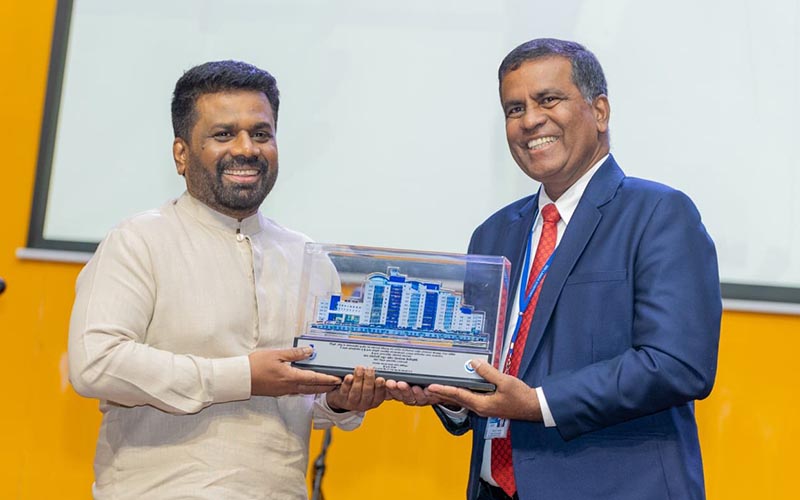
President Anura Kumara Disanayake stated that the current government is determined to make all necessary decisions for the country’s advancement and to improve the quality of life for its citizens.
The president expressed these views during an event held on Monday (27) at the Customs Department Auditorium to mark International Customs Day under the theme, ‘Customs Delivering on its Commitment to Efficiency, Security and Prosperity.’
The Customs Co-operation Council (CCC), established in 1952 with the participation of 17 European countries is independent intergovernmental body whose mission is to enhance the effectiveness and efficiency of Customs administrations. This council quickly became globally recognized, and Sri Lanka became a member in 1967. In 1994, the Customs Cooperation Council was renamed the World Customs Organization (WCO).
The first session of the Customs Cooperation Council was held on January 26, 1953, in Brussels, Belgium, marking the establishment of International Customs Day. As a result, every year on January 26, customs administration institutions across the world celebrate International Customs Day.
The President also mentioned that necessary actions are being taken to create a modern organizational structure, with structural reforms being implemented within Sri Lanka Customs, the Department of Excise, and the Department of Inland Revenue.
The President stated that laws and institutions must evolve to meet the challenges of the times and cannot remain static or permanent indefinitely.
Elaborating further, President Disanayake shared the following insights:
“Customs successfully fulfilled its responsibilities over the past year, and its efforts in stabilizing the economy are highly commendable. The achievements in meeting last year’s targets are being appropriately recognized.
However, simply achieving revenue targets is not enough to rebuild a collapsed economy. Addressing the economic crisis requires increasing the revenue-to-GDP ratio. The economic collapse has significantly disrupted the import-export market.
All of our actions are currently being carried out within the parameters set by the International Monetary Fund (IMF). While surface-level indicators may suggest economic recovery, the overall economy remains deeply damaged. Therefore, it is essential to approach the recovery process cautiously and with balance. Even a small mistake can cause significant disruptions to the economy. Therefore, the Customs Department must work collectively to achieve its targeted revenue of Rs. 2,550 billion.
A proposal has been submitted to improve facilities for Customs and establish a new salary structure. Discussions are underway with the Ministry of Finance and the Treasury to provide solutions.
This year’s budget has already addressed the increase in the basic salaries of public sector employees. Additionally, plans are in place to enhance the efficiency of the public service by integrating digitalization and technology. Efforts are also being made to implement legal reforms to build strong institutional frameworks.
There were conflicts between previous political administrations and the state service mechanism. Due to these disagreements, the political leadership failed to implement the necessary reforms to strengthen institutional frameworks at the right time. It was a challenging period to establish robust institutional structures.
The failure to introduce timely institutional changes resulted in the expected outcomes not being achieved. Consequently, before we could secure many opportunities for ourselves, external parties took advantage of our resources. As a result, Sri Lanka missed several opportunities to leverage its natural strategic position as a nation.
In the future, necessary measures must be taken to facilitate operations at the Sri Lanka Port, targeting a capacity of 11.3 million containers. Achieving this will require collective effort from all employees. Without such unity, the country cannot move forward. This year, the Customs Department has been assigned a revenue target of LKR 2,550 billion.
President Anura Kumara Disanayake presented merit certificates issued by the World Customs Organization to 20 Customs officers in recognition of their outstanding contributions to special operations. Additionally, two officers were honoured with skills awards during the event.
The Director General of Customs also presented a commemorative plaque to President Anura Kumara Disanayake to mark the occasion.
The event was attended by key dignitaries, including Minister of Labour and Deputy Minister of Economic Development Dr. Anil Jayantha Fernando, Governor of the Central Bank Dr. Nandalal Weerasinghe, Deputy Minister of Finance and Planning Harshana Suriyapperuma, Attorney General Parinda Ranasinghe, Secretary to the President Dr. Nandika Sanath Kumanayake, Secretary to the Ministry of Finance Mahinda Siriwardena, Director General of Customs Sarath Nonis, and other officials from the Customs Department.

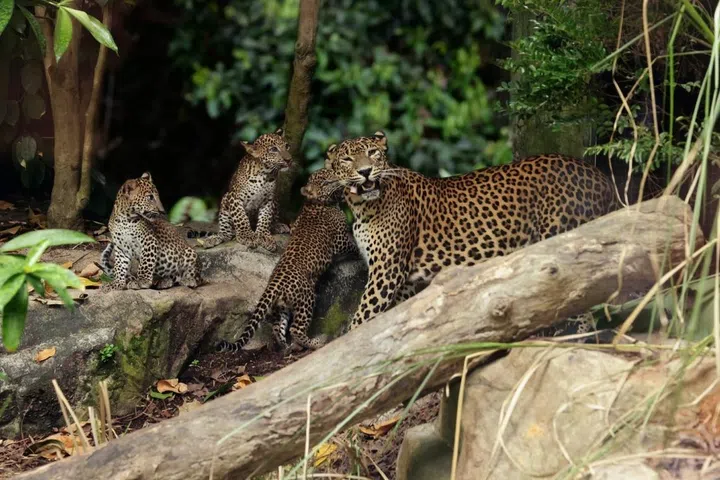
Three Sri Lankan leopard cubs that were born at the Singapore Zoo on Jan 1 have now made their public debut at the facility.
The two males and one female, born to mother Yala and father Asanka, are the first of their species yo be born at the Singapore Zoo. The last successful birth in Singapore was recorded at the Night Safari three decades ago.
The triplets, which are the pair’s first litter, are among around 80 Sri Lankan leopards in zoos worldwide.
The species is listed as vulnerable on the International Union for Conservation of Nature (IUCN) Red List, with fewer than 800 individuals estimated to remain in the wild.
Visitors can now see the triplets at the Wild Africa exhibit, said the Mandai Wildlife Group in a statement on April 16.
The cubs can be found in the exhibit with their mother daily until mid-May and, subsequently, every Wednesday, Saturday and Sunday.
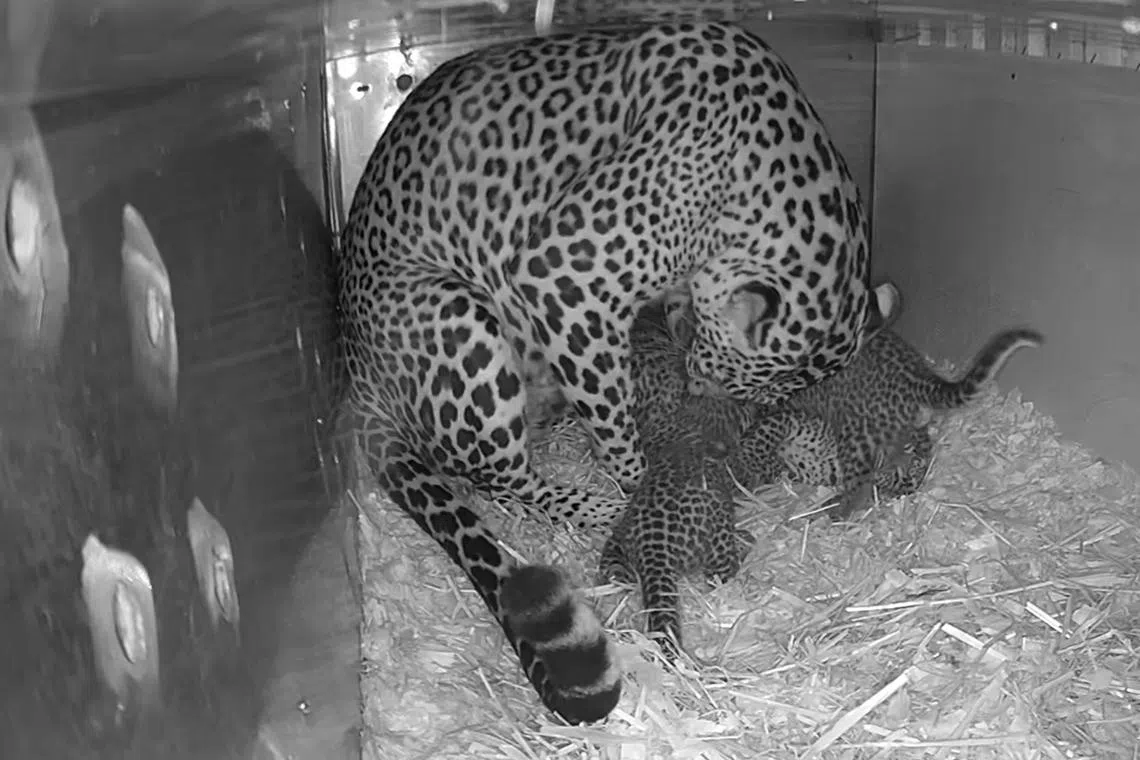
Yala with her cubs in their nest box, a month after their birth on Jan 1. (Straits Times)

A leopard cub investigating a piece of meat suspended from a tree – one of the several enrichment items in the Wild Africa exhibit designed to keep the cats mentally and physically stimulated. (Straits Times)
Mandai Wildlife Group curator Anand Kumar said it took nearly three years and close collaboration across continents to bring together a compatible pair of Sri Lankan leopards.
(Straits Times)
https://www.straitstimes.com/singapore/singapore-zoos-first-sri-lankan-leopard-cubs-make-their-public-debut?ref=top-stories

The Sri Lanka Navy has seized a local multi- day fishing trawler, it’s four man crew together with a consignment suspected to be narcotics off the Southern Coast of the island.
The vessel is presently being escorted to the Dikowita fisheries harbour for further investigations and legal proceedings.

US President Donald Trump has threatened to fire Federal Reserve Chair Jerome Powell if he does not step aside at the end of his term in May.
The two have been embroiled in a bitter spat over Powell’s reluctance to cut the central bank’s interest rate, despite Trump’s repeated calls.
Powell’s term expires on 15 May, but he is planning to remain in post until his successor, Kevin Warsh, is confirmed by the Senate.
“Then I’ll have to fire him,” Trump told Fox Business, when asked about Powell’s plans to stay on in the job.
“I’ve held back firing him. I’ve wanted to fire him, but I hate to be controversial,” Trump said.
Thom Tillis, an influential Republican senator on the committee which oversees nominations for the Federal Reserve chair, has threatened to block Warsh’s confirmation. If Warsh is not confirmed before Powell’s term expires, he plans to stay on temporarily in the post.
“That’s what the law calls for. That’s what we’ve done on several occasions,” Powell has said.
Tillis has warned Trump he will not let Warsh’s appointment go ahead unless a criminal investigation into Powell, linked to the renovation of the Federal Reserve building, is dropped.
[BBC]

Singapore Zoo’s first Sri Lankan leopard cubs make their public debut

Sri Lanka Navy seize multi day fishing craft suspected of smuggling narcotics

‘Sent to be killed’: How Russia forces migrants to fight in Ukraine

Babar Azam 71* helps Peshawar Zalmi extend lead at top

Trump threatens to fire Fed chair Jerome Powell if he doesn’t leave in May

Royal Challengers Bengaluru top the table after bowlers help thump Lucknow Super Giants

‘Dates have the highest sugar content to fight Coronavirus’

Sunday Island 27 December – Headlines

#SundayIsland 17th December – Headlines

Sunday Island – 28th March

Sunday Island Headlines – 21 March

Sunday Island – 21st February – Headlines
-

 News5 days ago
CEB orders temporary shutdown of large rooftop solar systems
-
 Features5 days ago
From Royal College Platoon to National Cadet Corps: 145 years of discipline, leadership, and modern challenges
-

 Business7 days ago
Israeli attack on Lebanon triggers local stock market volatility
-

 Business7 days ago
HNB Assurance marks 25 years with strategic transformation to ‘HNB Life’
-
 Latest News4 days ago
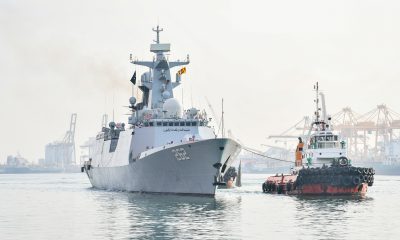
PNS TAIMUR & ASLAT arrive in Colombo
-

 News6 days ago
Anura Solomons passes away
-

 Features5 days ago
CIA’s hidden weapon in Iran
-

 Latest News3 days ago
Prasidh, Buttler set up comfortable win for Gujarat Titans