
Editorial
Stifling democracy


All the signs are that there will be no Provincial Council (PC) elections next year. The government’s decision to appoint a Parliamentary Select Committee (PSC) to inquire into matters pertaining to the delayed PC polls is an indication that the ruling NPP is afraid of facing an election any time soon and therefore all out to prevent its popularity and electoral strength from being put to test. It is using the same modus operandi as the previous governments to postpone the PC polls further—the delimitation of electoral boundaries. It has demonstrated that it has no sense of shame, just like those who made the PC polls disappear, as it were, eight years ago.
One may recall that electorates were delimited during the UNP-led Yahapalana government as a legal requirement for the implementation of the new mixed proportional system, but the report of the Delimitation Committee was not approved by Parliament. In August 2018, when a division was taken on the report following a debate, 139 MPs voted against it. There wasn’t a single vote for the report, which was required to be approved by a two-thirds majority, for the PC polls to be held under the new electoral system.
The Election Commission (EC) has reportedly said a fresh delimitation process will take about one year to reach completion. A PSC can be made to drag on, delaying the PC polls indefinitely. This seems to be the NPP’s battle plan. It is said that when a government fears the people, there is liberty. But when a government fears elections, democracy is in jeopardy. Since 2017, three governments have kept the PC polls in limbo by refusing to take action to hold them.
The PC polls can be held in a few months if Parliament resolves that they be conducted under the Proportional Representation (PR) system, election monitors and former EC Chairman Mahinda Deshapriya have said, urging the government and the Opposition to do away with the legal obstacles to the conduct of the PC polls fast, but the NPP government is sure to block any such attempt. Deshapriya is of the view that the PCs have been kept under the Governors in violation of a Supreme Court ruling. Emboldened by a string of defeats the NPP has suffered in cooperative society elections and in budget votes at some local government institutions, during the past several months, the Opposition is now pressuring the government to amend the PC Elections Act, enabling the PC polls to be held under the PR system, as in the past.
Ironically, some election monitors have urged the NPP government either to hold the PC polls expeditiously or to decide whether to retain the PCs, as it is antithetical to democracy to allow the PCs to be kept under the President through the Provincial Governors appointed by him. An opportunity has now presented itself for the JVP to fulfil its vow to do away with the PC system. The JVP drove thousands of its cadres to take up arms and lay down their lives in the name of a campaign to scuttle the PC system, among others, in the late 1980s The JVP leaders were seen recently commemorating the party members killed during their abortive uprising. They have made an about-turn on that vow, and are all out to retain control of the PCs by postponing elections further.
The Opposition is pretending that its leaders and members had nothing to do with the postponement of the PC polls. But they helped the Yahapalana government amend the PC Elections Act in 2017 to put off elections on the pretext of increasing female representation in the PCs. Most of the SJB MPs who were in the UNP at the time, the JVP, those who are in the SLPP at present, the SLMC, the TNA, etc., facilitated the passage of an amendment bill, which was changed beyond recognition at the committee stage, with a slew of sections smuggled into it to pave the way for the postponement of the PC polls as the UNP-led Yahapalana government was scared of facing an electoral contest.
Shame on both the JVP-led NPP, which is bent on delaying the PC polls further, and the Opposition, which has opted for ‘floating like a bee and stinging like a butterfly’ instead of launching an all-out campaign to pressure the government to legislate for the PC polls to be held fast under the PR system!


Saturday 17th January, 2026
The police headquarters has released an AI-generated image of a suspect wanted in connection with a fatal shooting incident in Dehiwala on 09 Jan., 2026, and sought public assistance to arrest him. AI has made the task of creating facial composites much easier. The public no doubt must cooperate with the police and help combat crime, but much more needs to be done to neutralise the dangerous underworld gangs.
Two notorious criminals and a female suspect arrested in Dubai were brought back yesterday. Dubai has become a haven for Sri Lankan criminals, and everything possible must be done to arrest all of them there and repatriate them here to stand trial for their crimes.
There have been several shooting incidents so far this year, and a couple of lives, including that of a teenager, have been lost. Last year saw more than 100 incidents of gun violence, which claimed scores of lives. One can only hope that the police will be able to bring the situation under control this year. Hope is said to spring eternal.
Underworld gangs have amply demonstrated their ability to strike at will anywhere although some of their leaders have been arrested. The police swing into action after shooting incidents and go hell for leather to arrest the shooters; in some cases, they succeed in their endeavour. Crime prevention is apparently not their forte.
Last year, a much-advertised campaign was launched to crush crime syndicates involved in drug dealing, killings and gun running. It yielded some discernible results, but very little is heard of it these days. Has it gone the same way as the past anti-crime operations?
Identikits, manually created or A-generated, could be deceptive in some cases however useful they may be in tracking down criminals on the run. This is a fact investigators should bear in mind lest they should arrest the wrong persons and torture them in the name of interrogating them.
It was alleged last week that the police had put a man to the question simply because he resembled a suspect in an identikit released to the media. The victim has claimed that he went to a police station in Colombo of his own volition after realising that there was a striking similarity between him and the suspect composite in question, only to be beaten mercilessly and asked to make a confession to a crime that he had not committed. The police have denied his claim. A thorough investigation must be conducted into the alleged incident.
Cases of mistaken identity are not rare in Sri Lanka, where the police make arrests hastily and consider suspects guilty until they are proven innocent. They have earned notoriety for acting according to their whims and fancies or at the behest of their political masters in arresting suspects. This is one of the reasons why the conviction rate remains extremely low in this country. It is between 4% and 6%. Some studies have even placed it at 2%.
Meanwhile, the Criminal Investigation Department (CID) must not be made to conduct politically motivated investigations, which prevent it from carrying out its duties and functions efficiently. Its raison d’etre is probing crimes, but successive governments have reduced it to a mere appendage of the party in power. Today, the situation has taken a turn for the worse, with government politicians rushing to the CID at the drop of a hat, demanding investigations. This practice must be brought to and end.

Friday 16th January, 2026
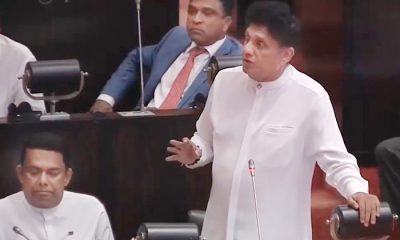
Never a dull day in Sri Lanka, where controversies abound. As if the ongoing political war on the government’s hurriedly introduced education reforms were not enough, there is a dispute over a religious symbol, of all things, The Opposition has taken exception to an image in a newly crafted learning module. SJB and Opposition Leader Sajith Premadasa insists that the symbol described as the Dhamma Chakka in the textbook is in fact the Ashoka Chakra. He took up the issue in Parliament last week, demanding an explanation from the government. Several other Opposition politicians have expressed similar views.
Responding to Premadasa’s argument, Prime Minister and Minister of Education and Higher Education Dr. Harini Amarasuriya told the House that the Buddhist symbol in the school textbook, introduced under the new education reform programme, looked similar to the Ashoka Chakra, but it was the Dhamma Chakka approved by the Ministry of Buddhist Affairs, the Advisory Council on Buddhist Affairs and the Maha Nayake Theras of the Asgiriya and Malwathu Chapters. However, the debate over the symbol in question is far from over; the Opposition politicians and their propagandists continue to castigate the government. The Chakka issue has left the public confused.
There have emerged two schools of thought over the Buddhist symbol in the school textbook. Differences between the Dhamma Chakka and the Ashoka Chakra are not limited to their distinct shapes alone, according to the critics of the symbol at issue. They have pointed out that the Dhamma Chakka symbolises the Noble Eightfold Path and moral law or Dhamma while the Ashoka Chakra represents law and justice (or dhamma in a civic sentence), movement, progress, good governance and discipline, and therefore in today’s context it is secular and not religious, as such. The Dhamma Chakka is found in Buddhist temples, stupas, manuscripts and religious art while the Ashoka Chakra is mostly in the Indian national flag, government emblems and currency and official seals. The rival school of thought insists that the symbol in the textbook is the real Dhamma Chakka and what the Opposition has taken up is a non-issue.
The ongoing debate is of immense interest in that the traditional Dhamma Chakka is known as a sacred Buddhist symbol of spiritual law and the path to liberation. The Ashoka Chakra has become a modern national symbol of India; it has been inspired by the Dhamma Chakka but used mostly in a secular context. The question is what prompted the government to use a symbol other than the traditional Dhamma Chakka in a school textbook, and thereby spark a controversy unncessarily.
Ironically, the NPP government drawing criticism for using a symbol that is confused with the Ashoka Chakra, a national symbol of India, is led by the JVP, which once launched a violent anti-Indian campaign and even gunned down traders who sold Indian onions or local varieties that resembled them. The government finds itself in a dilemma. Its critics maintain that the Dhamma Chakka in Sri Lanka’s state emblem is different from what the government calls the real Dhamma Chakka approved by the Ministry of Buddhist Affairs, the Advisory Committee on Buddhist Affairs and some Maha Nayake Theras. How can this glaring discrepancy be rectified? There cannot be two different Dhamma Chakkas—one in the state emblem and the other in school textbooks or elsewhere, according to those who want the government to stick to the traditional Dhamma Chakka.
It is imperative that the government, the Ministry of Buddha Sasana, the Opposition, the Maha Sangha, Buddhist scholars and other stakeholders address the Chakka issue urgently and clear up public confusion.


Thursday 15th January, 2026
The government finally swallowed its pride and postponed the implementation of education reforms meant for Grade 06. It has said its reform initiative is on track, but it is very likely to avoid a headlong rush. It may not concede defeat, but it is obviously wary of performing another high-wire act without a safety net amidst protests.
The government has done itself a favour by shelving the education reforms for Grade 06. Protests tend to snowball, and the Satyagraha campaigns, rallies and marches against the education reforms have the potential to develop into another ‘go-home’ movement.
The opponents of the current education reforms are now demanding that the government deep-six its reform package wholesale and ensure that the architects thereof bear the cost of error-ridden modules, amounting to about Rs. 70 million. Their message is loud and clear; those who wasted state funds for printing those modules will face legal action when the NPP loses power.
The Opposition and the trade unions critical of the proposed education reforms are still out for Prime Minister Dr. Harini Amarasuriya’s scalp, blaming her for the reform mess in the education sector. They are also making many unsubstantiated allegations against her. Trouble is far from over for her and the government.
Now that all stakeholders have agreed that the education system needs reform, the government should begin formulating education reforms anew while adopting an inclusive approach. The best way to set about the task of introducing reforms in any sector is to consult all key stakeholders and secure their concurrence.
The NPP government led by the JVP, which is a great admirer of the Chinese Communist Party, should have adopted the gradual trial-and-error approach recommended by Deng Xiaoping, and crossed the river by feeling the stones. Instead of taking one experimental step at a time and adapting to circumstances, the NPP government made the mistake of plunging headfirst into reforming the education system.
It has been proposed that the government set up a Presidential Task Force consisting of experts, political representatives, trade unionists and other stakeholders to reform the education system. This proposal deserves serious consideration. A broadly representative task force will help ensure the smooth implementation of education reforms. Well begun is said to be half done.
Meanwhile, Tuesday’s meeting between President Anura Kumara Dissanayake and some trade unions representing teachers and principals has been viewed in some quarters as part of a divide-and-rule strategy, for it has caused a rift between the trade unionists invited by the President and others, who claim that the event was scripted. However, those who met the President on Tuesday have thrown their weight behind the campaign to recover the cost of poorly crafted learning modules that have been shelved.
President of the All Ceylon United Teachers’ Association Ven. Yalwala Pannasekera Thera, one of the trade unionists who met the President on Tuesday, has given a karmic twist to the education reform issue. Tearing into the NPP politicians and state officials responsible for printing the badly drafted modules, he said yesterday those who misused funds meant for children would be reborn as frogs in Beira Lake and tortoises in the Kandy Lake.
Politicians who misuse state funds and abuse power may find themselves in the company of frogs and tortoises even before they go the way of all flesh. One may recall that in 2022, some politicians of the previous dispensation and their supporters swam with frogs in Beira Lake, where angry mobs plunged them. The same fate is likely to befall all politicians who let power get the better of them, resort to highhanded action, flaunting mandates and supermajorities, and thereby test the public’s patience.

Police step up crackdown on organised crime after securing 95 Interpol Red Notices

Julie’s exit gladdens Udaya’s heart

IMF fact-finding mission to visit Lanka from 22–28 Jan.

Countrywide police operation on Thursday nets 412 drunk drivers out of 554 arrests, including those wanted

Diplomatic thaw in Middle East sparks hope for Sri Lankan tea exports

US Ambassador Chung makes farewell call on Sajith

‘Dates have the highest sugar content to fight Coronavirus’

Sunday Island 27 December – Headlines

#SundayIsland 17th December – Headlines

Sunday Island – 28th March

Sunday Island Headlines – 21 March

Sunday Island – 21st February – Headlines
-

 Business2 days ago
Koaloo.Fi and Stredge forge strategic partnership to offer businesses sustainable supply chain solutions
-

 Business6 days ago
Dialog and UnionPay International Join Forces to Elevate Sri Lanka’s Digital Payment Landscape
-
 News6 days ago
Sajith: Ashoka Chakra replaces Dharmachakra in Buddhism textbook
-

 Editorial1 day ago
The Chakka Clash
-

 Features6 days ago
The Paradox of Trump Power: Contested Authoritarian at Home, Uncontested Bully Abroad
-

 Features6 days ago
Subject:Whatever happened to (my) three million dollars?
-
 Business2 days ago
SLT MOBITEL and Fintelex empower farmers with the launch of Yaya Agro App
-
 Features1 day ago
Online work compatibility of education tablets