
News
Speed maniacs visiting Horton Plains a menace to endangered bird species

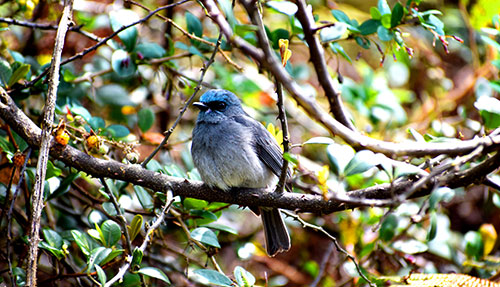
Fast moving vehicles at the Horton Plains National Park is causing serious problems to many animals that live there including the Sri Lanka dull-blue flycatcher, an endemic bird, Chathuranga Dharmaratne of the Faculty of Postgraduate Studies at the University of Sri Jayewardenepura (USJP) says.
Those birds generally occupied road banks as their nesting sites and many were killed each year by fast moving vehicles at the National Park, especially during the month April which was their breeding season, Dharmaratne said.
Dharmaratne pointed out that the April New Year season, during which a large number of local and foreign tourists visited Horton Plains, was the main breeding season for the particular species in that habitat.
 “The overlap of these two factors causes serious problems to the birds. Vehicles travel at high speeds within the national park and many animals die, especially dull-blue flycatchers during incubation or while feeding their nestlings. Furthermore, fledglings are also directly impacted by these fast-moving vehicles, as nesting sites are often located beside the road,” he said.
Dharmaratne recommends that there should be a speed limit for vehicles inside the National Park and surrounding montane cloud forests to prevent needless killing of the flycatcher as well as other endemic species.
“The dull-blue flycatcher prefers to use road banks as nesting sites and these are often disturbed by visitors. Wildlife viewing opportunities should be provided at safe distances from the nesting sites to avoid, or at least to minimise, disturbances by visitors. Visitors and photographers must be educated on the importance of maintaining a safe distance from breeding sites as much as possible.”
Sri Lanka Dull-Blue flycatcher is an endemic, understory insectivorous bird that is confined to the central hills of Sri Lanka (above 600m above sea level). This species has been already identified as Near-Threatened (NT) by the International Union for Conservation of Nature (IUCN), meaning it faces the risk of extinction in the near future.



The Cabinet of Ministers granted their concurrence to the resolution furnished by the Minister of Youth Affairs to appoint S. Achchudan of Special Grade of Sri Lanka Administrative Service, who is currently serving as an Additional Commissioner of Elections at the Elections Commission who is
recommended by the panel of interviewers to the post of Director General of the Sports Development Department with effect form 01.01.2026.

The Cabinet of Ministers granted approval to the proposal furnished by the Minister of Environment to publish the draft bill of the National Environment (Amended) Act in the government gazette notification and subsequently to submit the same to the Parliament for its concurrence.
The Cabinet of Ministers has approved the proposal presented by the Minister of Buddhism, Religious, and Cultural Affairs to provide tax relief on imported dates received as donations or gift for Ramadan.
This year’s Ramadan fasting season is scheduled to begin on 19-02-2026 and end on 21-03-2026.

Shafali, Renuka close in on top five in ICC T20I rankings

S. Achchudan appointed as Director General of the Sports Development Department.

Amendment of the National Environment Act No. 47 of 1980
Tax relief for Dates received as donations or gifts for Ramadan
Cabinet nod to establish the Sri Lanka Industrial Transformation and innovation Authority
Temporary employment of Sri Lankan labour in the State of Israel

‘Dates have the highest sugar content to fight Coronavirus’

Sunday Island 27 December – Headlines

#SundayIsland 17th December – Headlines

Sunday Island – 28th March

Sunday Island Headlines – 21 March

Sunday Island – 21st February – Headlines
-

 News6 days ago
British MP calls on Foreign Secretary to expand sanction package against ‘Sri Lankan war criminals’
-
 News5 days ago
Street vendors banned from Kandy City
-

 Sports6 days ago
Chief selector’s remarks disappointing says Mickey Arthur
-

 Opinion6 days ago
Disasters do not destroy nations; the refusal to change does
-

 News7 days ago
Sri Lanka’s coastline faces unfolding catastrophe: Expert
-

 News5 days ago
Lankan aircrew fly daring UN Medevac in hostile conditions in Africa
-

 Midweek Review7 days ago
Year ends with the NPP govt. on the back foot
-

 Sports2 days ago
Gurusinha’s Boxing Day hundred celebrated in Melbourne