
Connect with us

News

Speaker berates opposition for resorting to harangue at question time

Published

on

By Saman Indrajith

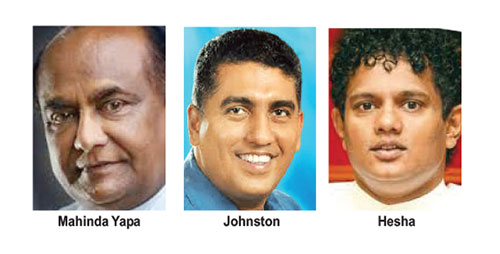
Speaker Mahinda Yapa Abeywardena yesterday (22) reprimanded the Opposition MPs for wasting the time of the House. He said that MPs should not make speeches when raising questions listed in the Order Paper because only one hour had been allotted for the question time.

He said so when Ratnapura District SJB MP Hesha Withanage raised supplementary questions and made a lengthy speech.

Withanage demanded to know from the Prime Minister the number of Cabinet ministers in governments since 1978.

Responding on behalf of the Prime Minister Chief of the Government Whip Highways Minister Johnston Fernando said that there had been nine parliaments since 1978 and there had been different numbers of Cabinet ministers in those government. He said that the first parliament in 1978 had 25 cabinet ministers and the second parliament in 1989 had 21 cabinet ministers. The third parliament in 1994 had 23 cabinet and 31 deputy ministers with a total of 54. The fourth parliament of 2000 had 42 cabinet and 36 deputy ministers with a total of 78. The Fifth Parliament of 2001 had 25 cabinet, 27 non-cabinet and eight deputy ministers with a total of 60. The sixth parliament of 2004 had 31 cabinet, three non-cabinet and 31 deputy ministers with a total of 65. The seventh parliament of 2010 had 37 cabinet 39 deputy ministers with a total of 76 ministers. The eighth parliament of 2015 had 45 cabinet and 38 state ministers making a total of 87 ministers. The eighth parliament of 2019 had 16 cabinet and 38 state ministers with a total of 54. The ninth parliament of 2020 has 27 cabinet and 40 state ministers with a total of 67.

The first and second parliaments of 1978 and 1989 had one female cabinet minister each. Third parliament of 1994 had three cabinet and five deputy female ministers with a total eight female members. The Fourth parliament of 2000 had four female cabinet ministers. The fifth parliament of 2001 had only one female cabinet minister. The sixth parliament of 2004 had three female cabinet ministers. The seventh parliament of 2010 had two female cabinet ministers and one female deputy minister post making it three female ministers. The eighth parliament of 2015 had a total number of six female ministerial posts – two cabinet, two state and two deputy posts.  The eighth parliament of 2019 had one female cabinet minister. The ninth parliament of 2020 has one female cabinet minister and two female state ministers with a total of three.

The highest percentage of female ministers was in 1994 with 13.04% and the lowest was in 2020 with 3.7 percent, Minister Fernando said.

Responding to the question the percentage of female ministers in the present government, Minister Fernando said it was 3.6. He said the figure was the same as the percentage of female representation in Parliament.

When the time came for the supplementary questions, MP Withanage said that if the funds spent on the number of Cabinet ministers since 1978 had been spent for the development, the country would have been in a better position. Then he lamented that the percentage of female members in parliament did not tally with the population’s female percentage. Thereafter, he said that under the previous government a ceiling on the number of Cabinet ministers had been imposed and the incumbent government was planning to remove it. He asked how the government would justify the proposed increase in the number of ministers.

Speaker Abeywardena intervened and said the MPs could not be allowed to make speeches making use of time allocated for questions. “You should ask only supplementary question. This cannot be permitted. We have to give consideration to the time. We move on to the next item in the order paper.”

S.M. Marikkar raising a point of order said that the government Cabinet, state and deputy ministerial posts to serve their people. The Opposition MPs had only one opportunity and that was by raising the people’s questions. “That is our right. Do not deprive us of our right,” MP Marikkar said.

The Speaker said that his concern too was to ensure the MPs’ rights and for that purpose time had to be managed.

Minister Fernando said that MP Withanage had not raised a single supplementary question and made a speech instead and, therefore, if the latter could raise a specific question the government was ready to answer them.


Continue Reading
Click to comment

Leave a Reply

Your email address will not be published. Required fields are marked *

Latest News

70,297 persons still in safety centers

Published

on

By

The Situation Report issued by the Disaster Management Center at 06:00AM on 16th December 2025 shows that 70,297 persons belonging to 22,338 house holds are still being housed at 731 safety centers established by the government.

The number of deaths due to the recent disastrous weather  stands at 643 while 183 persons are missing.

Continue Reading

News

MEPA to crack down on marine polluters

Published

on

… Warns would-be polluters of criminal prosecution, hefty fines and even blacklisting

The Marine Environment Protection Authority (MEPA) has warned that ship owners, operators and local entities responsible for marine pollution will face criminal prosecution, heavy financial penalties and possible blacklisting, MEPA Chairman Samantha Gunasekera said yesterday.

Gunasekera told The Island that Sri Lanka would no longer tolerate negligence and regulatory breaches that threaten the country’s marine ecosystems, coastal livelihoods and national economy.

“Any party that pollutes our seas—whether foreign vessels or local operators—should be prepared to face the full force of the law,” Gunasekera said. “There will be no room for excuses, delays or backdoor negotiations when marine pollution is involved.”

He said MEPA has intensified surveillance of major shipping routes, ports and environmentally sensitive zones amid rising maritime traffic through Sri Lankan waters, which remain among the busiest in the Indian Ocean.

by Ifham Nizam

Continue Reading

News

SC delegation, headed by CJ Surasena, observes Indian Supreme Court in action

Published

on

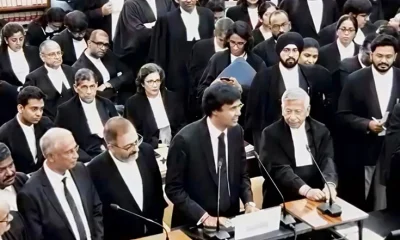
A 10-member delegation from Sri Lanka’s Supreme Court, headed by Chief Justice P. Padman Surasena, with Indian judicial officials

A 10-member delegation from Sri Lanka’s Supreme Court, headed by Chief Justice P. Padman Surasena, departed to New Delhi on the 11th of December, 2025, for an official visit to the Supreme Court of India as part of the ongoing official visit by the delegation to India.

The group was accorded a ceremonial welcome in the Court’s main hall, led by the Chief Justice of India (CJI) Surya Kant. CJI Kant told the assembled Judges that “the Indian judiciary was honoured to host” their Sri Lankan counterparts, expressing hope that the visit would be “meaningful and very constructive” and underscoring the “close emotional bonds” between the two countries.

The focal point of the programme was a special sitting of the Supreme Court. Chief Justice Surasena joined CJI Kant and Justice Joymalya Bagchi on the bench, presiding over the Court as a guest Justice. He was accompanied by nine other Supreme Court justices from Sri Lanka, who took seats in the well of CJI Kant’s courtroom to observe the day’s proceedings.

Supreme Court Bar Association President Vikas Singh formally greeted the delegation and praised Justice Surasena’s reformist efforts. Singh recalled the Sri Lankan Chief Justice’s own maxim, “If you want something you have never had, then you have got to do something you have never done”, highlighting the bold changes Surasena had introduced to modernise Sri Lanka’s Court system. Singh noted that these initiatives, particularly court digitization, were aimed at eradicating “the persisting problems of law delays” and streamlining case backlogs.

The Sri Lankan Judges spent the morning observing live Supreme Court proceedings in CJI Kant’s courtroom. This first-hand exposure to Indian court operations formed a key part of the programme’s judicial engagement. During the hour-long session, the visiting justices witnessed a range of cases on the Supreme Court’s roster, with Justice Surasena and the delegation following arguments from the front. The experience was designed to be immersive and following the hearing the Sri Lankan Judges were briefed on India’s own initiatives towards a digitalised court system, e-filing and case management systems.

The official programme then shifted to capacity-building and information exchange. In the early afternoon, Indian Supreme Court officials gave the Sri Lankan delegation detailed briefings on India’s technological initiatives. Court registrars demonstrated the e-filing system and other e-initiatives implemented by the Supreme Court of India. Additional presentations outlined the Court’s new case management systems and administrative reforms. These sessions highlighted how digital tools and better case-listing procedures have been used in India to increase efficiency. The Sri Lankan judges asked questions about India’s experience with electronic court records and the integration of technology in daily judicial work, reflecting their own interest in similar reforms back home.

The visit underscored the growing collaboration between the Indian and Sri Lankan judiciaries. Throughout the proceedings, both sides emphasised their shared legal traditions and mutual respect. As Chief Justice Surasena noted during the sitting, India is Sri Lanka’s “closest neighbour,” and historic links, even dating back to ancient epics, form the backdrop for today’s judicial dialogue. CJI Kant remarked that having the chief justices of two vibrant democracies together on the bench was a “significant moment” for the rule of law.

The Sri Lankan delegation continued its programme in Delhi on 12 December with a visit to the Delhi High Court and its International Arbitration and Mediation Centres. The exchange visit is expected to deepen judicial cooperation and provide practical insights for both courts. Officials on both sides say the engagement aimed at sharing best practices in court administration, reinforce legal ties and support ongoing reforms aimed at reducing case backlogs and delays.

Continue Reading

Trending