
Business
Spa Ceylon partners in private sector ocean conservation effort


A new partnership between Spa Ceylon, ‘All About That Reef’ and Scope Cinemas has set a precedent for how Sri Lanka’s private sector can leverage collaboration, brand influence and cultural platforms to drive environmental action. The initiative brought the globally acclaimed ‘OCEAN with David Attenborough’ documentary to Sri Lankan audiences this week through a series of free public screenings at Scope Cinema Multiplex, Havelock City Mall.
The screenings, held on September 30, were more than just a cinematic showcase. They symbolized how corporate responsibility, conservation advocacy and entertainment can converge to build awareness of ocean conservation while strengthening brand equity in a market where consumers are increasingly demanding sustainable practices.
Spa Ceylon, the world’s largest Luxury Ayurveda chain, with over 140 stores across 33 countries, has long embedded sustainability into its brand ethos. Its products are ethically sourced and cruelty-free, and the company has built a global reputation by linking luxury wellness to responsible consumption.
“Oceans sustain over three billion people globally, yet face unprecedented threats from climate change, pollution, and human activity, said Shalin Balasuriya, Co-Founder and Group Director of Spa Ceylon. “As a responsible global brand, we believe marine conservation is a shared responsibility that transcends borders. This initiative is a small but meaningful step towards safeguarding our oceans.”
For Spa Ceylon, aligning with a conservation-themed film narrated by David Attenborough is a strategic reinforcement of its image as a socially conscious luxury brand. By investing in the screenings, the company effectively positioned itself as a leader in linking consumer wellness to planetary well-being.
Marine conservation initiative, ‘All About That Reef’ brought its outreach expertise to the project, underscoring how narrative-driven engagement can inspire public responsibility.
Founder Aindri Morahela emphasized that Sri Lanka’s recent move to establish Marine Protected Areas (MPAs) in international waters highlights what can be achieved through collective action. “Screenings like this remind us that every effort—whether protecting, educating or simply sharing knowledge—contributes to something far greater, she said.
The collaboration demonstrates how conservation groups can expand their reach by forming alliances with consumer-facing companies and entertainment providers.
For Scope Cinemas, Sri Lanka’s leading cinema chain, the screenings showcased the business potential of expanding beyond entertainment into social impact.
Executive Chairman Naveen Cader explained, “Collaboration is the key to creating lasting impact. By working with Spa Ceylon and ‘All About That Reef’, we’ve shown that cinema can unite communities, spark important conversations and drive positive change.”
The initiative strengthens Scope Cinemas’ reputation as a cultural influencer while tapping into a growing audience base that values sustainability-driven content. For the entertainment sector, such partnerships demonstrate how film can become a tool for both education and brand differentiation.
From a business lens, the collaboration illustrates how the triple bottom line—people, planet and profit—can be operationalized. Spa Ceylon gains brand visibility while reinforcing its environmental commitments. Scope Cinemas broadens its influence beyond entertainment. ‘All About That Reef’ amplifies conservation advocacy with the reach of private sector partners.
By Ifham Nizam



If you want to understand Sri Lanka’s economy, don’t start with reports from the Ministry of Finance or the Central Bank. Go instead to a crowded clothing sale on the outskirts of Colombo.
In places like Nugegoda, Nawala, and Maharagama, temporary year-end sales have sprung up everywhere. They draw large crowds – not just bargain hunters, but families carefully planning every rupee. People arrive with SMS alerts on their phones and fixed budgets in their minds. This is not casual shopping. It is a public display of resilience, a tableau of how people are coping.
Tables are set up in parking lots and open halls, clothes spilling from cardboard boxes. When new stock arrives, hands reach in immediately – young and old, men and women – searching for the right size, the least faded colour, the smallest flaw that justifies the price. Everyone is heard negotiating, not with desperation, but with a quiet, shared dignity.
“Look at the prices in the malls, then look here,” says a middle-aged mother shopping for school uniforms in Maharagama. “This isn’t shopping for enjoyment. This is about managing life.” Food prices have already stretched her household budget thin. Here, she can buy trousers for half the usual price.
Women, often the household’s purchasing managers, move with determined efficiency. Men are just as involved – checking stiches, comparing prices, trying shirts over their own clothes. Inflation, here, wears the same face on everyone.
Bright banners promise “Trendy Styles!”, but most shoppers know better. These are last season’s clothes, cleared out to make room for next year’s stock. Still, no one feels embarrassment. “New” now simply means something you didn’t own before; the label matters far less than the price.
Not all items are discounted equally. Essentials – work trousers, denims, track pants – are only slightly cheaper. Sellers know these will sell regardless. The steepest discounts are reserved for the items people can almost afford to skip.
This is economic data you won’t find in official reports. Here, inflation is measured in real time. A young man studies a shirt’s price tag and calculates how many days of work it represents. Friends debate whether a slight fade is a fair trade for the price. Every transaction is a careful calculation.
Year-end sales have always existed. But since the economic crisis, they have taken on a new, grim significance. They offer a slight reprieve to households learning to steadily lower their aspirations. While the government speaks of fiscal discipline and a steady Treasury, everyday life remains a tightrope walk.
The Central Bank measures inflation in percentages. On the streets of Kiribathgoda, it is measured in trade-offs: one item instead of two; buying now or waiting for the Avurudu season; choosing need over want, again and again.
As evening falls, the crowds thin. The tables are left rumpled, hangers scattered like fallen leaves. Yet these spaces tell a story more powerful than any quarterly report – a story of business ingenuity, household struggle, and an economy where every single purchase is weighed with immense care.
In that careful weighing lies a quiet, unsettling truth. No matter what is said about replenished reserves or balanced budgets, these bargain tables – if they could speak – would tell the nation’s most heart-rending story. And they do, to anyone who chooses to listen.
By Sanath Nanayakkare

The global economy is forecast to expand by a “sturdy” 2.8% in 2026, exceeding consensus expectations, according to the latest Macro Outlook report from Goldman Sachs Research. This optimistic projection highlights a resilient recovery trajectory across major economies, albeit with significant regional variations and a persistent disconnect with labour market strength.
Goldman Sachs economists are most bullish on the United States, expecting GDP growth to accelerate to 2.6%, substantially above consensus estimates. This optimism stems from anticipated tax cuts, easier financial conditions, and a reduced economic drag from tariffs. The report notes that consumers will receive approximately an extra $100 billion in tax refunds in the first half of next year, providing a front-loaded stimulus. A rebound from the past government shutdown is also expected to contribute to what chief economist Jan Hatzius predicts will be “especially strong GDP growth in the first half” of 2026.
China’s economy is projected to grow by 4.8%, underpinned by robust manufacturing and export performance. However, economists caution that parts of the domestic economy continue to show weakness. In the euro area, growth is forecast at a modest 1.3%, supported by fiscal stimulus in Germany and strong growth in Spain, despite the region’s longer-term structural challenges.
A key concern outlined in the report is the stagnant global labour market. Job growth across all major developed economies has fallen well below pre-pandemic 2019 rates. Hatzius links this weakness partly to a sharp downturn in immigration, which has slowed labour force growth, with the disconnect being most pronounced in the United States.
While artificial intelligence (AI) dominates technological discourse, Goldman Sachs economists believe its broad productivity benefits across the wider economy are still several years away, with impacts so far largely confined to the tech sector.
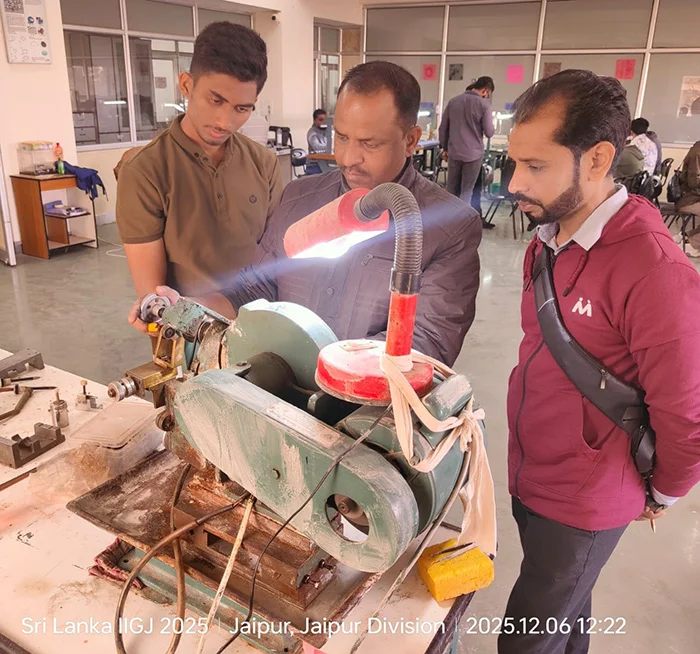
A 20-member delegation of professionals from Sri Lanka’s Gem and Jewellery sector visited India from 1–20 December 2025 to participate in a specialised Training and Capacity Building Programme. The delegation represented the gemstone cutting and polishing segments of Sri Lanka’s Gem and Jewellery industry.
The programme was organised pursuant to the announcement made by Prime Minister of India, Narendra Modi, during his visit to Sri Lanka in April 2025, under which India committed to offering 700 customised training slots annually for Sri Lankan professionals as part of ongoing bilateral capacity-building cooperation.
The 20-day training programme was conducted by the Government of India at the Indian Institute of Gem & Jewellery, Jaipur, Rajasthan. The curriculum comprised a comprehensive set of technical and thematic sessions covering the entire Gem and Jewellery value chain. Key modules included cleaving and sawing, pre-forming, shaping, cutting and faceting, polishing, quality assessment, and industry interactions, aimed at strengthening practical skills and enhancing design and production capabilities.
As part of the experiential learning component, the participants undertook site visits to leading gemstone manufacturing units, gaining first-hand exposure to contemporary production technologies, design development processes, and modern retail practices within India’s Gem and Jewellery ecosystem.
The specialised training programme contributed meaningfully to strengthening professional competencies, promoting knowledge exchange, and deepening institutional and industry linkages in the Gem and Jewellery sector between India and Sri Lanka, reflecting the continued commitment of both countries to capacity building and people-centric economic cooperation.

Navy seizes an Indian fishing boat poaching in northern waters

Mandhana, Shafali and Ghosh help India edge run-fest to go 4-0 up

Showers predicted in several provinces today (29th December)

Delay in govt. response to UK sanctions on ex-military chiefs, and others causes concern

Sri Lanka outlines seven key vectors of international cooperation at Moscow forum

Sri Lanka third most preferred destination for Indians

‘Dates have the highest sugar content to fight Coronavirus’

Sunday Island 27 December – Headlines

#SundayIsland 17th December – Headlines

Sunday Island – 28th March

Sunday Island Headlines – 21 March

Sunday Island – 21st February – Headlines
-

 News7 days ago
Members of Lankan Community in Washington D.C. donates to ‘Rebuilding Sri Lanka’ Flood Relief Fund
-

 News5 days ago
British MP calls on Foreign Secretary to expand sanction package against ‘Sri Lankan war criminals’
-

 Features7 days ago
General education reforms: What about language and ethnicity?
-

 News7 days ago
Suspension of Indian drug part of cover-up by NMRA: Academy of Health Professionals
-

 Sports5 days ago
Chief selector’s remarks disappointing says Mickey Arthur
-

 News4 days ago
Street vendors banned from Kandy City
-

 Editorial7 days ago
A very sad day for the rule of law
-

 News7 days ago
US Ambassador to Sri Lanka among 29 career diplomats recalled