

Connect with us

News

South Asia unites at landmark Colombo meeting to tackle crimes against wildlife

Published

on

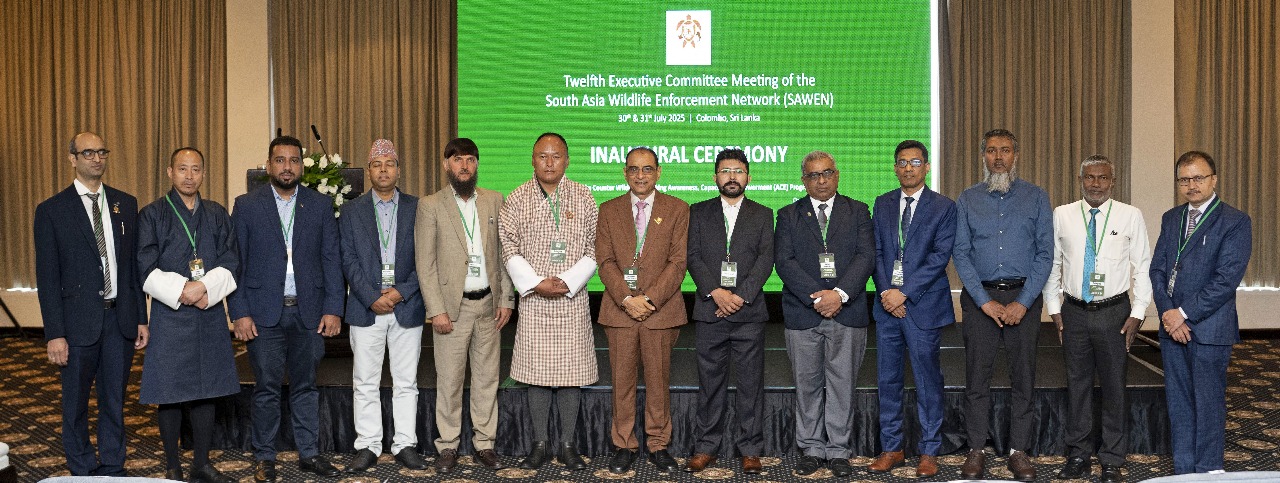
In a show of regional solidarity, South Asian nations reaffirmed their joint commitment to fighting the scourge of wildlife trafficking at the 12th Executive Committee Meeting of the South Asia Wildlife Enforcement Network (SAWEN), held yesterday at Kingsbury, in Colombo. The high-level gathering saw the participation of senior government officials, Ministers, legal experts, and conservation leaders from across the region, as well as international partners, underscoring the urgency and complexity of the crisis at hand.

The meeting served as both a symbolic and strategic milestone in South Asia’s collective efforts to dismantle wildlife crime networks that threaten the region’s rich biodiversity. The collaborative tone of the forum, hosted by Sri Lanka’s Ministry of Environment with the support of the Environmental Foundation (EFL), highlighted the need for stronger enforcement, intelligence sharing, and regional legal alignment in the fight against illegal wildlife trade.

Dr. Krishna Prasad Acharya, Secretary General of SAWEN, speaking to The Island emphasised the importance of unified political will in combatting crimes against wildlife. “We are awaiting your guidance, incentives, and recommendations in the days to come,” he said, addressing a room of regional leaders and enforcement heads. “Your insight and leadership will guide us towards meaningful outcomes and renewed momentum.”

Dr. Acharya lauded the active participation of Sri Lankan ministers and secretaries present at the meeting, noting that their engagement symbolised an expanding global commitment to protecting biodiversity beyond South Asia. He thanked all participants for their “enduring belief in the SAWEN mission” and recognised the tireless efforts of Sri Lanka’s environmental authorities, especially Dr. Manuri and her team, for fostering a collaborative and inclusive environment.

K.R. Uduwawala, Secretary to the Ministry of Environment, underscored Sri Lanka’s leadership in the regional anti-trafficking movement. “It’s a privilege to join you today,” he said. “Sri Lanka’s commitment to combating wildlife trafficking is evidenced by the establishment and operationalisation of SAWEN in 2011.”

The Sri Lankan SAWEN chapter, now involving 53 government agencies—including Customs, the Department of Wildlife Conservation, Police, and the Attorney General’s Department—has become a key national platform for tackling wildlife crime. Uduwawala emphasised that this inter-agency approach has vastly improved the detection, investigation, and prosecution of wildlife crimes.

“Through the Wildlife Trafficking Awareness, Capacity, and Enforcement (CACE) Programme, supported by the US Department of State, we’ve strengthened institutional capacity and created a practical enforcement network,” he noted.

Delivering the keynote address, Sri Lanka’s Deputy Environment Minister, Anton Jayakody, emphasised the government’s vision to integrate wildlife protection into broader environmental governance.

“This meeting is not just an operational milestone—it is a platform to reform and reinforce our commitment to sustainable environmental governance,” Jayakody stated. “We are committed to ensuring that our military and prosecutors are well-equipped to address wildlife crimes with the seriousness they demand.”

He thanked the United States Department of State and its Bureau of International Narcotics and Law Enforcement Affairs for supporting the CACE Programme and reaffirmed Sri Lanka’s pledge to strengthen inter-agency cooperation and policy reform in environmental enforcement.

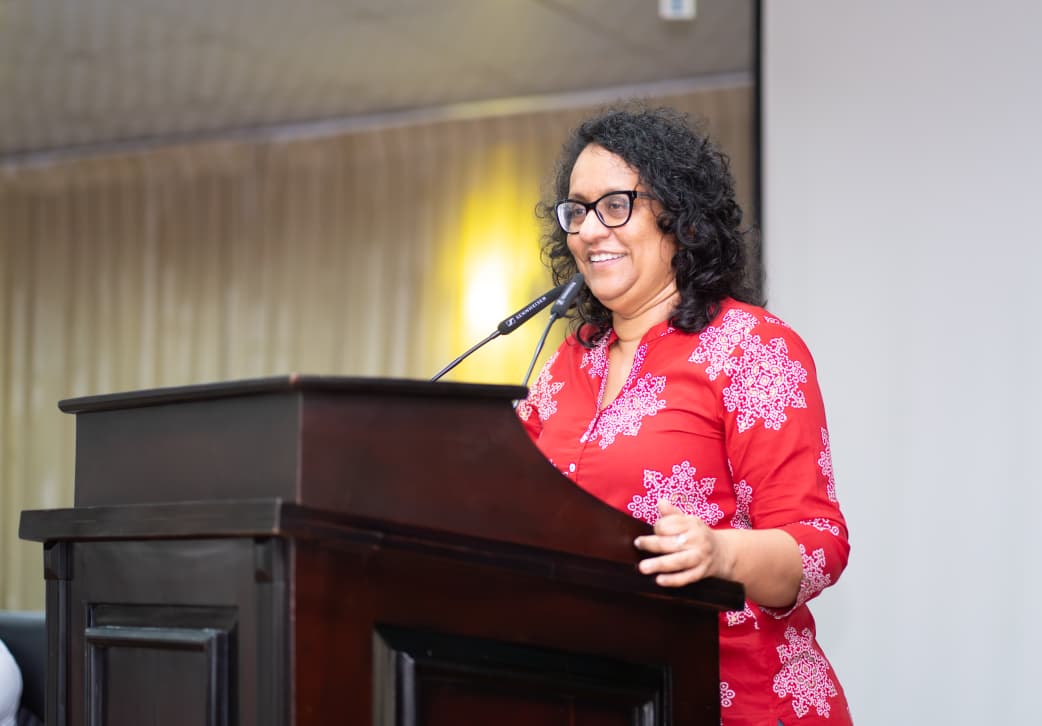
EFL Chairperson, Ms. Deshini Abeyewardena, delivered a stirring appeal for formalising the network structure of SAWEN at the national level. “While we see key heads and focal points attending these meetings, we have yet to formally establish SAWEN as a legally recognised network in some countries, including Sri Lanka,” she noted.

Drawing from EFL’s 44-year legacy of fighting for “Justice for Nature,” Abeyewardena highlighted how scientific and legal expertise must be integrated into enforcement mechanisms. “We are happy to have signed an MOU with the SAWEN Secretariat. EFL stands ready to provide scientific support and legal guidance to all participating agencies.”

She also raised concerns over the alarming loss of endemic species in the region due to trafficking and warned of a growing disconnect between development and biodiversity conservation. “We must ensure that our land-use policies prioritise sustainable development. Justice for Nature is not just a slogan—it’s a generational responsibility.”

Since 2021, the CACE Programme—led by EFL in partnership with the Department of Wildlife Conservation and funded by the US government—has made tangible progress in building institutional capacities and fostering collaboration. Ms. Abeyewardena credited the training provided to 15 enforcement agencies for the recent uptick in successful wildlife crime prosecutions.

Notably, she acknowledged the Attorney General’s Department for leading efforts to align prosecution strategies and standardise legal approaches across agencies, helping close enforcement gaps.

“This programme has unified law enforcement in Sri Lanka like never before,” she said. “What we’ve learned here can serve as a model for the region.”

Participants agreed that while SAWEN has facilitated critical dialogue and policy alignment, more must be done to operationalise its goals. “Wildlife crime cannot be tackled in isolation,” Uduwawala emphasised. “This is why platforms like SAWEN are essential to coordinate regional enforcement, intelligence exchange, and collective action.”

Sri Lanka, as the host nation, committed to further embedding SAWEN into its legal and institutional frameworks. “We look forward to exploring how SAWEN can synergise regional efforts through knowledge exchange, joint capacity building, and operational collaboration,” said Uduwawala.

As the executive meeting concluded, a shared message resonated across the conference hall: South Asia must act now to protect its natural heritage from the expanding threat of wildlife trafficking. With both ecological and security implications, the crisis demands not just political attention but lasting institutional transformation.

“We have the science. We have the legal frameworks. What we need now is political courage and regional unity,” said Ms. Abeyewardena. “This meeting must lead to more than resolutions. It must drive enforcement, reform, and long-term conservation.”

By Ifham Nizam


Continue Reading
Click to comment

Leave a Reply

Your email address will not be published. Required fields are marked *

Latest News

A new curriculum will be introduced for preschools in 2027, while steps will also be taken to train teachers accordingly – PM

Published

on

By

Prime Minister Dr. Harini Amarasuriya stated that a new curriculum will be introduced for preschools in 2027, while steps will also be taken to train teachers accordingly and to regulate preschools through a regulatory authority.

The Prime Minister made these remarks while addressing an awareness programme for preschool teachers in the Hambantota District on education reforms, held  on Sunday (15) at the Ambalantota Pradeshiya Sabha Auditorium.

During the programme, preschool teachers briefed  the Prime Minister about the challenges they currently face. Responding to their concerns, Dr. Harini Amarasuriya further stated:

“The issues within the preschool system cannot be discussed separately from the broader crisis in society and in the education sector. When we assumed office in 2024, our primary challenge was to free the country from its debt burden and to establish. a  sound economic indicators.

Although 2025 was a challenging year, we were able to bring the country’s economy to a certain level of stability and manage the national budget accordingly.

While we were working towards economic recovery, the war in the Middle East began, which has had certain impacts on our country as well.

A significant amount of Sri Lanka’s foreign remittances come from our fellow citizens working in the Middle East. Today, both their livelihoods and employment are under threat. In addition, a large number of tourists travelled to Sri Lanka through Middle Eastern airspace, and the closure of those air routes and airports has reduced tourist arrivals. Another issue concerns fuel transportation. This problem has affected not only Sri Lanka but many countries around the world. If the war continues for a long period, it will have further impacts on us, and therefore we must be prepared. We also need to manage the economy carefully and reduce certain expenditures.

Although we have the ability to borrow, our intention is not to weaken the country’s economy by relying on loans.

You are aware that we have begun implementing education reforms. Within that policy framework, we are also taking steps to reform preschool education. So far, the establishment of preschools and early childhood development has not been carried out in a systematic manner. Therefore, we must regulate and standardize all preschools, which is not an easy task.

First, all preschools must be formally registered. We have already prepared a curriculum for teacher training. In addition, we plan to introduce a new curriculum for preschools in 2027, provide teacher training accordingly, and regulate preschools through a regulatory authority. A recognized curriculum has also been prepared for the preschool diploma. In the future, priority for preschool teachers will be given based on these qualifications. We will also take gradual steps to enhance the professionalism of preschool teachers and establish a proper salary structure”.

The Prime Minister further stated that preschools fall under the authority of Provincial Councils and Pradeshiya Sabhas, while the line ministry can only provide policy recommendations. She also emphasized that issues related to preschools should be addressed in a systematic manner through structural committees and District Development Committees.

Member of Parliament Nihal Galappaththi and other public representatives, along with preschool teachers from the Hambantota District attended the awareness program.

(Prime Minister’s Media Division)

Continue Reading

News

Be mindful of the accuracy of information before sharing it on social media – PM

Published

on

By

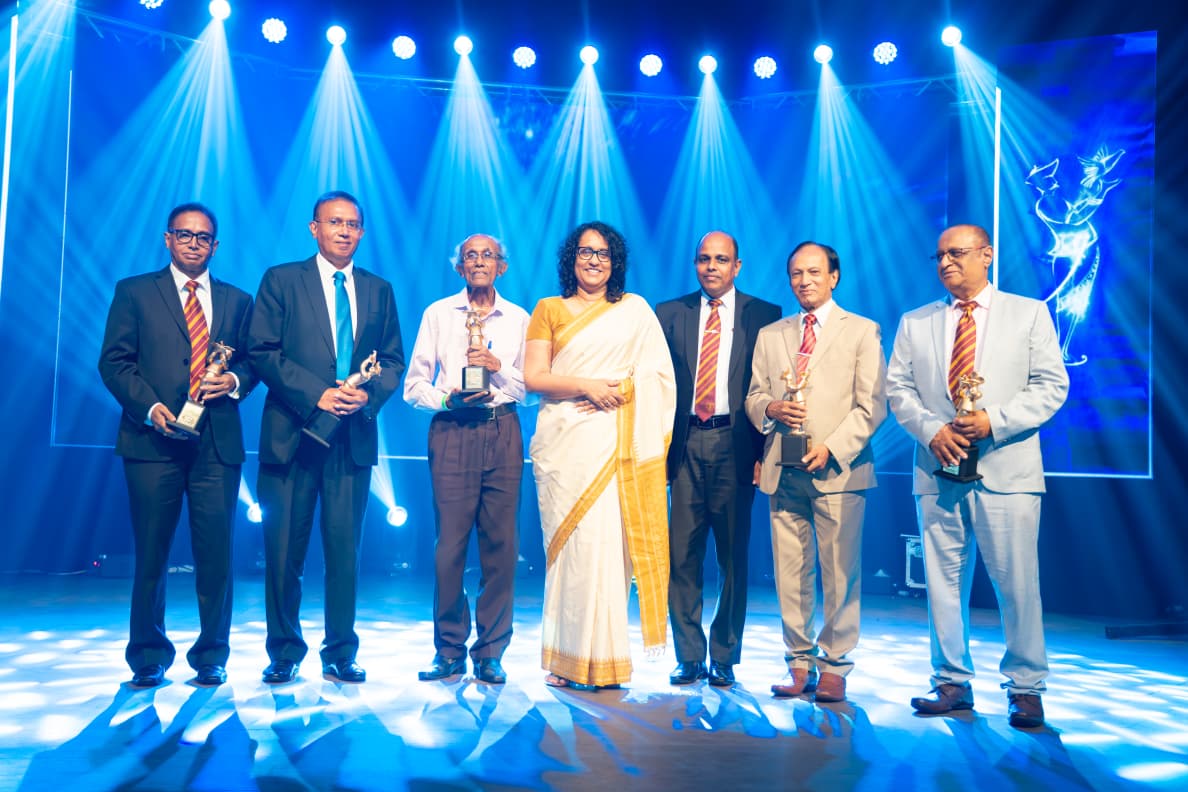
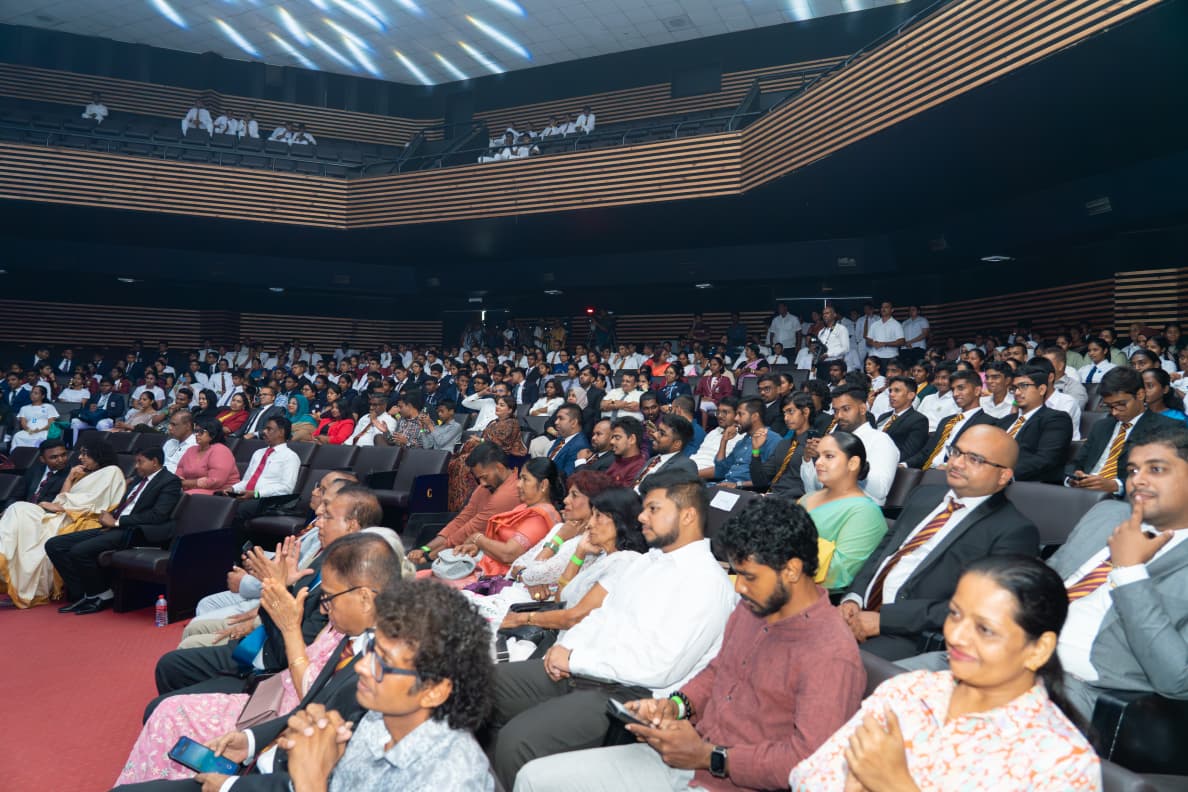
The Prime Minister made these remarks while addressing the “Sandeshaya” Media Awards Ceremony held on 14 March at the Kularathne Hall of Ananda College, Colombo. The event was organized with the aim of providing Sri Lankan school students with an opportunity to actively contribute to the national media discourse while promoting ethics, responsibility, and critical thinking.

During the “Sandeshaya” Awards Ceremony , lifetime awards granted only once in a lifetime were presented to distinguished veterans in the media field, while media awards were also presented to talented students in the school category. The ceremony was held under the patronage of the Prime Minister.

Expressing her views further, the Prime Minister stated:

“We live in an era where information technology and the media are changing rapidly. Along with these changes, many opportunities have emerged, but we are also confronted with numerous challenges.

We must prepare our younger generation to live in a society and a world transformed by information technology and the media.

When we observe the changes taking place in the media today, we can say that the media and information have become democratized. In the past, access to knowledge and information was largely limited to privileged or powerful groups. The authority to communicate information and decide what should be disseminated was held by a small group. However, with the advancement of technology, this has changed dramatically. As a result of this revolutionary transformation, information, data, and knowledge have now become accessible to everyone. In that sense, it is a positive development.

At the same time, we are no longer merely media viewers or consumers. As citizens, we can also become media creators. Citizens now have significant space to engage with the media and share information. While this is positive in one sense, it also carries certain dangers. There are serious questions, issues, and challenges regarding responsibility and credibility in the dissemination of information. Today, information flows so rapidly that it is sometimes difficult to determine what is true. Making decisions has become increasingly challenging. Not only in our country but globally, there have been many instances where societies have been set ablaze due to misinformation or deliberately distorted information. We have witnessed numerous occasions where people’s lives have been destroyed as a result.

Sometimes, without even realizing it, we get trapped on the internet. We share various things through our social media platforms, both necessary and unnecessary. However, what we often forget is that a large amount of personal information accumulates on the internet through these actions. Once incorrect information becomes widespread in this way, it becomes extremely difficult to erase.

The spread of false information weakens public trust in the information provided by the media, and this is extremely dangerous for a society. For the sustainability of a society, it is essential to maintain trust among citizens and trust in the institutions that influence people’s lives. Only through the trust we can safeguard the sustainability, continuity, and security of a society.

However, what has happened today due to the spread of misinformation? We no longer have confidence in our leaders. We do not even trust elders. There is doubt about whether the news we receive can be trusted. When credibility weakens within a society, it can push that society into crisis.

Therefore, it is extremely important to cultivate a culture that strengthens trust in leadership, promotes confidence in elders, and enhances awareness about reliable sources of information. In this context, those entering the field of media carry a significant responsibility.

Just like the senior professionals we honored today, you too may one day enter this field. However, there is a vast difference between the era in which they entered the profession and the era you will enter. You will carry a unique responsibility to strengthen the credibility of the media and to stand firmly behind the information you present.

You must be able to stand by the information you provide. You must reflect on whether the information you share is true and who might be affected by it. Ensuring the credibility of the information you disseminate is also your responsibility.

Similarly, as users of any form of media, we all bear a responsibility to verify the reliability of the information we receive and to be aware of how to distinguish between truth and falsehood. That is why digital literacy and media literacy are essential. It is also for this reason that we believe such subjects and concepts must be incorporated into education reforms so that our student generation can learn them.’

The Prime Minister further stated that citizens have a responsibility to be mindful of the truthfulness of information before sharing content found on the internet and social media with others.

The event was attended by the Secretary to the Ministry of Health and Mass Media Anil Jasinghe, Principal of Ananda College D.M.L.P. Dissanayake, journalists, principals, teachers, and students.
(Prime Minister’s Media Division)
Continue Reading

Latest News

Heat Index at ‘Caution level’ at some places in the Western, Sabaragamuwa, Southern and North-western provinces and in Monaragala, Mannar, Anuradhapura and Vavuniya districts

Published

on

By

Warm Weather Advisory
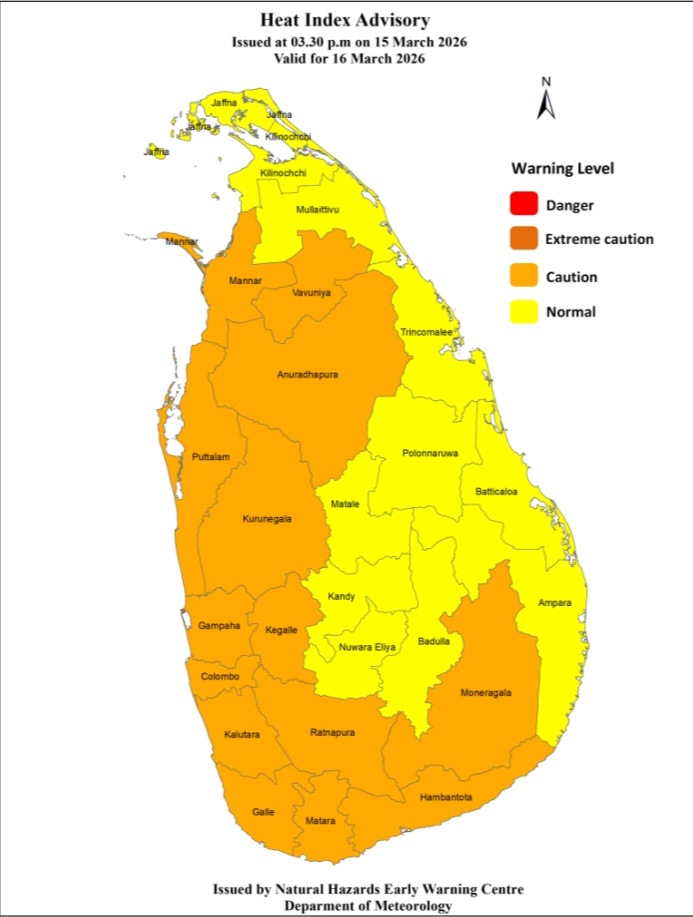
Issued by the Natural Hazards Early Warning Centre of the Department of Meteorology  at 3.30 p.m. on 15 March 2026, valid for 16 March 2026.

The public is warned that the Heat index, the temperature felt on human body is likely to increase up to ‘Caution level’ at
some places in the Western, Sabaragamuwa, Southern and North-western provinces and in Monaragala, Mannar, Anuradhapura and Vavuniya districts.

The Heat Index Forecast is calculated by using relative humidity and maximum temperature and this is the condition that is felt on your body. This is not the forecast of maximum temperature. It is generated by the Department of Meteorology for the next day period and prepared by using global numerical weather prediction model data.


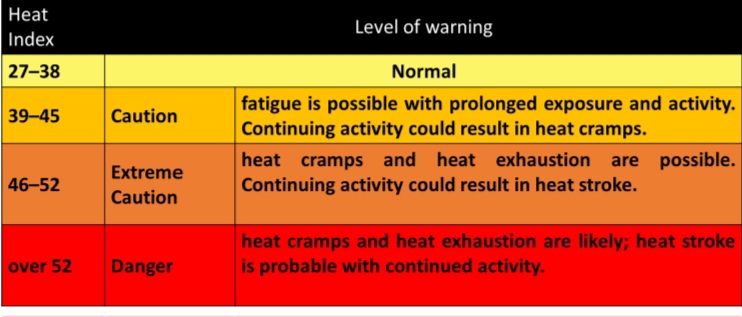
Effect of the heat index on human body is mentioned in the above table and it is prepared on the advice of the Ministry of Health and Indigenous Medical Services.

ACTION REQUIRED
Job sites: Stay hydrated and takes breaks in the shade as often as possible.
Indoors: Check up on the elderly and the sick.
Vehicles: Never leave children unattended.
Outdoors: Limit strenuous outdoor activities, find shade and stay hydrated.
Dress: Wear lightweight and white or light-colored clothing.

Note:
In addition, please refer to advisories issued by the Disaster Preparedness & Response Division, Ministry of Health in this regard as well. For further clarifications please contact 011-7446491


Continue Reading

Trending