
News
SLN conducts risky diving operation at capsized Chinese fishing vessel on high seas


The Sri Lanka Navy (SLN) embarked on a Search and Rescue/Recovery (SARR) operation to assist the ongoing operations of the capsized Chinese fishing vessel LU PENG YUAN YU 028, which was reported on 16th May 2023 in the Australian Search and Rescue Region, south of Sri Lanka.
On the directives of the Commander of the Navy, Vice Admiral Priyantha Perera, the Navy’s Offshore Patrol Vessel, SLNS Vijayabahu, with a team of Navy divers, was directed to engage in this crucial mission.
As per Sri Lanka’s commitment to the International Convention for the Safety of Life at Sea (SOLAS), the Maritime Rescue Coordination Center (MRCC) Colombo, established at the Navy Headquarters, is responsible for coordinating and facilitating maritime search and rescue operations in its designated region, as well as neighbouring regions.
As SLN arrived on the scene, the regional stakeholders have already commenced extensive aeronautical search and surface search in the area of the overturned Chinese fishing vessel. Having reached the location, the courageous Sri Lanka Navy divers meticulously searched for air pockets ,within the upturned vessel, hoping to find any survivors. After strenuous diving, amidst the challenges of zero visibility and enormous water turbulence, the Navy divers recovered two bodies from the captain’s cabin and accommodation area and they were handed over to the Tug De Tian on scene.
In addition, the Navy divers recovered 12 more bodies of the crew from various compartments of the vessel. Due to decomposition and the potential health hazards posed by operating in contaminated waters, with limited protective gear, it was determined that retrieving those bodies would be exceedingly dangerous. Next, the decision was made to map the locations of the bodies, while prioritizing the safety of the SLN divers.
Subsequently, the Diving officer and Navy divers, attached to SLNS Vijayabahu ,embarked on MV SHANDONG DE LONG which arrived there with a team of Chinese salvage team and made them a comprehensive briefing on the mapped locations of corpses, safe passages for divers to enter and exit the overturned vessel

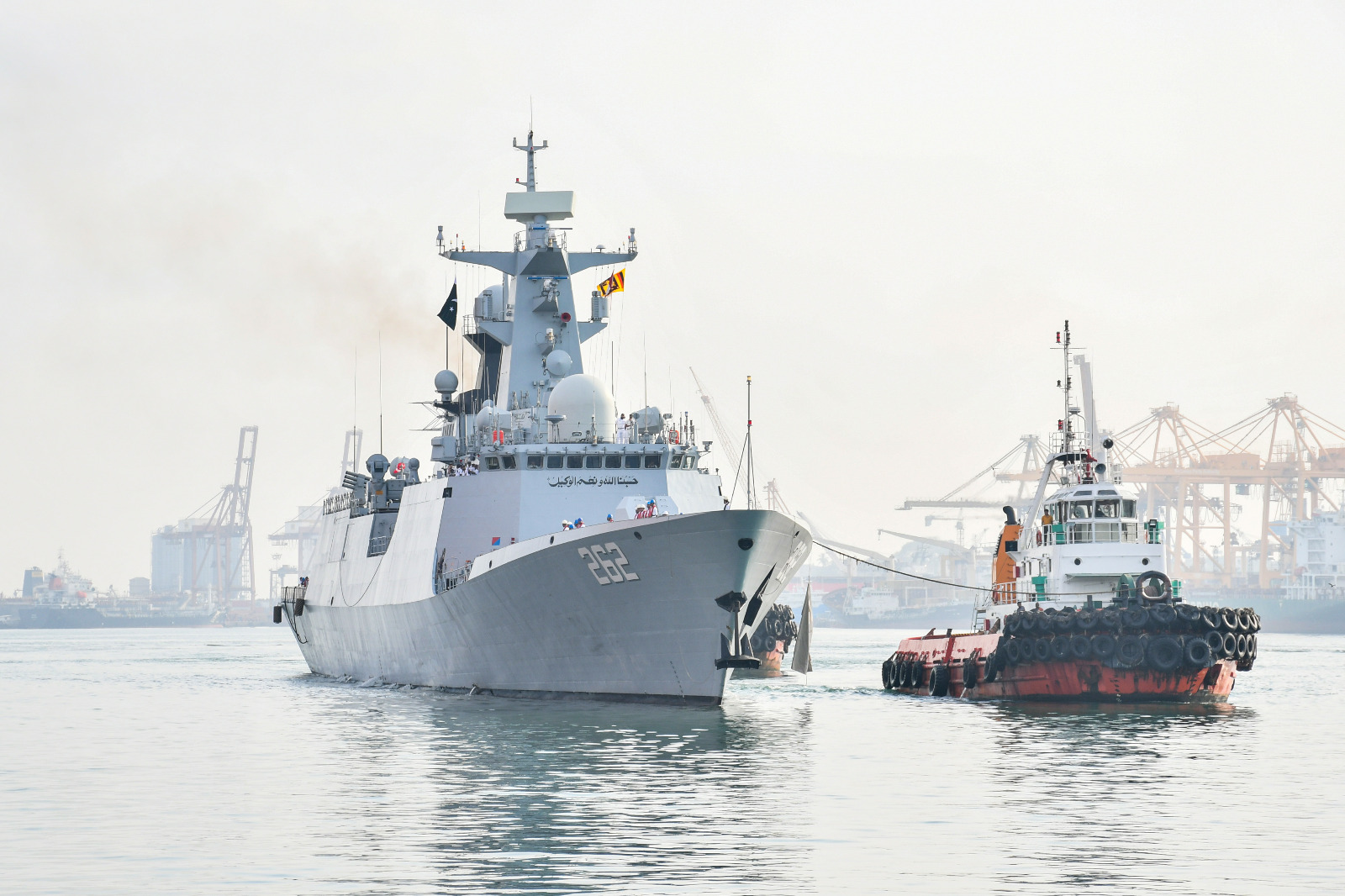
The Pakistan Navy Ship (PNS) TAIMUR and ASLAT arrived at the Port of Colombo on a goodwill visit on 12 Apr 26.
The visiting ships were welcomed by the Sri Lanka Navy in
compliance with naval traditions.
The duo of ships is commanded by Captain NIAMAT SAEED KHAN (PNS TAIMUR) and Captain NADIR MATEEN AFRIDI (PNS ASLAT).
Meanwhile, the ships are expected to conduct a Bilateral Naval Exercise LION STAR V with the Sri Lanka Navy in Colombo seas.
Latest News
Heat index likely to increase up to ‘Caution level’ at some places in the Northern, North-central, North-western, Western, Sabaragamuwa, Southern and Eastern provinces and Monaragala district


Warm Weather Advisory
Issued by the Natural Hazards Early Warning Centre at 3.30 p.m. on 11 April 2026, valid for 12 April 2026
The Heat index, the temperature felt on the human body is likely to increase up to ‘Caution level’ at some places in the Northern, North-central, North-western, Western, Sabaragamuwa, Southern and Eastern provinces and Monaragala district.
The Heat Index Forecast is calculated by using relative humidity and maximum temperature and this is the condition that is felt on your body. This is not the forecast of maximum temperature. It is generated by the Department of Meteorology for the next day period and prepared by using global numerical weather prediction model data.

Effect of the heat index on human body is mentioned in the above table and it is prepared on the advice of the Ministry of Health and Indigenous Medical Services.
ACTION REQUIRED
Job sites: Stay hydrated and takes breaks in the shade as often as possible.
Indoors: Check up on the elderly and the sick.
Vehicles: Never leave children unattended.
Outdoors: Limit strenuous outdoor activities, find shade and stay hydrated.
Dress: Wear lightweight and white or light-colored clothing.
Note: In addition, please refer to advisories issued by the Disaster Preparedness & Response Division, Ministry of Health in this regard as well. For further clarifications please contact 011-7446491.
Latest News
Sun directly overhead Cheddikulam, Kebithigollewa, Gomarankadawala and Nilaveli about 12:11 noon. today [12]

On the apparent northward relative motion of the sun, it is going to be directly over the latitudes of Sri Lanka from 05th to 15th of April in this year.
The nearest areas of Sri Lanka over which the sun is overhead today (12th) are Cheddikulam, Kebithigollewa, Gomarankadawala and Nilaveli about 12:11 noon.

PNS TAIMUR & ASLAT arrive in Colombo

Sanju Samson and Jamie Overton deliver first points for Chennai Super Kings

Arya, Prabhsimran and Shreyas help Punjab Kings ace another 200-plus chase

Beauty of Sri Lanka in focus: Global showcase blends art, diplomacy and conservation

Showers expected in the Western, Sabaragamuwa, Central, Southern, North-western and Uva provinces and in Ampara, Batticaloa and Polonnaruwa districts after 1.00 p.m.

Heat index likely to increase up to ‘Caution level’ at some places in the Northern, North-central, North-western, Western, Sabaragamuwa, Southern and Eastern provinces and Monaragala district

‘Dates have the highest sugar content to fight Coronavirus’

Sunday Island 27 December – Headlines

#SundayIsland 17th December – Headlines

Sunday Island – 28th March

Sunday Island Headlines – 21 March

Sunday Island – 21st February – Headlines
-

 News6 days ago
Lankan-origin actress Subashini found dead in India
-

 News4 days ago
AG: Coal procurement full of irregularities
-

 Business3 days ago
Israeli attack on Lebanon triggers local stock market volatility
-

 News24 hours ago
CEB orders temporary shutdown of large rooftop solar systems
-

 Business4 days ago
Hayleys Mobility introduces Premium OMODA C9 PHEV
-

 Business3 days ago
HNB Assurance marks 25 years with strategic transformation to ‘HNB Life’
-

 News6 days ago
UN Regional Director launches SL’s first Country Gender Equality Profile during official visit
-

 Sports4 days ago
DS to face St. Anthony’s in ‘Bridges of Brotherhood’ cricket encounter