
News
SL Anti-Terrorism Bill less draconian than one in Britain

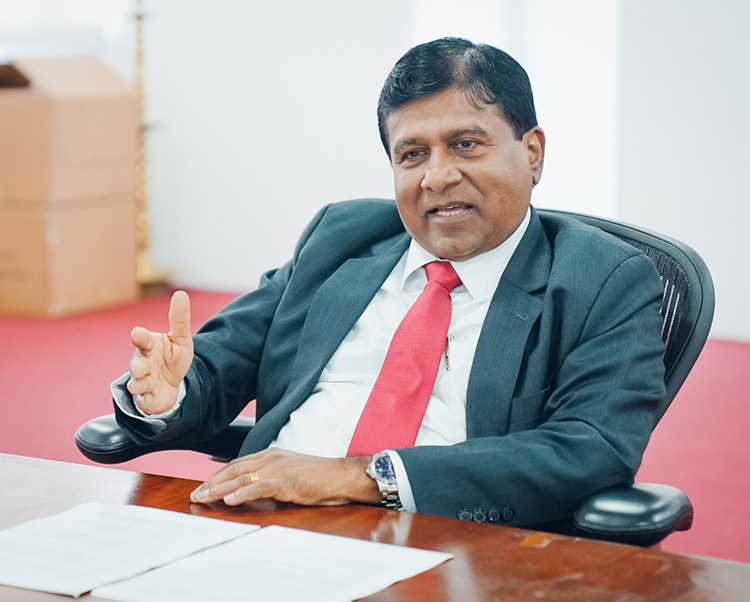
– Justice Minister Rajapakshe
By Saman Indrajith
Justice Minister Dr Wijeyadasa Rajapakshe yesterday told Parliament that the provisions contained in the Anti-Terrorism Bill, presented to the House, were less severe and harsh than those in the counter terrorism laws in Great Britain.
Dr. Rajapakshe said so responding to a question raised by SLMC leader Rauff Hakeem, who asked the Minister to explain the changes the new Bill envisaging to be introduced to the Prevention of Terrorism Act.
Earlier in the day, the Minister presented the Bill to the House and Secretary General of Parliament Kushani Rohanadeera read out the Bill’s preamble: “Anti-Terrorism,— Bill to make provision for the protection of the National Security of Sri Lanka and the people of Sri Lanka from acts of terrorism, other offences associated with terrorism and certain specified acts constituting the offence of terrorism committed within or outside Sri Lanka; for the prevention of the use of Sri Lankan territory and its people for the preparation for terrorism outside Sri Lanka; to provide for the detection, identification, apprehension, arrest, detention, investigation, prosecution and punishment of any person who has committed an act of terrorism or any other offence associated with terrorism; for the repeal of the Prevention of Terrorism (Temporary Provisions) Act, No. 48 of 1979; and for matters connected therewith or incidental thereto.”
Responding to MP Hakeem, Minister Dr. Rajapakshe said: “The Prevention of Terrorism Act had many criticisms against it. In 2015, we started the process of bringing a new law under the name of Counter Terrorism Act. It was presented to Parliament and then challenged before the Supreme Court and the Supreme Court has issued its determination on the Counter Terrorism Bill.”
However, the then government had not been able to proceed with the Bill and following the Easter Sunday terror attacks, the proces had come to a halt. “In 2022, we resumed the process. We decided to bring about a new Act on the matter. We formulated a new Act, and it took one and half years because we allowed all stakeholders to express their views on this. We met with all Ambassadors and High Commissioners in this country and explained to them the content of this legislation. They also approved it.
“Thereafter we gazetted it and hoped to take it up in Parliament in November, but there were concerns that if we presented the Bill in the House, it would hinder the chances for people to go before the court against it because court vacation was to commence soon. There were requests from many parties to postpone it. As such, we delayed the process. Briefly I can explain some of the changes that we introduced. A court can convict a person on the basis of a confession. It is not recognized under the normal law of evidence. Yet it was possible under the special laws of the PTA.
It was the biggest criticism against the PTA. We have removed that and now it goes as per the normal law of evidence. The second issue of contention was that as per the existing law, the Defence Minister has the powers to issue detention orders. The Defence Minister can give a detention order for three months and he can also extend it.
There was a proposal that powers should be given to the DIGs. We now plan to give those powers to the Defence Secretary. As per the law to be introduced, the Defence Secretary can give a detention order for one month and if there is a need to extend that, then prior approval of a magistrate is needed. So, we brought the detention under the courts’ powers. In addition, the Human Rights Commission would be given powers to visit and inspect those under detention.
“We did not have a definition for the term terrorism. Though there is an internationally accepted definition for the term corruption there is no such definition for the term terrorism. Each country has defined it as per their needs and requirements. We have brought about a definition for the term terrorism which is quite similar to the definition in the Counter Terrorism Act in Great Britain. However, our definition is not as severe as the one in Great Britain.”









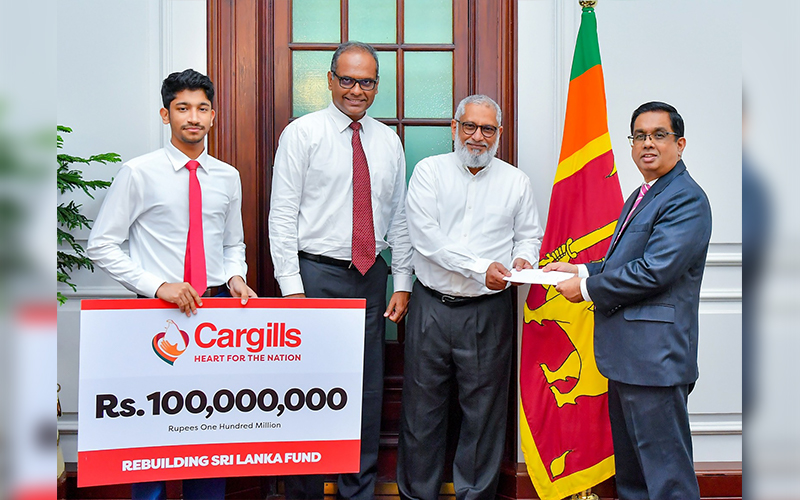
A donation of Rs. 100 million was made to the “Rebuilding Sri Lanka” Fund by Cargills (Ceylon) PLC.
The relevant cheque was handed over on Monday (22) by Imtiaz Abdul Wahid, Managing Director of Cargills (Ceylon) PLC, to Secretary to the President, Dr. Nandika Sanath Kumanayake.
Dilanta Jayawardena and Chandana Kelegama of Cargills (Ceylon) PLC were also present at the occasion.

House Committee, BASL and TISL take common stand
The Chairman of the Committee on Public Finance (CoPF) has found fault with President Anura Kumara Dissanayake for what it calls the inordinate delay in appointing a new Auditor General. CoPF Chairman Dr. Harsha de Silva, in a letter dated Dec. 22 addressed to President Dissanayake, has pointed out that the Office of the AG remains vacant.
The SJBer raised the serious issue with the President close on the heels of the interventions made by the Bar Association of Sri Lanka (BASL) and Transparency International Sri Lanka (TISL).
Dr. de Silva has emphasised that the failure on the part of the President to fill the vacancy is a matter of serious concern. The Constitutional Council has repeatedly rejected the President’s nominee while questioning his suitability.
The following is the text of CoPF Chairman’s letter to the President: ” I wish to respectfully bring to your attention that the Office of the Auditor General has remained vacant since 7 December, following the conclusion of the tenure of the Acting Auditor General on 6 December. At present, there is neither a substantive nor an acting Auditor General in the country, and consequently, the Audit Service Commission remains without a chairman. Given the prevailing circumstances of the country, the continuous absence of this constitutionally mandated post is a matter of serious concern.
Under Article 148 of the Constitution, Parliament exercises full control over public finance. The effective exercise of this control is constitutionally dependent on the continuous functioning of an independent audit mechanism.
Article 154 of the Constitution establishes the office of the Auditor General and mandates the audit of all State institutions and the reporting of such audits to Parliament. The absence of an Auditor General disrupts this mandatory constitutional process. This mandate is further reinforced by Section 3 of tile National Audit Act, No. 19 of 2018.
Moreover, the oversight functions of the Committee on Public Accounts, and the Committee on Public Enterprises in terms of Standing Orders 119, and 120 are directly dependent on audit reports issued by the Auditor General. The continued vacancy therefore materially undermines parliamentary financial oversight.
As the Committee on Public Finance (CoPF) is responsible for reviewing the budget and work programme of the National Audit Office, I consider it my duty, as the Chair of the CoPF, to urge the immediate appointment of the Auditor General.
Accordingly, I respectfully request that urgent action be taken to appoint a suitable, qualified and experienced individual as the Auditor General in accordance with Article 153(1) of the Constitutional, without further delay.”
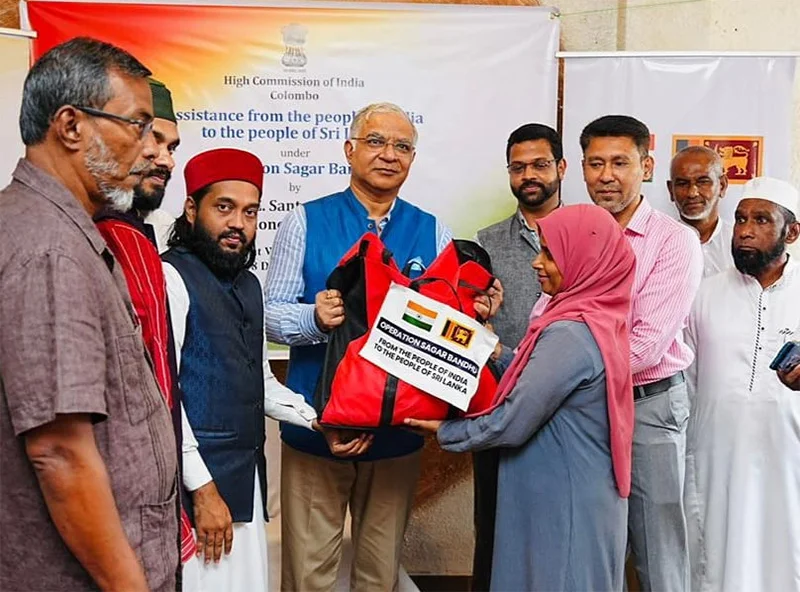
As part of India’s continued assistance to Sri Lanka under ‘Operation Sagar Bandhu’, the Indian High Commission in Colombo, Assistant High Commission in Kandy and Consulate General of India in Jaffna conducted humanitarian assistance distribution drives for families affected by Cyclone Ditwah in different parts of the country, the Indian HC said.
The text of the HC statement: “On 18 December, High Commissioner of India Santosh Jha distributed relief kits among affected families in the Kolonnawa in coordination with All Ceylon Sufi Spiritual Association and among children of Bhaktivedanta Children’s Home ‘Gokulam’ at ISKCON Temple in Colombo. Earlier this month, the High Commissioner also distributed assistance among residents of Nayanalokagama, village specially designated for the visually impaired, and among affected families in Negombo in the Gampaha District.
Between 9 and 19 December, Assistant High Commission of India in Kandy distributed essential food items and supplies among hundreds of affected families in Kandy, Nuwara Eliya and Badulla Districts.
Similarly, the Consulate General of India in Jaffna carried out several distribution drives for affected families in Mannar, Mullaitivu and Kilinochchi, as well as island territories of the Jaffna District.
This assistance is over and above several tonnes of food and relief material handed over by India to the Government of Sri Lanka under ‘Operation Sagar Bandhu’.”

Cargills (Ceylon) PLC Donates Rs. 100 million to “Rebuilding Sri Lanka” Fund

Showers may occur in Uva province and in Ampara, Batticaloa, Matale and Nuwara-Eliya districts

CoPF Chief steps up pressure on Prez to appoint AG

Indian HC and Consulates extend humanitarian assistance to families affected by Cyclone Ditwah

Sri Lanka prepares to deploy fresh military contingent under UN command

New measures to protect environmentally sensitive Sri Pada region

‘Dates have the highest sugar content to fight Coronavirus’

Sunday Island 27 December – Headlines

#SundayIsland 17th December – Headlines

Sunday Island – 28th March

Sunday Island Headlines – 21 March

Sunday Island – 21st February – Headlines
-

 News2 days ago
Members of Lankan Community in Washington D.C. donates to ‘Rebuilding Sri Lanka’ Flood Relief Fund
-

 Business6 days ago
Unlocking Sri Lanka’s hidden wealth: A $2 billion mineral opportunity awaits
-

 News6 days ago
Army engineers set up new Nayaru emergency bridge
-

 Latest News5 days ago
Landslide early warnings issued to the districts of Badulla, Kandy, Kurunegala, Matale and Nuwara-Eliya extended till 8AM on Sunday (21)
-
 News6 days ago
TISL, civil society flay NPP govt. for holding up Auditor General’s appointment
-
 Opinion6 days ago
The Maha Jana Handa at Nugegoda, cyclone destruction, and contenders positioning for power in post-NPP Sri Lanka – II
-

 Latest News6 days ago
Tannane goal from own half sets Morocco on way to FIFA Arab Cup 2025 title
-
 News6 days ago
Sri Lankans rescued from cybercrime centers in Myanmar repatriated