
News
SC allows first-ever climate change FR case to proceed


The Supreme Court of Sri Lanka yesterday (08) granted leave to proceed in a historic fundamental rights petition (SCFR No. 177/22) filed by the Centre for Environmental Justice (CEJ) and its Directors, challenging the state’s failure to adopt and implement adequate measures to mitigate the adverse impacts of climate change.
A three-judge bench, comprising Justice Janak de Silva, Justice Sobhitha Rajakaruna and Justice M. Sampath K. B. Wijeratne, after considering the submissions, allowed the petition to proceed. This landmark decision paves the way for a full hearing on the merits of the case, which argues that state inaction on climate change constitutes a violation of the fundamental rights of Sri Lankan citizens.
The petition names nine Respondents, including the President, the Minister and Secretary of the Ministry of Environment, the Central Environmental Authority, the Sustainable Energy Authority, the Ceylon Electricity Board, the Public Utilities Commission, the Inspector General of Police, the Minister of Transport and the Attorney General.
The petitioners contend that the current and projected impacts of climate change—including rising temperatures, sea-level rise, extreme weather events, and threats to agriculture, health, and livelihoods—directly and imminently infringe upon the constitutional rights of citizens. These include:
* The right to equality and equal protection of the law (Article 12(1)).
* The freedom to engage in any lawful occupation, profession, trade, business, or enterprise (Article 14(1) (g)).
* The freedom of movement and of choosing one’s residence within Sri Lanka (Article 14(1) (h)).
The petition details Sri Lanka’s high vulnerability to climate change and cites the government’s failure to meet its international commitments under the Paris Agreement, as well as its domestic statutory and policy obligations. It highlights deficiencies in key areas such as renewable energy development, vehicle emission standards, fossil fuel dependency, and the protection of natural carbon sinks.
Dr. Ravindranath Dabare, along with Ms. Savanthi Ponnamperuma and Ms. Uvindi Dissanayake, Attorneys-at-Law, appeared for the petitioners on the instructions of Ms. Kanchana Balachandra, Attorney-at-Law.
“This grant of leave to proceed is a significant first step towards judicial recognition of climate change as a core fundamental rights issue in Sri Lanka,” said Dr. Dabare. “It affirms that citizens have a right to demand accountability from the state for its failure to act against a known existential threat that disproportionately impacts the most vulnerable.”
The Centre for Environmental Justice (CEJ), as a public interest litigation organisation, filed this action to compel the state to adopt science-based, ambitious, and urgent mitigation and adaptation strategies to safeguard the rights of present and future generations of Sri Lankans.



India’s External Affairs Minister, Dr. Subramaniam Jaishankar, met with the Prime Minister of Sri Lanka, Dr. Harini Amarasuriya, on 23 December at Temple Trees, during his visit to Sri Lanka as the Special Envoy of Indian Prime Minister Shri Narendra Modi.
The meeting took place as part of the official visit aimed at holding discussions with Sri Lanka’s top leadership, at a time when the nation commenced reconstruction efforts following the devastation caused by Cyclone Ditwah.
During the discussions, the Minister of External Affairs of India reaffirmed readiness to extend support for Sri Lanka, including assistance in rebuilding railways, bridges, and strengthening of the agricultural sector in the country. He also highlighted the importance of having effective systems in place to respond to disaster situations, supported by strong legislative, administrative, and institutional frameworks. Both sides reviewed ongoing relief efforts and explored avenues to further strengthen bilateral cooperation in disaster response and recovery.
The Prime Minister commended the Government of India for the continued support, noting that the recovery process following the devastation caused by Cyclone Ditwah include beyond immediate relief efforts to long-term measures such as resettlement, and reconstruction of habilitation and infrastructure.
The Prime Minister further stated that steps have been taken to reopen schools as part of the process of restoring normalcy, with close monitoring in place. The Prime Minister emphasized the need to ensure stability, reduce vulnerability, and strengthen protection mechanisms highlighting the solidarity of the people, their strong spirit of volunteerism, and collective action demonstrated during the emergency situation.
The event was attended by the High Commissioner of India Santosh Jha, Additional Secretary (IOR), MEA Puneet Agrawal, Joint Secretary (EAMO), MEA Sandeep Kumar Bayyapu, Deputy High Commissioner Dr. Satyanjal Pandey, and representing Sri Lankan delegation, Secretary to the Prime Minister Pradeep Saputhanthri, Additional Secretary to the Prime minister Ms.Sagarika Bogahawatta, Director General (South Asia), Ministry of Foreign Affairs Samantha Pathirana, Deputy Director, South Asia Division, Ministry of Foreign Affairs Ms.Diana Perera.
[Prime minister’s media division]

Sri Lanka is standing on the edge of a coastal catastrophe, with the nation’s lifeline rapidly eroding under the combined assault of climate change, reckless development and weak compliance, Director General of the Department of Coast Conservation and Coastal Resource Management (DCC&CRM) Dr. Terney Pradeep Kumara has warned.
“This is no longer an environmental warning we can afford to ignore. The crisis is already unfolding before our eyes,” Dr. Kumara told The Island, cautioning that the degradation of Sri Lanka’s 1,620-kilometre coastline has reached a point where delayed action could trigger irreversible damage to ecosystems, livelihoods and national security.
He said accelerating coastal erosion, rising sea levels, saltwater intrusion and the collapse of natural barriers, such as coral reefs and mangroves, are placing entire coastal communities at risk. “When mangroves disappear and reefs are destroyed, villages lose their first line of defence. What follows are floods, loss of homes, declining fisheries and forced displacement,” he said.
Dr. Kumara stressed that the coastline is not merely a development frontier but the backbone of Sri Lanka’s economy and cultural identity. “More than half of our tourism assets, fisheries and key infrastructure are concentrated along the coast.
If the coast fails, the economy will feel the shock immediately,” he warned.
Condemning unregulated construction, illegal sand mining and environmentally blind infrastructure projects, he said short-term economic interests are pushing the coastline towards collapse. “We cannot keep fixing one eroding beach while creating three new erosion sites elsewhere. That is not management—it is destruction,” he said, calling for science-driven, ecosystem-based solutions instead of politically convenient quick fixes.
The Director General said the Department is intensifying enforcement and shifting towards integrated coastal zone management, but warned that laws alone will not save the coast. “This is a shared responsibility. Policymakers, developers, local authorities and the public must understand that every illegal structure, every destroyed mangrove, weakens the island’s natural shield,” he added.
With climate change intensifying storms and sea surges, Dr. Kumara warned that Sri Lanka’s vulnerability will only worsen without urgent, coordinated national action. “The sea has shaped this nation’s history and protected it for centuries. If we fail to protect the coast today, we will be remembered as the generation that allowed the island itself to be slowly eaten away,” he went on to say.
By Ifham Nizam
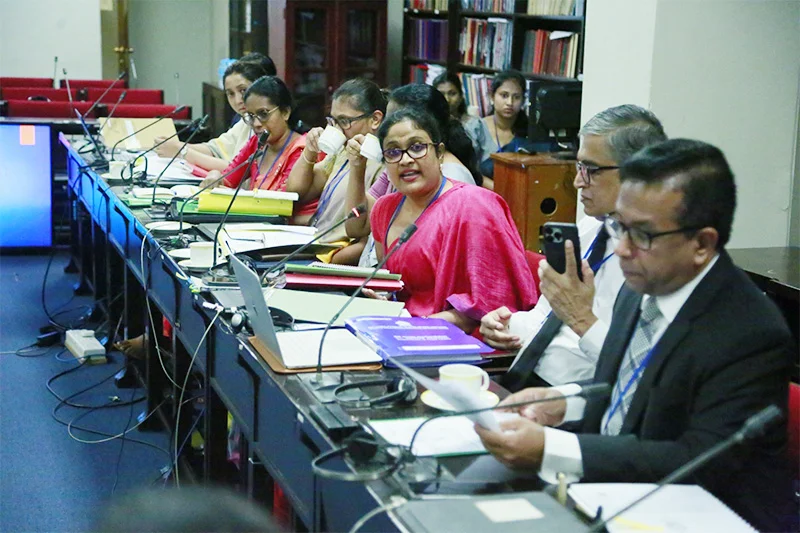
The Sectoral Oversight Committee (SoC)on Economic Development and International Relations recently examined the Microfinance and Credit Regulatory Authority Bill and the proposed amendments thereto.
The SoC met in Parliament under the chairmanship of Member of Parliament Ms. Lakmali Hemachandra, (Attorney at Law). A group of officials representing the Central Bank of Sri Lanka, the Department of Development Finance of the Ministry of Finance, Planning and Economic Development, and the Legal Draftsman’s Department participated in the meeting.
The Microfinance and Credit Regulatory Authority Bill was presented to Parliament for its First Reading on 26.11.2025. Accordingly, the Committee held an extensive discussion on the amendments that have been proposed to the Bill. The Chair of the Committee, Hon. Member of Parliament Ms. Lakmali Hemachandra, (Attorney at Law) stated that it is important to give careful and further consideration to this Bill and that discussions on the proposed amendments will be held again on a future date.
Members of Parliament Lakshman Nipuna Arachchi, Thilina Samarakoon, Nilanthi Kottahachchi, Attorney at Law, Sagarika Athauda, Attorney at Law, Suranga Ratnayaka, and Wijesiri Basnayake also participated in this Committee meeting.

Several spells of showers may occur in Central, Uva and Eastern provinces and in Polonnaruwa and Mullaittivu districts

India’s External Affairs Minister meets Sri Lanka PM

Shafali 69 not out , spinners lead India’s rout of Sri Lanka

Sri Lanka’s coastline faces unfolding catastrophe: Expert

SOC examines proposed amendments to the Microfinance and Credit Regulatory Authority Bill

CEB–NTPC joint venture seeks investors for 50 MW Sampur solar project

‘Dates have the highest sugar content to fight Coronavirus’

Sunday Island 27 December – Headlines

#SundayIsland 17th December – Headlines

Sunday Island – 28th March

Sunday Island Headlines – 21 March

Sunday Island – 21st February – Headlines
-

 News1 day ago
Members of Lankan Community in Washington D.C. donates to ‘Rebuilding Sri Lanka’ Flood Relief Fund
-

 News6 days ago
Pope fires broadside: ‘The Holy See won’t be a silent bystander to the grave disparities, injustices, and fundamental human rights violations’
-

 News6 days ago
Pakistan hands over 200 tonnes of humanitarian aid to Lanka
-

 Business5 days ago
Unlocking Sri Lanka’s hidden wealth: A $2 billion mineral opportunity awaits
-

 News5 days ago
Army engineers set up new Nayaru emergency bridge
-

 News6 days ago
Officials of NMRA, SPC, and Health Minister under pressure to resign as drug safety concerns mount
-

 News6 days ago
Expert: Lanka destroying its own food security by depending on imported seeds, chemical-intensive agriculture
-

 Editorial6 days ago
Flawed drug regulation endangers lives