
Sports
Remarkable National Athletics Championship of 1995

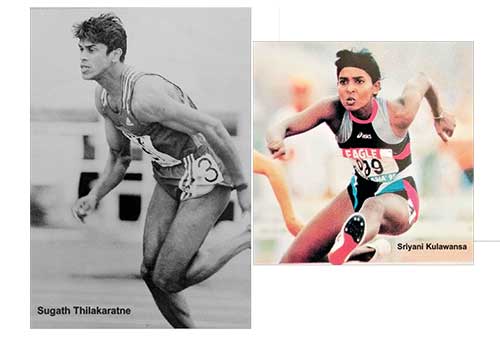
12 National records were established at the annual event 25 years ago
by Reemus Fernando
Sri Lanka Athletics will conduct the 98th National Athletics Championships at the Sugathadasa Stadium from today. Looking back at a remarkable National Championship conducted by the athletics governing body 25 years ago. “Performance wise there has been no other National Championship at which so many national records were created” says Sri Lanka Athletics statistician Saman Kumara Gunawardena referring to the 73rd National Athletics Championship which was held from October 24 to 26, 1995 at the Sugathadasa Stadium.
The championship was held in an era which is popularly known as the golden era of track and field sports in the country. Prominent athletes including Sugath Thilakaratne, Chinthaka de Soysa, Sriyani Kulawansa, Damayanthi Dharsha and Olympic medallist Susanthika Jayasinghe, who were well known even in the Asian circuit were at their peak during this time. But neither Susanthika nor Dharsha took part in this championship which witnessed 12 national records being established.
As per the veteran athletics statistician Gunawardena, the 12 national records established at that meet is the highest number of national records established at a single national championship to date. Incidentally two athletes who created records later improved on them to have them against their names even today.
Hurdler Mahesh Perera and distance runner Keshani Samarakoon created two records each. Perera clocked 14.07 seconds to win the 110 metres hurdles in a new national record time and also had an equally remarkable 51.93 seconds performance to win the 400 metres hurdles, again in a new national record time. Perera was the runner up in the 100 metres dash won by Chinthaka de Soysa.
Keshani Samarakoon created new records in the women’s 1500 metres (4:32.19 secs) and the 3000 metres (9:41.44 secs). In both events her runner up was Sujeewa Nilmini Jayasena who would later become one of Sri Lanka’s best long distance runners of her era.
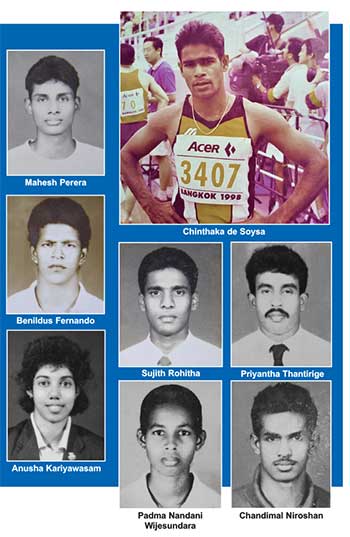 The men’s 200 metres produced a notable tape finish with Chinthaka de Soysa and Sugath Thilakaratne both breasting in a time of 21.19 seconds, a new national record. Soysa was adjudged the winner. Thilakaratne yet to win Asian Games and Asian Championship golds clocked 46.63 seconds to win his pet event the 400 metres. Two years later he would accomplish those Asian achievements and more than a decade later he would become the president of Sri Lanka Athletics.
Long distance events returned notable performances with Saman Weerawardana ( 14:21.79 secs), JMS Jayaweera (14:30.20 secs) and RMR Ramanayake (14:39.45 secs) winning first, second and third places respectively producing sub15 minute timings.
The men’s 10,000 metres witnessed JMS Jayaweera returning a time of 30:10.23 seconds to create a new national record.
Legendary marathoner SLB Rosa had clocked 29 minutes and 18 seconds in a 10,000 metres in 1975 in Arkansas City, USA but the performances achieved overseas had not been recognized even by 1995. But now Sri Lanka Athletics lists Rosa’s 1995 record as the National record.
In the men’s long jump Benildus Fernando created a new national record clearing 7.74 metres. The first and second runners up were Sujith Rohitha (7.42m) and Indika Chaminda Vithanage (7.27m). Incidentally all three athletes have held the national record during their careers.
Ruwan Pradeep Perera who towered above the rest of the field for a long period dominating pole vault established one of the national records at this meet clearing 4.41 metres.
A giant in the throwing arena, Talavou Alailima won both the shot put (16.21m) and the discus throw. The feat of 50.24 metres to win the discus throw was recorded as a new national mark. A new javelin national record was created by Pradeep Nishantha, who years later, become the coach of Sumeda Ranasinghe, the first Sri Lankan javelin thrower at the Olympics,. Incidentally, like Nishantha Jayasinghe, many athletes who won places at this 1995 National Championships went on to become coaches.
Steeplechase winner Priyantha Thantirige, pole vaulter Ruwan Pradeep Perera, triple jump winner Chandimal Niroshan, hurdlers Sriyani Kulawansa and Nayanthi Kumari Chandrasena, sprinters Dhammika Nandakumara and Tamara Saman Deepika, high jumper Imalka Ranaweera, many time shot put and discus throw national champion Padma Nandani Wijesundara and fellow throwers M.A.S.N. Manchanayake and Saluja Karawita and distance runners, R.M. Tissa Rathnayake and R.M.L.B. Rathnayake went on to become coaches.
In the women’s category Sriyani Kulawansa stood out winning both the 100 metres and the 100 metres hurdles. Her hurdles performance was a new national record. While Yamuna Jayalath Yapa took the 400 metres hurdles record under her name, Jayamini Illeperuma won the 400 and 800 metres. In a rare achievement D.A. Inoka from Walala, won the 10,000 metres.
Of the winners of this meet Chinthaka de Soysa, Benildus Fernando, Mahesh Perera, Sugath Thilakaratne and Sriyani Kulawansa made it to 1996 Olympics and many others who won also went on to clinch golds and silvers at the South Asian Games. (Statistics for this story were provided by Sri Lanka Athletics statistician Saman Kumara Gunawardena)
MEN
100 M:
1. Chinthaka De Soysa (SL Army) 10.52 secs., 2. Mahesh Perera (Track Master SC) 10.65 secs, 3. PK Sujith Rohitha (Sri Lak AC) 10.85 secs.
200 M:
1. Chinthaka de Soysa (SL Army) 21.19 secs. (NSLR), 2. Sugath Thilakaratne (Track Master SC) 21.19 secs, 3. Dhammika Nandakumara (SL Army) 21.79 secs.
400 M:
1. Sugath Thilakaratne (Track Master SC) 46.63 secs, 2. SR Rathnadeepa (Sri Lak AC) 48.06 secs, 3. Suresh Dematapitiya (CT & FC) 48.25 secs.
800 M:
1. RM Tissa Rathnayake (SL Army) 1:49.85 secs, 2. RMLB Rathnayake (SL Army) 1:50.49 secs, 3. PMGA Dharmasena (SL Navy) 1:50.74 secs.
1500 M:
1. Lalith Galappaththi (Unattached) 3:56.43 secs, 2. RM Tissa Rathnayake (SL Army) 3:56.96 secs, 3. RMLB Rathnayake (SL Army) 3:58.16 secs.
5000 M:
1. Saman Weerawardana (SL Army) 14:21.79 secs, 2. JMS Jayaweera (SL Army) 14:30.20 secs, 3. RMR Ramanayake (SL Army) 14:39.45 secs.
10000 M:
1. JMS Jayaweera (SL Army) 30:10.23 secs (NSLR), 2. RMR Ramanayake (SL Army) 31:10.76 secs, 3. W Sanjeewa (SL Army) 31:19.50 secs.
110 M. Hurdles:
1. Mahesh Perera (Track Master SC) 14.07 secs (NSLR), 2. Tarique Gunasekara (Track Master SC) 14.74 secs, 3. Kenneth Perera (Sri Lak AC) 15.11 secs.
400 M. Hurdles:
1. Mahesh Perera (Track Master SC) 51.93 secs. (NSLR), 2. RC Pushpakumara (SL Army) 52.78 secs, 3. Sunimal Manamperi (SL Army) 53.96 secs.
3000 M. Steeplechase:
1. PP Thantirige (SL Army) 9:06.52 secs, 2. Ajith Ebert Silva (SL Army) 9:17.25 secs, 3. DW Prasantha (SL Army) 9:29.56 secs.
High Jump:
1. Patrick Saparamadu (CT & FC) 1.95m, 2. S Maximus Fernando (Ace AC) 1.90m, 3. Glen Wilson (CT & FC) 1.90m.
Pole Vault:
1. Ruwan Pradeep Perera (SL Army) 4.41 m (NSLR), 2. DMG Dissanayake (SL Army) 4.20m, 3. W Somarathne (SL Army) 4.15m.
Long Jump:
1. T Benildus Fernando (Sri Lak AC) 7.74 m (NSLR), 2. PK Sujith Rohitha (Sri Lak AC) 7.42m, 3. Indika Chaminda Vithanage (Track Master SC) 7.27m.
Triple Jump:
1. Chandimal Niroshan (Ace AC) 15.42m, 2. PS Senathilake (SL Army) 15.05m, 3. PA Manawadu (CT & FC) 14.96m.
Shot Put:
1. Talavou F Alailima (Track Master SC) 16.21m, 2. W. Fonseka (SL Army) 12.18m, 3. Suranga Weerasinghe (SL Schools) 12.03m.
Discus Throw:
1. Talavou F Alailima (Track Master SC) 50.24m (NSLR), 2. Ajith Jayakody (SL Army) 46.06m, 3. Alexi Gunasekara (Ace AC) 39.04m.
Javelin Throw:
1. AB Pradeep Nishantha (SL Army) 64.62 m (NSLR), 2. PK Aluvihare (Track Master SC) 62.82m, 3. APS Jayajeewa (Sri Lak AC) 60.16m.
WOMEN
100 M:
1. MA Sriyani Kulawansa (Ace AC) 11.92 secs, 2. Tamara Saman Deepika (SL Army) 11.92 secs, 3. Dilhani Rupasinghe (SL Army) 12.04 secs.
200 M:
1. Tamara Samandeepika (SL Army) 24.27 secs, 2. Dilhani Rupasinghe (SL Army) 25.90 secs, 3. PC Hemathilake (SL Schools) 26.68 secs.
400 M:
1. Jayamini Illeperuma (Ace AC) 55.59 secs, 2. BG Chandralatha (SL Army) 56.80 secs, 3. HH Thambaralatha (Matara DAA) 57.97 secs.
800 M:
1. Jayamini Illeperuma (Ace AC) 2:13.36 secs, 2. AG Dhammika Kumari (Kegalle DAA) 2:14.47 secs, 3. AMN Edirisinghe (SL Schools) 2:20.93 secs.
1500 M:
1. Keshani Samarakoon (SL Air Force) 4:32.19 secs (NSLR), 2. Sujeewa Nilmini Jayasena (Unattached) 4:40.38 secs, 3. Udeni Kanchanamala (Track Master SC) 4:40.84 secx.
3000 M:
1. Keshani Samarakoon (SL Air Force) 9:41.44secs (NSLR), 2. Sujeewa Nilmini Jayasena (Unattached) 9:44.36 secs, 3. Udeni Kanchanamala (Track Master SC) 10:12.26 secs.
10000 M:
1. D.A. Inoka (SL Schools) 39:15.88 secs, 2. Deepa Priyangani (Matara DAA) 40:45.02 secs, 3. WM Irin (Kegalle DAA) 41:23.76 secs.
100 M. Hurdles:
1. MA Sriyani Kulawansa (Ace AC) 13.53 secs (NSLR), 2. Inoka Umayani (SL Army) 15.63 secs, 3. Nayanthi Kumari Chandrasena (Track Master SC) 16.18 secs.
400 M. Hurdles:
1. Yamuna Jayalath Yapa (Sri Lak AC) 62.79 secs (NSLR), 2. Anusha Jayweera (SL Schools) 63.25 secs, 3. Viyanka Welpahla (SL Navy) 63.89 secs.
High Jump:
1. Muditha Hiripitya (Sri Lak AC) 1.64m, 2. DG Rajapaksha (SL Navy) 1.61m, 3. Imalka Ranaweera (Sri Lak AC) 1.58m.
Long Jump:
1. Anusha Kariyawasam (Sri Lak AC) 5.87m, 2. KM Indrani (Matale DAA) 5.62m, 3. PES Fernando (Sri Lak AC) 5.58m.
Triple Jump:
1. R. Thushari Ariyaratne (SL Army) 12.00m, 2. Padma Nandani Wijesundara (Track Master SC) 11.90m, 3. PES Fernando (Sri Lak AC) 11.45m.
Shot Put:
1. Padma Nandani Wijesundara (Track Master SC) 11.31m, 2. LR Siribaddana (Track Master SC) 11.02m, 3. M.A.S.N. Manchanayake (Track Master SC) 10.36m.
Discus Throw:
1. Padma Nandani Wijesundara (Track Master SC) 41.60m, 2. L Saluja Karawita (SL Schools) 38.30m, 3. Suneetha Iranganie (Puttalam DAA) 34.86m.
Javelin Throw:
1. MA Priyanka Nishani (Sri Lak AC) 43.74m, 2. Rosemary Fernando (Sri Lak AC) 40.76m, 3. Chamani Ridma Fernando (SL Schools) 38.60m.
4X100 M. Inter Club Relay:
1. SL Army 49.31secs, 2. Ace AC 50.13 secs, 3. Track Master SC 51.15 secs
Keys:
New Sri Lanka Record -NSLR


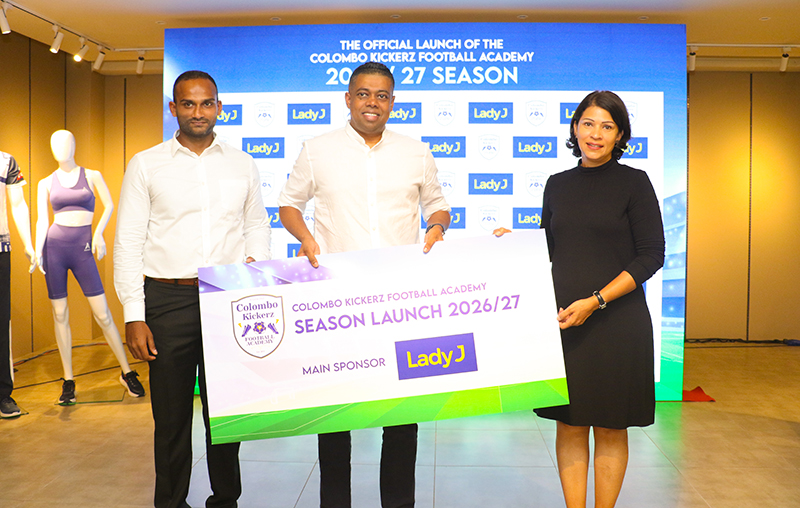
Colombo Kickerz Football Academy at a media briefing held on Wednesday (25) announced that ‘LadyJ’ one of the largest homewear stores in Sri Lanka has come on board as the acadamie’s main sponsor and The Papapare as the Digital Media Partner in the 2026/27 season.
With over 300 aspiring football enthusiasts between the ages of 5 to 18 on roll,
Colombo Kickerz Football Academy founded in 2015 by Ms Viveca Weerasinghe is one of the largest football academies in the island.
The academy provides their changes woth the opportunity of being nurtured by internationally trained coaches and gain experience by playing in local and international competitions on their way to become Sri Lanka’s future football stars.
Managing Director of LadyJ Anuraddha Wijerathne highlighted the importance of investing in sports at grassroot level and supporting young athletes.
Many would argue that had Sri Lanka gone into the recent World Cup with all their big guns fit and firing, they might have reached the semis. That’s the popular line doing the rounds. But if we are calling it as we see it, this campaign was heading for a collapse even before the first ball was bowled.
Reappointing Dasun Shanaka as captain was a gamble, lacked foresight and in the end created divisions within the team. The decision to bring back Pramodya Wickremasinghe as Chairman of Selectors didn’t inspire confidence either. It was a move that had trouble written all over it, the kind that can unsettle a dressing room before a ball is even delivered. It’s like appointing Mervyn Silva as Public Relations Minister. A bull in a China shop is less troublesome than these two southerners.
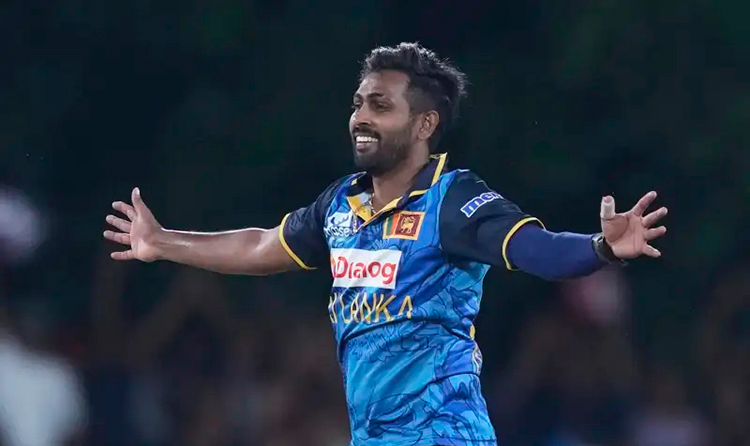
Of course, injuries played their part. Losing Matheesha Pathirana and Eshan Malinga robbed the attack of bite, but the biggest dent was the absence of Wanindu Hasaranga. A proven match-winner, Hasaranga is the sort who can turn a game on its head in the space of a couple of overs. Without him, Sri Lanka were always chasing the game.
What is more concerning is the recurring nature of Hasaranga’s injuries. Missing yet another global tournament due to a hamstring issue raises serious questions. Over the last two years, the pattern has been far from encouraging, and for a professional cricketer, that’s an area that needs urgent attention.
Clearly frustrated by the injury crisis that derailed the campaign, Sri Lanka Cricket have decided to take a firmer stance. Players seeking No Objection Certificates for the IPL will now have to clear fitness tests first. It’s a step in the right direction and one that had been coming for some time.
In the past, when the board tried to assert control, players pushed back, often using franchise connections to apply pressure. This time, however, SLC seem prepared to stand their ground and ensure that national duty is not treated as optional.
There has to be a sense of accountability. It does not sit well when key players miss a World Cup and then turn up fully fit for franchise cricket. That is a contradiction that undermines both the team and the system.
Nuwan Thushara’s situation, however, presents a slightly different picture. The slinging seamer, who was not part of the World Cup squad, has also struggled to meet fitness standards. SLC have inserted a clause allowing them to withhold NOCs for three months beyond the contract period, a move that shows the board have learned from past lapses.
That said, Thushara’s case deserves a degree of empathy. At 31, he is nearing the latter stages of his career and opportunities like the IPL do not come around often. While fitness standards must be upheld, there is also room for discretion, particularly in cases where the player was not part of the World Cup plans.
If players are now seeking leniency, it also reflects gaps in how fitness has been managed over time. Preparation at this level is a long-term investment, not something that can be patched up overnight.
by Rex Clemetine
Latest News
Heat Index likely to increase up to ‘Caution level’ at some places in the Western, Sabaragamuwa, Southern, Eastern, North-western, Northern and North-central provinces and in Monaragala district

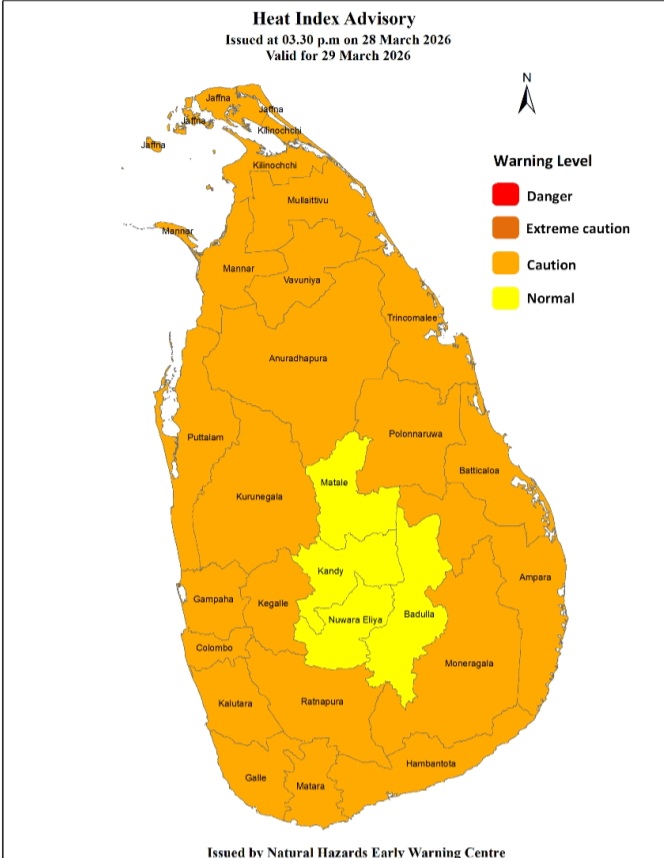
Warm Weather Advisory
Issued by the Natural Hazards Early Warning Centre of the Department of Meteorology
Issued at 3.30 p.m. on 28 March 2026, valid for 29March 2026.
Heat index, the temperature felt on the human body is likely to increase up to ‘Caution level’ at some places in the Western, Sabaragamuwa, Southern, Eastern, North-western, Northern and North-central provinces and in Monaragala district.
The Heat Index Forecast is calculated by using relative humidity and maximum temperature and this is the condition that is felt on your body. This is not the forecast of maximum temperature. It is generated by the Department of Meteorology for the next day period and prepared by using global numerical weather prediction model data.

Effect of the heat index on human body is mentioned in the above table and it is prepared on the advice of the Ministry of Health and Indigenous Medical Services.
ACTION REQUIRED
Job sites: Stay hydrated and takes breaks in the shade as often as possible.
Indoors: Check up on the elderly and the sick.
Vehicles: Never leave children unattended.
Outdoors: Limit strenuous outdoor activities, find shade and stay hydrated.
Dress: Wear lightweight and white or light-colored clothing.
Note:
In addition, please refer to advisories issued by the Disaster Preparedness & Response Division, Ministry of Health in this regard as well. For further clarifications please contact 011-7446491.

National Namal Uyana Declared a ‘National Heritage of Sri Lanka’

Philippine transport strikers say Marcos Jr failing to control oil prices

One ant for $220: the new frontier of wildlife trafficking

Three Lebanese journalists killed in Israeli strike, say broadcasters

Showers will occur at a few places in the Sabaragamuwa province and in Colombo, Kaluthara, Galle, and Matara districts after 2.00 pm

War-linked power crunch pushes Lanka to four-day week

‘Dates have the highest sugar content to fight Coronavirus’

Sunday Island 27 December – Headlines

#SundayIsland 17th December – Headlines

Sunday Island – 28th March

Sunday Island Headlines – 21 March

Sunday Island – 21st February – Headlines
-

 News5 days ago
Senior citizens above 70 years to receive March allowances on Thursday (26)
-

 Features2 days ago
A World Order in Crisis: War, Power, and Resistance
-

 Features7 days ago
Trincomalee oil tank farm: An engineering marvel
-

 News3 days ago
Energy Minister indicted on corruption charges ahead of no-faith motion against him
-

 News4 days ago
US dodges question on AKD’s claim SL denied permission for military aircraft to land
-

 Features7 days ago
The scientist who was finally heard
-

 Business4 days ago
Dialog Unveils Dialog Play Mini with Netflix and Apple TV
-

 Sports3 days ago
SLC to hold EGM in April