
Foreign News
Rare wildflowers blanket Atacama desert

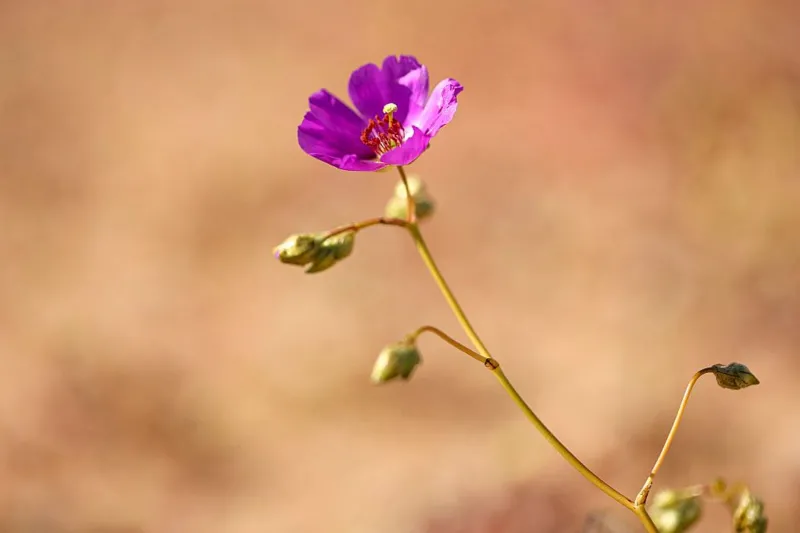
The Atacama desert in Chile sits long and lean, sandwiched between the Andes Mountains and the Pacific Ocean.
The desert’s extreme aridity makes it one of the clearest places on Earth to view the night sky and is famous for being home to the largest radio telescope in the world.
But the usually barren landscape has been transformed by a carpet of colourful wildflowers, which have been brought to life by significant rainfall during the southern hemisphere’s winter months.
This is thought to be an event that only occurs every few years, when above average rainfall soaks the desert floor, causing dormant seeds to spring to life.
The Atacama desert typically receives less than 15mm of rain every year.
But the area had more than 12mm of rain during August alone – most of which fell on just one day.
The desert even saw a rare blanket of snow back in June.
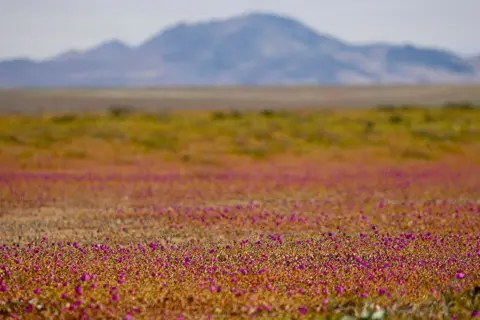
(BBC)
This magnificent bloom is made up of more than 200 different species of wildflowers, some of which do not grow anywhere else in the world. It typically occurs between the end of August and November.
Although thought of as rare, this phenomenon also occurred in 2024, following heavy rainfall in the area.
This year’s display will be at its peak for another few weeks, according to CONAF, Chile’s National Forest Corporation.
(BBC)


Israel is to revoke the licenses of 37 aid groups working in Gaza and the occupied West Bank, saying they failed to meet requirements under new registration rules.
Well-known international non-governmental organisations (INGOs) such as ActionAid, the International Rescue Committee and the Norwegian Refugee Council are among those that will have their licenses suspended on 1 January, with their operations to end within 60 days.
Israel said the groups, among other things, had failed to hand over “complete” personal details of their staff.
The move was heavily criticised by foreign ministers from 10 countries including the UK, who said the new rules were “restrictive” and “unacceptable”.
In a joint statement, the foreign ministers of the UK, France, Canada, Denmark, Finland, Iceland, Japan, Norway, Sweden and Switzerland said the forced closure of INGO operations would “have a severe impact on access to essential services including healthcare”.
They added that the humanitarian situation in Gaza remained “catastrophic” and called on Israel’s government to ensure INGOs were able to operate “in a sustained and predictable way”.
Israel’s Ministry of Diaspora Affairs, which is in charge of registration applications, said the new measures would not impact the flow of humanitarian assistance to Gaza.
It added that aid continued to be delivered through “approved and vetted channels”, including UN agencies, bilateral partners, and humanitarian organisations.
It said the primary reason aid groups were having their licences revoked was “the refusal to provide complete and verifiable information regarding their employees,” which it said was critical to preventing “the infiltration of terrorist operatives into humanitarian structures”.
Earlier this month, UN-backed experts said there had been improvements in nutrition and food supplies in Gaza since a ceasefire was brokered between Israel and Hamas in October, but 100,000 people still experienced “catastrophic conditions” the following month.
Israeli military body Cogat, which controls Gaza’s crossings, said the organisations that will be suspended “did not bring aid into Gaza throughout the current ceasefire”.
It added that “even in the past their combined contribution amounted to only about 1% of the total aid volume”.
The Ministry of Diaspora Affairs said that fewer than 15% of organisations providing humanitarian assistance to Gaza were found to be in violation of the new regulatory framework.
That framework includes several grounds for rejection, including:
- Denying the existence of Israel as a Jewish and democratic state
- Denying the Holocaust or the Hamas-led attacks on Israel on 7 October 2023
- Supporting an armed struggle against Israel by an enemy state or terrorist organisation
- Promoting “delegitimisation campaigns” against Israel
- Calling for a boycott of Israel or committing to participate in one
- Supporting the prosecution of Israeli security forces in foreign or international courts
The Humanitarian Country Team of the Occupied Palestinian Territory – a forum that brings together UN agencies and more than 200 local and international organisations – previously warned that the new registration system “fundamentally jeopardises” the operations of INGOs in Gaza and the West Bank.
“The system relies on vague, arbitrary, and highly politicised criteria and imposes requirements that humanitarian organisations cannot meet without violating international legal obligations or compromising core humanitarian principles,” it said.
It added: “While some INGOs have been registered under the new system, these INGOs represent only a fraction of the response in Gaza and are nowhere near the number required just to meet immediate and basic needs.”
According to the Humanitarian Country Team, INGOs currently run or support most of Gaza’s field hospitals and primary healthcare centres, emergency shelter responses, water and sanitation services, nutrition stabilisation centres for children with acute malnutrition, and critical mine action activities.
In a statement, Israel’s Minister of Diaspora Affairs and Combating Antisemitism, Amichai Chikli, said: “The message is clear: humanitarian assistance is welcome — the exploitation of humanitarian frameworks for terrorism is not.”
Other organisations to be suspended include CARE, Medico International and Medical Aid for Palestinians.
[BBC]
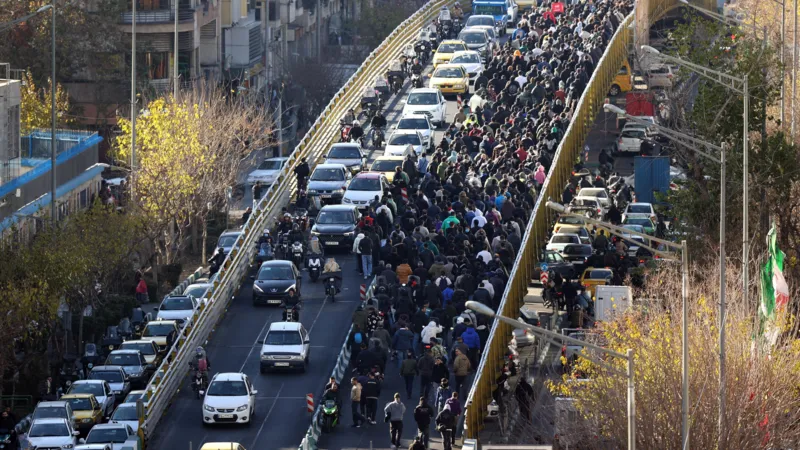
Protests and strikes in Iran over inflation and currency devaluation have spread from the capital, Tehran, to several other cities on a third day of unrest.
The protests began on Sunday after shopkeepers in Tehran’s Grand Bazaar staged a strike when the Iranian rial hit a record low against the US dollar on the open market.
Since then, videos verified by BBC Persian have shown demonstrations in the cities of Karaj, Hamedan, Qeshm, Malard, Isfahan, Kermanshah, Shiraz and Yazd. Police were also seen using tear gas in an attempt to disperse demonstrators.
The Iranian government said it “recognises the protests” and would listen “with patience, even if it is confronted with harsh voices”.
President Masoud Pezeshkian wrote on X late on Monday that he had instructed the interior minister to hold talks with what he described as “representatives” of the protesters so that measures could be taken “to resolve the problems and act responsibly”.
He also accepted the resignation of Iran’s central bank governor, Mohammadreza Farzin, and named former economy and finance minister Abdolnasser Hemmati to replace him.
University students have also joined the protests, chanting anti-government slogans including “Death to the dictator” – a reference to the Supreme Leader, Ayatollah Ali Khamenei, who holds ultimate power in Iran.
Some protesters were also heard chanting slogans in support of the son of the late Shah Mohammad Reza Pahlavi, who was overthrown in the 1979 Islamic Revolution, including “Long live the Shah”.
In response, Reza Pahlavi, who lives in exile in the United States, wrote on X: “I am with you. Victory is ours because our cause is just and because we are united.”
“As long as this regime remains in power, the country’s economic situation will continue to deteriorate,” he added.
The US state department’s Persian-language account on X also expressed support for the protests.
It said the US “praises their courage” and stands with those seeking “dignity and a better future” after years of failed policies and economic mismanagement.
Iran was reportedly high on the agenda of a meeting between US President Donald Trump and Israeli Prime Minister Benjamin Netanyahu in Florida on Monday,
At a joint news conference afterwards, Trump declined to say whether he supported regime change in Iran, but said: “They’ve got a lot of problems: tremendous inflation, their economy is bust, their economy is no good, and I know people aren’t so happy.”
The president also said he might back another round of Israeli air strikes on Iran if the country rebuilt its ballistic missile or nuclear programmes.
During a 12-day war between Israel and Iran in June, the US carried out air strikes on key Iranian uranium enrichment sites. Iran insists its nuclear programme is entirely peaceful.
President Pezeshkian vowed on Tuesday that Iran’s response to “any oppressive act of aggression” would be “severe and regret-inducing”.
Iran’s supreme leader has repeatedly said that Israel’s government hoped mass protests would erupt in Iran during the war and topple the regime.
“They wanted to create sedition on the streets… But people were absolutely not influenced by what the enemy wanted,” Khamenei said in September.
[BBC]

A scheme to encourage climbers to bring their waste down from Mount Everest is being scrapped – with Nepalese authorities telling the BBC it has been a failure.
Climbers had been required to pay a deposit of $4,000 (£2964), which they would only get back if they brought at least 8kg (18lbs) of waste back down with them.
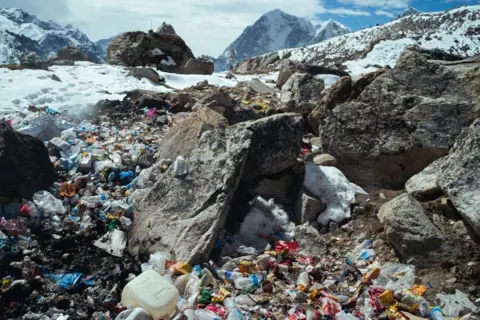
It was hoped it would begin to tackle the rubbish problem on the world’s highest peak, which is estimated to be covered in some 50 tonnes of waste.
But after 11 years – and with the rubbish still piling up – the scheme is being shelved because it “failed to show a tangible result”
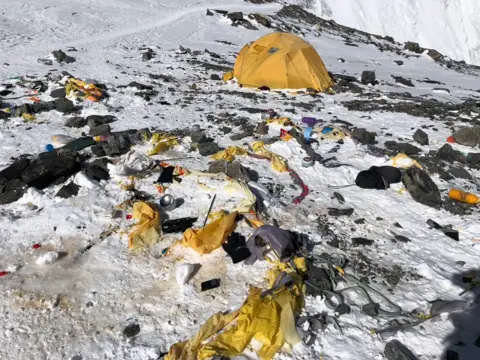
Himal Gautam, director at the tourism department, told the BBC that not only had the garbage issue “not gone away”, but the deposit scheme itself had “become an administrative burden”.
Tourism ministry and mountaineering department officials told the BBC most of the deposit money had been refunded over the years – which should mean most climbers brought back their trash.
But the scheme is said to have failed because the rubbish climbers have brought back is usually from lower camps – not the higher camps where the garbage problem is worst.
“From higher camps, people tend to bring back oxygen bottles only,” said Tshering Sherpa, chief executive officer of the Sagarmatha Pollution Control Committee, which runs an Everest checkpoint.
“Other things like tents and cans and boxes of packed foods and drinks are mostly left behind there, that is why we can see so much of waste piling up.”
Mr Sherpa said on average a climber produces up to 12kg (26lbs) of waste on the mountain where they spend up to six weeks for acclimatisation and climbing.
Apart from the “flawed rule” that required climbers to bring back less trash than they produce, authorities in the Everest region said lack of monitoring has been the main challenge.
“Apart from the check point above the Khumbu Icefall, there is no monitoring of what climbers are doing,” said Mr Sherpa.
Nepalese authorities are hoping a new scheme will be more effective.
Under the changed rule, officials said, a non-refundable clean-up fee from climbers will be used to set up a checkpoint at Camp Two and also deploy mountain rangers who will keep going to the higher parts of the mountain to make sure climbers bring down their trash.
Tourism ministry officials said it will most probably be $4,000 per climber – the same amount as deposit money – and will come into effect once passed by the parliament.
Mingma Sherpa, chairperson of the Pasang Lhamu rural municipality, said the change was something the Sherpa community had lobbied for for many years now.
“We had been questioning the effectiveness of the deposit scheme all this time because we are not aware of anyone who was penalised for not bringing their trash down.
“And there was no designated fund but now this non-refundable fee will lead to creation of a fund that can enable us to do all these clean-up and monitoring works.”

The non-refundable fee will form part of a recently introduced five-year mountain clean-up action plan, with Jaynarayan Acarya, spokesperson at the ministry of tourism, saying it was designed “to immediately address the pressing problem of waste on our mountains”.
Although there has been no study quantifying the waste on Everest, it is estimated there are tons of it including human excrement which does not decay on the higher part of the mountain because of freezing temperature.
And the growing number of climbers each year, averaging around 400 with many more supporting staff, has been a growing concern for mountaineering sustainability.
[BBC]

Lasith Malinga to work with the Sri Lanka Team in lead up to T20 World Cup

Highest revenue in 93-year history of Inland Revenue Department collected in 2025

Showers or thundershowers will occur at times in the Northern, Eastern, Central, North-central, North-western and Uva provinces

Israel to bar 37 aid groups from Gaza

Protests spread across Iran for third day after currency hits record low

Sri Lanka Customs exceeds revenue targets to enters 2026 with a surplus of Rs. 300 billion – Director General

‘Dates have the highest sugar content to fight Coronavirus’

Sunday Island 27 December – Headlines

#SundayIsland 17th December – Headlines

Sunday Island – 28th March

Sunday Island Headlines – 21 March

Sunday Island – 21st February – Headlines
-

 News6 days ago
British MP calls on Foreign Secretary to expand sanction package against ‘Sri Lankan war criminals’
-
 News5 days ago
Street vendors banned from Kandy City
-

 Sports6 days ago
Chief selector’s remarks disappointing says Mickey Arthur
-

 Opinion6 days ago
Disasters do not destroy nations; the refusal to change does
-

 Sports2 days ago
Gurusinha’s Boxing Day hundred celebrated in Melbourne
-

 News5 days ago
Lankan aircrew fly daring UN Medevac in hostile conditions in Africa
-

 Sports3 days ago
Time to close the Dickwella chapter
-

 Sports6 days ago
Royal record crushing innings win against Nalanda