
News
Public Security Minister: Terrorists still at large pose threat to Sri Lanka

By Saman Indrajith
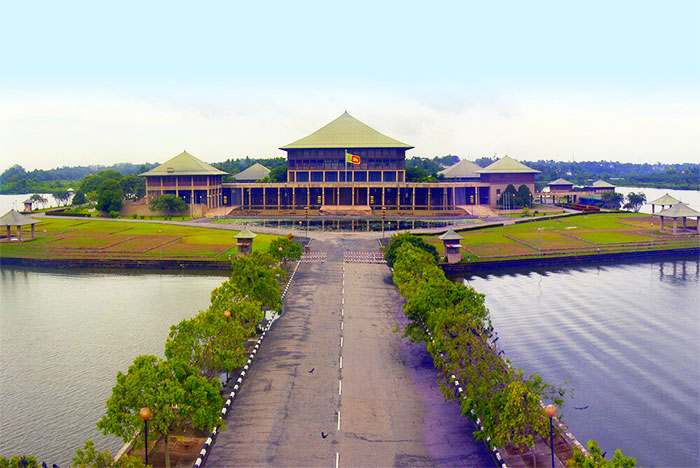
Public Security Minister Rear Admiral (Retd) Sarath Weerasekera told Parliament on Wednesday (22) that Sri Lanka would be under threat as long as the IS ideology promising 72 virgins in paradise for those who sacrificed their lives in the name of Jihad existed.
“Anyone who believes in that ideology could carry out an attack any time. It is not easy to identify them,” the minister said, responding to a question by SJB Colombo District MP Mujibur Rahman.
Minister Weerasekera said that Ven Gnansara during a recent TV talk show highlighted the same threat and Muslim MPs instead of trying to find faults with the messenger should support the government to get rid of terror ideologies from society.
MP Rahman said: “Ven. Gnanasara has recently made a statement during a live telecast on Hiru TV that there would be another terror attack. He said he had informed the President of the threat. He also said that he had all information including the details of the explosives and where the attack would take place. What action has the government?”
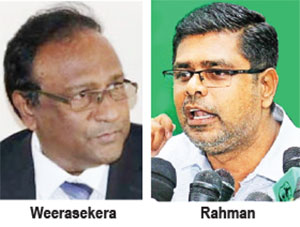 Minister Weerasekera said that inquiries had been made from Ven Gnanasara Thera regarding his statements. “When Ven Gnanasara was questioned by investigators, the he said that he made those statements based on the Al Quran. Ven Gnanasara Thera said that there is a Sinhala translation of Al Quran by Abdul Razeek of Sri Lanka Thowheed Jamaath. That translation contains some sections which may motivate the Muslims to engage in clandestine activities in the name of their religion. He also said so in the TV talk show.
“Ven Gnanasara thera said that no responsible Muslim leader or Islamic religious leader has rejected those sections that advocate terror attacks,” the minister said.
Weerasekera said that Wahabism’s aim was the creation of a theocratic state ruled by an Islamic leader with the title of Caliph. “This ideology is espoused by ISIS. It is not easy to detect persons believe in Wahabism. This is why its hard to make arrests. For example, the Lankan born Islamic terrorist who launched a recent attack in New Zealand had been under surveillance since 2016. Later, he was released by court. He erased pro-ISIS documents and videos from his computer but he did not erase the ideology from his mind.”
The terrorist had knifed innocents believing that he would go to paradise and live with beautiful virgins, the minister said, adding that there were many such people in Sri Lanka.
“There cannot be different laws for different religions. These laws nurture extremist ideologies. Ven Gnanasara’s is right when he says extremists can carry out terror attacks any time. We have strengthened our intelligence network on account of this threat. We need the support of the Muslim people and their organisations to arrest persons who can become a threat. It is wrong to make allegations of racism whenever security forces arrest such extremists. In the aftermath of the Easter Sunday attacks we have detained some people who held and propagated the IS ideology, funded such teachings and associated closely with those who carried out the terror attacks,” he said.
The Minister added that there are Muslim MPs who speak on behalf of those detainees. The terrorists who carried out the suicide terror attacks at the Shangri-La were two sons of a business tycoon.
“They were educated and wealthy. If such educated persons fall prey for the promise of 72 virgins in heaven, what about the youth who have no such education and money? It is not a task difficult to recruit an average Muslim youth with this ideology. They are exposed to teachings that justify terror and killing innocents in the name of religion. They lobbied and exerted pressure on the authorities to release the terror suspect who thereafter carried out a knife attack in New Zealand. Now you see the results.”
Weerasekara said that a leader of the student organisation of the Jamaat e Islami had been involved in damaging Buddha statues in Mawanella. For 25 years the leader of Jamaat-e- Islami had been Rasheed Hajjul Akbar. The man wrote a book which states that Jihad should be launched to protect Islam and that lives had to be sacrificed to achieve that goal.
” Akbar was arrested by the Yahapalana government and MP Mujibur Rahman pressed for his release. This is an MP that spoke highly of the Jamaat-e-Islami. Later, Akbar was released without conditions. The Presidential Commission of Inquiry on page 270 of its report has identified Akbar as one who propagated the creation of an Islamic State in Sri Lanka. The Attorney General should take action to prosecute him for promoting this ideology. The two sons of Akbar’s brother were involved in destroying Buddha statues in Mawanella. They and suicide bomb attacker at Dehiwala were members of the student wing of this organisation. Jamaat-e-Islami literature justifies suicide attacks and it was Akbar who channelled funds for sending Lankan Muslims abroad for training in the 1990s. Muslim MPs got him released. It was our government that took him into custody again. There are such terrorists at large. They are the ones Ven. Gnanasara Thera has warned of. This is much more complicated than the LTTE. We will arrest those who should be arrested and rehabilitate those who should be rehabilitated. We need your support to keep the country safe.”

Latest News
Heat Index at Caution Level in the Western, Sabaragamuwa, Southern, Eastern, North-western, Northern and North-central provinces and in Monaragala district


Warm Weather Advisory
Issued by the Natural Hazards Early Warning Centre
Issued at 3.30 p.m. on 31 March 2026, valid for 01 April 2026.
The Heat index, the temperature felt on human body is likely to increase up to ‘Caution level’ at some places in the Western, Sabaragamuwa, Southern, Eastern, North-western, Northern and North-central provinces and in Monaragala district.
The Heat Index Forecast is calculated by using relative humidity and maximum temperature and this is the condition that is felt on your body. This is not the forecast of maximum temperature. It is generated by the Department of Meteorology for the next day period and prepared by using global numerical weather prediction model data.

Effect of the heat index on human body is mentioned in the above table and it is prepared on the advice of the Ministry of Health and Indigenous Medical Services.
ACTION REQUIRED
Job sites: Stay hydrated and takes breaks in the shade as often as possible.
Indoors: Check up on the elderly and the sick.
Vehicles: Never leave children unattended.
Outdoors: Limit strenuous outdoor activities, find shade and stay hydrated.
Dress: Wear lightweight and white or light-colored clothing.
Note:
In addition, please refer to advisories issued by the Disaster Preparedness & Response Division, Ministry of Health in this regard as well. For further clarifications please contact 011-7446491.

Govt. rations stocks as imports falter
By Ifham Nizam
The government faces a looming fertiliser crisis ahead of the 2026 Yala season, with a sharp shortfall in urea threatening paddy yields and food security.
Experts have warned that the fertiliser shortage will take its toll on the yala harvest.
With just over 100,000 tonnes of fertiliser in stock by early March—barely enough for paddy cultivation alone—and more than half of expected imports either cancelled or delayed, the government has moved to ration supplies through Agrarian Service Centres, based on last year’s consumption.
Leading crop scientist Professor Buddhi Marambe has warned that while rationing is unavoidable, it will reduce productivity. “Even last season we applied below recommended levels. This year, the gap will be worse,” he said.
Authorities are prioritising paddy, followed by maize and tea, as limited stocks are stretched across crops.
However, experts estimate yields could fall by 15–20% if nutrient shortages persist—raising the risk of higher food prices in the months ahead.
The crisis has been worsened by global disruptions, including Gulf conflict affecting fertiliser shipments and precautionary export restrictions by key suppliers, such as China.
Although the Government is pursuing deals with countries like Russia, supplies remain uncertain.
With global urea prices surging and production costs rising, smallholder farmers are expected to be the hardest hit.
“This is a wake-up call,” Prof. Marambe said, urging urgent steps to build buffer stocks and strengthen Sri Lanka’s long-term food security strategy.
By Shamindra Ferdinando
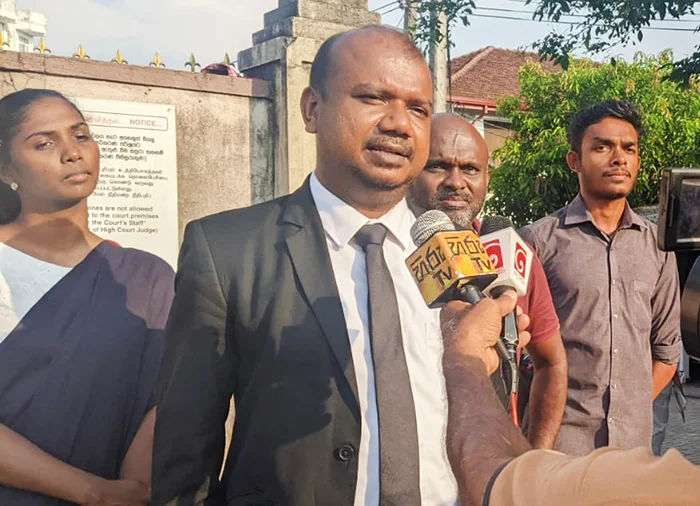
Frontline Socialist Party (FSP) spokesman Pubudu Jayagoda says the Gampaha Magistrate’s Court order that the ruling JVP hand back the FSP’s Kirindiwela office, grabbed by a group of JVP politicians on 02 September, 2025, has shown that the government cannot undermine the law.
Jayagoda said that the FSP had been compelled to move the court against the JVP as the Gampaha police refused to intervene due to political pressure. “They probably thought we were going to give up that office. Perhaps, the ruling party felt they could forcibly occupy other FSP offices,” Jayagoda said.
FSP’s Administrative Secretary Chamira Koswatta and trade unions, which operated from the Salmal Garden office, sought the court intervention to confirm the ownership of that building in the FSP. The court initially transferred the building to the police and issued a directive to law enforcement authorities to remove the JVP/NPP from that building.
Among the 20 respondents was Tilvin Silva, General Secretary of the JVP. Those now identified themselves as FSP quit the JVP in 2011 and later formed their own party.
Gampaha Additional Magistrate Shilani Perera on Monday ruled that the legitimate owner was the FSP. The Magistrate ruled that the FSPers had been forced out of that office, illegally.
Jayagoda said that the FSP considered the court ruling a victory for democracy and a devastating blow to the increasingly authoritarian JVP/NPP rule.

Amelia Kerr hits 139-ball 179* as New Zealand pull off record chase to level series

Punjab Kings fined for slow over-rate

Ice-cool Connolly leads nervy Punjab Kings home on IPL debut

Showers expected in the Western, Sabaragamuwa and Southern provinces in the evening or night

Heat Index at Caution Level in the Western, Sabaragamuwa, Southern, Eastern, North-western, Northern and North-central provinces and in Monaragala district

Urea shortage threatens Yala harvest: Experts

‘Dates have the highest sugar content to fight Coronavirus’

Sunday Island 27 December – Headlines

#SundayIsland 17th December – Headlines

Sunday Island – 28th March

Sunday Island Headlines – 21 March

Sunday Island – 21st February – Headlines
-

 Features5 days ago
A World Order in Crisis: War, Power, and Resistance
-

 News6 days ago
Energy Minister indicted on corruption charges ahead of no-faith motion against him
-

 News7 days ago
US dodges question on AKD’s claim SL denied permission for military aircraft to land
-

 Business7 days ago
Dialog Unveils Dialog Play Mini with Netflix and Apple TV
-

 Sports6 days ago
SLC to hold EGM in April
-
 Opinion6 days ago
When elephants fight, it is the grass that suffers
-

 Latest News7 days ago
A strong Technical and Vocational Education and Training (TVET) system equips individuals with practical, relevant, and future-oriented skills helping to innovate responsibly towards a greener and sustainable future – PM
-

 Features6 days ago
Lest we forget