
News
Prof. Peiris strongly defends re-opening of schools

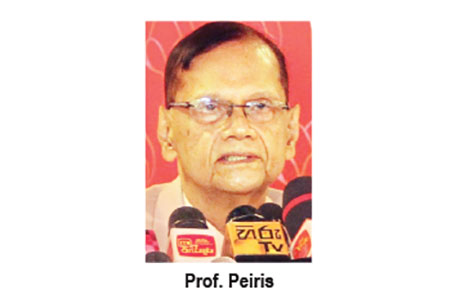
Education Minister Prof. G.L Peiris yesterday (23) strongly defended the government decision to re-open schools in areas not affected by the rampaging coronavirus epidemic.
Schools in the Western Province and some areas isolated due to the epidemic remained closed.
Addressing the media at Waters Edge, Prof. Peiris emphasised that all schools couldn’t be kept shut, pending total eradication of the epidemic.
Such a strategy wouldn’t be realistic, Prof. Peiris said, pointing out that the government decided to re-open schools after having studied the situation.
Responding to a barrage of questions regarding possible risks faced by the student population, the Education Minister asked how schools could remain closed indefinitely.
“Of course, the Education Ministry took the decision in line with overall government response to the corona threat,” Prof. Peiris shot back, pointing out that the situation would be monitored closely.
The Education Minister assured that sufficient funds had been allocated to regional school authorities to provide whatever material support necessary. The minister provided a breakdown of funds made available to provinces while acknowledging the possibility shortcomings.
The minister said that a perfect system couldn’t be expected during the ongoing crisis.
Responding to another query, the minister said that in areas where schools were re-opened some remained closed in terms of the decision taken by school authorities in consultation with relevant stakeholders.
Prof. Peiris said that the Education Ministry permitted school authorities to decide on the re-opening in terms of the overall approval given by the ministry. Therefore, six schools in the East, 14 in Central Province, 14 in North central, 12 in Sabaragamuwa, 48 in North Western Province and 1 in the South remained closed.
Prof. Peiris pointed out that the government conducted the Year 5 Scholarship Examination and GCE Advance Level examination though some opposed the idea. What would have happened if both examinations were cancelled to appease those who opposed everything for the sake of opposing, the minister asked
(SF)

The Ministry of Education, Higher Education and Vocational Education has entered into agreements with Sri Lanka Insurance Corporation General Limited to execute the Suraksha Student Insurance programme which is implemented with the objective of facilitating to maintain student education activities of students who experience disturbances to education due to numerous health issues without any interruption.
From this, approximately 40 lacks of students educated in government schools, government approved private schools, Pirivena and assisted special schools are covered under health
insurance, accident coverage, and life insurance categories.
Considering the issues recognized when implementing this programme, the Cabinet of Ministers granted approval to the particulars furnished by the Prime Minister in her capacity in the post of the Minister of Education, Higher Education and
Vocational Education that the ‘Suraksha’ Student Insurance Programme for the year 2025 / 2026 will be implemented including the following amendments and thereby actions will be taken to issue relevant circular instructions.
• Implementation of ‘Suraksha’ Student Insurance Programme until 31.08.2026 in relation to the year 2025 / 2026
• Amendment of the annual income of low income category considered at granting parent death benefit from rupees 180,000/- to rupees 240,000/-
• Granting benefit up to rupees 75,000/- for the Scoliosis Brace which is used for correcting distortion of the spinal code and Cochlea Equipment.
• Granting benefits up to rupees Rs. 20,000/- for students those who are taking medicine for longer periods for ailments in the category of critical illness category and another 07 identified ailments.
• Adding 05 more ailments as Pneumothorax, Encephalitis, Thalassemia, Hereditary Spherocytosis and Sickle Cell Anemia which are in the critical ailment category.
• From 01.09.2025, providing opportunity to handover the claim applications for obtaining benefits to any regional office of Sri Lanka Insurance General Limited.
Latest News
Establishment of Consultancy Boards for strengthening and promoting local production industries.

20 Consultancy Boards have been established by now covering the production industries field with the objective of minimizing the policy issues in industries and entrepreneurship development.
It has been recognized the requirement of establishing consultancy committees for another 07 special industry sectors that are not covered by the aforementioned consultancy committees.
Accordingly, the Cabinet of Ministers granted approval to the proposal furnished by the Minister of Industries and Entrepreneurship Development to establish Consultancy Committees for the following industry sectors comprised of not
more than 25 members representing experts in the state institutions, commercial boards / assemblies, institutions (Universities and Research Institutions) and experts in the respective industries sector.
• Indigenous medicine and traditional / hereditary medical sector
• Confectionaries related production industries sector
• Traditional handicraft industries sector
• Chicken related industries sector
• Ornamental fish and sea weed related industries sector
• Creative craft related industries sector
• Event management sector
News
National progress can be achieved only when everyone fulfills the responsibilities entrusted to them with steadfast determination, unity of purpose and resilience in the face of any challenge – President

President Anura Kumara Dissanayake stated that national progress cannot be achieved through suspicion and mistrust of one another, but only when everyone fulfills the responsibilities entrusted to them with steadfast determination, unity of purpose and resilience in the face of any challenge.
The President pointed out that by properly fulfilling the responsibilities entrusted to the President and the Government, to religious institutions, to the people and to the security forces, it is possible to swiftly rebuild the motherland with the pride and dignity that once belonged to us in history. The President invited everyone to work together towards this goal.
President Anura Kumara Dissanayake made these remarks on Saturday (21) morning while attending as the Chief Guest at the Commissioning and Passing Out Parade of cadet officers at the Sri Lanka Military Academy in Diyatalawa.
While noting that Sri Lanka possesses a proud heritage and a history of victories, the President stated that the country has suffered multiple forms of decline over the past few decades. He added that the responsibility entrusted to everyone today is to transform the motherland once again into a state that commands high value and respect on the global stage.
The President stated that, as President and as a government, he would do his best to fulfill the responsibilities entrusted to him in rebuilding the nation. He further noted that the Government is fulfilling its responsibility to rebuild the economy and establish the necessary mechanisms for it, to strengthen the rule of law and to transform politics from a profession that amasses public wealth into one that serves the people.
Commander-in-Chief President Anura Kumara Dissanayake, who arrived at the Diyatalawa Military Academy, was received with full military honours.
This marked the 100th Passing Out Parade of the Diyatalawa Military Academy, the Army’s premier officer training institution that has produced heroic leaders for both the nation and the Sri Lanka Army. A total of 240 cadet officers belonging to Regular Cadet Courses Nos. 93 and 94B, Short Course No. 23, Regular Course No. 62 and Volunteer Female Cadet Course No. 19 were commissioned into the Army following successful military training. Notably, this group also included eight foreign cadet officers.
The Commander-in-Chief, President Anura Kumara Dissanayake inspected the Passing Out Parade of the cadet officers and presented the Championship Colours to the best cadet squad, swords to the commissioned officers and Presidential Merit Awards to the officers who secured first place in their respective courses.
Addressing the gathering, President Anura Kumara Dissanayake further stated that the role played by the Army for the country and its people during every difficult situation is commendable and he expressed special appreciation for the outstanding service rendered in rescuing civilians and providing assistance during the recent cyclone.
Addressing the Passing Out Parade, the Commander-in-Chief, President Anura Kumara Dissanayake, further stated;
“Having entered the Sri Lanka Military Academy in Diyatalawa as cadet officers and received internationally recognised training and education, you are being commissioned today. I believe this will be a very special moment in your lives. I wish you every success as you move forward in your professional careers and strive to achieve your future aspirations and hopes.
At this moment, your parents are watching you. From your early childhood, they wished for a good future for their children. Today is a special moment for them to feel proud of you. Seeing their child standing before them, bearing the responsibility of the motherland and holding the honoured sword of the Army in their hands, is a source of immense pride. Today, you have given your parents the highest respect and recognition they deserve.
I am confident that you will fulfill your parents’ hopes and expectations and lead a meaningful life while safeguarding the dignity and value inherent in this profession.
Your senior officers are also watching you. Through great sacrifice and by enduring challenging periods, they have preserved the honour, value and professionalism of the Sri Lanka Army.
Under their supervision and proper guidance, you have received your training and are being commissioned today. The Commander of the Army and the senior officers are observing you with expectation, hoping that you will continue to uphold and protect the honour and values they brought to this profession.
The Government, I as President, and our motherland place great expectations upon you. Our country has faced many challenges during different periods. In overcoming those challenges; your senior officers have sacrificed their lives for the security, peace and people of this motherland. You stand today on soil sanctified by those who sacrificed their lives in heroic struggles to liberate our motherland.
Therefore, an inescapable responsibility rests upon all of us. As members of the Sri Lanka Army, you bear an irrevocable duty to ensure the security of our motherland and its people. We place our trust and hope in you. Our country faced a major disaster due to the cyclone and civilian life was completely disrupted. Providing food to certain communities became extremely difficult and rescuing some lives posed significant challenges. From that day to this, the Sri Lanka Army has played a major role in confronting every challenge. I take this opportunity to express my gratitude to them.
Members of the armed forces are engaged in extremely demanding tasks, making great efforts to restore normalcy to civilian life. The responsibility placed upon you is not merely that of a profession. There are many different professions and your friends are engaged in various occupations. Each of those professions carries its own responsibility and values. However, I believe that you have been entrusted with exceptionally high values and a tremendous responsibility rests upon your shoulders.
We must rebuild our motherland. From many directions, our country has faced serious threats. There was a period when the state machinery weakened and collapsed and another when the economy was severely challenged and deteriorated. There was a time when social wellbeing completely eroded. Human relationships began to lose their value. Relationships between parents and children began to break down. Relationships between teachers and students began to deteriorate. Relationships between religious institutions and their congregations began to weaken. Our country was moving towards becoming a state where all human relationships had broken down.
Now, the responsibility entrusted to us is to transform this motherland into a state that commands high values and recognition in the world. Similar responsibilities are entrusted to you as well. This country cannot be taken forward by working against one another or by acting with suspicion and mistrust. As a nation, we can progress only if all of us act with firm determination to properly fulfil the responsibilities entrusted to us. I pledge to you that, as a state, we will utilise the responsibilities entrusted to us to rebuild this nation.
I invite everyone to work together towards this goal.”
Deputy Minister of Defence Aruna Jayasekara; Secretary to the Ministry of Defence, Air Vice Marshal (Retired) Sampath Thuyacontha; Commander of the Army, Lieutenant General Lasantha Rodrigo; Commander of the Navy, Vice Admiral Kanchana Banagoda; Commander of the Air Force, Air Marshal Vasu Bandu Edirisinghe; and Inspector General of Police, Attorney-at-Law Priyantha Weerasuriya, along with the Commandant of the Sri Lanka Military Academy, Major General M.J.R.N. Medagoda, defence coordination officers, senior Army officers, and the parents of the graduating cadet officers, were among those present on the occasion.

Implementation of the loan scheme, “Sustainable Agriculture Program”

Cabinet nod to implement ‘Suraksha’ Student Insurance Programme in the year 2025 / 26
Establishment of Consultancy Boards for strengthening and promoting local production industries.

Match fees more than doubled for women’s domestic cricketers in India

National progress can be achieved only when everyone fulfills the responsibilities entrusted to them with steadfast determination, unity of purpose and resilience in the face of any challenge – President

Indonesia’s Gede Priandana becomes first to pick five wickets in an over in T20Is

‘Dates have the highest sugar content to fight Coronavirus’

Sunday Island 27 December – Headlines

#SundayIsland 17th December – Headlines

Sunday Island – 28th March

Sunday Island Headlines – 21 March

Sunday Island – 21st February – Headlines
-

 Midweek Review7 days ago
How massive Akuregoda defence complex was built with proceeds from sale of Galle Face land to Shangri-La
-
 News6 days ago
Pope fires broadside: ‘The Holy See won’t be a silent bystander to the grave disparities, injustices, and fundamental human rights violations’
-

 News6 days ago
Pakistan hands over 200 tonnes of humanitarian aid to Lanka
-

 Business5 days ago
Unlocking Sri Lanka’s hidden wealth: A $2 billion mineral opportunity awaits
-

 News12 hours ago
Members of Lankan Community in Washington D.C. donates to ‘Rebuilding Sri Lanka’ Flood Relief Fund
-
 News7 days ago
Burnt elephant dies after delayed rescue; activists demand arrests
-

 Editorial7 days ago
Colombo Port facing strategic neglect
-

 News5 days ago
Army engineers set up new Nayaru emergency bridge