
News
Prez Putin’s massive victory proves failure of Western intervention – Russian envoy

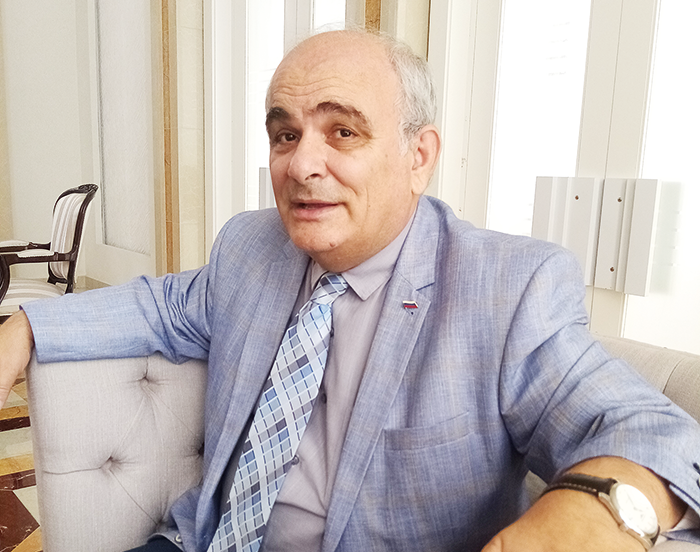
…highlights duplicity of their response to alleged war crimes here and Gaza genocide
Text and pic by Shamindra Ferdinnado
Russian Ambassador to Sri Lanka Levan S. Dzhagaryan declared that incumbent leader Vladimir Putin’s massive victory at the recently concluded presidential poll proved that US-led efforts to influence the outcome on the basis of the Ukraine war was an utter flop.
Referring to external machinations in elections in various countries, including Sri Lanka, Dzhagaryan explained how contrary to Western expectations the Russian electorate exercised their franchise in support of their sitting President.
In an exclusive interview with The Island at the Russian mission on the Baudhaloka Mawatha, yesterday (19), a smiling Dzhagaryan said that he was not surprised at all by the result.
Dzhagaryan attributed the unprecedented victory that gave the Russian leader a fresh six-year term to the ongoing Ukraine war.
Russia intensified military operations in late Feb 2022 thereby transformed the low-intensity conflict that was going on since 2014.
“Let me set the record straight regarding the situation there. It is not a war against Ukraine. It is a war between Russia and the collective West in Ukrainian territory at the expense of Ukraine. Ukraine is being used as a leverage to defeat Russia,” Dzhagaryan said.
The people rallied around the President as they resented the costly high profile but catastrophic Western project meant to subvert Russia, the Ambassador said.
Declaring that the flawed Western strategy in Ukraine definitely influenced the Russian electorate, Dzhagaryan pointed out that even those who hadn’t been so keen on March polls ended up at polling booths, both in Russia and various other parts of the world.
Dismissing skepticism expressed by the West, Dzhagaryan said that: “In the west … .nobody none of the leaders is popular as President Putin is. Everybody knows that,” the envoy said, referring to the response of the global south and even people in the US and Europe to the stand taken by Russia. “We are for a multi-polar world. That is the big difference between Russia and the US,” Dzhagaryan said.
Commenting on domestic challenges as well as developments in the global south and rest of the world against the backdrop of Putin’s re-election and the forthcoming US presidential poll, Dzhagaryan recalled the Republican Trump’s claim that the 2020 US election victory was stolen from him.” I do not want to comment on American elections because unlike them we do not interfere in domestic affairs of other nations.”
Having secured over 87% of the total vote, President Putin would go ahead with his programmes meant to improve living standards of the Russians. The ambassador explained the housing, education, industries and a range of other projects, including in regions that were brought back to Russia. “Those regions were historically Russia’s,” Dzhagaryan declared, adding that Russia was quite optimistic of the future.
Referring to the global south namely Asia, Africa and Latin America, Dzhagaryan said Russia maintained good relations with them and they also resented Western domination. Underscoring the pivotal importance of Russia-Africa summit held in last July in St. Petersburg, Dzhagaryan said that it was intended to enhance comprehensive and equal cooperation between Russia and African nations across all areas of society including politics, security, economic relations, science and technology, and the cultural and humanitarian spheres.
Asked whether the war between Russia and the West in Ukraine weakened the Russian economy as claimed by western media and various other interested parties, Dzhagaryan emphasized that their economy was stronger. In terms of the GDP, Russia secured number 5 position, the ambassador said, adding that the US, China, India and Japan were ahead of them. “In Europe, we are number one,” a beaming Dzhagaryan said, declaring that Western sanctions hadn’t achieved what their leaders hoped for.
Asserting that sanctions quite often failed to achieve intended results as in the case of Russia, Dzhagaryan said that Sri Lanka, too, benefited from Western actions. “Due to European sanctions, Russians cannot visit Europe. Therefore, they visit Thailand, Indonesia, United Arab Emirates, Turkey, Sri Lanka and India. Sri Lanka, too, should be grateful to those who decided on sanctions.”
The Island also asked how Russia addressed Western accusations regarding the death of Alexei Navalny, the Russian opposition leader who died in an Arctic prison last month, the ambassador declared they propagated lies. Dzhagaryan explained how Western propaganda targeted countries and the recent case of attempts to discourage the Russian electorate is a case in point.
Dzhagaryan said that President Putin in late February 2022 called West an ’empire of lies’. That was because their strategy heavily depended on unsubstantiated accusations, Dzhagaryan pointing out the efforts made by them to undermine the Russian presidential poll and in the aftermath of President Putin’s sweeping victory sought to ridicule it.
Reference was made to the US invasion of Iraq in 2003 on the basis of false claims that the President Saddam Hussein was having Weapons of Mass Destruction (WMDs). Have they found at least one WMD so far? Dzhagaryan asked.
The bottom line is that Western leaders cannot stomach President Putin’s popularity.
Responding to Western criticisms, the Ambassador stressed that foreign observers were allowed. They included a team from Sri Lanka and the West. Explaining the daunting task in countering Western propaganda, Dzhagaryan said that Russia Today was prohibited in America and Europe.
When The Island pointed out that Russia Today couldn’t be accessed here after the eruption of war in Ukraine, Dzhagaryan assured that he would look into it.
Dzhagaryan said that the US-led lack of Western response to Israeli brutal military offensive in Gaza while demanding Sri Lanka’s accountability for the alleged war crimes exposed their hypocrisy. Declaring that the name of the game is double standards and hypocrisy, Dzhagaryan, who previously served as Russia’s top envoy in Tehran for 11 years said.
Commenting on relations between Russia and Sri Lanka, Dzhagaryan reiterated concerns over the grounding of Aeroflot flight in June 2022 at the BIA. That incident couldn’t have been justified under any circumstances, the ambassador said, appreciating many Sri Lankans, including lawmakers expressing concern over it.
Referring to the Supreme Court here clearing a lawyer who had been embroiled in that controversy, Dzhagaryan pointed out that Sri Lanka tourism suffered due to the suspension of Aeroflot flights following the incident.
Declaring that over 230,000 Russians have visited Sri Lanka since Oct 2022 after Aeroflot resumed services Dzhagaryan said that he sincerely hoped Sri Lanka wouldn’t repeat the mistake.
The Russian envoy discussed the growing importance of BRICS that was launched in 2006 by Russia, China, India and Brazil. In 2011 South Africa joined BRICS and the grouping has further expanded with the inclusion of UAE, Iran, Ethiopia and Egypt, the ambassador said, citing the their share of the world’s total gross domestic product (GDP) in terms of purchasing power parity (PPP) in 2020 to underline the strength.
Responding to another query, Dzhagaryan said that President Putin’s victory would be a mega boost to BRICS.
Asked about the status of Russia’s relationship with Sri Lanka against the perceived notion that Sri Lanka was somewhat aligned with the US, Dzhagaryan said that unlike the West, Russia didn’t interfere in domestic affairs. “We haven’t expressed our opinion on Online Safety Bill and other issues and would like to ask other countries not to interfere in domestic issues.”
“They have many issues but interfere in faraway lands to divert attention, that is part of their strategy,” Dzhagaryan said. Referring to French President recent declaration of readiness to deploy French ground forces in Ukraine, the Russian Ambassador said that he should instead first of all address the issues raised by the French farming community. Garbage should be removed from Paris and other French cities.
Dzhagaryan said that Russia expected Sri Lanka to continue with what he called a balanced neutral policy regarding various issues, including Ukraine. The ambassador said that Russia was prepared to work with Sri Lanka whoever wielded political power but stressed the importance of Colombo pursuing a neutral policy.
In spite of heavy Western pressure, Sri Lanka refrained from voting against Russia at the UN. India, too, refused to take sides in the Ukraine issue. “We like to see Sri Lanka among the countries listed as friendly.”
Commenting on Russia-India relations against the backdrop of New Delhi joining US-led ‘Quad,’ Dzhagaryan said that the two countries maintained strong ties. Referring to President Putin’s declaration of Russia’s privilege partnership with India, Dzhagaryan said that India benefited because it did not join sanctions against Russia. Like China, India was a major importer of Russian oil, the ambassador said that Moscow accepted India maintaining relations with other countries.
Recalling how the US and other NATO countries abandoned Afghanistan, Dzhagaryan said that Ukraine hadn’t learnt a lesson though the entire world realised how Western powers fled Kabul after having promised to look after the country.
The Russian Ambassador said that the Ukraine war could have been avoided if not for the intervention made by former UK Premier Boris Johnson who flew into Kiev and pushed the puppet regime to continue the war. Had that not happened the efforts made by Turkey to finalise a peace deal could have succeeded, he said.





During an operation conducted in the dark hours of 27 Dec 25, the Sri Lanka Navy seized an Indian fishing boat and apprehended 03 Indian fishermen while they were poaching in Sri Lankan waters, south of the Delft Island in Jaffna.
The seized boat and Indian fishermen (03) were brought to the Kreinagar Jetty and were handed over to the Fisheries Inspector of Jaffna for onward legal proceedings.


Admiral of the Fleet Wasantha Karannagoda said that he is still waiting for the government’s response to the UK sanctions imposed on three ex-military officers, including him, and a former member of the LTTE.
The former Navy Chief said so in response to The Island query whether he was aware of the position taken by a three-member ministerial committee, consisting of Foreign Minister Vijitha Herath, Justice and National Integration Minister Harshana Nanayakkara and Deputy Defence Minister Maj. Gen (retd) Aruna Jayasekera.
The government named the committee in the wake of the UK declaration of travel bans and asset freezes in respect of Karannagoda, General Shavendra Silva, General Jagath Jayasuriya and Vinayagamoorthy Muralitharan, also known as Karuna. Maj. Gen. Jayasekera said that they inquired into the issue at hand.
Karannnagoda said that he would like to know the government’s recommendations if the ministerial committee briefed the Cabinet as per a decision taken by the Cabinet of Ministers. Karannagoda said that the issue should have been taken at the highest level as various interested parties continue to humiliate the war-winning military by targeting selected individuals.
Other sources, familiar with the issues at hand, told The Island that the government was yet to announce its stand.
Sources pointed out that the Opposition has been silent on what they called a matter of utmost national importance.
Cabinet spokesman Dr. Nalinda Jayathissa is on record as having described the UK move as a unilateral move and that committee was formed to examine the developments and recommend appropriate measures to the Cabinet.
Foreign Minister Herath told The Island the government was not successful in getting the British to withdraw sanctions. Describing the UK decision as unilateral, the Miniser said that the government conveyed its concerns but the UK didn’t change its stand.
The Island raised the issue with Minister Herath and Admiral Karannagoda in the wake of British MP of Sri Lankan origin, Uma Kumaran requesting the UK Foreign Secretary Yvette Cooper to expand on the government’s sanctions imposed on the four above-mentioned persons.
During a Foreign Affairs Committee meeting on 16 December, the MP for Stratford and Bow highlighted the lack of accountability and political will from the current Sri Lankan government to address war crimes and mass atrocities committed in Sri Lanka.
Sources said that David Lammy, who served as Secretary of State for Foreign, Commonwealth and Development Affairs at the time of the declaration of sanctions, had no qualms in declaring that the action taken against four Sri Lankans was in line with a commitment he made during the election campaign to ensure those responsible wouldn’t be allowed impunity. The UK government statement quoted Lammy as having said that this decision ensured that those responsible for past human rights violations and abuses were held accountable.
By Shamindra Ferdinando
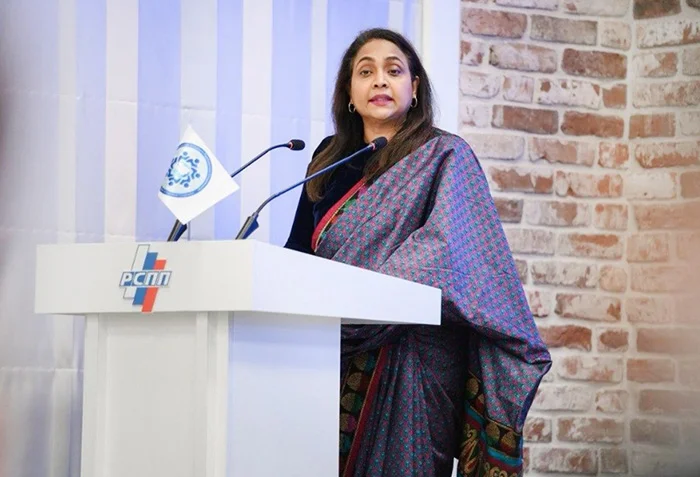
Sri Lankan Ambassador to the Russian Federation, Shobini Gunasekera recently presented a conceptual framework of seven key vectors that defined contemporary international relations and facilitated dialogue among States. She made the presentation at XI Moscow International Financial and Economic Forum held under the theme “Building Bridges: Partnership without Borders”.
In her address, the Ambassador emphasised that these vectors represent the channels through which ideas circulate, trade expands, and peace is strengthened, serving as guiding principles for cooperation amid global uncertainties. The seven key vectors highlighted were economic ties as a foundation for long-term stability; political choice and diplomacy through dialogue and multilateral engagement; security cooperation to address cross-border threats; cultural linkages through education, tourism, and professional exchanges; technological advancement, particularly in digital systems and artificial intelligence; environmental stewardship through collective action on renewable energy and climate change; and humanitarian obligations, including disaster relief and development cooperation.
Drawing on Sri Lanka’s experience, the Ambassador illustrated the practical application of these principles by highlighting the country’s strategic location in the Indian Ocean, its role as a trade and logistics hub, and its active engagement in regional groupings such as BIMSTEC and the Indian Ocean Rim Association, where the Russian Federation serves as a Dialogue Partner.
The potential for enhanced Sri Lanka–Russia bilateral cooperation was underscored, particularly through complementarities between Russia’s technological and energy expertise and Sri Lanka’s logistical capabilities and maritime infrastructure. She noted that such synergies could support joint initiatives in trade, innovation, tourism, and logistics, while cultural and scientific exchanges would further strengthen mutual understanding between the two countries.
Concluding her remarks, the Ambassador stated that sustained progress requires dialogue, mutual respect, and forward-looking partnerships capable of shaping a shared and stable future.

Navy seizes an Indian fishing boat poaching in northern waters

Mandhana, Shafali and Ghosh help India edge run-fest to go 4-0 up

Showers predicted in several provinces today (29th December)

Delay in govt. response to UK sanctions on ex-military chiefs, and others causes concern

Sri Lanka outlines seven key vectors of international cooperation at Moscow forum

Sri Lanka third most preferred destination for Indians

‘Dates have the highest sugar content to fight Coronavirus’

Sunday Island 27 December – Headlines

#SundayIsland 17th December – Headlines

Sunday Island – 28th March

Sunday Island Headlines – 21 March

Sunday Island – 21st February – Headlines
-

 News7 days ago
Members of Lankan Community in Washington D.C. donates to ‘Rebuilding Sri Lanka’ Flood Relief Fund
-

 News5 days ago
British MP calls on Foreign Secretary to expand sanction package against ‘Sri Lankan war criminals’
-

 Features7 days ago
General education reforms: What about language and ethnicity?
-
 News7 days ago
Suspension of Indian drug part of cover-up by NMRA: Academy of Health Professionals
-
 Sports5 days ago
Chief selector’s remarks disappointing says Mickey Arthur
-
 News4 days ago
Street vendors banned from Kandy City
-

 Editorial7 days ago
A very sad day for the rule of law
-

 News7 days ago
US Ambassador to Sri Lanka among 29 career diplomats recalled