
News
Prez poll 2024: Sharply divided SLFP pulling in different directions


By Shamindra Ferdinando
Jaffna District SLFP parliamentarian Angajan Ramanathan yesterday (06) said that he would decide whom to support at the forthcoming presidential election depending on the response of independent candidate Ranil Wickremesinghe and SJB leader Sajith Premadasa to his proposals.
Lawmaker Ramanathan said so when The Island asked him what he would do as the solitary SLFPer elected under the hand symbol at the last general election held in August 2020.
Acknowledging that the 13 SLFPers who had been elected and appointed on the SLPP National List were divided over the party’s stance at the presidential poll, MP Ramanathan said that he recently handed over a set of proposals, based on aspirations of those living in the Jaffna electorate, to President Ranil Wickremesinghe.
MP Ramanathan said: “President Wickremesinghe, during his visit to Jaffna late last week visited my political office there. People’s proposals were handed over to him. The President responded positively. I’ll be handing over the same set of proposals to SJB leader today.”
Responding to another question, MP Ramanathan said that he wouldn’t discuss their proposals with other Jaffna-based political parties. “I have no intention to do so,” the Deputy Chairperson of Committees said.
Having unsuccessfully contested Jaffna on the UPFA ticket at the 2010 and 2015 general elections, Ramanathan first entered Parliament in 2015 on the UPFA National List. Ramanathan switched his allegiance to Maithripala Sirisena’s SLFP at the 2020 general election.
Meanwhile, a section of the SLFP led by General Secretary of the Party Dayasiri Jayasekera following lengthy deliberations has decided to back SJB leader Sajith Premadasa’s candidature at the presidential election.
The SLFP and SJB will finalize their agreement at the Waters Edge today (07). General Secretary of the UPFA Thilanga Sumathipala, too, has pledged his support to this endeavour.
Lawmaker Jayasekera told The Island that it would be a grave blunder on the part of those who enjoy ministerial perks to believe the voters would follow them.
Acknowledging that of the 14-member parliamentary group, the majority backed President Wickremesinghe’s candidature, the former Yahapalana Minister said those who voted for them wouldn’t be swayed and the party was confident of their continuous support.
MP Jayasekera pointed out that the SLPP secured a staggering 145 seats at the last general election, with the backing of the SLFP. Unfortunately, that party quite conveniently had forgottten the SLFP’s contribution and acted in such a brazen manner much to the disappointment of those who expected a genuine change.
“We are at crossroads,” MP Jayasekera said, urging the electorate to be mindful of President Wickremesinghe’s machinations. Whatever Wickremesinghe’s ministers say, voters should be aware of the danger in case the UNP leader won the election with the backing of an utterly corrupt section of the ruling party.
One-time SLFP Chairman and ex-General Secretary as well as current Senior Vice President Prof. Rohana Lakshman said that the party followed, what he called, a proper consultation process before reaching consensus on Premadasa’s candidature.
Prof. Lakshman said that he didn’t want to support Wijeyadasa Rajapakshe though the former leader Sirisena did so. “We had no option but to take a decision in the wake of the Election Commission declaring the date of the presidential election,” Prof. Lakshman said.
Asked whether the party considered fielding its own candidate after legal challenge against their original choice the then Justice Minister Rajapakshe, Prof. Lakshman said that they felt such a move as unrealistic due to post-Aragalaya realignment of political parties.
Both MP Jayasekera and Prof. Lakshman said that President Wickremesinghe, backed by the SLPP, posed a massive threat to the democratic system. Their project should be thwarted at any cost, they declared, urging the voters to rally around the SJB candidate.
Prof. Lakshman said that those who betrayed the party for ministerial portfolios and other perks and privileges squandered a golden opportunity to present a united face to the electorate. The bottom line is they treacherously held onto positions at the expense of the party, thereby undermined the very principles of the party, Prof. Lakshman said.


In a decisive strike against the drug menace, the Sri Lanka Navy intercepted a local multiday fishing trawler carrying a staggering haul of suspected narcotics in the seas southwest of the island.
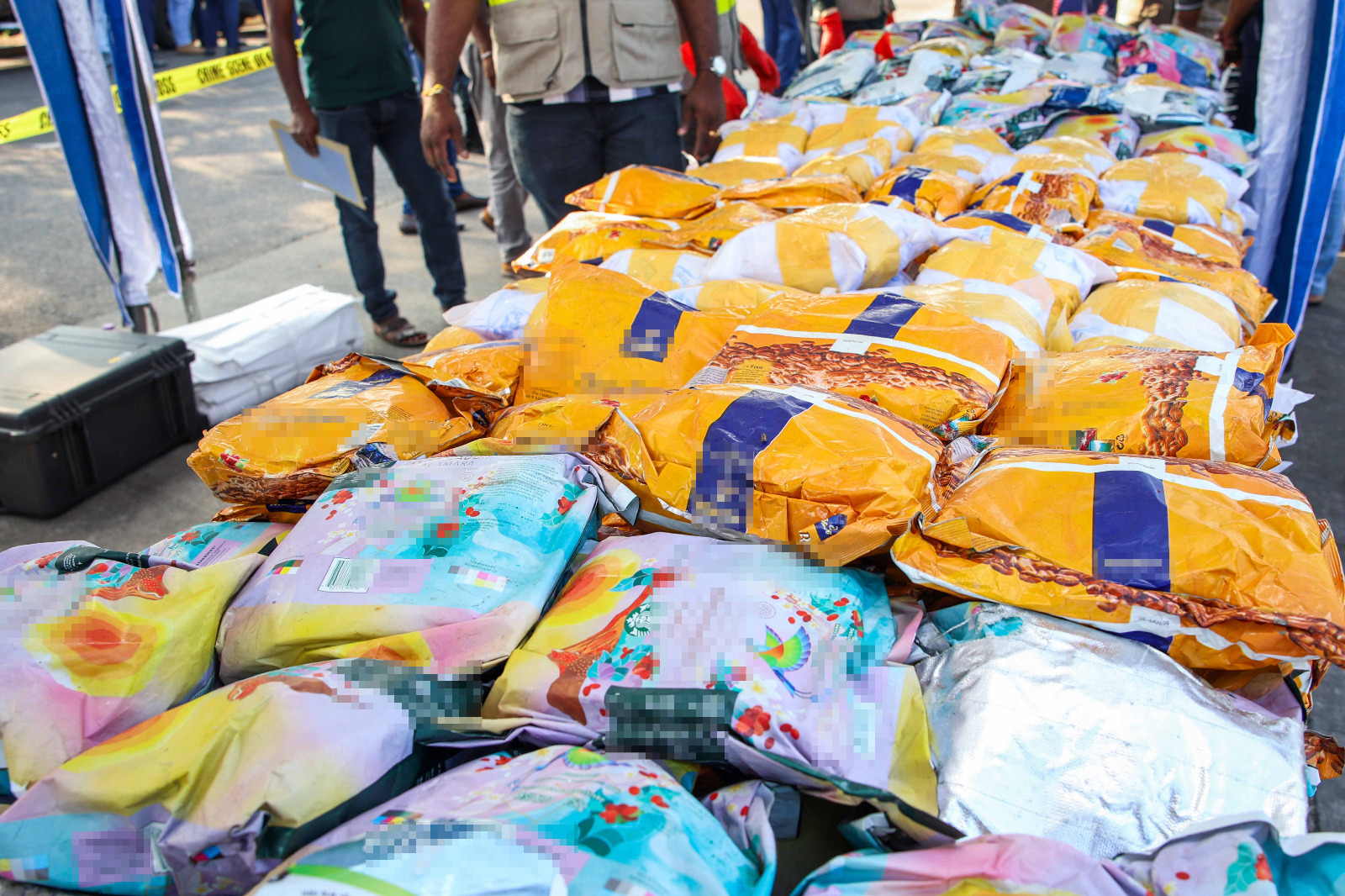
This operation, carried out under the national mission “A Nation United”, resulted in the apprehension of six suspects (06) and the seizure of the trawler used to smuggle the illicit substance.
Following the mid-sea interception, the trawler was escorted to the Dikkowita Fisheries Harbour on the morning of 01 Apr 2026. A meticulous inspection conducted by the Police Narcotic Bureau (PNB) subsequently confirmed that the sacks (19) aboard contained more than 323kg of heroin.
The Commander of the Navy, Vice Admiral Kanchana Banagoda, accompanied by the Commander Western Naval Area and the Director General Operations, visited the Dikowita harbour to personally inspect the drug haul.
Addressing the media, the Navy Commander emphasized that these intensified surveillance efforts are carried out under the direct guidance of the Ministry of Defence. He highlighted that the Navy and the Sri Lanka Coast Guard have strategically coordinated operations across the island’s maritime zones to disrupt trafficking routes and ensure national security.
The Commander of the Navy stated that through surveillance operations conducted this year, the Navy has intercepted local multi-day fishing trawlers attempting to bring illegal substances. This has enabled the seizure of a large quantity of narcotics intended to be smuggled into Sri Lanka.
Furthermore, based on foreign intelligence received by the Sri Lanka Navy, continuous surveillance operations carried out off the Beruwala sea area over the past few days led to the recent (01 April) successful operation, he opined.
The Naval Chief stated that so far this year, 07 local multi-day fishing trawlers have been apprehended by the Navy. The street value of the narcotics seized from these boats is estimated to be approximately Rs. 40 billion.
The 06 suspects, the fishing trawler, and the seized heroin were handed over to the Police Narcotic Bureau for comprehensive investigation and onward legal proceedings.
News
PM opens ‘Silver Age Center,’ an Elder Care, Training and Research Centre built with modern facilities in Kataragama

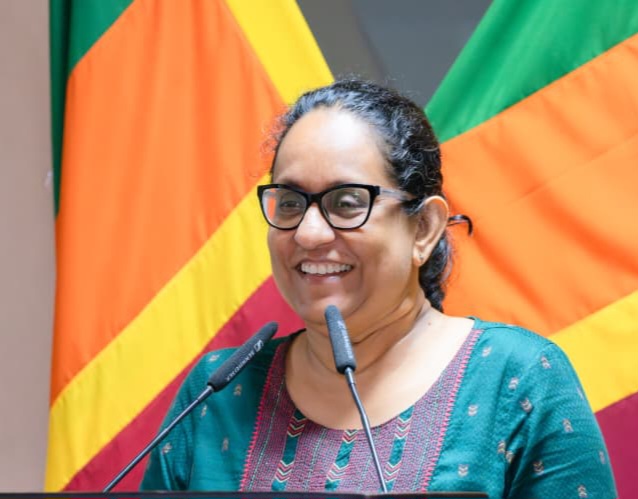
Prime Minister Dr. Harini Amarasuriya stated that a society must be built where all senior citizens can lead lives of safety, freedom, happiness, health, mobility, and spiritual well-being, with their rights safeguarded. She further emphasized that this is a responsibility shared by both the government and society.
The Prime Minister made these remarks on Tuesday (31st of March) while virtually participating in the opening of the ’Silver Age Center,’ an Elder Care, Training and Research Centre constructed with modern facilities in Kataragama. The event was held at the Ministry of Rural Development, Social Security and Community Empowerment, located in the new Sethsiripaya building.
During the event, the Prime Minister was presented with a draft of regulations and guidelines related to the regulation of institutions that provide residential care for senior citizens, by representatives of the National Council for Senior Citizens.
Expressing her views further, the Prime Minister stated:
“This project, which commenced in 2022, had been halted due to various reasons. However, we have now resumed the project and are pleased to hand it over to the public today.
One of the key commitments of our policy is to create a society that ensures safety and protects the rights of all. Everyone, from the young to the elderly, deserves to enjoy these rights, freedom, and happiness.
A significant portion of our population is rapidly transitioning into senior age. However, the age of 60 still represents an active stage of life where individuals can contribute meaningfully to society and the economy. Senior citizens have needs, as well as abilities and valuable experience. We must recognize that they can continue to engage with society and remain active contributors.
Institutions that provide services for senior citizens play a vital role, and maintaining them is a social responsibility. It is essential to ensure the rights and provision of necessary services for all senior citizens, whether they live within families, independently, or in institutional settings.
We must ensure access to healthcare, transportation, lifelong learning, freedom, happiness, and spiritual well-being for senior citizens, while safeguarding their rights.
We should move beyond the traditional concept of ’elders homes’ and instead develop institutions that cater to the diverse needs of senior citizens, enabling them to spend their later years with dignity and respect.”
The opening of the ’Silver Age Center,’ Elder Care, Training and Research Centre, was carried out by Deputy Minister of Trade, Commerce, Food Security and Cooperative Development, R. M. Jayawardhana, along with regional public representatives and government officials. The occasion was attended virtually by the Minister of Rural Development, Social Security and Community Empowerment, Dr. Upali Pannilage; Secretary to the Ministry, Sampath Manthrinayake; and other ministry officials.
(Prime Minister’s Media Division)
Latest News
Heat Index at Caution Level in the Western, Sabaragamuwa, Southern, Eastern, North-western, Northern and North-central provinces and in Monaragala district

Warm Weather Advisory
Issued by the Natural Hazards Early Warning Centre
Issued at 3.30 p.m. on 01 April 2026, valid for 02 April 2026.
The Heat index, the temperature felt on human body is likely to increase up to ‘Caution level’ at some places in the Western, Sabaragamuwa, Southern, Eastern, North-western, Northern and North-central provinces and in Monaragala district.
The Heat Index Forecast is calculated by using relative humidity and maximum temperature and this is the condition that is felt on your body. This is not the forecast of maximum temperature. It is generated by the Department of Meteorology for the next day period and prepared by using global numerical weather prediction model data.

Effect of the heat index on human body is mentioned in the above table and it is prepared on the advice of the Ministry of Health and Indigenous Medical Services.
ACTION REQUIRED
Job sites: Stay hydrated and takes breaks in the shade as often as possible.
Indoors: Check up on the elderly and the sick.
Vehicles: Never leave children unattended.
Outdoors: Limit strenuous outdoor activities, find shade and stay hydrated.
Dress: Wear lightweight and white or light-colored clothing.
Note:
In addition, please refer to advisories issued by the Disaster Preparedness & Response Division, Ministry of Health in this regard as well. For further clarifications please contact 011-7446491.

Navy seize 323kg of heroin from fishing vessel in southwestern seas

Magnitude 7.4 quake hits off Indonesia’s Ternate, tsunami warning lifted

NASA successfully launches historic Artemis II moon mission

Sameer Rizvi arrives in the IPL to guide Delhi Capitals home in low-scoring chase

Trump to give primetime address on Iran war as questions swirl over his next move

PM opens ‘Silver Age Center,’ an Elder Care, Training and Research Centre built with modern facilities in Kataragama

‘Dates have the highest sugar content to fight Coronavirus’

Sunday Island 27 December – Headlines

#SundayIsland 17th December – Headlines

Sunday Island – 28th March

Sunday Island Headlines – 21 March

Sunday Island – 21st February – Headlines
-

 Features5 days ago
A World Order in Crisis: War, Power, and Resistance
-

 News6 days ago
Energy Minister indicted on corruption charges ahead of no-faith motion against him
-

 Sports6 days ago
SLC to hold EGM in April
-

 Opinion6 days ago
When elephants fight, it is the grass that suffers
-

 Latest News7 days ago
A strong Technical and Vocational Education and Training (TVET) system equips individuals with practical, relevant, and future-oriented skills helping to innovate responsibly towards a greener and sustainable future – PM
-

 Features6 days ago
Lest we forget
-

 News2 days ago
Tariff shock from 01 April as power costs climb across the board
-
 Business6 days ago
Pan Asia Bank empowers export sector as Strategic Partner of NCE Export Awards