
News
President Wickremesinghe accused of using electoral reforms to delay elections, raising concerns of a constitutional coup


By Rathindra Kuruwita
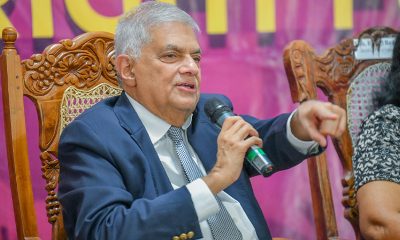
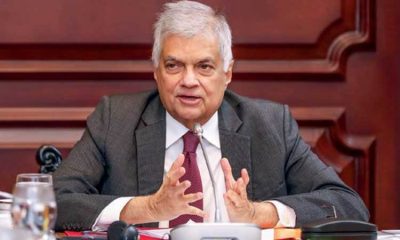
President Ranil Wickremesinghe is exploiting calls for progressive electoral reforms from society to delay elections, Executive Director of the Institute for Democratic Reforms and Electoral Studies (IRES) Manjula Gajanayake, alleged on Thursday.
Gajanayake expressed his concerns to The Island, stating that this strategy may lead to long-term crises.
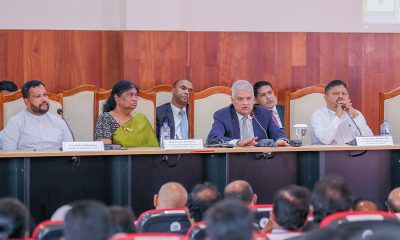
President Wickremesinghe, through a Gazette, dated 16 October 2023, has established a Commission of Inquiry, led by retired Supreme Court Justice Priyasath Dep, whom some alleged is a relative of the President. This Commission is tasked with investigating and proposing changes to current election laws and regulations. It consists of nine members and is mandated to assess existing electoral frameworks and offer recommendations that align with current requirements.
Gajanayake noted that the stated goals of this initiative appear progressive and align with the demands made by election monitors, academics, and political parties over the years. These goals include enhancing representation for women and youth, adopting electronic voting using modern technology, and facilitating voting for Sri Lankans residing abroad. Additionally, the Commission is exploring the possibility of individuals contesting and representing two councils simultaneously, allowing those elected to Parliament to participate in provincial council elections concurrently.
The Commission is also examining other factors, such as permitting private sector voters engaged in election-related services on voting day to use postal voting and modifying the first-past-the-post voting system to better suit the pluralistic nature of society. Furthermore, it is tasked with proposing media standards, a code of conduct for political entities and their members, and strengthening laws governing political party registration and operations to enhance trust and public accountability, he said.
Gajanayake said that this is not the first time President Wickremesinghe has used progressive societal demands to his advantage. Earlier this year, a Committee, led by former head of the Elections Commission, Mahinda Deshapriya, was asked to reduce the number of local councillors from 8,400 to 4,000, the IRES head said.
“There was a feeling that there are too many local councillors, and no one could object to reducing them. Deshapriya has handed over a report on how to reduce the number. If the government actually wanted to reduce the number, they could have used these reports to do so. However, these reports are now shelved. It is obvious that the government only wanted to delay local council elections by this endeavour. Thus, it is clear that the Committee appointed on 16 October 2023 is a similar move by the President,” he said.
Gajanayake said appointing such a committee, when elections are near, is akin to undermining the legislature and the Elections Comission.
“The President now directly controls both local and provincial councils. Local councils haven’t had elected representatives for over six months, and provincial councils have not had elected representatives for over 60 months. Now the governors control both these bodies, and the President controls the governors,” he said.








The government, under heavy Opposition fire over inclusion of a sex website in the Grade 6 English module, as well as overall education reforms, has decided to put on hold reforms in respect of Grade 6.
Cabinet Spokesman and Media and Health Minister Dr. Nalinda Jayatissa announced the government decision yesterday (13) at the post-Cabinet media briefing at the Information Department.
According to him, the decision had been taken at the previous day’s Cabinet meeting, chaired by President Anura Kumara Dissanayake. Dr. Jayatissa said that education reforms pertaining to Garde 6 had been put on hold until 2027.
The Minister said that other proposed education reforms would be implemented as planned. The Minister said that action would be taken against those responsible for the inclusion of a link to a sex website following investigations conducted by the Criminal Investigation Department and the National Education Institute.
The SJB and several other political parties, as well as civil society groups, have accused the government of promoting an LGBTQ agenda, through the proposed education reforms.
The Opposition grouping Mahajana Handa, on Monday, made representations to the Mahanayake Thera of the Malwatta Chapter regarding the controversial reforms, while urging their intervention to halt the project.
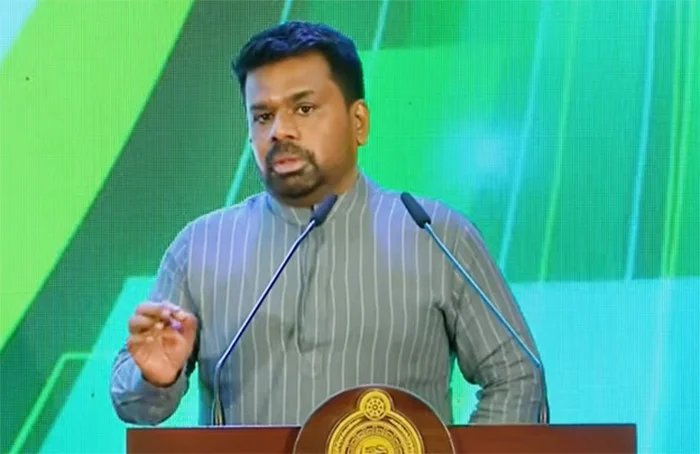
President Anura Kumara Dissanayake yesterday (13) vowed to go ahead with his government’s agenda, regardless of the destruction caused by Cyclone Ditwah.
Emphasising the responsibility on the part of all to contribute to the post-Ditwah recovery efforts, President Dissanayake said that he would have complete faith in the public service.
The President said so at the launch of the re-building Sri Lanka project at the BMICH yesterday.
The JVP and NPP leader said that he wouldn’t take advantage of the death and destruction caused by the cyclone or use the situation as an excuse to reverse their agenda or weaken it.
President Dissanayake said that in spite of many calling for amending the then Budget, in view of the cyclone, the government presented the proposals that were agreed before the disaster struck.

The United States has announced that it will provide the Sri Lanka Air Force with 10 US Navy TH-57 helicopters free of charge.
The announcement was made by outgoing US Ambassador Julie Chung, who stated, on social media, that the helicopters would be transferred under the United States’ Excess Defence Articles programme. The aircraft are Bell 206 Sea Ranger helicopters previously operated by the US Navy.
US sources said that the transfer was intended to strengthen Sri Lanka’s disaster response capabilities, following the devastating cyclone that struck the island at the end of 2025 and killed more than 600 people. US officials have framed the move as a humanitarian measure aimed at improving aerial rescue and relief operations.

Showery condition over the island is expected to reduce from tomorrow (15th)

USA’s Ali Khan claims having been ‘denied’ India visa ahead of T20 World Cup

At least 28 dead as crane collapses onto train in Thailand

Fair weather will prevail except for a few showers in the Uva, Eastern, Western and Central provinces and in Galle, Matara and Rathnapura districts

Trump cancels US-Iran meetings, urges protesters to take over institutions

Govt. bows to pressure, shelves Grade 6 reforms

‘Dates have the highest sugar content to fight Coronavirus’

Sunday Island 27 December – Headlines

#SundayIsland 17th December – Headlines

Sunday Island – 28th March

Sunday Island Headlines – 21 March

Sunday Island – 21st February – Headlines
-

 Business4 days ago
Dialog and UnionPay International Join Forces to Elevate Sri Lanka’s Digital Payment Landscape
-
 News4 days ago
Sajith: Ashoka Chakra replaces Dharmachakra in Buddhism textbook
-

 Features4 days ago
The Paradox of Trump Power: Contested Authoritarian at Home, Uncontested Bully Abroad
-

 Features4 days ago
Subject:Whatever happened to (my) three million dollars?
-

 News4 days ago
Level I landslide early warnings issued to the Districts of Badulla, Kandy, Matale and Nuwara-Eliya extended
-

 News4 days ago
65 withdrawn cases re-filed by Govt, PM tells Parliament
-

 Opinion6 days ago
The minstrel monk and Rafiki, the old mandrill in The Lion King – II
-

 News4 days ago
National Communication Programme for Child Health Promotion (SBCC) has been launched. – PM