
News
President appoints committee to facilitate and oversee implementation of National Action Plan to mitigate human-elephant conflict

Text and Pictures by PRIYAN DE SILVA
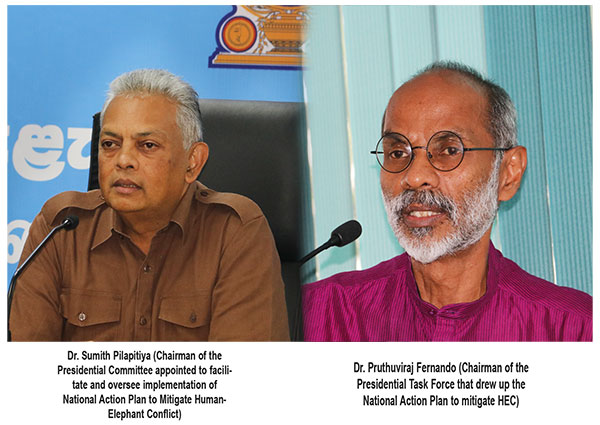
President Ranil Wickremesinghe has appointed a Presidential Committee, headed by former Director General of Wildlife Conservation, Dr. Sumith Pilapitiya, to monitor the progress of the implementation of the National Action Plan for Human-Elephant Conflict Mitigation.
The National Action Plan for Human-Elephant Conflict Mitigation was drawn up by a Presidential Task Force, appointed by former President Gotabaya Rajapaksa, which was headed by Dr Pruthuviraj Fernando of which Dr. Pilapitiya was a member. After much consultation with all stake holders, including the public, the final action plan was handed over to the then President Gotabaya Rajapaksa and no further action was taken until President Wickremesinghe took the initiative to implement it.
The other members of the PC, appointed by President Wickremesinghe to facilitate and oversee implementation of National Action Plan to Mitigate Human-Elephant Conflict (HEC), are Dr. Pruthuviraj Fernando (Chairman Centre of Conservation and Research and Chairman of the Presidential Task Force appointed to draw up the National Action Plan for Human-Elephant Conflict Mitigation), W.M.A.P.B. Wanninayake (Additional Secretary, Ministry of Public Administration, Home Affairs, Provincial Councils and Local Government), H.D. Ratnayake (Additional Director, Ministry of Wildlife and Forest Resources Conservation), Chandrika V. Athugala (Additional Secretary, Ministry of Irrigation), R.M.R. Rathnayaka (District Secretary, Kurunegala), Janaka Jayasundera (District Secretary, Anuradapura), A.H.M.L. Abeyrathne (Commissioner General, Department of Agrarian Development), Chandana Sooriyabandara (Director General Department of Wildlife Conservation),
Dr. K.M.A. Bandara (Conservator General of Forests), Eng. K.D.N. Siriwardena (Director General of Irrigation), Keerthi Kotagama (Director General of Mahaweli Authority of Sri Lanka), S.A.B. Herath (Director General in the Office of the Chief of Staff, Presidential Secretariat), and Malkanthi Rajapaksa, Senior Assistant Secretary to the President have been appointed as the Secretary to the Committee.
In Sri Lanka over 300 elephants die due to HEC each year while the number of humans that are killed by elephants averages around 100.
It was reported that HEC in Sri Lanka was at its highest in 2019 with 405 elephants and 121 humans losing their lives. The corresponding figures for 2020 was 318 elephants and 112 humans.
According to statistics obtained from the Centre for Conservation and Research (CCR) between the period 2010 to 2019 14,516 incidents of Human Elephant Conflict had been reported. During which time 2631 elephants had been killed by humans and 807 humans had been killed by elephants while another 579 more had been injured. 10,532 incidents of property damage had also been reported.










Latest News
Heat Index at Caution Level in the Western, Sabaragamuwa, Southern, Eastern, North-western, Northern and North-central provinces and in Monaragala district


Warm Weather Advisory
Issued by the Natural Hazards Early Warning Centre
Issued at 3.30 p.m. on 31 March 2026, valid for 01 April 2026.
The Heat index, the temperature felt on human body is likely to increase up to ‘Caution level’ at some places in the Western, Sabaragamuwa, Southern, Eastern, North-western, Northern and North-central provinces and in Monaragala district.
The Heat Index Forecast is calculated by using relative humidity and maximum temperature and this is the condition that is felt on your body. This is not the forecast of maximum temperature. It is generated by the Department of Meteorology for the next day period and prepared by using global numerical weather prediction model data.

Effect of the heat index on human body is mentioned in the above table and it is prepared on the advice of the Ministry of Health and Indigenous Medical Services.
ACTION REQUIRED
Job sites: Stay hydrated and takes breaks in the shade as often as possible.
Indoors: Check up on the elderly and the sick.
Vehicles: Never leave children unattended.
Outdoors: Limit strenuous outdoor activities, find shade and stay hydrated.
Dress: Wear lightweight and white or light-colored clothing.
Note:
In addition, please refer to advisories issued by the Disaster Preparedness & Response Division, Ministry of Health in this regard as well. For further clarifications please contact 011-7446491.

Govt. rations stocks as imports falter
By Ifham Nizam
The government faces a looming fertiliser crisis ahead of the 2026 Yala season, with a sharp shortfall in urea threatening paddy yields and food security.
Experts have warned that the fertiliser shortage will take its toll on the yala harvest.
With just over 100,000 tonnes of fertiliser in stock by early March—barely enough for paddy cultivation alone—and more than half of expected imports either cancelled or delayed, the government has moved to ration supplies through Agrarian Service Centres, based on last year’s consumption.
Leading crop scientist Professor Buddhi Marambe has warned that while rationing is unavoidable, it will reduce productivity. “Even last season we applied below recommended levels. This year, the gap will be worse,” he said.
Authorities are prioritising paddy, followed by maize and tea, as limited stocks are stretched across crops.
However, experts estimate yields could fall by 15–20% if nutrient shortages persist—raising the risk of higher food prices in the months ahead.
The crisis has been worsened by global disruptions, including Gulf conflict affecting fertiliser shipments and precautionary export restrictions by key suppliers, such as China.
Although the Government is pursuing deals with countries like Russia, supplies remain uncertain.
With global urea prices surging and production costs rising, smallholder farmers are expected to be the hardest hit.
“This is a wake-up call,” Prof. Marambe said, urging urgent steps to build buffer stocks and strengthen Sri Lanka’s long-term food security strategy.

By Shamindra Ferdinando
Frontline Socialist Party (FSP) spokesman Pubudu Jayagoda says the Gampaha Magistrate’s Court order that the ruling JVP hand back the FSP’s Kirindiwela office, grabbed by a group of JVP politicians on 02 September, 2025, has shown that the government cannot undermine the law.
Jayagoda said that the FSP had been compelled to move the court against the JVP as the Gampaha police refused to intervene due to political pressure. “They probably thought we were going to give up that office. Perhaps, the ruling party felt they could forcibly occupy other FSP offices,” Jayagoda said.
FSP’s Administrative Secretary Chamira Koswatta and trade unions, which operated from the Salmal Garden office, sought the court intervention to confirm the ownership of that building in the FSP. The court initially transferred the building to the police and issued a directive to law enforcement authorities to remove the JVP/NPP from that building.
Among the 20 respondents was Tilvin Silva, General Secretary of the JVP. Those now identified themselves as FSP quit the JVP in 2011 and later formed their own party.
Gampaha Additional Magistrate Shilani Perera on Monday ruled that the legitimate owner was the FSP. The Magistrate ruled that the FSPers had been forced out of that office, illegally.
Jayagoda said that the FSP considered the court ruling a victory for democracy and a devastating blow to the increasingly authoritarian JVP/NPP rule.

Punjab Kings fined for slow over-rate

Ice-cool Connolly leads nervy Punjab Kings home on IPL debut

Showers expected in the Western, Sabaragamuwa and Southern provinces in the evening or night

Heat Index at Caution Level in the Western, Sabaragamuwa, Southern, Eastern, North-western, Northern and North-central provinces and in Monaragala district

Urea shortage threatens Yala harvest: Experts

2025 property grab: Court orders JVP to hand back Yakkala office to FSP

‘Dates have the highest sugar content to fight Coronavirus’

Sunday Island 27 December – Headlines

#SundayIsland 17th December – Headlines

Sunday Island – 28th March

Sunday Island Headlines – 21 March

Sunday Island – 21st February – Headlines
-

 Features4 days ago
A World Order in Crisis: War, Power, and Resistance
-

 News5 days ago
Energy Minister indicted on corruption charges ahead of no-faith motion against him
-

 News6 days ago
US dodges question on AKD’s claim SL denied permission for military aircraft to land
-

 Business6 days ago
Dialog Unveils Dialog Play Mini with Netflix and Apple TV
-

 Sports5 days ago
SLC to hold EGM in April
-

 Latest News6 days ago
A strong Technical and Vocational Education and Training (TVET) system equips individuals with practical, relevant, and future-oriented skills helping to innovate responsibly towards a greener and sustainable future – PM
-

 Opinion5 days ago
When elephants fight, it is the grass that suffers
-

 Features5 days ago
Lest we forget