
News
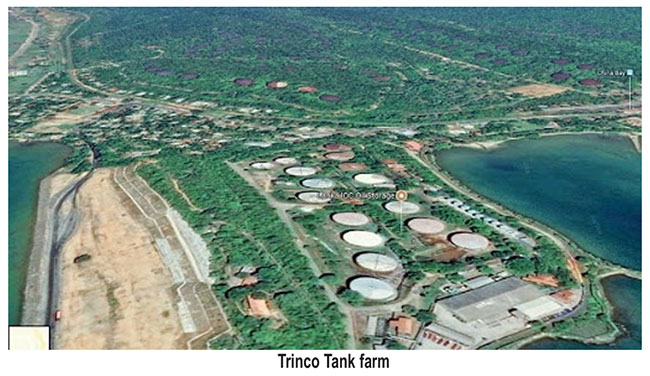
Petitions challenging Trinco oil tank farm deal re-fixed for support on 25 May

By Chitra Weerarathne
The two petitions filed on the Trincomalee Oil Tanks agreement were re-fixed for Support on 25 May after they were called before the Supreme Court on Thursday .
The first respondent, Attorney General, was given time till 11 March to file objections.
The first petition was filed by Wakmulle Uditha Thera of the Jathika Bhikku Peramuna. He filed the fundamental rights violation petition through Attorney-at-Law Sunil Watagala.
The second petition was filed jointly by Elle Gunawansa Thera and Bengamuwe Nalaka Thera.
The petitioners have named 47 persons including the Attorney General, the Secretary to the President, the Minister of Finance, the Secretary to the Ministry of Defence, the Minister of Energy, and the Auditor General as respondents.
The petitioners claim that the Minister of Energy Udaya Gammanpila, at a press conference on 4 January, announced the Cabinet had approved the joint development of the Trincomalee Petroleum Tank Complex with Lanka Indian Oil Company.
The petitioners have claimed that it was reported in the media that an agreement was signed between the government of Sri Lanka and the Lanka IOC to establish a company named Trinco Petroleum Terminals Pvt. Ltd., to carry out the development activities.
The petitioners have claimed that the Constitution does not give Cabinet the power to make such a decision and thus the manner in which the agreement was signed is against the law.
The petitions allege that the Cabinet has violated the public’s trust in the government and the rule of law.
The petitioners have requested the Supreme Court to nullify the agreement and the decision of the Cabinet of Ministers.
The petitioners have also demanded that the Cabinet decision and copies of the agreement be placed before the Supreme Court for an inquiry.
The petitioners have further requested the Supreme Court to issue an order under Article 132 (3) of the Constitution to consider this petition before a special panel of judges.
The bench comprised Justice Murdhu Fernando, Justice Yasantha Kodagoda and Justice Shiran Gooneratne.

Latest News
Heat Index at Caution level’ in the Northern, North-central, North-western, Western and Southern provinces and in Trincomalee district.


Warm Weather Advisory
Issued by the Natural Hazards Early Warning Centre
Issued at 3.30 p.m. on 12 April 2026, valid for 13 April 2026.
Heat index, the temperature felt on human body is likely to increase up to ‘Caution level’ at some places in the Northern, North-central, North-western, Western and Southern provinces and in Trincomalee district.
The Heat Index Forecast is calculated by using relative humidity and maximum temperature and this is the condition that is felt on your body. This is not the forecast of maximum temperature. It is generated by the Department of Meteorology for the next day period and prepared by using global numerical weather prediction model data.

Effect of the heat index on human body is mentioned in the above table and it is prepared on the advice of the Ministry of Health and Indigenous Medical Services.
ACTION REQUIRED
Job sites: Stay hydrated and takes breaks in the shade as often as possible.
Indoors: Check up on the elderly and the sick.
Vehicles: Never leave children unattended.
Outdoors: Limit strenuous outdoor activities, find shade and stay hydrated.
Dress: Wear lightweight and white or light-colored clothing.
Note:
In addition, please refer to advisories issued by the Disaster Preparedness & Response Division, Ministry of Health in this regard as well. For further clarifications please contact 011-7446491.

On the apparent northward relative motion of the sun, it is going to be directly over the latitudes of Sri Lanka from 05th to 15th of April in this year.
The nearest areas of Sri Lanka over which the sun is overhead today (13th) are Pesalai, Mankulam and Nedunkerny about 12:11 noon.
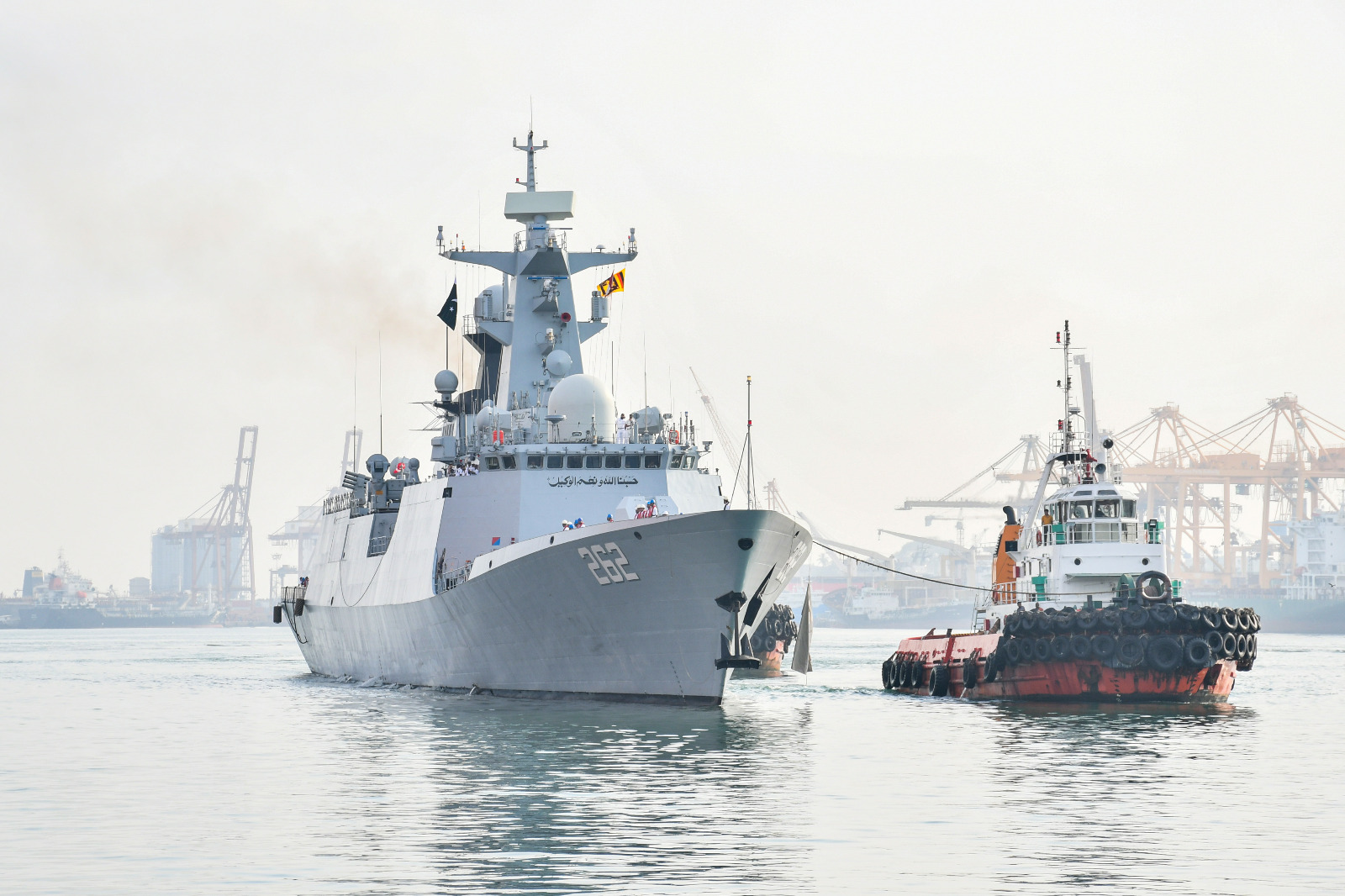
The Pakistan Navy Ship (PNS) TAIMUR and ASLAT arrived at the Port of Colombo on a goodwill visit on 12 Apr 26.
The visiting ships were welcomed by the Sri Lanka Navy in
compliance with naval traditions.
The duo of ships is commanded by Captain NIAMAT SAEED KHAN (PNS TAIMUR) and Captain NADIR MATEEN AFRIDI (PNS ASLAT).
Meanwhile, the ships are expected to conduct a Bilateral Naval Exercise LION STAR V with the Sri Lanka Navy in Colombo seas.

Salt and Patidar power RCB past Mumbai Indians

Prasidh, Buttler set up comfortable win for Gujarat Titans

Heat Index at Caution level’ in the Northern, North-central, North-western, Western and Southern provinces and in Trincomalee district.

Showers above 75 mm are likely at some places in the Western, Sabaragamuwa, Central, Southern and North-western provinces.

Sun directly overhead Pesalai, Mankulam and Nedunkerny about 12:11 noon

PNS TAIMUR & ASLAT arrive in Colombo

‘Dates have the highest sugar content to fight Coronavirus’

Sunday Island 27 December – Headlines

#SundayIsland 17th December – Headlines

Sunday Island – 28th March

Sunday Island Headlines – 21 March

Sunday Island – 21st February – Headlines
-

 News2 days ago
CEB orders temporary shutdown of large rooftop solar systems
-

 News7 days ago
Lankan-origin actress Subashini found dead in India
-

 News5 days ago
AG: Coal procurement full of irregularities
-

 Business4 days ago
Israeli attack on Lebanon triggers local stock market volatility
-

 Business5 days ago
Hayleys Mobility introduces Premium OMODA C9 PHEV
-

 News7 days ago
UN Regional Director launches SL’s first Country Gender Equality Profile during official visit
-

 News7 days ago
Dialog Launches ‘GanuDenu QR’, Making Cashless Transfers Free for All with eZ Cash and Dialog Finance
-

 Business4 days ago
HNB Assurance marks 25 years with strategic transformation to ‘HNB Life’