
Business
Pan Asia Bank posts a compelling performance in 2022 while looking ahead with optimism


Pan Asia Banking Corporation PLC reflected resilience amidst a multitude of adversities emerging from challenging macro-economic conditions, as the Bank reported its financial performance for the year 2022, which showed judicious portfolio management and prudency exercised in managing asset quality.
The interest income for the year rose by 42% due to increase in market lending rates and re-pricing effect of facilities in response to the market conditions, resulted from the policy decisions taken by the Central Bank of Sri Lanka to increase the policy rates and remove the interest rate caps on certain Lending products. Further, the significant volume growth in Pawning advances and Term Loans also led to the increase in interest income.
The Total Assets of the Bank stood at Rs. 208 billion as of 31st December 2022 after posting a growth of 10% during the year, supported mainly by the expansion in Rupee Treasury Bills and loan book. The Gross Loans and Advances book recorded a growth of 2% to reach Rs. 154 billion with major contributions from the Retail segment.
The Bank’s Profit was weighed down by higher credit loss expenses and exchange losses on loans and advances and foreign currency denominated financial instruments of the Government of Sri Lanka. The Bank increased its provision buffers for loan losses during the year under review sensibly, through introducing changes to its impairment models taking into consideration of increased level of risks and uncertainties emerged due to the turbulent economic conditions prevailed in the country.
“Our performance is a testament that we have put quality over quantity this year, when circumstances dramatically changed from what we witnessed last year. This was achieved by managing assets and liabilities to generate returns from our existing portfolio while also keeping a closer tab on the operational expenses amid runaway inflation,” said Nimal Tillekeratne, the Bank’s Managing Director/Chief Executive Officer.
The Bank increased the impairment provision buffers on its investments in Sri Lanka International Sovereign Bonds (SLISBs) up to 35%, due to the increased level of credit risk as a result of prevailing external public debt service standstill of the Government of Sri Lanka, and the possible adverse outcomes of the ongoing comprehensive debt restructuring programme.
The amounts charged to the income statement during the year 2022 include provisions made on foreign currency exposures to the Government of Sri Lanka amounting to Rs. 3.80 billion. However, when presenting the figures, the management has presented the impact of the currency depreciation on the impairment charges of loans and advances and investments under Other Operating Income/Losses, where the exchange gains from the corresponding assets have been recognized.
Pan Asia Bank strived for earnings maximization through portfolio re-alignment and cost management despite sector vulnerabilities that prevailed since last year. The Bank reported a Net Interest Margin of 4.70% during the year 2022. Meanwhile, the Bank reported a Return on Equity (ROE %) of 10.58% and a Post-Tax Return on Assets of 1.00% despite unprecedented macro-economic conditions during the year under review.
Earnings Per Share (EPS) for the year dropped to Rs. 4.52 from Rs. 6.95 mainly due to increased inflated funding costs, exchange losses and impairment charges. Meanwhile, the Bank’s Net Asset Value Per Share as of 31st December 2022 stood at Rs. 46.58 after an appreciation of 11%.
Pan Asia Bank maintains all its Capital and Liquidity Ratios well above the regulatory minimum standards. Its Tier 1 Capital Ratio and Total Capital Ratio as of 31st December 2022 stood at 14.09% and 16.07% respectively. Further, its leverage ratio stood at 8.21% at the year end.
The Bank’s Bank Level Statutory Liquid Assets Ratio (SLAR) as of 31st December 2022 stood at 21.60%. Meanwhile, the Liquidity Coverage Ratio (LCR) under BASEL III stood well above the statutory minimums. The Bank maintained an LCR of 226.09% and 253.11% for All Currencies and LKR respectively.
Amidst these changes, Bank’s the commitment to technology adoption was demonstrated via many activities deployed during 2022 to ensure a seamless banking experience. Pan Asia Bank became the First Bank to integrate with the Lanka Clear, Common Interface of Lanka Pay Payment platform, through Internet Banking – enabling customers to carry out government payments digitally. Existing customers were also empowered to open savings accounts through Internet Banking. The implementation of the new leasing system during the period under consideration enhanced internal processes and the overall customer experience. Despite the external environment, the Bank continues to invest and focus on the core operation, product management, people development and technology integrations.
Going from strength to strength, Pan Asia Bank secured the Runner-up Award – Banking sector, and the Merit Award – Corporate Governance category, at the annual National Business Excellence Awards (NBEA), organized by the National Chamber of Commerce of Sri Lanka. It was also selected by LMD as one of the top 15 ‘Most Awarded Entities’ and top ‘Most Respected’ Entities along with many other accolades and recognitions. The most recent addition is Pan Asia Bank being ranked amongst Business Today’s Top 40 business organizations for 2021-2022. This award is given to the largest organizations in the country based on a variety of criteria such as portfolio, profits and risks taken, resilience, passion, and how well challenges are met.
“I am proud to say that Pan Asia Bank was able to navigate the challenging year in a prudent manner to further strengthen the confidence of its all stakeholders and demonstrate its credentials as the Truly Sri Lankan Bank in the country by supporting its employees, customers and the wider community. I wish to thank our customers, business partners, employee and management, and the Board and the regulator for their guidance, and for being with us in continued cooperation during unprecedented times. We move ahead with determination to take any challenge as a responsible corporate citizen to steer the economy forward and look ahead with cautious optimism to better times ahead,” commented Jayantha S.B.Rangamuwa, Chairman of Pan Asia Bank.
Recording consistent growth year after year, Pan Asia Bank is strongly positioned as the ‘Truly Sri Lankan Bank’, marking an illustrious journey that has promoted financial security and fulfilled the aspirations of its customers while supporting the prosperity of the nation.



The latest earnings report for Sampath Bank PLC (SAMP), analysed by First Capital Research (FCR), firmly supports a positive outlook among investors. The research firm has stuck with its “MAINTAIN BUY” recommendation , setting optimistic targets: a Fair Value of LKR 165.00 for 2025 and LKR 175.00 for 2026. This signals strong belief that the bank is managing the economy’s recovery successfully.
The key reason for this optimism is the bank’s shift towards aggressive, yet smart, growth. Even as interest rates dropped across the market, which usually makes loan income (Net Interest Income) harder to earn, Sampath Bank saw its total loans jump by a huge 30.2% compared to last year. This means the bank lent out a lot more money, increasing its loan book to LKR 1.1 Trillion. This strong lending, which covers trade finance, leasing, and regular term loans, shows the bank is actively helping businesses and people spend and invest as the economy recovers.
In addition to loans, the bank has found a major new source of income from fees and commissions, which surged by 42.6% year-over-year. This money comes from services like card usage, trade activities, and digital banking transactions. This shift makes the bank less reliant on just interest rates, giving it a more stable and higher-profit way to earn money.
Importantly, this growth hasn’t weakened the bank’s foundations. Sampath Bank is managing its funding costs better, partly by improving its low-cost current and savings account (CASA) ratio to 34.5%. Moreover, the quality of its loans is getting better, with bad loans (Stage 3) dropping to 3.77% and the money set aside to cover potential losses rising to a careful 60.25%.
Even with the new, higher capital requirements for systemically important banks, the bank remains very strong, keeping its capital and cash buffers robust and well above the minimum standards.
In short, while the estimated profit for 2025 was adjusted slightly, the bank’s excellent performance and strong strategy overshadow this minor change. Sampath Bank is viewed as a sound stock with high growth potential , offering investors attractive total returns over the next two years.
By Sanath Nanayakkare

The Asian Development Bank (ADB) has approved a $200 million loan to support the ongoing Mahaweli Development Program, Sri Lanka’s largest multiuse water resources development initiative.
The program aims to transfer excess water from the Mahaweli River to the drier northern and northwestern parts of Sri Lanka. The Mahaweli Water Security Investment Program Stage 2 Project will directly benefit more than 35,600 farming households in the North Central Province by strengthening agriculture sector resilience and enhancing food security.
ADB leads the joint cofinancing effort for the project, which is expected to mobilize $60 million from the OPEC Fund for International Development and $42 million from the International Fund for Agricultural Development, in addition to the ADB financing.
“While Sri Lanka has reduced food insecurity, it remains a development challenge for the country,” said ADB Country Director for Sri Lanka Takafumi Kadono. “Higher agricultural productivity and crop diversification are necessary to achieve food security, and adequate water resources and disaster-resilient irrigation systems are key.”
The project will complete the government’s North Central Province Canal (NCPC) irrigation infrastructure, which is expected to irrigate about 14,912 hectares (ha) of paddy fields and provide reliable irrigated water for commercial agriculture development (CAD). It will help complete the construction of tunnels and open and covered canals. The project will also establish a supervisory control and data acquisition system to improve NCPC operations. Once completed, the NCPC will connect the Moragahakanda Reservoir to the reservoirs of Huruluwewa, Manankattiya, Eruwewa, and Mahakanadarawa.
Sri Lanka was hit by Cyclone Ditwah in late November, resulting in the country’s worst flood in two decades and the deadliest natural hazard since the 2004 tsunami. The disaster damaged over 160,000 ha of paddy fields along with nearly 96,000 ha of other crops and 13,500 ha of vegetables.
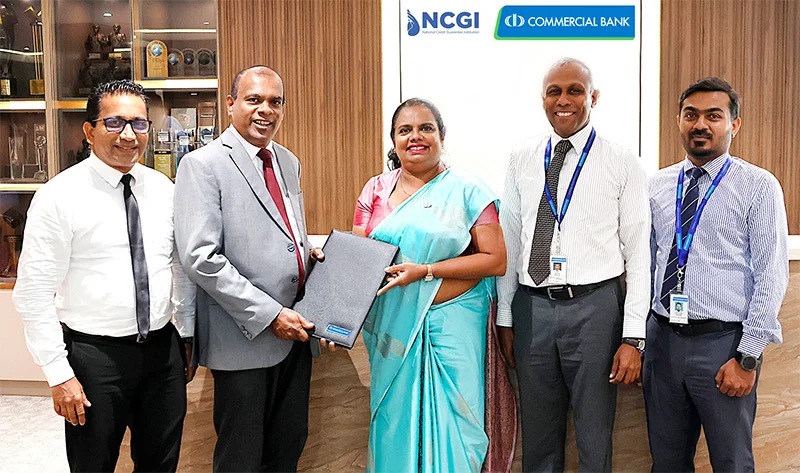
The Commercial Bank of Ceylon has reaffirmed its long-standing commitment to advancing women’s empowerment and financial inclusion, by partnering with the National Credit Guarantee Institution Limited (NCGIL) as a Participating Shareholder Institution (PSI) in the newly introduced ‘Liya Shakthi’ credit guarantee scheme, designed to support women-led enterprises across Sri Lanka.
The operational launch of the scheme was marked by the handover of the first loan registration at Commercial Bank’s Head Office recently, symbolising a key step in broadening access to finance for women entrepreneurs.
Representing Commercial Bank at the event were Mithila Shyamini, Assistant General Manager – Personal Banking, Malika De Silva, Senior Manager – Development Credit Department, and Chathura Dilshan, Executive Officer of the Department. The National Credit Guarantee Institution was represented by Jude Fernando, Chief Executive Officer, and Eranjana Chandradasa, Manager-Guarantee Administration.
‘Liya Shakthi’ is a credit guarantee product introduced by the NCGIL to facilitate greater access to financing for women-led Micro, Small, and Medium Enterprises (MSMEs) that possess viable business models and sound repayment capacity but lack adequate collateral to secure traditional bank loans.

Akbar Brothers crowned MBSA A-Division champions

Several spells of showers will occur in the Northern, North-Central, Eastern, Uva and Central provinces

Bondi Beach gunmen who killed 15 after targeting Jewish celebration were father and son, police say

Govt. urged to take action against deputy minister

India sends stock of life-saving medicines

George Keyt Foundation contributes to national disaster relief efforts

‘Dates have the highest sugar content to fight Coronavirus’

Sunday Island 27 December – Headlines

#SundayIsland 17th December – Headlines

Sunday Island – 28th March

Sunday Island Headlines – 21 March

Sunday Island – 21st February – Headlines
-

 Features6 days ago
Finally, Mahinda Yapa sets the record straight
-

 News7 days ago
Cyclone Ditwah leaves Sri Lanka’s biodiversity in ruins: Top scientist warns of unseen ecological disaster
-

 Features6 days ago
Handunnetti and Colonial Shackles of English in Sri Lanka
-

 Business4 days ago
Cabinet approves establishment of two 50 MW wind power stations in Mullikulum, Mannar region
-

 News5 days ago
Gota ordered to give court evidence of life threats
-

 Features7 days ago
An awakening: Revisiting education policy after Cyclone Ditwah
-

 Features5 days ago
Cliff and Hank recreate golden era of ‘The Young Ones’
-

 Opinion6 days ago
A national post-cyclone reflection period?