
News
Not sufficient focus on trafficking of women for sex trade and child labour – Prof. Gunaratne


Professor Camena Gunaratne has said that there was not enough focus in Sri Lanka on the various national plans on internal trafficking of women into working as sex workers and child labour. She said so at the Centre for Poverty Analysis (CEPA’s) open forum recently that essentially dealt with issues pertaining to victims of human trafficking.
The Asia Foundation (TAF) and the Center for Poverty Analysis (CEPA) publicly shared the findings from the study on “Optimising Screening and Support Services for Victims of Gender-Based Violence (GBV) and Trafficking in Persons (TIP)” recently via a Zoom conference.
Prof. Gunaratne discussed the legal and regulatory framework governing TIP (Trafficking in Persons) in Sri Lanka that consist of international and regional Conventions, in addition to domestic laws, regulation and policies. Professor Gunaratne further elaborated on the elements of trafficking and how it has become a complex, constantly evolving phenomenon requiring concerted, multipronged counter-efforts by both international and national actors.
The multi-country study commissioned by The Asia Foundation was carried out in India, Nepal and Sri Lanka with funding from United States Department of State, Office to Monitor and Combat Trafficking in Persons. The national level reports were compiled by the Center for Poverty Analysis (CEPA) for Sri Lanka, FXB India Suraksha for India, and Social Science Baha for Nepal while the regional study will be released in the first quarter of 2022.
A spokesperson said that the Asia Foundation hoped to engage key policymakers to integrate the research recommendations into their current efforts through evidence-based policy advocacy. As such, The Asia Foundation, Sri Lanka and CEPA will conduct several closed-door meetings with key government stakeholders in the coming months.
Chandima Arambepola (CEPA), Dr. Ramani Jayasundere (The Asia Foundation Sri Lanka) and Professor Camena Gunaratne (Open University of Sri Lanka) were present at this national convening. The national convening was attended by a diverse audience with representatives from NGOs, Civil Society Organisations (CSOs), Development Organisations, academics and other parties and stakeholders with interest in this field.
Chandima Arambepola commenced the forum by introducing the study background, methodology, the existing policy framework and the National Plan of Action to Address Gender-based Violence (GBV), conceptualising Trafficking in Persons (TIP) as a form of GBV. Ms. Arambepola further examined challenges in victim identification stemming from how service providers understand GBV and TIP which leads to gaps in service provision. She elaborated on the recommended way forward to enhance the existing support framework to provide better access to services for victims.
In the next session Dr Ramani Jayasundere explained the interplay between TIP and GBV, and how TIP is treated differently from GBV. She spoke of how GBV is based on gender inequalities in a patriarchal system and unequal power relations between men and women. TIP is also based on unequal power relations but is a complex crime driven by criminal syndicates to earn profit. Dr. Jayasundere described how TIP is one of the worst forms of GBV, and GBV is an important driver of human trafficking and a tool to control women, children and men.
The Asia Foundation is a nonprofit international development organisation committed to improving lives across a dynamic and developing Asia, The Asia Foundation works through its network of offices in 18 Asian countries. Read more about the Foundation’s work.


The government, under heavy Opposition fire over inclusion of a sex website in the Grade 6 English module, as well as overall education reforms, has decided to put on hold reforms in respect of Grade 6.
Cabinet Spokesman and Media and Health Minister Dr. Nalinda Jayatissa announced the government decision yesterday (13) at the post-Cabinet media briefing at the Information Department.
According to him, the decision had been taken at the previous day’s Cabinet meeting, chaired by President Anura Kumara Dissanayake. Dr. Jayatissa said that education reforms pertaining to Garde 6 had been put on hold until 2027.
The Minister said that other proposed education reforms would be implemented as planned. The Minister said that action would be taken against those responsible for the inclusion of a link to a sex website following investigations conducted by the Criminal Investigation Department and the National Education Institute.
The SJB and several other political parties, as well as civil society groups, have accused the government of promoting an LGBTQ agenda, through the proposed education reforms.
The Opposition grouping Mahajana Handa, on Monday, made representations to the Mahanayake Thera of the Malwatta Chapter regarding the controversial reforms, while urging their intervention to halt the project.
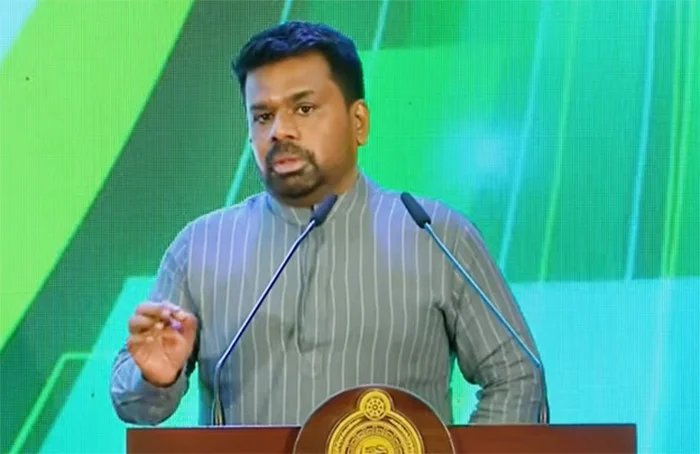
President Anura Kumara Dissanayake yesterday (13) vowed to go ahead with his government’s agenda, regardless of the destruction caused by Cyclone Ditwah.
Emphasising the responsibility on the part of all to contribute to the post-Ditwah recovery efforts, President Dissanayake said that he would have complete faith in the public service.
The President said so at the launch of the re-building Sri Lanka project at the BMICH yesterday.
The JVP and NPP leader said that he wouldn’t take advantage of the death and destruction caused by the cyclone or use the situation as an excuse to reverse their agenda or weaken it.
President Dissanayake said that in spite of many calling for amending the then Budget, in view of the cyclone, the government presented the proposals that were agreed before the disaster struck.

The United States has announced that it will provide the Sri Lanka Air Force with 10 US Navy TH-57 helicopters free of charge.
The announcement was made by outgoing US Ambassador Julie Chung, who stated, on social media, that the helicopters would be transferred under the United States’ Excess Defence Articles programme. The aircraft are Bell 206 Sea Ranger helicopters previously operated by the US Navy.
US sources said that the transfer was intended to strengthen Sri Lanka’s disaster response capabilities, following the devastating cyclone that struck the island at the end of 2025 and killed more than 600 people. US officials have framed the move as a humanitarian measure aimed at improving aerial rescue and relief operations.

Showery condition over the island is expected to reduce from tomorrow (15th)

USA’s Ali Khan claims having been ‘denied’ India visa ahead of T20 World Cup

At least 28 dead as crane collapses onto train in Thailand

Fair weather will prevail except for a few showers in the Uva, Eastern, Western and Central provinces and in Galle, Matara and Rathnapura districts

Trump cancels US-Iran meetings, urges protesters to take over institutions

Govt. bows to pressure, shelves Grade 6 reforms

‘Dates have the highest sugar content to fight Coronavirus’

Sunday Island 27 December – Headlines

#SundayIsland 17th December – Headlines

Sunday Island – 28th March

Sunday Island Headlines – 21 March

Sunday Island – 21st February – Headlines
-

 Business4 days ago
Dialog and UnionPay International Join Forces to Elevate Sri Lanka’s Digital Payment Landscape
-
 News4 days ago
Sajith: Ashoka Chakra replaces Dharmachakra in Buddhism textbook
-

 Features4 days ago
The Paradox of Trump Power: Contested Authoritarian at Home, Uncontested Bully Abroad
-

 Features4 days ago
Subject:Whatever happened to (my) three million dollars?
-

 News4 days ago
Level I landslide early warnings issued to the Districts of Badulla, Kandy, Matale and Nuwara-Eliya extended
-

 Business22 hours ago
New policy framework for stock market deposits seen as a boon for companies
-

 Opinion6 days ago
The minstrel monk and Rafiki, the old mandrill in The Lion King – II
-

 News4 days ago
65 withdrawn cases re-filed by Govt, PM tells Parliament