
News
No decision by Education Ministry to deploy Air Force personnel as IT and English teachers, says GL


By Saman Indrajith
Education Minister Prof G.L. Peiris told Parliament yesterday that his Ministry had not made any decision to deploy Air Force personnel as teachers at schools.
The Minister said so responding to a question raised by SJB Matale District MP Rohini Kumari Wijeratne, who said that there were media reports quoting teachers’ unions that Air Force personnel had been deployed to teach English and IT in schools at Kebitigollewa and Vavuniya; the Secretary to the Ministry of Education had accepted a proposal by the Commander of the Air force. The use of military personnel would violate the provisions of the Teacher Service Minute and there would be questions regarding the quality of education, the MP said.
MP Wijeratne said that the teacher-student ratio of the country was 20:1. “So every 20 students have a teacher and that shows there is no such teacher shortage but a problem of the Ministry failing to manage the numbers. During the time of the yahapalana government we introduced a national policy as regards teacher transfers. There are many other persons who have completed teacher training and are awaiting appointments. In such a situation, how could the government deploy Air Force personnel as school teachers.”
Minister Prof. Peiris said that there had been no such decision made by the Ministry of Education, but he would look into the allegation made by the unions.
Responding to a question raised by SJB Ratnapura District MP Hesha Withanage, the Minister said that the Education Ministry had taken several initiatives to eliminate shortages in rural schools.
“We took action to improve conditions in rural schools. We increased facilities and improved projects such as e-thaksalawa and Gurugedara to rectify disparities. We know that there is more work to be done and have taken action to create equal opportunities for all students. Some of the programmes we implemented have yielded positive and progressive results. For example, there were ten students who scored 200 out of 200 marks at the last Grade Five scholarship examination. All those are from outstations.”

Latest News
Heat Index at Caution level’ in the Northern, North-central, North-western, Western and Southern provinces and in Trincomalee district.


Warm Weather Advisory
Issued by the Natural Hazards Early Warning Centre
Issued at 3.30 p.m. on 12 April 2026, valid for 13 April 2026.
Heat index, the temperature felt on human body is likely to increase up to ‘Caution level’ at some places in the Northern, North-central, North-western, Western and Southern provinces and in Trincomalee district.
The Heat Index Forecast is calculated by using relative humidity and maximum temperature and this is the condition that is felt on your body. This is not the forecast of maximum temperature. It is generated by the Department of Meteorology for the next day period and prepared by using global numerical weather prediction model data.

Effect of the heat index on human body is mentioned in the above table and it is prepared on the advice of the Ministry of Health and Indigenous Medical Services.
ACTION REQUIRED
Job sites: Stay hydrated and takes breaks in the shade as often as possible.
Indoors: Check up on the elderly and the sick.
Vehicles: Never leave children unattended.
Outdoors: Limit strenuous outdoor activities, find shade and stay hydrated.
Dress: Wear lightweight and white or light-colored clothing.
Note:
In addition, please refer to advisories issued by the Disaster Preparedness & Response Division, Ministry of Health in this regard as well. For further clarifications please contact 011-7446491.

On the apparent northward relative motion of the sun, it is going to be directly over the latitudes of Sri Lanka from 05th to 15th of April in this year.
The nearest areas of Sri Lanka over which the sun is overhead today (13th) are Pesalai, Mankulam and Nedunkerny about 12:11 noon.
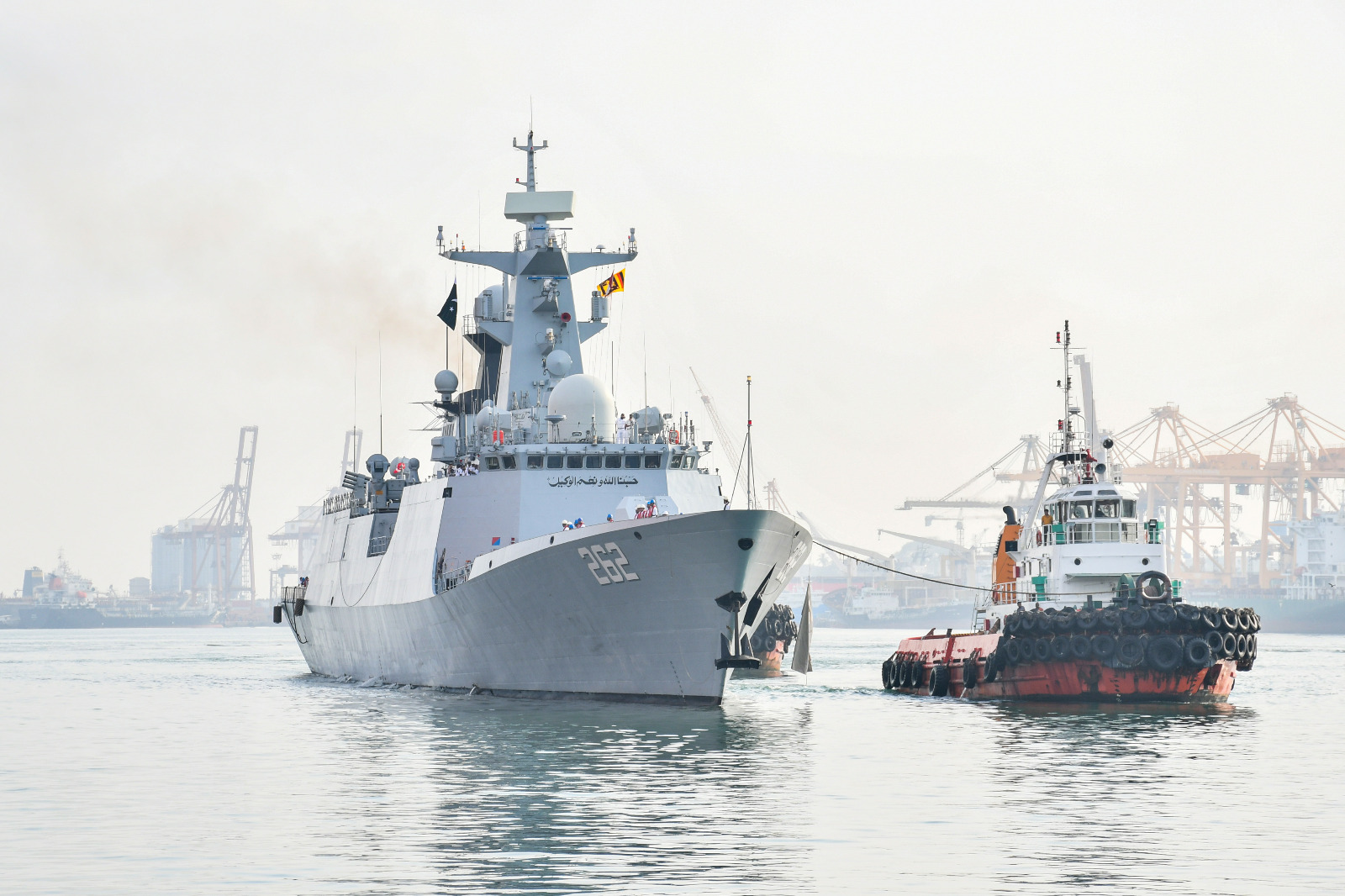
The Pakistan Navy Ship (PNS) TAIMUR and ASLAT arrived at the Port of Colombo on a goodwill visit on 12 Apr 26.
The visiting ships were welcomed by the Sri Lanka Navy in
compliance with naval traditions.
The duo of ships is commanded by Captain NIAMAT SAEED KHAN (PNS TAIMUR) and Captain NADIR MATEEN AFRIDI (PNS ASLAT).
Meanwhile, the ships are expected to conduct a Bilateral Naval Exercise LION STAR V with the Sri Lanka Navy in Colombo seas.

Salt and Patidar power RCB past Mumbai Indians

Prasidh, Buttler set up comfortable win for Gujarat Titans

Heat Index at Caution level’ in the Northern, North-central, North-western, Western and Southern provinces and in Trincomalee district.

Showers above 75 mm are likely at some places in the Western, Sabaragamuwa, Central, Southern and North-western provinces.

Sun directly overhead Pesalai, Mankulam and Nedunkerny about 12:11 noon

PNS TAIMUR & ASLAT arrive in Colombo

‘Dates have the highest sugar content to fight Coronavirus’

Sunday Island 27 December – Headlines

#SundayIsland 17th December – Headlines

Sunday Island – 28th March

Sunday Island Headlines – 21 March

Sunday Island – 21st February – Headlines
-

 News6 days ago
Lankan-origin actress Subashini found dead in India
-

 News4 days ago
AG: Coal procurement full of irregularities
-

 News1 day ago
CEB orders temporary shutdown of large rooftop solar systems
-

 Business3 days ago
Israeli attack on Lebanon triggers local stock market volatility
-

 Business4 days ago
Hayleys Mobility introduces Premium OMODA C9 PHEV
-

 Business3 days ago
HNB Assurance marks 25 years with strategic transformation to ‘HNB Life’
-

 News6 days ago
UN Regional Director launches SL’s first Country Gender Equality Profile during official visit
-

 News6 days ago
Dialog Launches ‘GanuDenu QR’, Making Cashless Transfers Free for All with eZ Cash and Dialog Finance