
News
NFC launched Rs 100 mn project in honour of Lester James Peries without approval


Waste, corruption and irregularities galore
It was revealed during the COPE (Committee on Public Enterprises) proceedings on Monday (19) that the National Film Corporation (NFC) hadn’t even bothered to obtain approval for the construction of a museum and a film school named after the late Lester James Peries. Construction work commenced on April 5, 2019.
The COPE has instructed the NFC Chairman Dr. Jayantha Dharmadasa to complete the Rs 100 mn project following the due process.
The following is the text of the statement issued by Parliament after examination of the Auditor General’s Reports and the Current Performance Reports for the Fiscal Years 2016 and 2017 of the Sri Lanka National Film Corporation:
The Chairman of the COPE Prof. Charitha Herath said that many issues have transpired due to the lack of standards in the process of digitizing cinemas.
Accordingly, The COPE Chair pointed out that a new perspective on the part of the Sri Lanka National Film Corporation with regards to the digitization of cinemas is required. He stated the above at the COPE Committee meeting held on the 19th of July 2021.
The COPE Meeting was held to examine the Auditor General’s Reports and the Current Performance Reports for the Fiscal Years 2016 and 2017 of the Sri Lanka National Film Corporation.
The COPE also disclosed that the outstanding film production loan balance which was given by the National Film Corporation and Fund as at 31 December 2020 is Rs. 141,292,087.
The Committee also directed the Corporation to take immediate action in order to recover the outstanding loan amount of Rs. 7,780,983 given to 146 cinemas which were closed before 2001.
Recommendations were made at the COPE meeting held on 24th March 2016 to formulate a programme for the modernization of cinema halls and to report on the progress. The COPE inquired the National Film Corporation regarding the non-implementation of the decisions taken.
By the end of 2019, the Corporation maintained 09 current bank accounts and the Committee disclosed that its average monthly balance was Rs. 29.2 million. The COPE chair pointed out that the lack of proper financial management governing the institution was a serious concern.
The COPE paid special attention regarding the failure to complete the construction of a museum and a film school named after Dr. Lester James Peries which commenced on April 05th, 2019 at an estimated cost of Rs. 99.9 million on time.
The approval of the Urban Development Authority had not been obtained for the construction. The Committee instructed the Chairman of the National Film Corporation, Dr. Jayantha Dharmadasa to complete the project following the due process.
The Committee further directed the Chairman of the National Film Corporation to conduct a feasibility study on the establishment of a Film School.
It was also revealed that two officers who had not been confirmed in a permanent position at the Department of Cultural Affairs in 2019 and another officer had been appointed to fill the three vacancies existing in the National Film Corporation as acting officers and to perform duties with their salaries and allowances amounting to a total of Rs. 3,098,046.
The Committee paid special attention towards the non-recovery of the movie rental of Rs. 12,343,433 from the Maradana Cine City Cinema Hall from 2003 to 31st May 2016 as at March 2021.
Although Rs. 25 million has been allocated for the improvement of the production facilities of the University Studio in Kelaniya and Rs. 50 million has been allocated for the establishment of a film archive and restoration of films, the amount had not been utilized during the year under review. The Committee also paid special attention to the fact that out of the Rs. 50 million allocated for the establishment of a National Training School, only Rs. 500,000 was spent.
The Committee also inquired from the Corporation regarding the non-compliance with the Procurement Guidelines pertaining to the expenditure of Rs. 44,394,717 for the Presidential Film Awards which was held on 31st March 2017.
COPE Chairman Prof. Herath instructed the Secretary to the Ministry of Buddhasasana, Religious and Cultural Affairs Prof. Kapila Gunawardena to inquire into the matter and submit a report to the Committee.
The Committee also paid special attention to the fact that an action plan for the year 2020 has not been prepared in line with the 2020-2025 Combined Plan.
It was also pointed out that the annual reports of the National Film Corporation since 2015 have not been tabled in Parliament. The Committee directed the Secretary to the Ministry to take immediate action in that regard.
The Committee made note that there are 57 vacancies in the National Film Corporation at present and that the Corporation had not acted upon getting the amendments to the recruitment procedure approved by the Management Services Department.
The Committee making a recommendation to the Secretary to the Ministry stated that several high-ranking officials of the Corporation had been suspended and that investigations regarding such suspensions should be completed expeditiously. The Committee was of the view that the delay of some disciplinary inquiries by one and a half years was an issue of concern.
Prof. Kapila Gunawardena stated that at present the distribution of films was done by the private sector and that a gazette notification would be issued in the future to take it over to the government.
Minister (Dr.) Sarath Weerasekera addressing the committee pointed out the need to electronically distribute tickets in cinemas.
Minister Mahindananda Aluthgamage, State Ministers Susil Premajayantha and Indika Anuruddha, Members of Parliament Patali Champika Ranawaka, Eran Wickramaratne, Harsha de Silva, Anura Kumara Dissanayake, Jagath Pushpakumara, Jayantha Samaraweera, Premnath C. Dolawaththa, Shanakiyan Rasamanickam and Uddika Premarathna were present at the meeting.






Latest News
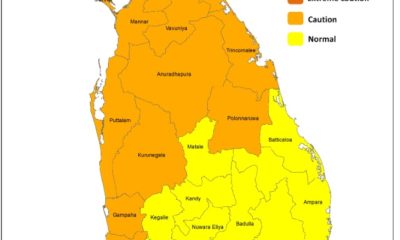
Heat Index at Caution level’ in the Northern, North-central, North-western, Western and Southern provinces and in Trincomalee district.


Warm Weather Advisory
Issued by the Natural Hazards Early Warning Centre
Issued at 3.30 p.m. on 12 April 2026, valid for 13 April 2026.
Heat index, the temperature felt on human body is likely to increase up to ‘Caution level’ at some places in the Northern, North-central, North-western, Western and Southern provinces and in Trincomalee district.
The Heat Index Forecast is calculated by using relative humidity and maximum temperature and this is the condition that is felt on your body. This is not the forecast of maximum temperature. It is generated by the Department of Meteorology for the next day period and prepared by using global numerical weather prediction model data.

Effect of the heat index on human body is mentioned in the above table and it is prepared on the advice of the Ministry of Health and Indigenous Medical Services.
ACTION REQUIRED
Job sites: Stay hydrated and takes breaks in the shade as often as possible.
Indoors: Check up on the elderly and the sick.
Vehicles: Never leave children unattended.
Outdoors: Limit strenuous outdoor activities, find shade and stay hydrated.
Dress: Wear lightweight and white or light-colored clothing.
Note:
In addition, please refer to advisories issued by the Disaster Preparedness & Response Division, Ministry of Health in this regard as well. For further clarifications please contact 011-7446491.

On the apparent northward relative motion of the sun, it is going to be directly over the latitudes of Sri Lanka from 05th to 15th of April in this year.
The nearest areas of Sri Lanka over which the sun is overhead today (13th) are Pesalai, Mankulam and Nedunkerny about 12:11 noon.
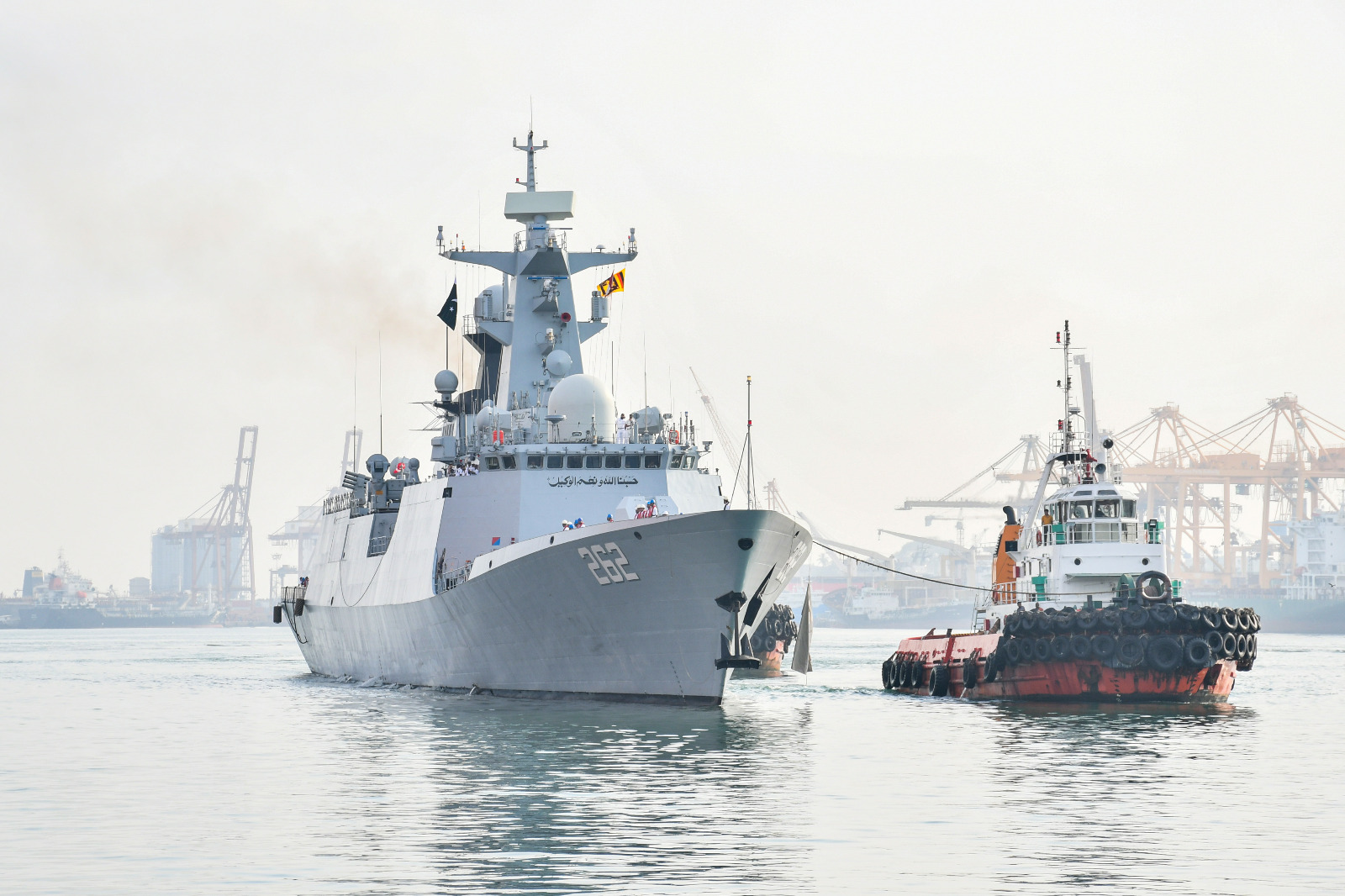
The Pakistan Navy Ship (PNS) TAIMUR and ASLAT arrived at the Port of Colombo on a goodwill visit on 12 Apr 26.
The visiting ships were welcomed by the Sri Lanka Navy in
compliance with naval traditions.
The duo of ships is commanded by Captain NIAMAT SAEED KHAN (PNS TAIMUR) and Captain NADIR MATEEN AFRIDI (PNS ASLAT).
Meanwhile, the ships are expected to conduct a Bilateral Naval Exercise LION STAR V with the Sri Lanka Navy in Colombo seas.

Salt and Patidar power RCB past Mumbai Indians

Prasidh, Buttler set up comfortable win for Gujarat Titans

Heat Index at Caution level’ in the Northern, North-central, North-western, Western and Southern provinces and in Trincomalee district.

Showers above 75 mm are likely at some places in the Western, Sabaragamuwa, Central, Southern and North-western provinces.

Sun directly overhead Pesalai, Mankulam and Nedunkerny about 12:11 noon

PNS TAIMUR & ASLAT arrive in Colombo

‘Dates have the highest sugar content to fight Coronavirus’

Sunday Island 27 December – Headlines

#SundayIsland 17th December – Headlines

Sunday Island – 28th March

Sunday Island Headlines – 21 March

Sunday Island – 21st February – Headlines
-

 News6 days ago
Lankan-origin actress Subashini found dead in India
-

 News1 day ago
CEB orders temporary shutdown of large rooftop solar systems
-

 News4 days ago
AG: Coal procurement full of irregularities
-

 Business3 days ago
Israeli attack on Lebanon triggers local stock market volatility
-

 Business4 days ago
Hayleys Mobility introduces Premium OMODA C9 PHEV
-

 Business3 days ago
HNB Assurance marks 25 years with strategic transformation to ‘HNB Life’
-

 News6 days ago
UN Regional Director launches SL’s first Country Gender Equality Profile during official visit
-

 News6 days ago
Dialog Launches ‘GanuDenu QR’, Making Cashless Transfers Free for All with eZ Cash and Dialog Finance