
Sports
Memories of Zimbabwe 2004

by Rex Clementine
There are many good things about writing for The Island and one of them is that you get to see every game that Sri Lanka plays at home, every Test match they play overseas and all major ICC events. One of those memorable tours was Zimbabwe 2004. On the cricket field, Sri Lanka whitewashed Zimbabwe and Murali claimed the World Record for the first time breaking Courtney Walsh’s record for most wickets in Tests. Off the field, the Sri Lankan reporters had a firsthand experience of the plight of Zimbabwe people due to poverty, high inflation, unemployment, shrinking foreign reserves, power cuts and food shortage. Something similar to what we are experiencing back home at present.
It must be said that 18 years ago we never expected to get a taste of Zimbabwe’s medicine in our backyard one day.
It was a six week tour. What was really saddening to note was the high inflation and as a result devaluation of currency. When we landed in Harare, the exchange rate was for one US Dollar you got 4500 Zimbabwe Dollars. By the time the tour was over, after 40 days, the exchange rate was for one US Dollar 5200 Zimbabwe Dollars! The currency had no value. If you went to a bank to cash 100 US$, you had to carry a bag as you would get vast amount of money. Money of little use.
Last month, when we went to India, the exchange rate was for one Indian Rupee we paid 2.6 Sri Lankan Rupees. Three weeks later, by the time the tour was over, it had gone up by massive scales as we had to pay 3.6 Sri Lankan Rupees for one Indian Rupee. Today, one INR is equal to 4:15 LKR! All of it happening in a matter of one month. It’s really scary to think of returning to India in December for the ODI leg of the tour.
Coming back to Zimbabwe, like Sri Lanka, it’s a beautiful country. Their main sources of income are agriculture and tourism with the stunning Victoria Falls being the star attraction. We had booked the train to get there. But when we reached the station we were informed that the train had been cancelled due to shortage of fuel. Eventually, we made it to the falls thanks to a Sri Lankan Doctor practicing in Harare by the name of Anion Anthony. He drove us all the way to Victoria Falls. Eventually, as the country’s situation worsened he migrated to New Zealand.
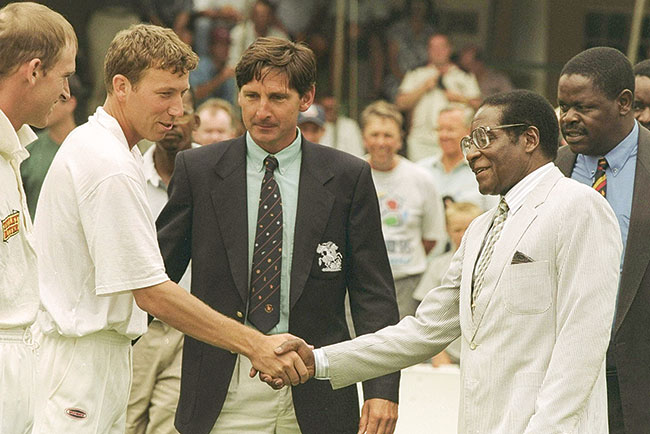
There were protests all across Zimbabwe especially in the main cities of Harare and Bulawayo. President Robert Mugabe ruled with an iron fist. The cricket board chief was one of his buddies, Peter Chingoka. There was this press conference in Harare where a journalist writing for AFP by the name of John Kelly asked some uncomfortable questions. Chingoka literally threatened the journalist to withdraw his question or face the consequences. Poor Kelly had little choice. Chingoka, a chain smoker, died a few years ago. Haven’t heard from Kelly in a while.
President Mugabe’s ill advised policies were a major reason for crashing of Zimbabwe economy. So what did he actually do? Well, he just ordered acres of farm land owned by whites to be distributed among the majority blacks. Eventually, the blacks had the lands but they did not have the knowledge on agriculture or how to handle equipment. It should have been probably done over a period of time. Not overnight. The whites migrated in vast numbers and there were massive food shortage. There were sanctions imposed by western countries and the economy crashed faster than Zimbabwe’s cricket team.
Mugabe’s palace was right next to the Harare Sports Club. That’s where Murali broke the World Record. We would get off the taxi and walk to the ground with the Presidential Palace just opposite us. It was heavily guarded and photographs or loitering was not allowed.
In order to discourage journalists from coming to Zimbabwe, Mugabe had a strange rule. Although we had accreditation from the Zimbabwe Cricket Board, every reporter had to register with the Media Ministry and obtain a pass. For which we had to pay a princely sum of US$ 250 each! You were issued the pass provided you signed a document assuring that you didn’t write anything bad about the political developments in the country. Some journalists got into trouble like Mihir Bose, the BBC Sports Editor, who had flown to Zimbabwe to report Murali breaking the World Record. They had kept a close eye on what he had been reporting. Security forces visited his hotel room and deported him. Pretty scary scenes.
The military in Zimbabwe was powerful. Government servants were often corrupt.
Mugabe and his wife Grace were accused of embezzling the country’s wealth. There were allegations that he had secret accounts in Switzerland and castles in Scotland. Their children lived extravagant lives while the rest of the country was starving.
Most of Mugabe’s travel within the country was done in helicopters. It was a frequent sight from the press box to see helicopters flying over us. Not just one at a time but three due to security reasons.
Soon after Sri Lanka finished their tour, Australia landed in Zimbabwe. However, the tour was cancelled as the Australian government had concerns about human rights violations in the country. It was very strange for a cricket team to arrive in a country and fly back home without playing a single game.
Despite the anger and frustration among the locals, Zimbabweans were peaceful people and never did we witness or read about violence or crime. It was a beautiful, clean country and had superb infrastructure. Every local we met from the taxi drivers to security guards spoke perfect English.
Mugabe’s power hunger saw the country from being the granary of Africa becoming one of the poorest in the world.





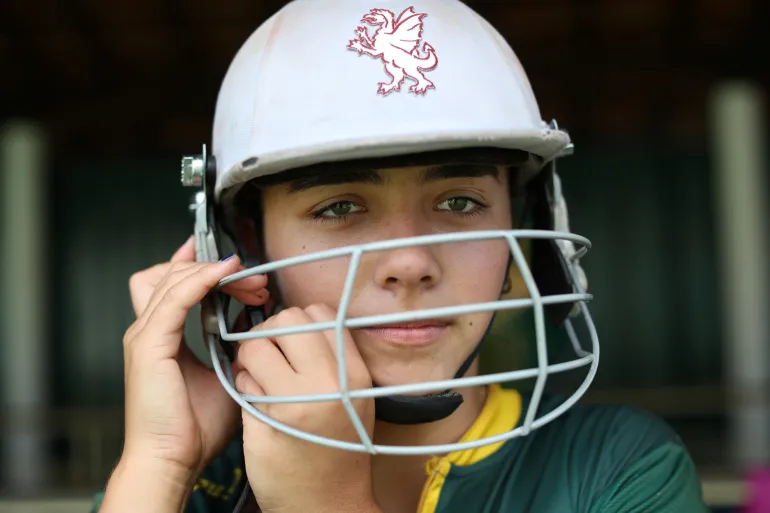
Brazil are the unlikely candidates to have claimed two cricket records as one of their bowlers took a record nine wickets – including five in a row – in their 189-run T20 Women’s International victory against Lesotho in Botswana.
Having won the toss on Thursday, at the BCA Kalahari Women’s T20 International Tournament, Brazil posted a daunting 202-8 with wicketkeeper Monnike Machado hitting 69 off 41.
The fun, for the Brazilians, was only just beginning, though, as Laura Cardoso claimed a hat-trick with the last three deliveries of her first over – the second of the Lesotho innings – to set in motion the incredible feat that eventually saw the Africans bowled out for 13.
The 21-year-old then continued her wicket-taking achievement with a Women’s T20 International first of five dismissals in a row as she struck with the first two balls of her second over. This was all part of claiming the first nine Lesotho wickets to fall, but being denied the chance to take all 10 after a change of bowling following her third over. Her final wicket was Ret’sepile Limema, who fell to the fifth ball of the fifth over, with Cardoso replaced for the following over at that end. Her nine wickets, nevertheless, is the best return in either men’s or women’s T20 internationals.
The right-arm seamer did, indeed, come close to another hat-trick, when she claimed wickets with the last two balls of her second over, which itself totalled four victims.
Cardoso, who has has taken 55 wickets in 48 T20 matches for Brazil, replaces Indonesia’s Rohmalia Rohmalia at the top of the Women’s T20 best bowling rankings, as she finished with figures of 3-2-4-9.
Rohmalia had claimed seven wickets in 2024 in a match against Mongolia in Bali. Only three other women have claimed seven in a T20 international.
The men’s record, and the overall in the format, had been held by Bhutan’s Sonam Yeshey after he took eight wickets for seven runs against Myanmar last year.
The previous record for the number of wickets in consecutive deliveries was four, and was jointly held with the most prominent occasion in women’s cricket being when Shakera Selman pulled off the feat for the West Indies against Pakistan in 2018. Afghanistan’s Rashid Khan and Sri Lanka’s Lasith Malinga are among the most notable bowlers from the men’s game to have claimed four consecutively in the format.
Although a huge winning margin, Brazil’s overall win does not compare with Argentina’s record after they beat Chile by 364 runs in 2023. The Argentinians had struck 427-1 to set up their victory.
Lesotho’s part in the record extends to no further than Cardoso’s haul, with the record-lowest total belonging to Mali, who were bowled out for 6 in 2019 by Rwanda.
Brazil, who lead the six-team tournament with five straight wins, play Mozambique on Friday.
[Aljazeera]
| Date | Match |
|---|---|
| May 3 | 1st ODI |
| May 6 | 2nd ODI |
| May 9 | 3rd ODI |
| May 12 | 1st T20I |
| May 14 | 2nd T20I |
| May 15 | 3rd T20I |
[Cricbuzz]


Brazil bowler Laura Cardoso takes 9 Lesotho wickets in record-breaking T20 win

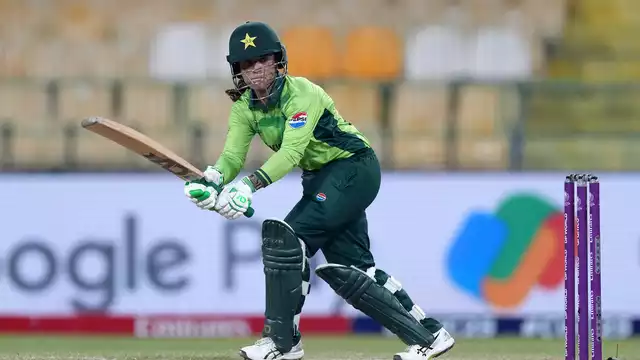
Zimbabwe Women set for maiden tour of Pakistan

Bangladesh advance match timings to save energy

PM on inspection tour of newly renovated Colombo Central Bus Stand

Israel to hold direct talks with Lebanon but no ceasefire, Netanyahu says

Sun directly overhead Nagawilluwa, Galgamuwa, Sigiriya, Palugasdamana and Mankerni about 12:11 noon today (10)

‘Dates have the highest sugar content to fight Coronavirus’

Sunday Island 27 December – Headlines

#SundayIsland 17th December – Headlines

Sunday Island – 28th March

Sunday Island Headlines – 21 March

Sunday Island – 21st February – Headlines
-

 Features6 days ago
Ranjith Siyambalapitiya turns custodian of a rare living collection
-

 News6 days ago
Global ‘Walk for Peace’ to be held in Lanka
-

 News4 days ago
Lankan-origin actress Subashini found dead in India
-

 News2 days ago
AG: Coal procurement full of irregularities
-

 Features6 days ago
Beyond the Blue Skies: A Tribute to Captain Elmo Jayawardena
-

 Business23 hours ago
Israeli attack on Lebanon triggers local stock market volatility
-

 Features6 days ago
Aspects of Ceylon/Sri Lanka Foreign Relations – 1948 to 1976
-

 Business2 days ago
Hayleys Mobility introduces Premium OMODA C9 PHEV