
Life style
Memories of a schoolgirl in Ceylon, 1960


125th year celebrations of SACRED HEART CONVENT, Galle (1896 – 2020)
by Savitri de Alwis
(Vice Captain, Queen’s Own, 1970)
The echo of frenzied cheering ebbing and flowing like a wave from the open pavilion of the Galle esplanade fill my ears as if it were only yesterday. I can hear Rev. Sister Rosina, Mistress of Queens Own House. spurring me on fitfully on the loudspeaker in the open event cycle race. My spindly legs pedal furiously, perfectly navigate the tracks and breeze through the touch line to victory on an old rackety Men’s Raleigh bicycle, borrowed on the spot for the race from the school watcher! As I cross the winning line I look back at my competitors, way behind me like specks on the track doing a balancing act with their bikes! Indeed, not many girls cycled then nearly 50 years ago, with the exception of tomboys and the posh girls from Colombo who were sent to our boarding school for strict discipline under firm but kind Irish and Belgian nuns.
Yet oddly we were in awe of these posh girls from Colombo with their ‘mod’ hairstyles, a far cry from our tightly plaited hair doused in coconut oil! But moreover they spoke the Queen’s English like they owned it. This was 1970 and the unforgettable events of a sports meet indelibly etched in my memory as a school girl at Sacred Heart Convent in Galle, a leading private girls’ day/boarding school. Established in 1896, by the Sisters of Charity in Belgium, it was for the education of young girls in Galle. The school is entering its 125th anniversary this year, a great milestone in its unbroken record of unblemished service and duty for charity (love). My three sisters, my little brother at nursery and I were privileged to walk through the hallowed hallways of Sacred Heart Convent from its nursery and on to secondary school half a century ago.
The decade beginning 1960 was thrifty era in Ceylon yet carefree and laid back. It was the decade of Beatles, Elvis, flower power and bell bottoms! We were school girls embracing an unhurried lifestyle, footloose and fancy free. Our precious parents paid for our education with their hard-earned money. At the helm of the school as Principal was the much adored and celebrated Rev. Sister Adrian, a bespectacled young Irish nun with rimmed glasses which framed her porcelain countenance. Always immaculately dressed in a crisp white habit, with an angelic face, she was soft spoken but firm and her presence ubiquitous! The sprawling magnificent Victorian buildings of the school which spread extensively, exuded charm and grandeur. Their impressive long and open corridors decorated with imposing Roman arches harmoniously arranged around a quadrangle is where we hung out and had our daily ‘fix’. Yes, a daily fix of ‘achcharu’ bought for five cents from Mura-aiya’s kade below the staff room.
The solid stone wall chapel with ornate stained glass windows on the premises was an integral part of the school and the Catholic girls looked ever so sanctimonious therein with their dainty little face veils, twirling their Rosary beads. We wished we could be like them! The ‘Parlour’ adjacent the Chapel where the nuns took refuge was also sacrosanct with strictly no entry except during music exams when Trinity College Music Examiners arrived from England on a BOAC jet. I recall as a 10-year old, with much trepidation and awe, entering the sanctuary of the Parlour for the very first time ever for my music exam. The dark brown floors were pristine and shining; I could almost eat off the floor I thought! The slender white Ionic Roman columns decorated the verandah around an open courtyard with its brilliant flowers interspersed with clipped shrubbery were stunning. It was surreal and I, for a fleeting moment, felt like Alice in Wonderland falling through a rabbit-hole!
English drama and poetry were fundamental to our education. We loved the annual English Day celebrations enjoying Shakespeare drama, poetry, oratory etc. under the keen eye of Miss Orlene de Silva a doyen of English teaching. It was the skillful Senior School production of Robert Browning’s mythical Pied Piper of Hamlin that clinched us the first prize in the Galle District Inter School English Day celebrations in 1969. A bevy of charming teens narrated the poem animatedly as the mystical Pied Piper, the writer, stormed the stage for her pound of flesh; a thousand guilders! And as we played out the story with aplomb our parents watched us with pride at the Galle Town Hall. There were other triumphant productions we took on in our stride – Oliver Twist, Twelth Night and Pride and Predjudice. To to this day the thought of Ranmalie de Zilva’s perfect fit as a proper little Mrs. Bennet on and off stage evoke fond memories.
Western music and singing were also high on the school’s agenda. The very first school percussion band was formed very modestly by our gracious Miss Malini Senanayake around 1969 with half a dozen melodicas and two accordions. One accordion was played by the musically gifted Priyadarshani Keerthisinghe and the other, attempting to emulate her wizardry sheepishly, was the writer. Helene Dias Abeysinghe had the shoulders to carry the huge bass drum and keep the beat stylishly like her effortless Shot Putt throws she did with a twirl! The excitement and novelty of being in the school band made us unconsciously audacious. loving to parade in our tartan skirts and berets and march the length and breadth of the Galle esplanade blowing our horns!
It was Miss Malini who trained and entered us to compete in the All Island Schools’ Singing Competition at Royal College, Colombo having won the first place in Galle Inter Schools’ Singing competition. The choir classic ‘Happy Wanderer’ in four part harmony was sung exquisitely by the school choir. Sports too were an integral part of the curriculum. We were gluttonous for a 20 cents Aleric’s Popsicle that the tuck shop sold, and Nandanie Rajapakse, my beloved Games Captain, smothered us with Aleric’s’ ice cream when we played like Trojans and brought the netball trophies home. It was fascinating too, to watch our fine athletes. Consy Rodrigo, Beatrice Bandara and Deidre Senanayake were like flying machines dominating the track and field events near the grotto of Jesus, Mary and Sacred Heart at the rear of the school.
The boarders had a habit of climbing the grotto to a vantage point to peek at the road beyond Kandewatte canal to check if the boys from our brother school. St. Aloysius College, were hovering around like helicopters. But the nuns were too sharp for their little theatrics! Life was uncomplicated. There were no mobile phones, social media or TV, period! We played outdoors avidly and immersed ourselves in hand me down books. It was ‘Robin Blue’ that made our uniforms dazzling white and a heavy charcoal fired smoothening iron pressed our uniforms. These were turned out at home on a hand sewing machine and oh so frugally using the material bought after queuing at the Co-op due to rationing. There were no fancy trainers then, only canvas shoes cleaned with pipeclay dripping like fresh cream! We learned to be creative and innovative and if a shoe gave way with the endless walking, jumping and running, we’d pretend to have an injury on that foot, slapping a plaster on it and slip on a flip flop as we walked to school unabashedly with one shoe and a flip flop. A bandage was sometimes used for effect! We almost always got away with it, dodging the hawk eyed Miss Padmini de Silva.
School days were happy and hauntingly memorable as are our beloved teachers who made all the difference. This is dedicated to them and to all my schoolmates scattered throughout the globe, remembering the good times we shared in the spirit of unity in that once in a lifetime incredible journey with, as our motto reminds us, ‘Cor Unum, Anima Una’ – One heart, One soul. May it be always so!


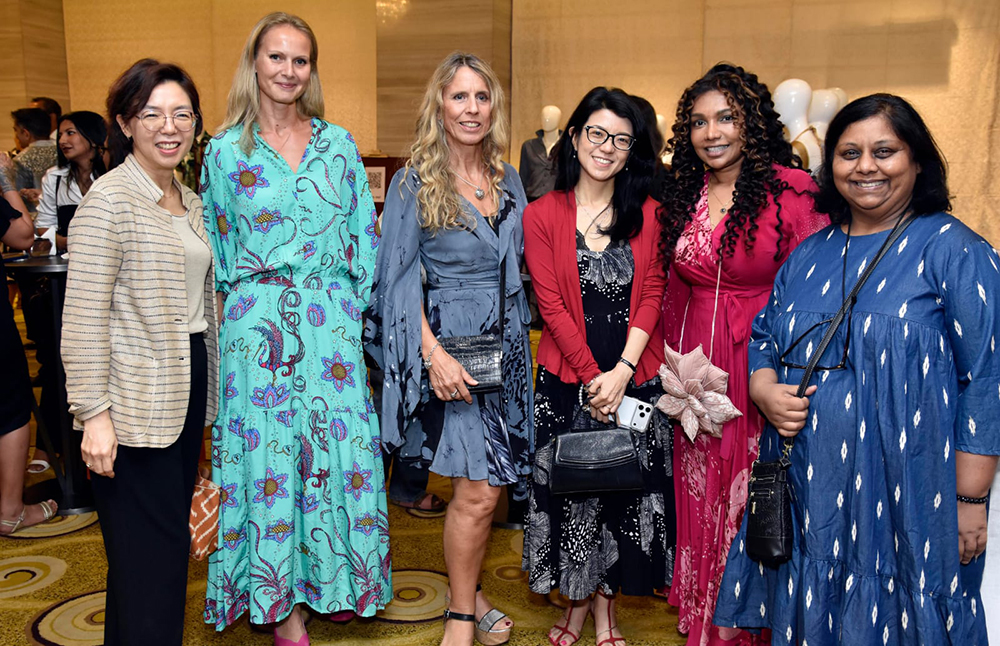
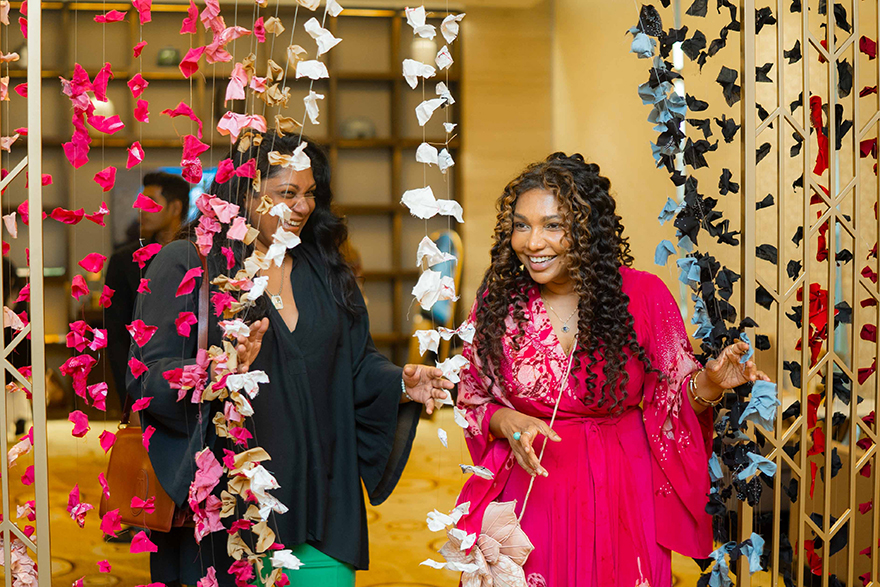
As the Colombo skyline softens into golden hour “Sundown with Buddhi Batiks “at Sheraton Colombo unfolded as a seamless blend of heritage and contemporary elegance – an experience that felt both intimate and visually striking.
The evening drew a crowd that reflected the very essence of the brand it celebrated refined, creative and deeply connected with flowing silhouettes, to cultural and the quiet hum of conversation over curated cocktails.
Buddhi Batiks with Darshi Keerthisena is a label celebrated for transforming Sri Lankan batik into modern, wearable art. Her story telling through fabric where each piece reflected craftsmanship, culture, and a contemporary design language. The collection leaned into effortless elegance, resort ready kaftans, structured yet fluid dresses and statement pieces that moved as beautifully as they look. The atmosphere was electrifying. Guest sipped on delicated curated cocktails as soft music hummed in the background, creating an ambience that felt both exclusive and deeply relaxed.
More than aesthetics, Buddhi Batiks tells stores. Each motif, each gradation of colour carried a sense of place and memory.
Buddhi Batiks is proof that fashion can honour heritage without compromising on glamour, with every brush stroke of wax and every hand dyed.
The event, aptly named Sundown, was an ode to the timeless elegance of Sri Lankan craftsmanship, seamless fabrics woven into contemporary silhouettes that speak to a global sensibility.
The collection by Buddhi Batiks drew inspiration from Sri Lanka’s natural landscape, from the shimmering coastlines to the lush inland jungle, translated into vivid patterns and textures on display.
-
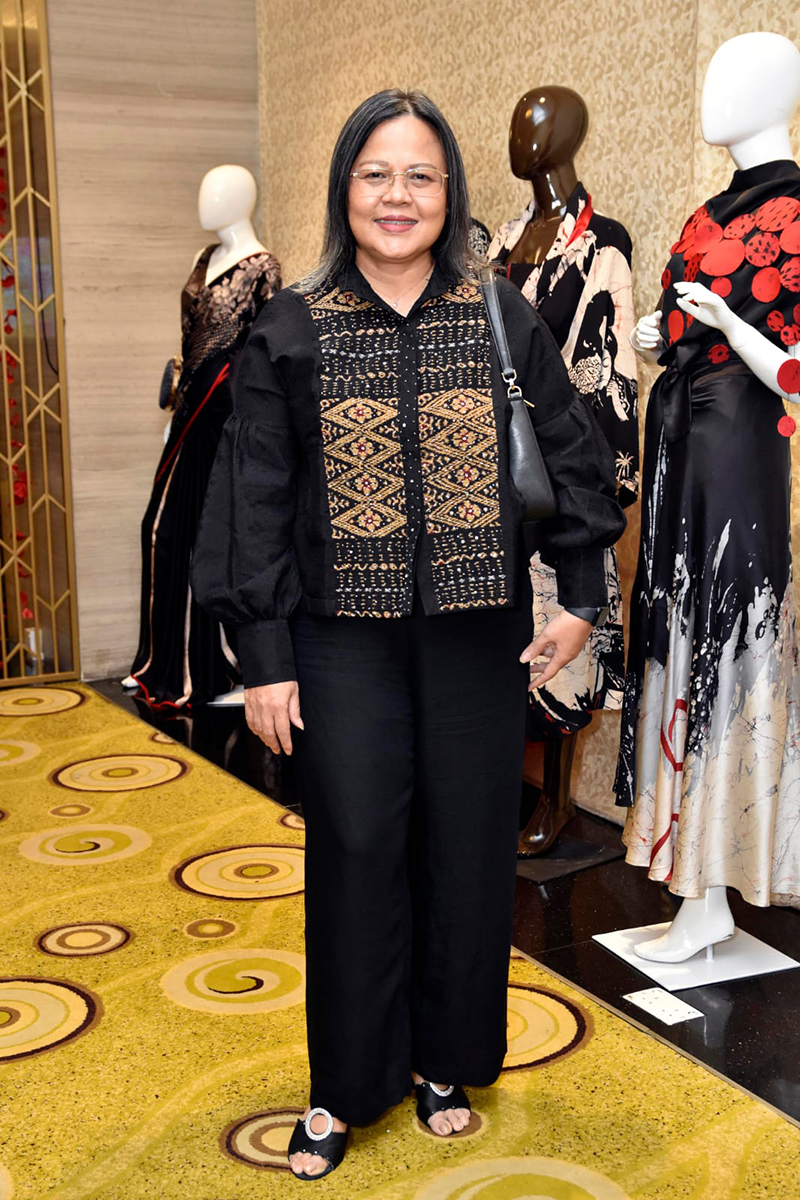
- High Commissioner of Indonesia in Sri Lanka- Dewi Gustina Tobing
-
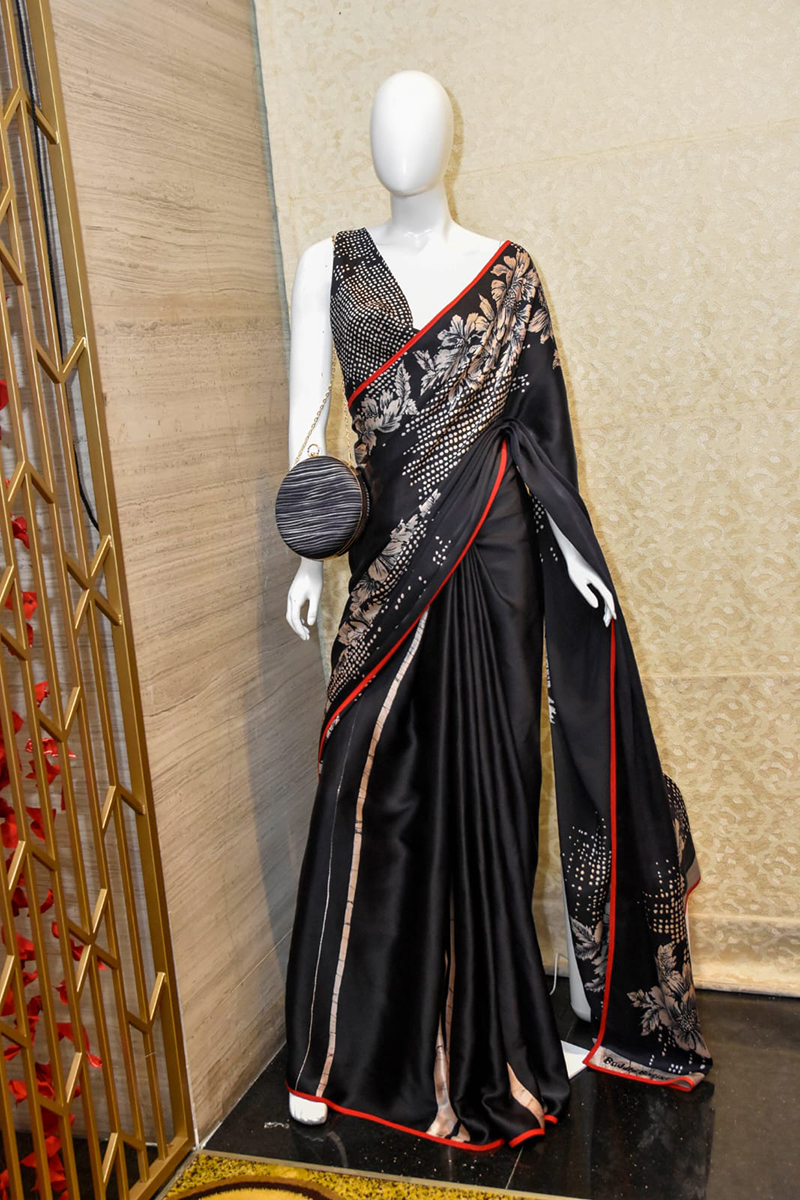
- Every fold tells a story
The brand celebrated Sri Lankan’s rich artistic legacy while embracing a global fashion vision.
There are designers who wear fashion and then there are designers who live fashion, Darshi Keerthisena, creative director and CEO of Buddhi Batiks, belongs to the latter. She hasn’t merely followed a family tradition. She has reimagined it, transforming Sri Lankan batiks from a cultural craft into a globally resonant fashion statement. Under Dharshi’s leadership, Buddhi Batiks has evolved far beyond traditional cotton saris. She has introduced silk, geogette and satin as canvasses for Batik, infusing pieces with contemporary silhouettes and subtle, sophisticated colour stories that appeal to international design sensibilities. Her innovations have taken batik onto global platforms.
Darshi’s innovation isn’t only stylistic, it is ethical. She has championed sustainable practises, such as digital printing on recycled textiles and eco friendly dyes, while keeping handmade batik at the heart of the brand.
Her career has been marked by accolades and awards Dharshi’s vision for batik is expansive. She sees it not just on runaway gowns or resort wear, but translated into interiors, accessories and everyday life, capable of transcending borders while keeping the soul of Sri Lankan artisan’s heritage alive.
Sheraton Colombo Sri Lanka’s most prestigious 5-star hotels with Paul Sun, General Manager and his dedicated team, [played a key role and the hotel’s assistance went beyond providing a venue, it was a seamless blend of hospitality, event management and creative support.
By Zanita Careem

Farzana Baduel stands as a powerful voice in global communication and a passionate advocate for women’s empowerment making her perspective especially relevant on International Women’s Day. As CEO of Curzon PR,in UK she has built a career defined by influence, resilience and purpose championing the advancement of women’s leadership.
 (Q) How would you describe the role of women in the UK today and how does it compare to women’s role in Sri Lanka?
(A) Women in the UK today hold positions of real influence across politics, business, media, academia and the creative industries. There are strong legal protections around equality and conversations about gender parity have become mainstream. But equality in law does not always translate to equality in lived experience, particularly when it comes to pay gaps, the weight of childcare, and who actually occupies the most senior positions.
Sri Lanka presents a genuinely fascinating paradox. It elected the world’s first female Prime Minister in 1960, yet many women still face structural and cultural constraints, especially outside urban centres. What strikes me about Sri Lankan women is their extraordinary resilience and entrepreneurial spirit, often demonstrated within more traditional frameworks. That combination of ambition and adaptability is something I find deeply impressive.
Both countries are progressing. But both still have considerable work to do.
(Q) Are there areas where UK women face challenges that Sri Lankan women may not, or vice versa?
(A) In the UK, one of the most persistent challenges is what I would describe as the double burden: professional ambition sitting alongside disproportionate domestic responsibility. There is also the very modern pressure of digital culture, the weight of image, comparison, online abuse and public scrutiny that affects women in ways men rarely experience to the same degree.
In Sri Lanka, the challenges tend to be more structural. Economic instability, limited access to opportunity in rural areas, and in some cases stronger social conservatism around gender roles all shape what is possible for women. And yet extended family networks in Sri Lanka can offer something many women in the UK genuinely lack: built in childcare, intergenerational support, a community that holds you.
The pressures differ. But the underlying theme is remarkably consistent. Women everywhere are negotiating expectations that men are simply not asked to meet.
(Q) How do you define what it means to be a woman today, and have there been moments where your gender shaped your opportunities or challenges?
(A) To me, being a woman today means navigating complexity with strength. It means holding ambition and empathy in the same space without apologising for either. It means being commercially sharp and emotionally intelligent. Above all, it means resilience.
There have certainly been moments in my career where being a woman changed the dynamic in a room, particularly in senior advisory spaces involving government or corporate leadership. Early on, I sometimes had to prove competence before being taken seriously. Over time I came to understand that credibility does not come from changing who you are. It comes from deep expertise and calm authority.
Gender shapes experience. But it does not have to define potential.
(Q) How can women lift each other up in workplaces, communities and society at large?
(A) By being genuinely generous with opportunity. Sponsorship matters far more than mentorship. It is powerful when senior women actively advocate for other women in rooms those women are not in. That kind of invisible advocacy changes careers.
By rejecting scarcity thinking. There is not only one seat at the table.
And by modelling integrity. When women support each other publicly and privately, it does not just help individuals. It changes workplace cultures entirely.
(Q) Do you believe women are getting enough representation in leadership roles? If not, what needs to change?
(A) Progress has been made. But representation at the very top, in boardrooms and in global political leadership, remains deeply uneven. And the solution is not simply about recruiting more women. It is about changing the systems they are recruited into: flexible leadership structures, normalised parental leave for both men and women, transparent promotion criteria, and zero tolerance for the kind of subtle bias that is so easy to dismiss but so corrosive over time.
Representation is not about optics. It is about influence. Those are not the same thing.
(Q) What societal expectations or stereotypes have you personally encountered as a woman?
(A) The most persistent one is the idea that women must choose between warmth and authority, that being decisive risks being labelled difficult. Men are rarely subjected to that framing. A decisive man is simply a leader.
There is also the expectation that women should balance everything effortlessly, as though the juggle should be invisible. The reality is that balance is dynamic, often imperfect, and occasionally held together by nothing more than determination and strong coffee.
(Q) What challenges do women face in accessing healthcare or support, and how can society improve this?
(A) Even in developed countries, women’s health is frequently under researched and under prioritised, particularly around reproductive health, menopause and mental health. This is not a niche issue. It affects half the population.
Improvement requires sustained investment in research, workplace policies that recognise women’s health realities, and a collective willingness to remove the stigma that still clings to these conversations. Health is not a private inconvenience. It is a public priority.
(Q) Do you feel women are encouraged enough to pursue their passions alongside family and work responsibilities?
(A) The encouragement exists in rhetoric. The practical support frequently does not. True encouragement requires structural foundation: affordable childcare, flexible working arrangements, and a cultural acceptance that ambition in women is not selfish. It is not something that requires justification.
Women should never feel they must apologise for aspiration.
(Q) How do media portrayals of women impact society’s perception of them?
(A) Media shapes norms in ways we often do not notice until we look back. When women are portrayed primarily through the lens of appearance, domestic roles or conflict narratives, it quietly narrows the public imagination about what leadership looks like.
When media platforms showcase women as thinkers, strategists, innovators and policymakers, something opens up, especially for young girls who are watching and deciding, consciously or not, what is possible for them. Representation shapes expectation. That is not a small thing.
(Q) What changes would you most like to see for women in the next decade?
(A) Economic parity, not just participation. Greater support for women entrepreneurs. More women shaping foreign policy and global governance. A healthier and kinder public discourse online.
But most importantly, I would like to see confidence. Young women growing up without internalised limits, without the quiet voice that tells them to take up less space. That, more than any policy change, is what transforms the next generation.
(Q) And finally, how do you define what it means to be a woman today?
(A) To be a woman today is to stand fully in your capability without shrinking for anyone’s comfort. It is to embrace both strength and compassion, not as opposites but as complements. It is to define yourself rather than accept the definitions others impose upon you.
And perhaps most importantly, it is to leave the path a little wider for the women who come after you.
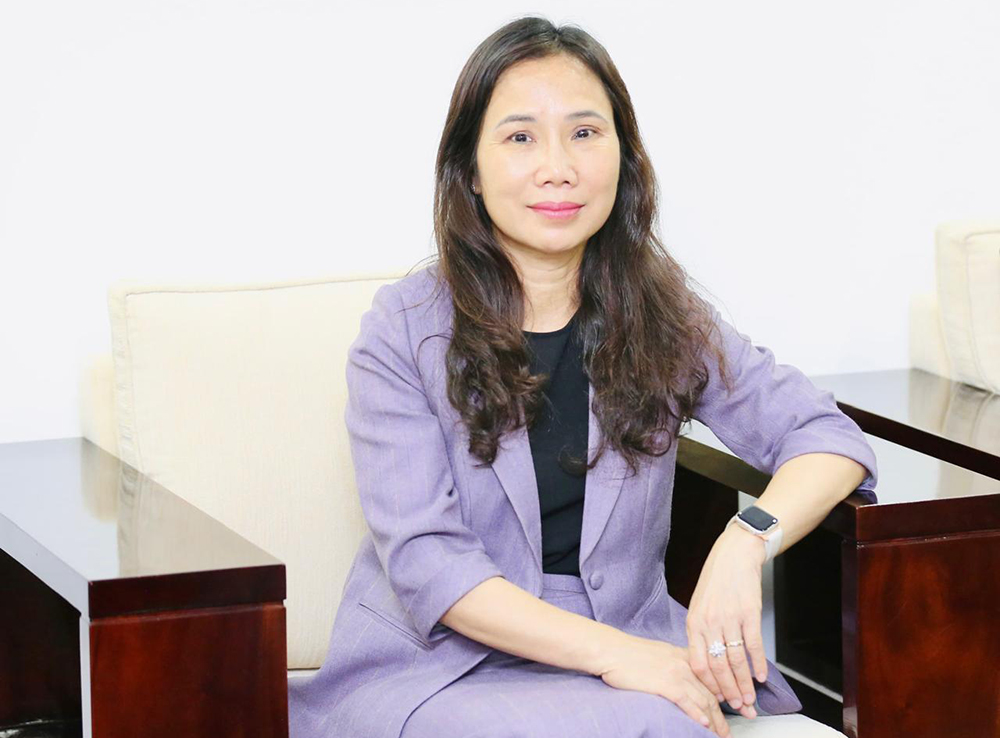
Grace, resilience and quiet determination define the women of both Vietnam and Sri Lanka, two nations bound not only by rich cultural heritage, but by the enduring strength of their women. As the world marked International Women’s Day, the interview with the Vietnamese Ambassador in Sri Lanka offers a compelling lens into how tradition and modernity intervine to shape the lives of women across these societies Women in Vietnam and Sri Lanka continue to redifine their roles, balancing family, career and ambition with remarkable pause. While their journeys were shaped by distinct histories and cultural naunces there is a shared narrative of perseverance, adaptability and progress. In this interview the envoy reflects on these parallels and contrasts, offering insight into the evolving status of women. The challenges, they face and the inspiring strides being made towards equality.
Q How would you describe the role of women in Vietnam compared to Sri Lankan women?
A Women in Vietnam and Sri Lanka share many important similarities. In both societies, women are known for their diligence, resilience, and strong sense of responsibility toward family and community. Having experienced periods of war, conflict, and economic hardship, women in both countries deeply understand the values of sacrifice, solidarity, and perseverance. They often carry multiple roles at the same time—caregivers, income earners, and community supporters. In both countries, there has been an increasingly active participation of women in the workforce, including trade, manufacturing, SMEs, as well as in the leadership. It is meaningful to recognize these shared qualities that quietly but steadily contribute to social stability and national development.
Q From your personal experience, what defines a modern woman in your country?
A From my personal experience, a modern woman is someone who strives for balance rather than choosing between roles. She values education, independence, and self-development, while remaining deeply committed to her family and social responsibilities. She is confident, adaptable, and increasingly comfortable using technology and global networks. At the same time, she respects cultural values and traditions, selecting what is meaningful rather than rejecting them entirely. Modern women today are not defined only by career success, but by their ability to manage multiple responsibilities with empathy, resilience, and purpose.
Q Have you seen a significant change in women’s roles over the past decade?
A Yes, there have been noticeable and positive changes over the past decade. More women are pursuing higher education, entering diverse professional fields, and participating actively in economic and social life. Attitudes toward women’s leadership and decision-making roles have gradually improved, especially among younger generations. At the same time, women continue to shoulder major responsibilities within the family. This dual role has become more visible and more openly discussed. While challenges remain, the growing recognition of women’s contributions—both at work and at home—reflects a meaningful shift toward a more inclusive understanding of development.
Q Women in Vietnam are often visible in trade and entrepreneurship. How does this compare with Sri Lanka?
A Women in both Vietnam and Sri Lanka demonstrate a strong entrepreneurial spirit, particularly in trade, services, and family-based businesses. Many women engage in economic activities not only for personal ambition, but also to support their families and contribute to their communities. In both countries, women entrepreneurs are known for their adaptability, hard work, and practical approach to business. While the scale and sectors may differ, the underlying motivation and resilience are remarkably similar. With better access to finance, markets, and mentoring, women in both societies have great potential to further expand their entrepreneurial impact.
Q Do you think society equally values women’s economic contributions in both countries?
A Societal recognition of women’s economic contributions has improved, but full equality has not yet been achieved in either country. Women’s income is increasingly important for household stability, yet their unpaid care work often remains invisible. Professional success is respected, but women are still expected to prioritize family responsibilities. This creates pressure to constantly balance multiple roles. It is important to acknowledge that true equality means valuing both paid and unpaid work, and creating supportive environments that allow women to contribute economically without compromising their well-being or family life.
Q Vietnam has relatively strong female participation in governance. What drives this? Why is female representation still low in Sri Lanka?
A Both Vietnam and Sri Lanka recognize the importance of women’s participation in governance, and both have many capable women leaders. Differences in representation are largely shaped by institutional structures and political culture rather than women’s ability or commitment. Where supportive frameworks, mentoring, and clear pathways exist, women are more likely to enter public leadership.
In Sri Lanka, many talented women also serve their communities in different ways, though public roles can be more demanding to combine with family responsibilities. Creating more supportive and flexible pathways can help more women step forward and share their perspectives, enriching decision-making and social cohesion.
Q What are the most pressing issues women still face today?
A One of the most pressing challenges women face today is achieving a healthy balance between work, family responsibilities, and personal life. Women continue to carry a disproportionate share of caregiving and household duties, even when they are fully engaged in professional work. Gender inequality in wages, leadership opportunities, and decision-making persists. Social expectations often require women to excel in all areas simultaneously, creating emotional and physical strain. Addressing these issues requires not only policy support—such as childcare and flexible work—but also cultural change that encourages shared responsibility and mutual respect.
Q Do globalization and social media help accelerate gender equality?
A Globalization and social media can play a positive role in accelerating gender equality by expanding access to information, markets, and role models. They allow women to connect, learn, and express their voices beyond traditional boundaries. Many women entrepreneurs and professionals have benefited from digital platforms. However, these tools also bring challenges, including online harassment and unrealistic social pressures. Their impact depends on how responsibly they are used and supported. When combined with education, digital literacy, and safeguards, globalization and social media can become powerful tools for women’s empowerment.
Q How do you see the future of women evolving in the next 10 years?
A Over the next decade, I expect women to play an even more visible role in leadership, entrepreneurship, and innovation. Flexible work models and digital technologies will help more women participate in the economy while managing family responsibilities. Younger generations are already embracing more balanced views on gender roles and shared caregiving. While challenges will remain, especially in achieving true equality, the overall direction is positive. With sustained support from institutions, families, and society, women’s contributions will continue to shape more inclusive and resilient communities.
Q What can Sri Lanka learn from Vietnam in terms of empowering women economically?
A Sri Lanka can draw useful lessons from Vietnam’s emphasis on integrating women into value chains, supporting small businesses, and linking skills training with market access. Practical support—such as simplified procedures, access to finance, and business networks—helps women move from informal activities to sustainable enterprises. Equally important is recognizing women’s economic roles publicly and socially. Empowerment is most effective when economic opportunity is combined with family support and social respect. These shared principles are especially meaningful and highlight when celebrated International Women’s Day on 8 March.
By Zanita Careem

Bodies of 84 Iranian sailors killed in US torpedo strike to be repatriated

Four crew members killed after US refuelling plane crashes in Iraq

Safeguarding linguistic heritage is not only a cultural responsibility, but also a shared commitment to preserving the diversity of our world – PM

This is not an ordinary scholarship programme. It defines the future vision of our country – PM

West Indies name unchanged squad for home T20Is against Australia

Duplantis breaks world pole vault record in Uppsala

‘Dates have the highest sugar content to fight Coronavirus’

Sunday Island 27 December – Headlines

#SundayIsland 17th December – Headlines

Sunday Island – 28th March

Sunday Island Headlines – 21 March

Sunday Island – 21st February – Headlines
-

 News7 days ago
Peradeniya Uni issues alert over leopards in its premises
-

 News5 days ago
Repatriation of Iranian naval personnel Sri Lanka’s call: Washington
-

 News7 days ago
Wife raises alarm over Sallay’s detention under PTA
-
 Features5 days ago
Winds of Change:Geopolitics at the crossroads of South and Southeast Asia
-

 News4 days ago
Prof. Dunusinghe warns Lanka at serious risk due to ME war
-

 Sports3 days ago
Royal start favourites in historic Battle of the Blues
-

 Latest News7 days ago
Heat Index at ‘Caution Level’ in the Sabaragamuwa province and, Colombo, Gampaha, Kurunegala, Anuradhapura, Vavuniya, Hambanthota and Monaragala districts
-

 Features6 days ago
The final voyage of the Iranian warship sunk by the US