
News
Medical specialists urge govt to sound WHO on anti-Covid-19 vaccine

While some seek approval for ‘Dhammika Peniya’
By Shamindra Ferdinando
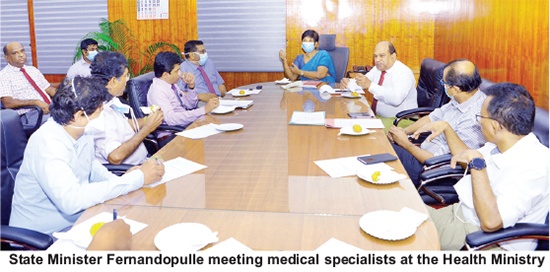
A group of medical specialists has requested Primary Health Care, Epidemics and COVID Pandemic Control Minister Dr. Sudarshini Fernandopulle to apprise the World Health Organization (WHO) of Sri Lanka’s readiness to use an anti-Covid-19 vaccine approved by it.
The discussion took place close on the heels of Dr Razia Pendse, WHO Representative in Sri Lanka meeting Dr. Fernandopulle. The ministry spokesperson said that they discussed how to provide the vaccine once a decision was made in that regard.
The WHO is yet to issue licence to any of the vaccines produced by various countries.
The group of specialists has emphasized the pivotal importance of reaching a consensus with the WHO in this regard when Dr. Fernandopulle sought opinion as regards acquisition of foreign vaccines touted as Covic-19 cure.
Secretary to the Ministry Dr. Harsha Amal de Silva, Senior Professor of Medicine at the University of Kelaniya Janaka de Silva, Prof. Anuja P. Premawardena also of Faculty of Medicine, University of Kelaniya, Prof. Arjuna de Silva of Faculty of Medicine, University of Kelaniya, Prof. Sarath Lekamwasam, Faculty of Medicine, University of Ruhuna, Dr. Ananda Wjewickrema of National Institute of Infectious Diseases, Dr. Pradeep Kumarasinghe of the National Hospital and Dr. Bodhika Samarasekera of Gampaha Hospital had participated in the discussion held on Wednesday (23) at the Health Ministry.
At the onset of the meeting, State Minister Fernandopulle emphasized that counter measures in respect of Covid-19 should be taken on a scientific basis. The State Minister said that the Covid-19 should be appropriately tackled as a pandemic. The minister said so at the meeting called to discuss ways and means of tightening control over Covid-19. Dr. Fernandopulle stressed that the ongoing epidemic control project should be based on technical decisions and implemented with the support of the media.
The State Minister called the meeting with specialists in the wake of the high profile government efforts to subject untested, homemade herbal brew ‘ Dhammika Paniya’ for what co-cabinet spokesperson Dr. Ramesh Pathirana called placebo control randomized double-blind clinical trial.
President Gotabaya Rajapaksa recently created a special ministry for Dr. Fernandopulle to step up government efforts against the rampaging virus against the backdrop of the second Covid-19 wave threatening to overwhelm the badly overstretched health sector.
According to the Ministry spokesperson, the discussion covered problems encountered in tackling the disease, direction in the ongoing operations, co-operation between the ministry and medical specialists and ways and means to improve health facilities provided to those living in rural areas and the needy.
The specialists sounded the State Minister on the need to continue with medical education, nursing and laboratory services in spite of the continuing difficulties.
The specialists asserted that the economy could be revived by taking proper measures, including a vaccination project. They appreciated resumption of tourism and the State Minister taking a sensible stand in respect of various proposals. In an obvious reference to Dr. Fernandopulle’s public stand that local remedies should be subjected to proper scrutiny, the specialists commended the minister.
Meanwhile, Health Minister Pavithra Wanniarachchi yesterday (24) directed managers of 16 Economic Centres (EC) to follow specific guidelines in operation of their centres as their failure to do so would cause a catastrophe. Addressing EC managers, Minister Wanniarachchi warned unless strict procedures were followed Covid-19 could spread to the entire country through ECs. The Health Ministry issued a series of specific instructions on running their operations.
Authoritative sources told The Island that immediate were needed to be carried out as regards implementation of a proper vaccination programme once the WHO issued license/licenses taking into consideration a range of factors, particularly the suitability of the selected vaccine. Sources acknowledged that the government hadn’t allocated funds whatsoever through Budget 2021 for covid-19 vaccine.




Latest News
Heat Index at Caution Level in the Western, Sabaragamuwa and North-western provinces and Monaragala district.


Warm Weather Advisory issued by the Natural Hazards Early Warning Centre of the Department of Meteorology at 3.30 p.m. on 09 March 2026, valid for 10 March 2026.
The public are warned that the Heat index, the temperature felt on the human body is likely to increase up to ‘Caution level’ at some places in Western, Sabaragamuwa and North-western provinces and in Monaragala district.
The Heat Index Forecast is calculated by using relative humidity and maximum temperature and this is the condition that is felt on your body.
This is not the forecast of maximum temperature. It is generated by the Department of Meteorology for the next day period and prepared by using global numerical weather prediction model data.
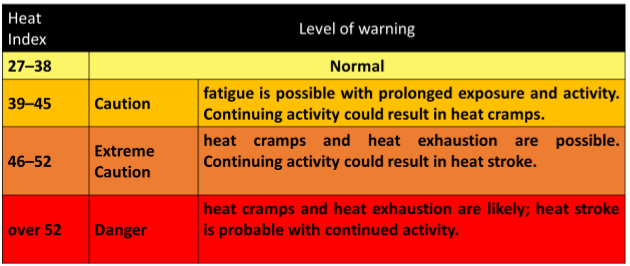
Effect of the heat index on the human body is mentioned in the above table and it is prepared on the advice of the Ministry of Health and Indigenous Medical Services.
ACTION REQUIRED
Job sites: Stay hydrated and takes breaks in the shade as often as possible.
Indoors: Check up on the elderly and the sick.
Vehicles: Never leave children unattended.
Outdoors: Limit strenuous outdoor activities, find shade and stay hydrated.
Dress: Wear lightweight and white or light-colored clothing.
Note:
In addition, please refer to advisories issued by the Disaster Preparedness & Response Division, Ministry of Health in this regard as well. For further clarifications please contact 011-7446491.

Prof. Priyanga Dunusinghe has warned that Sri Lanka could face a catastrophic situation due to a rapid and sharp drop in revenue caused by the escalating Gulf war.
Appearing on Derana ‘Big Focus’ yesterday, the Professor in Economics in the Department of Economics, and Head – Department of Information Technology, University of Colombo, Dunusinghe said that that drop in remittances from the Middle East, as well as exports, should be examined against the backdrop of runaway oil prices.
Dunusinghe said so responding to interviewer Pasan de Silva who sought expert opinion on the crisis. Referring to continuing Iranian retaliatory attacks on Gulf countries hosting US military bases, the academic pointed out that approximately one million Sri Lankans were employed in the region.
Global oil prices rose to over $100 per barrel on 08 March, for the first time since the Russia-Ukraine war erupted in February 2022. By noon prices were around USD 115 per barrel.
If a consensus couldn’t be reached soon, the consequences for Sri Lanka would be devastating, Dunusinghe said, suggesting that the government should seriously consider, what he called, a relatively small but immediate fuel hike to cushion the impact of future fuel price hikes.
Dunusinghe explained that in addition to the drop in remittances from the Middle East, Sri Lanka could lose employment opportunities in the war devastated region. Responding to the interviewer, the Prof said that if the situation further deteriorated the government would have to face the daunting challenge of evacuating Sri Lankans from the Middle East.
Referring to the devastating impact of Cyclone Ditwah, Dunusinghe pointed out that in terms of the agreement with the IMF, finalised in 2023, the debt repayment would have to be recommenced in 2028. The new Middle East war has placed the country in an extremely difficult situation, Dunusinghe said, while emphasising the responsibility on the part of the government to address the issues at hand immediately.
The rapidly changing oil markets indicated that regardless of optimism expressed by the US and Israel of swift victory, the ground realities were quite different, the academic said.
By Shamindra Ferdinando
The NPP governmnet has completed a major restructuring of its power sector, marking one of the most significant transformations in the country’s electricity industry in recent times, Minister of Power and Energy Engineer Kumara Jayakody says.
Addressing directors and senior officials of the newly established institutions in the power sector, while also connecting with employees of the new entities, via Zoom, the Minister said the restructuring programme had now been fully implemented with the objective of strengthening the sector, while ensuring continued state ownership.
Jayakody said the reforms represented a decisive step towards building a stronger and more resilient electricity sector, capable of meeting both present and future challenges facing the country.
“We have completed the restructuring programme that marks one of the biggest transformations in Sri Lanka’s power sector. Let us work together with dedication and commitment, within the newly established institutions, to realise the dream of ‘a prosperous country and a beautiful life,’” the Minister said.
The Minister stressed that the current government had reversed earlier attempts, by the previous administration, to break up the Ceylon Electricity Board (CEB) into 12 entities, as part of a privatisation drive.
Instead, he said, the government had established several new companies that would remain 100 percent state-owned, thereby safeguarding public ownership of the electricity sector, while introducing the structural reforms needed to modernise and strengthen the industry.
According to Jayakody, the restructuring initiative was carefully designed to ensure that the electricity sector would remain under state control while being equipped with the institutional capacity required to address emerging energy demands, technological changes and economic pressures.
He noted that one of the government’s key priorities, during the reform process, had been the protection of employee rights and privileges.
“As a government representing working people, we paid special attention to protecting the rights and benefits of employees. We assure you that the privileges and rights enjoyed by you as CEB employees will continue without even the slightest reduction when you join the new institutions,” the Minister said.
He added that the government had also taken steps to address long-standing grievances raised by employees and trade unions in the power sector.
Jayakody said many of the demands made by workers over the years had now been fulfilled, including some that had not yet been formally requested by unions or employee representatives.
“Many of the issues raised by workers in the past have now been resolved. In some instances, the government moved to address concerns even before they were formally requested by employees or trade unions,” he said.
The Minister also noted that throughout the restructuring process, the government had maintained a regular dialogue with trade unions representing workers in the electricity sector.
He said the authorities had held discussions with union representatives on several occasions and listened to their concerns before finalising key aspects of the restructuring programme.
Jayakody emphasised that the establishment of the new institutions represented a significant milestones in the development of Sri Lanka’s electricity sector.
“At this important moment, when a major step is being taken towards the development of the country’s power sector, I invite all of you to treat this as a national mission and make the fullest use of the opportunities available within these new institutions,” he said.
The Minister also expressed his appreciation to all those who had contributed to the successful completion of the restructuring programme.
He said the transformation of the electricity sector had required the cooperation and commitment of many stakeholders, including officials, employees and policymakers.
Energy sector analysts say the restructuring of the power sector is expected to play a critical role in improving efficiency, governance and long-term planning in electricity generation, transmission and distribution.
Sri Lanka’s electricity industry has faced several challenges in recent years, including rising fuel costs, supply disruptions and the need for increased investment in renewable energy and grid infrastructure.
Officials say the new institutional framework is expected to enhance operational efficiency while ensuring that the strategic assets of the electricity sector remain under state ownership.
The government maintains that the restructuring programme will ultimately strengthen the country’s energy security while supporting broader economic development.
By Ifham Nizam

Heat Index at Caution Level in the Western, Sabaragamuwa and North-western provinces and Monaragala district.

Showers likely in the Northern province and in Trincomalee and Anuradhapura districts

Prof. Dunusinghe warns Lanka at serious risk due to ME war

Power sector restructuring completed; new state-owned entities established: Govt.

Pilleyan held over Eastern Uni VC’s 2006 disappearance seeks SC intervention: Case to be taken up on 18 March

Lanka takes part in Thai Red Cross Charity Bazaar

‘Dates have the highest sugar content to fight Coronavirus’

Sunday Island 27 December – Headlines

#SundayIsland 17th December – Headlines

Sunday Island – 28th March

Sunday Island Headlines – 21 March

Sunday Island – 21st February – Headlines
-
 News4 days ago
University of Wolverhampton confirms Ranil was officially invited
-

 News5 days ago
Legal experts decry move to demolish STC dining hall
-

 News4 days ago
Female lawyer given 12 years RI for preparing forged deeds for Borella land
-

 News3 days ago
Peradeniya Uni issues alert over leopards in its premises
-

 Business6 days ago
Cabinet nod for the removal of Cess tax imposed on imported good
-
 News4 days ago
Library crisis hits Pera university
-

 News3 days ago
Wife raises alarm over Sallay’s detention under PTA
-
 Business6 days ago
War in Middle East sends shockwaves through Sri Lanka’s export sector